






















The principle of autonomy, interpreted by the Director to suit his own ends, has ruined the institute
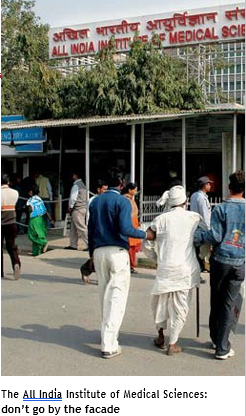
THE controversy that engulfed the All India Institute of Medical Sciences (AIIMS) for the past 18 months and the massive media coverage have created an impres-sion that it was a turf war between the Union Health and Family Welfare Minister, Dr Anbumani Ramadoss, and the AIIMS Director, Dr P Venugopal, over the issue of autonomy.The percep-tion is that the legendary surgeon fought to preserve the autonomy of the insti-tute, guaranteed by statute, while the minister tried to encroach upon the Director’s turf.This is far from the truth. This also gives credence to Ramadoss’ allegation that the Delhi media is “casteist”. Perhaps, while covering a highly emotive issue like the anti-quota agitation the journalists failed to see Venugopal’s real motive.
First, as per the provisions of the AIIMS Act of 1956, there is a clearly defined hierarchy in which the Minister (ex-officio President of AIIMS) is the boss and the Director is an employee of the Institute and subordinate to the President.Their respective areas of con-trol and extent of power are clearly defined in the rulebook which has been in operation for the past 50 years. Therefore, to refer to an administrative chaos as a turf war between the boss and his subordinate is not only distortion of fact but also untenable.
To avail of a day’s casual leave, the Director has to write an application to the President. Any faculty member or Group A officer wishing to avail of leave beyond 30 days must have the prior approval of the President.The Director does not have the power to sanction leave beyond 30 days.All the powers for governance of the institute vest with the Institute Body (IB)—the apex body constituted under the Act. Next in the hierarchy are the Governing Body (GB) and the President/Minister.The powers of the Director are the powers delegat-ed to him by the IB/GB through the President. In disciplinary matters and service conditions almost the entire Central Civil Service rules are applica-ble to the staff, including the Director.
As per the AIIMS Act of 1956, there is a hierarchy in which the Minister (ex-officio President of AIIMS) is the boss and the Director is an employee of the Institute and subordinate to the President
So what is autonomy and how does it operate as far as the AIIMS administra-tion is concerned? Two aspects are very clear. First, the President is very much a part and parcel of the administration. Second, when we talk of autonomy as referred to in the Act, it is for the insti-tute and not for any individual officer. Section 25 of the Act stipulates that the Institute is controlled by the Central government. Section 26 clarifies that, in the event of a dispute “between the Institute and the Central Government, the decision of the Central Government on such dispute shall be final”.
At AIIMS, many a time, a prospective beneficiary or a dealing official, keen to help a colleague, advises the Director to use his/her discretionary power.This is a trap. In reality, in a fair administration, there is nothing like a blind discre-tionary/arbitrary power.The acid test is: the essence of good governance is the absence of arbitrary power. But invariably successive Directors loved this power and contributed to the mess.
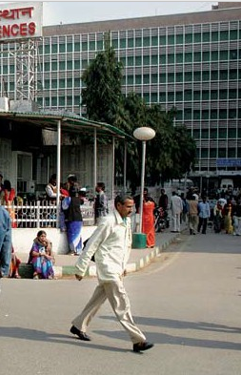
Unfortunately, for outsiders, it would be an eye-opener to learn the kind of things that happen at AIIMS in the name of administration. The so-called autonomy works as a double-edged sword for the employees. The Director conveniently invokes his autonomous powers if he decides to favour or harm someone at his level. Even otherwise, without taking the blame on himself, he decides to refer the matter to the Ministry and manages to get a govern-ment order as per his liking. Employees have lost their jobs for making a legiti-mate complaint. Residents are laid off on concocted charges without even an inquiry. Venugopal himself has been a party to many such orders. He created a noise only when the Ministry acted against him as per the rules.
Excess of autonomy
AIIMS has suffered not due to a deficit of autonomy but an excess of it. Replying to the debate in Parliament on the AIIMS Bill in 1956, setting at rest the members’ apprehensions on auton-omy to the institute, Health Minister Rajkumari Amrit Kaur had said the institute would enjoy adequate autono-my and there would be no undue gov-ernment interference in its functioning. She stood by her word. For her, the establishment of AIIMS was the realization of a dream.
A scrutiny of the functioning of AIIMS vis-à-vis the role of the Minister and the Ministry since 1956 shows that successive Directors have enjoyed unbridled autonomy.In the beginning it was essential to allow a free hand to the Director who was entrusted to build the institute brick by brick.And, with a per-son of the stature and integrity of Dr BB Dikshit, the first Director, the affairs of the institute were in safe hands.
As time passed, Directors more often than not took liberty with the autono-my of the institute. There are several instances when Directors literally inter-preted autonomy and acted in the most autocratic manner.
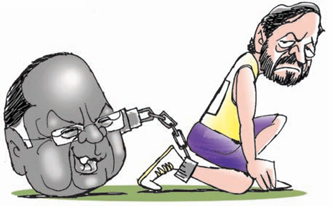
The Venugopal phenome-non had to happen.
Ramadoss is guilty of not waking to the warning and reining in Venugopal before he went berserk
The biggest mistake Rajkumari Amrit Kaur committed was to get her-self nominated to the board, thereby allowing successive Ministers to occupy the position. Let us not go into the details as to how and why this happened despite there being no specific provision in the Act to have the Union Health Minister on the board. She may have had the best of intentions.It is quite pos-sible that without her being there we might not be seeing the AIIMS of today. The second mistake she committed was to be part and parcel of the AIIMS administration in her capacity as President. The third was to make the Director—always a medical man, with-out any knowledge of administration or governance—the administrative head.
It is essential to clarify that successive Ministers failed to devote adequate time and exercise necessary control over AIIMS affairs to put in place a strong administrative culture, supported by a dynamic HR policy.The Minister, who has to preside over dozens of such insti-tutions besides multifarious activities of a huge Ministry, has very little time for the institute.Moreover,there were occa-sions when the Minister changed almost every six months while the Director continued for five years. Thus, the Director has become all-powerful.
The Director,being a doctor and hav-ing direct access to the highest in gov-ernment, judiciary and legislature (for that matter, anybody), is the most pow-erful executive in the country. He can appoint and promote people as he likes—a power that even the Prime Minister or Cabinet Secretary does not enjoy. Needless to say, he can ruin lives and destroy careers—the victim cannot even seek justice. At best he/she can write a representation to the Minister or approach a court in Delhi.
The growing tendency of auto-cratic and whimsical functioning has not only fractured adminis-
tration but also greatly affected academ-ic, research and patient-care activities on the whole, leading to a multi-organ fail-ure. In AIIMS, known for its research contributions, the Director undertakes controversial research for the sake of publicity without even obtaining the mandatory ethical clearance. Then his name appears in the list of doctors charged with plagiarism.
For nearly three years,Venugopal did not convene meetings of some impor-tant “standing committees”—supervi-sory bodies to oversee various functions of the Institute—as required under the Act.A former Director, a few years ago, did not bother to convene the IB for more than a year till an MP on the board threatened to bring a privilege motion against him for violating the Act.
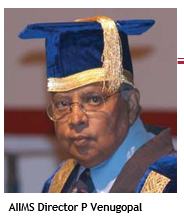
The Venugopal phenomenon had to happen. Ramadoss is guilty of not wak-ing to the warning and reining in Venugopal before he went berserk.The Venugopal episode may soon come to an end but it will leave enduring trauma for many, including the institute.At this juncture, the government may consider applying screening parameters to select future directors, and look for more psy-chological stability, socially acceptable personality and moral integrity. If AIIMS is to survive, it needs a human touch, a leader.