



















IT is widely acknowledged that India’s public services, particularly the executive grades, have maintained high standards. The Indian Administrative Service (IAS) has always risen to the occasion whenever there has been a national crisis and when governments have changed. A country with over a billion people and with complex cus toms and traditions couldn’t have asked for more. The IAS has earned a reputation for holding India together.
The Lal Bahadur Shastri National Academy of Administration in Mussoorie can be proud of its alumni members of the IAS and other all-India executive services for their excellent performance. Over the last four-and-a half decades, the LBSNAA has trained thousands of IAS and other officers to administrate India. The carefully crafted courses have provided knowledge, skills and attitudes to LBSNAA’s alumni, making IAS officers some of the best administrators in the world.
India and Sri Lanka both inherited the colonial system of administration from the British. The Raj created the Indian Civil Service which later gave way to the Indian Administrative Service while Sri Lanka, then Ceylon, estab lished the Ceylon Civil Service, which was replaced by the Ceylon Administrative Service and later succeeded by the Sri Lanka Administrative Service. The recruits to the CAS and the SLAS were groomed and moulded by the Academy of Administrative Studies in Colombo. In the 1970s, theAcademy of Administrstive Studies (AAS) was renamed Sri Lanka Institute of Development Administration (SLIDA) which at present provides the necessary knowledge, skills and attitudes to the entrants to most executive-level All Island services, foremost of which is the SLAS.
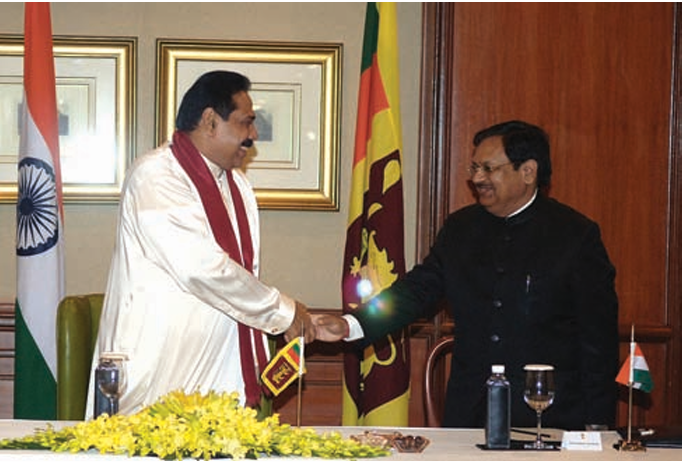
A visit to LBSNAA by President Mahinda Rajapaksa of Sri Lanka in November 2006 has culminated in a Memorandum of Understanding between the Indian acad emy and SLIDA for collaboration on many fronts. The sign ing of the MoU took place in New Delhi recently when Rajapaksa visited India to deliver a keynote speech at the Hindustan Times Leadership Summit.
Lack of project
management and
contract adminis
tration skills in
the public sector
have impeded Sri
Lanka’s growth
This collaboration between the two key institutes responsible for moulding and nurturing of the administrators in the two countries augurs well for Sri Lanka as well as India. In particular, the MoU will be able to provide an on-going and consistent opportunity for SLIDA to interact with the LBSNAA’s faculty, which over the years has honed its training skills. Given India’s network of academic establishments,
uch as the Indian Institutes of Management, universities and many learning networks, the LBSNAA has been able to draw upon a huge reservoir of skills to finetune its faculty competencies to train India’s administrators. This is where SLIDA will gain from the MoU because in Sri Lanka, such a fine network of academic institutions, particularly pertaining to administrative studies, does not exist.
The task of SLIDA in coming years will be stupendous; it will have to produce administrators who are able to overseeand steer development in the post-conflict era. As Sri Lanka gets ready and moves towards a political solution to the crisis that has plagued the country for well over 25 years, the quality of administrators will be a critical factor for Sri Lanka’s success. Whilst Sri Lanka has been able to ensure education for all and reached a high level of literacy and quality healthcare for its population throughout the country, in major infrastructure development it has not shown significant progress. Lack of project management and contract administration skills in the public sector and poor monitoring of progress have impeded Sri Lanka’s growth to a large extent. These will be SLIDA’s challenges in years to come and the liaison with LBSNAA will certainly help SLIDA to find the right direction.
Faculty development through exchange, upgrading and revision of curricula, participation of trainees in selected courses, joint research and publication, and periodic interaction between the administrations of the two institutions are envisaged through the MoU and both Sri Lanka and India will not only benefit from each other’s experiences but will also reach new levels in their bilateral relations.
