


















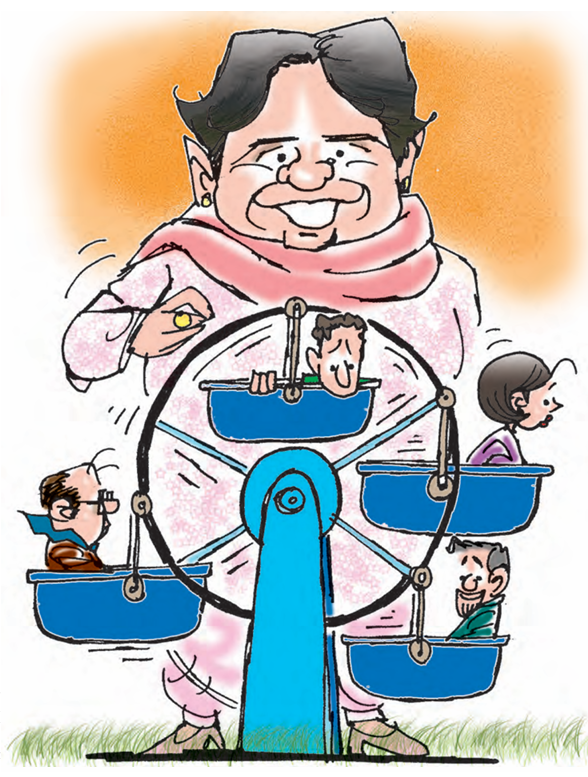
Despite Uttar Pradesh Chief Minister Mayawati thundering, “The transfer business has come to an end” soon after assuming office on May 13 last year, the facts defy her pronouncement. The business of transfers is firmly entrenched and flourishing. But, then, is it proper to blame her? After all, she is only following precedence. By the end of December 2007, she had transferred 647 officers. As her government marked a year of being in power, it has notched up over a thousand transfers to its (dis)credit.
Within a fortnight of assuming office, she twice transferred 24 officers. In the next month, 10 officers were shifted twice. An officer’s tenure in a posting averaged about three months. Mayawati also reshuffled her Secretariat at least six times, while 90 per cent of District Magistrates and district police chiefs have been reshuffled twice or more.
The civil services board, revived with much fanfare and headed by the Chief Secretary, has become redundant.
The Bahujan Samaj Party victory in the May 2007 polls was significant in that, after a gap of 16 years, the state got a single party government – but at the cost of governance. Deaths are increasing in drought-hit Bundelkhand. Mayawati announces new schemes every other day – but can a “bureaucracy in a perpetual state of transit” deliver?
IPS officers have been worst hit, with 257
being transferred. The government shifted 95
per cent within 165 days of assuming office
The state has 422 IAS officers and 270 IPS officers. It is the latter who have been worst hit, with 257 being transferred. By using the Right to Information Act, Amit Awasthi of Vikalp Samiti organization gathered details about the transfer of IPS officers. The government shifted 95 per cent of IPS officers within 165 days of assuming office – between May 13 and October 24, 2007. In the process, some dubious records were set. Five officers were transferred 5 times, 11 officers 4 times, 38 officers 3 times, 87 officers twice, and 93 officers faced just a single transfer. Mercifully, the government cancelled only 15 transfers during this period.
On May 13 this year, as the Mayawati government celebrated its first anniversary, the state’s IPS officers celebrated one year of uninterrupted posting of two lucky colleagues, Prashant Kumar and Nachiketa Jha – the district police chiefs of Maharajgang and Hamirpur, respectively.
The drought-stricken district of Mahoba in Bundelkhand saw four District Magistrates – Samir Varma, JP Mishra, Anita Chatterji and Vijay Vishwas Pant – and four police chiefs – Ghyan Singh, Ajay Mishra, Deepak Sharma and RP Singh – in this one year. One of these officers, transferred for the seventh time, gave vent to his frustration before the local press. He was then transferred from Mahoba to Azamgarh within a month.
In Banda district, three District Magistrates and two Commissioners were changed. In the remaining five districts of Bundelkhand, transfers of officers have been affected three times. These reckless transfers are taking a serious toll of developmental and relief work, resulting in an exodus of the rural population.
As a retired IAS officer and former General Secretary of the Rajya Sabha, RC Tripathi, commented, “Civil servants cannot perform when they are not sure of their stay in the chair. They are also simple human beings and need time to understand a district’s history, geography, people’s requirements and expectations. UP is reeling under bureaucratic instability. In our times, the prospect of a transfer never arose before two or three years.”
Governance is the known casualty of such transfers, yet every government does this in the name of overhauling the system. The purpose is to benefit a select few who cut across party lines and are known faces in the corridors of power.
The seeds of transfer were dormant during the time of Congress stalwarts like CB Gupta and Banarasi Das but sprouted when ND Tiwari headed the state with a colourful coterie. Vir Bahadur Singh and VP Singh then irrigated the field and transfers grew into a full-fledged industry for the first time when Mulayam Singh Yadav headed the Janata Dal government in 1989. Even in the last regime, it was an open secret that Mulayam Singh Yadav’s brother and former Minister, Shivpal Singh Yadav, and an MP, Ramgopal Yadav, were the de facto bosses of Mulayam’s transfer factory.
The transfer industry flourished during Mayawati’s first government. The Ministers were asked to make monthly payments which they could mobilize only through transfers. Mayawati needed money for elections and expansion of the party base. The most influential person in this business was Captain Rizvi.
In the Kalyan Singh government, Kushum Rai virtually ruled the state. During Ram Prakash Gupta’s regime, transfer matters were reportedly dealt with by his son, Rajiv Lochon, and Sandeep Bansal. When Rajnath Singh replaced Gupta, his brother-in-law, Arun Singh, and an information department employees, Hemant Singh, were the most sought-after conduit to the Chief Minister. Arun Singh is a Delhi-based chartered accountant and is currently president of the Investment Cell of the BJP. During Mayawati’s second stint, Babu Singh Kushwaha, Nasimuddin Siddiqui and PL Punia dictated orders. At present, Shashank Shekhar Singh, Vijay Shanker Pandey and AK Jain are monitoring the transfers in the name of governance.
And of course, there are the eternal survivors – Pramod Tiwari, Jagdambika Pal, Nasib Pathan, Vijay Saraswat, Siraz Mehndi and Naresh Aggarwal – who operate during every regime.
A senior IAS officer points out, “Frequent transfers of the officers are indicators of an administration turning bad. It also creates all sorts of problems for officers and their families and leads to wastage of public money. There are officers who have been transferred five times or more in less than a year. What results can they deliver? The inconvenience to their families can also be imagined. It appears that transfer bills of IPS officers are not cleared promptly because the funds allocated for the purpose have been spent.”
It is an open secret that some politically well-linked people are running the transfer business in the state. The transfer rates are fixed: For a gazetted officer, it is Rs 5-10 lakh; for a non-gazetted officer, it is Rs 2-3 lakh. The transfer rates are higher for districts in western UP – Rs 10-20 lakh for IAS officers. Ghaziabad and Noida are the costliest districts. Among IPS officers, they have to pay more for cities like Kanpur.
Interestingly, the rates are lower for the post of District Magistrate because developmental work had been assigned to the Chief Development Officer (CDO) by the previous government. The districts under the National Rural Employment Guarantee Schemes, Rae Bareli, Kushinagar and Sonbhadra, have CDOs and only these CDOs can afford to pay higher rates.