








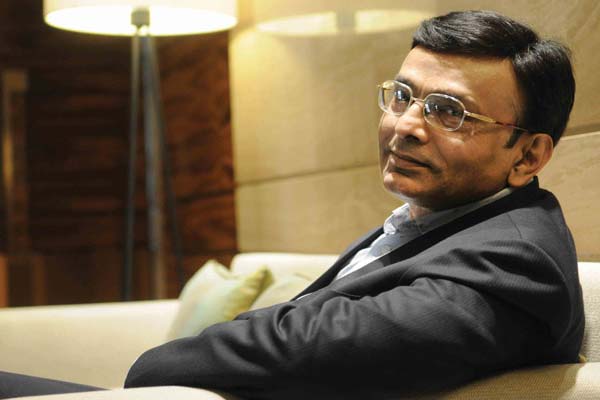














Boeing Integrated Defense Systems is a $32.4-billion business headquartered in St Louis, Missouri, US with 72,000 employees worldwide. It provides network-centric system solutions to its global military, government and commercial customers. Vivek Lall is IDS’ Vice-President and Country Head, after having held numerous leadership roles in marketing and engineering at Boeing. He earlier worked with Raytheon and NASA Ames Research Center and taught classes in aerodynamics and propulsion for aircraft and spacecraft to US Air Force and Boeing personnel.
Lall studied mechanical engineering in Canada and aeronautical engineering in Florida. He also has a doctorate in aerospace engineering. He was awarded a gold medal from Cambridge University for contribution in the field of aerospace. A member of the Sigma Gamma Tau Aerospace Honour Society and the Pi Mu Epsilon Mathematics Honour Society, he was president of the Mathematical Association of America. Excerpts from an interview by Anil Tyagi:
gfiles: What is your focus in India?
Vivek Lall: Until recently, India has relied on indigenous capabilities and non-US suppliers for its defence requirements, but improved relations between the US and India have forged a stronger alliance between the two countries and created the opportunity for defence acquisitions from US manufacturers. So we are here to improve the defence capabilities of India on a par with world standards.
gfiles: What are you offering India?
VL: Boeing will soon submit its bid for India’s Medium Multi-Role Combat Aircraft competition. Currently, our offer to India includes the combat-proven F/A-18 E/F Super Hornet multi-role combat fighter, the P-8I multi mission maritime patrol aircraft (MPA), the heavy lift CH 47F and MH-47G Chinook helicopters, and the combat proven attack helicopter, the AH-64D Apache Longbow The Integrated Defense Systems (IDS) portfolio extends to the C-17 Globemaster III strategic lift cargo plane, and C4ISR platforms and Airborne Early Warning and Control systems. IDS is also a leading provider of aerospace support systems and network-centric operations that have high relevance to India’s requirements.
gfiles: What is the super F/A-18E/F Super Hornet Block II?
VL: The F/A-18 Super Hornet offers India the most advanced see-all, do-all combat fighter in production today, capable of defending the nation from the Himalaya to the Indian Ocean with unmatched lethality, pilot safety and the promise of 30+ years of US Navy-funded upgrades. Continuous new technology insertion (US Navy-supported) will provide the Indian Air Force with advanced multirole combat capabilities and robust capability to defend Indian airspace and coastlines for 30+ years.
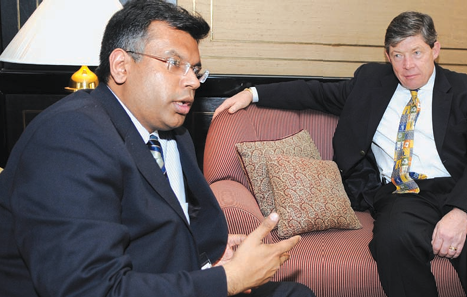
gfiles: What about technology transfer?
VL: The India production assembly line Super Hornet offers transfer of technology (pending US government approval) and production line processes to groom a skilled Indian aerospace labour force. Boeing is planning to offer India the latest advanced US technology (pending US government approval) relating to radar evasion, AESA radar, network centric capabilities, twin-engine safety for India’s vast distances, commonality with the US Navy. These products are all network-centric capabilities for close battlefield cooperation, simultaneous air-to-air and air-to-ground capabilities, incomparable detection, targeting, tracking and self-protection features. Aircrews can see further, track more targets more accurately and at greater distances.
gfiles: What are you offering the Indian Navy?
VL: Boeing IDS is offering the P-8I, the next generation of Maritime Patrol Aircraft. The P-8I, the world’s most advanced anti-submarine and anti-surface warfare plane, is offering to India the reach, speed, technology and endurance necessary to protect 7,000 km of coastline, and to extend beyond India’s shores to protect crucial international shipping lanes. The P-8I offers any country tremendous capability advances over legacy systems.
gfiles: What is in your portfolio and how is it suited to India?
VL: We have many products, like the CH-47 Chinook, AH 64 D Apache Longbow, AEW&C, C-17, Harpoon, that we are offering the Indian defence forces.
‘We have many prod
ucts, like the CH-47
Chinook, AH 64 D
Apache Longbow,
AEW&C, C-17,
Harpoon, that we are
offering the Indian
defence forces’
gfiles: But how is this useful for India?
VL: The CH-47 Chinook offers India a powerful workhorse helicopter capable of supporting the Indian Army in rugged high-altitude outposts. It offers India medium-to-heavy-lift and high-altitude transportation. The AH-64D Apache Longbow is the newest version of the Apache and a candidate to fulfill the attack helicopter and reconnaissance requirements of numerous armed forces worldwide The 737 AEW&C can offer India’s armed forces a precise picture of the battlefield for enhanced decision-making. It expands the AWACS family to include a high-performance, affordable system with designed-in payload, space, power, cooling and computing capacity reserves which provide substantial future growth capability.
The C-17 is the new global airlift standard with strategic capabilities. It’s the airlifter of choice in the global war on terrorism and for humanitarian and disaster relief efforts worldwide.
Then there’s Harpoon. The US Navy and Boeing have extensive experience in integrating Harpoon missiles on domestic and international aircraft.
Integrating Harpoon in the Indian Air Force’s Jaguar aircraft is low-risk and provides the IAF with exceptional ASuW (Anti-Surface Warfare) capabilities. Harpoon Block II expands the capabilities of the Harpoon anti-ship weapon. The world’s most successful anti-ship missile, Harpoon features autonomous, all-weather, over-the-horizon capability.
gfiles: What is the super F/A-18E/F Super Hornet Block II?
VL: The combat-proven F/A-18E/F Super Hornet Block II is the 21st century’s premier multi-role strike fighter with all the proven capability, flexibility and performance necessary to modernize the air or naval aviation forces of any country at a compelling cost. Two versions are currently in production: the single-seat E model and the two-seat F model. Both are true multi-role aircraft, able to perform virtually every mission in the tactical spectrum, including air superiority, day/night strike with precision-guided weapons, fighter escort, close air support, suppression of enemy air defence, maritime strike, reconnaissance, forward air control and tanker.
The Block II Super Hornet’s suite of integrated and networked systems provides enhanced interoperability and support for ground forces as well as the overall force commander. A comprehensive spiral development design concept — including the addition of the APG-79 Active Electronically Scanned Array (AESA) radar — offers continuously improving overall mission capability and supportability. AESA tracks twice as many targets as current systems, provides long detection range, high-resolution synthetic aperture radar (SAR) maps at long stand-off ranges, simultaneous air-to-air and air-to-ground tracking, an optimized low radar cross-section that complements the electronic warfare suite.
With a total of 11 weapon stations, the Super Hornet also provides extraordinary payload flexibility by carrying a mixed load of air-to-air and air-to-ground ordnance. A typical basic loadout for a self-escort strike mission starts with an advanced infrared targeting pod, one AIM-120 “AMRAAM”, two AIM-9 “Sidewinder” missiles, and an external fuel tank. This leaves six under wing weapon stations available to carry a variety of weapons and other stores.
gfiles: Has anybody purchased the F/A -18F?
VL: In March 2007, Australia announced its intention to purchase 24 F/A-18F Super Hornets. This represents the first international sale of the F/A-18E/F Super Hornet. As of September 2007, Boeing delivered more than 340 Super Hornets to the US Navy.
gfiles: Are you supplying the same equipment to Pakistan or any neighbouring country?
VL: We’re not supplying the same equipment to Pakistan.