




















A study of the attendance record of the MPs of both Houses of Parliament conducted some time back yielded interesting statistics. The survey would not have been possible but for the persistence of a band of young men and women who form the Parliament Research Service (PRS) team, a non-profit body, which is doing yeoman work concerning Parliament and legislation. The attendance record of the MPs was, so far, a “secret” document. But an RTI application seeking the record has changed all that.
The statistics prepared on the basis of the record – for the period between June 2004 and December 2006 – indicated that the average attendance in both Houses is 70-75 per cent. It was also found that MPs below the age of 40 have lower attendance. The lowest attendance is by those MPs who are engaged in industry/business, media, entertainment, which mean those with an active career in these areas. Lawyers and educationists in the Lok Sabha have the best attendance.
The study provided many more interesting insights into the MPs’attendance. The PRS, which also comes out with session-wise and year-wise statistics related to Parliament, gives us a glimpse into what happened in these sessions – how many Bills were passed, how many hours were spent on discussing them, how many hours Parliament worked in all, and so on. In fact, even the Lok Sabha and Rajya Sabha websites provide details about even the number of hours lost due to disturbances/walkouts/stalling of the proceedings.
There is enough quantitative data available about Parliament’s proceedings. However, it does not tell us what the MP did when he was present in the House, and how effective he was. Or, for that matter, how he has been nurturing his constituency.
As a regular observer of Parliament’s proceedings and as someone who interacts with the MPs regularly during the sessions and otherwise, what strikes one is the MPs’ angst. Much of it stems from their frustration at not being acknowledged for their hard work and studious approach to their primary responsibility as lawmakers. Instead, the spotlight is almost always on the trouble-makers.
Who are the MPs who perform
their tasks as lawmakers, who
hold the government account
able and represent their voters
effectively? Who are the MPs
who neglect these tasks?
One of the most oft-heard comments by the more serious MPs, born out of disappointment and irritation, is: “What is the use of spending so much time preparing for a debate or participating effectively in legislation, if no public recognition is given to us?” The present Speaker, Somnath Chatterjee, who has been one of the more serious MPs for decades, understands this aspect and has held meetings with media heads. He has requested the media to look at the positive happenings in Parliament, while certainly not neglecting the negative features.
But the Speaker’s efforts have had only a marginal impact, going by the print and electronic media coverage during recent Parliament sessions.
Despite the negative portrayal by a large section of the media of happenings in Parliament, the fact remains that outside those few moments during the day when all hell seems to break loose, there are many interesting and stimulating debates. Many a relevant question is raised and Ministers are cornered. Many interventions are made even from the Government’s side and doubts cleared, thereby leading to a consensus.
Speaker Somnath Chatterjee
has requested the media to
look at the positive happenings
in Parliament, while certainly
not neglecting the negative
features
However, if at all reported by the media, much of it gets buried – leading to frustration among MPs who have contributed to purposeful proceedings. On the other hand, a few troublemakers, shouting slogans and interrupting the proceedings, make headlines and get prime time treatment.
If this is one, very significant, aspect of the dwindling interest in Parliament today, another relates to how MPs get away without any accountability. Ironically, the Parliamentary system, based on the concept of accountability, with MPs being those who are chosen to call the Government to account, escapes accountability.
Who are the MPs who perform their tasks as lawmakers, who hold the government accountable and represent their voters effectively? Who are the MPs who neglect these tasks and are busier utilizing their position and power for their own ulterior motives? Is there any system to account for it? Can the ordinary citizen hold a mirror to his MP’s work and his performance?
Sadly, in India there seems to be no mechanism or system to assess the qualitative performance of MPs. The need for such a mechanism is most felt these days, as we see all around a sense of despondency over the functioning of Parliament, with people increasingly viewing MPs with scepticism and, worse, suspicion.
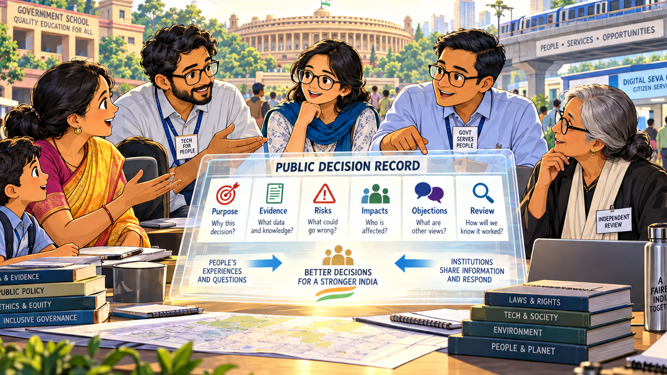
A methodology needs to be adopted, first by developing parameters –acceptable across the board – to assess the performance of MPs not just in the House but in their constituencies too. An annual or bi-annual assessment under such a widely accepted system would not only go a long way to putting our Parliamentary system in a better perspective, but also provide a motivation for the MPs themselves to perform better. It would also bring in the much-needed recognition to those MPs, and there are a number of them from all parties, who put long and dedicated hours into their job but who go unsung and unheard.