
















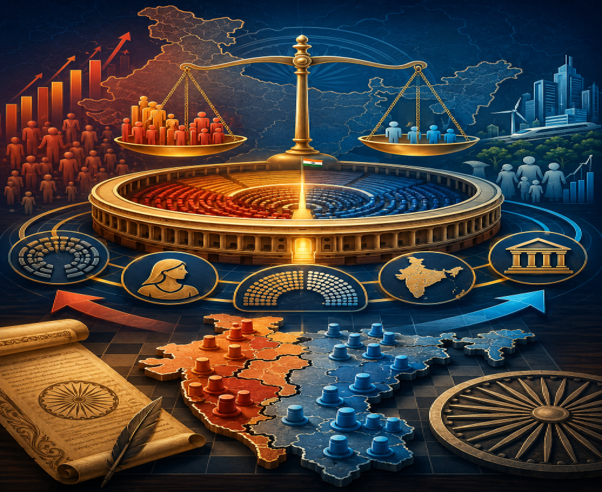










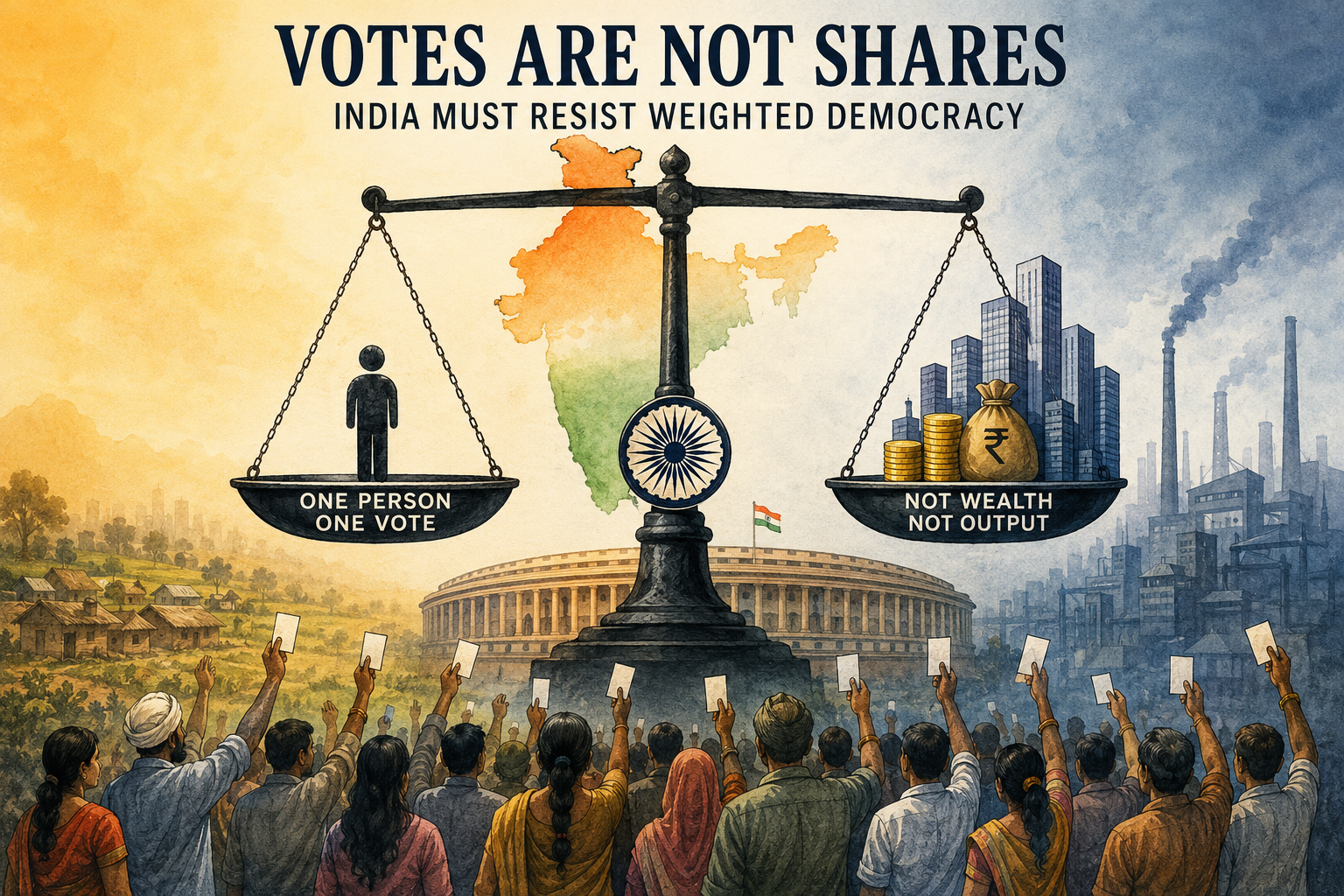
Why India must resist weighted representation? As India heads toward a historic delimitation exercise, a deeper constitutional struggle is unfolding: should political power follow population, prosperity — or the founding promise of equal citizenship?
The Pause Before the Storm
When the Delimitation Bill failed to secure the two-thirds parliamentary majority required for constitutional amendment, many observers exhaled with relief. The political temperature dropped. The headlines moved on. And now, with no vote imminent and no immediate crisis demanding resolution, the dust has settled — for a while.
This is precisely the moment to think clearly.
Parliamentary debates on representation are ill-suited to careful reasoning. Regional anxieties run hot. Political careers are felt to be at stake. Slogans travel faster than arguments, and the pressure to perform outrage crowds out reflection. When the chamber is loudest, the thinking is often at its worst.
That is why this pause matters. What India decides about representation — how it balances equality of franchise with regional fairness, how it weighs demographic change against constitutional principle — will shape its democratic character for generations. Those decisions should not be made in the heat of a legislative crisis. They should be thought through now, while there is still time to think. A legislative defeat, after all, is not a democratic settlement. When the question returns — and it will — India needs answers that go beyond seat counts and census projections.
The Demographic Paradox
The immediate trigger for the delimitation debate is a story of divergence — one part of India succeeding, and being made to feel it has failed.
Southern states — Tamil Nadu, Kerala, Karnataka, Telangana, and Andhra Pradesh — invested early and consistently in public health, women’s education, and family welfare. The results are visible in fertility rates below replacement level, maternal mortality figures that rival middle-income countries, and human development indices that outperform the national average. These are not accidents. They are the products of sustained, deliberate policy over decades.
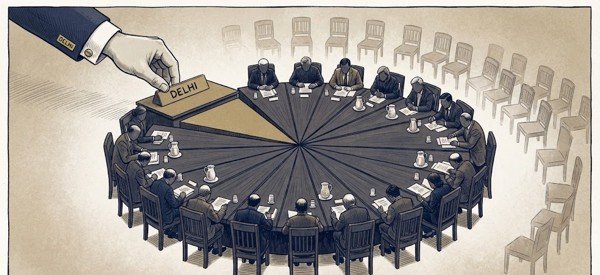
The demographic consequence of this success, under a strictly population-based delimitation formula, is a shrinking share of Lok Sabha seats. States that chose development face political penalty. States where fertility remains high — largely in the Hindi heartland — would gain. To the southern political class, this feels not like mathematics, but like punishment. Their frustration is legitimate. But it does not, by itself, resolve the underlying constitutional question.
The delimitation debate is no longer about seat counts alone. It is about whether India remains a republic of
equal citizens — or drifts toward a democracy weighted by wealth and economic output.
The principle of one person, one vote is not a technicality. If parliamentary seats are not periodically adjusted to reflect population, an MP from a southern constituency may end up representing significantly fewer citizens than an MP from a northern one — in some cases the gap could be twofold. That is a quiet but real distortion. A citizen in a more populous constituency is structurally one among many more. That inequality is as troubling, in its own way, as the penalty on development.
The Shareholder Fallacy
The most dangerous idea circulating in this debate sounds reasonable on its surface: that states contributing more to the national economy should have proportionally greater political influence. Call it “shareholder democracy” the notion that political weight should track fiscal contribution.
This argument deserves to be confronted directly, because it does not merely threaten regional fairness. It threatens the philosophical architecture of the Indian republic.
India’s founders understood something that market logic tends to obscure: political equality is not a reward for economic success — it is a precondition for social legitimacy. The decision to extend universal adult franchise in 1950, to a country with staggering illiteracy, deep caste hierarchies, and widespread poverty, was an act of radical democratic faith. It said, in effect, that the poorest farmer in Bihar has the same right to shape his government as the most prosperous industrialist in Maharashtra. Not a similar right. The same right.
To introduce economic weighting into representation is to repudiate that faith. It converts citizenship from a moral status — inherent, equal, inalienable — into a market position. The absurdity becomes vivid at the individual level: it would be equivalent to saying that Mukesh Ambani’s vote should count as a thousand votes, while the labourer in his factory counts as one. Applied at the state level, prosperity-linked representation implies precisely the same logic.
History’s Cautionary Examples
History offers warnings about where this path leads. Property qualifications in early British parliamentary elections, poll taxes in the American South, the Bantustan system in apartheid South Africa — each represented an attempt to use economic criteria to dilute political equality. Each produced not efficiency, but fracture.
India is not immune to this fracture. A democracy that tells its poorer citizens — in Uttar Pradesh, in Bihar, in Jharkhand — that their votes count for less because their states generate less GDP is a democracy that has started to eat itself.
India’s Constitution deliberately anchors Lok Sabha representation to population, not prosperity. Every citizen’s vote carries equal value, irrespective of geography, income, or regional economic output. This is not merely a technical arrangement — it is a moral commitment embedded in the republic. Any suggestion that representation be recalibrated on economic contribution sets a precedent of a hierarchy of citizenship, where economic power translates into political power. That runs directly counter to democratic equality.
Why Economic Output Cannot Buy Political Weight
Even on its own terms — as a practical rather than philosophical proposition — the case for prosperity-linked representation collapses under scrutiny.
The most fundamental flaw is that economic output is not the product of any single state acting in isolation. Industrial success in Maharashtra depends on migrant labour from Uttar Pradesh and Bihar. Tamil Nadu’s manufacturing sector relies on raw materials drawn from across the subcontinent. The consumer demand sustaining Gujarat’s export industries is generated by citizens in every corner of the country. To treat this profoundly interdependent ecosystem as a competition — and reward its winners with extra political weight — is to fundamentally misunderstand what a union is.
The empirical record makes this plainer still. Bihar, Uttar Pradesh, and West Bengal have long maintained large contingents in Parliament. If seats translated into prosperity, they should be among India’s wealthiest states. They are not. Conversely, Goa, Haryana, and Sikkim — states with relatively modest parliamentary delegations — have achieved per capita incomes far above the national average. Prosperity follows the quality of governance and human capital investment. It does not follow the size of a state’s Lok Sabha delegation.
The same holds true at the level of national leadership. India’s Prime Ministers have emerged from remarkably diverse regional backgrounds — Manmohan Singh from Punjab, H.D. Deve Gowda from Karnataka, P.V. Narasimha Rao from Andhra Pradesh, Morarji Desai from Gujarat, Narendra Modi from Gujarat contesting from Varanasi. None of them owed their rise to the arithmetic weight of their home states in Parliament. Once in office, the position transcends regional identity entirely. Even leaders who became Prime Ministers with the support of large northern coalitions — Indira Gandhi, Rajiv Gandhi, Manmohan Singh — did so by building majorities that reached far beyond any single region.
Parliament Is a National, Not a Regional Institution
There is a second error embedded in the delimitation debate — subtler but equally consequential: the assumption that parliamentary representation is, at its core, a regional matter. That an MP exists to serve a geographic constituency, and that if a state’s seat share shrinks, its voice in Parliament shrinks with it.
This picture is incomplete in an important way. India’s Constitution does not require a candidate to contest from the state in which they were born, raised, or educated. Every one of the 543 Lok Sabha seats — wherever it is located — is open to any Indian citizen who meets basic eligibility criteria. A reduction in the number of constituencies formally allocated to Tamil Nadu or Kerala does not reduce the number of seats that politicians of southern origin can win. What changes is the number of home-ground constituencies. The total playing field remains the same.
Members of Parliament carry a national mandate. While constituencies are geographically defined, the role of an MP extends beyond local boundaries to shaping laws and policies for the entire country. Southern leaders who win from northern constituencies do not thereby cease to carry southern perspectives into Parliament. They carry them precisely because of who they are — not because of where they stood for election.
History Proves Political Opportunity Is Not Geographically Confined
India’s own democratic record makes this concrete. J. B. Kripalani contested from multiple constituencies across northern India. George Fernandes, deeply associated with Bombay’s trade union movement, went on to represent Bihar in Parliament. I. K. Gujral, originally from Punjab, was slated to run from Bihar. Indira Gandhi contested from Medak in Andhra Pradesh. Atal Bihari Vajpayee represented constituencies in Uttar Pradesh. Narendra Modi, rooted in Gujarat, chose to contest from Varanasi.
Southern anxieties over representation have reopened one of the republic’s most sensitive questions — can democracy remain equal when development and
demography move in opposite directions?
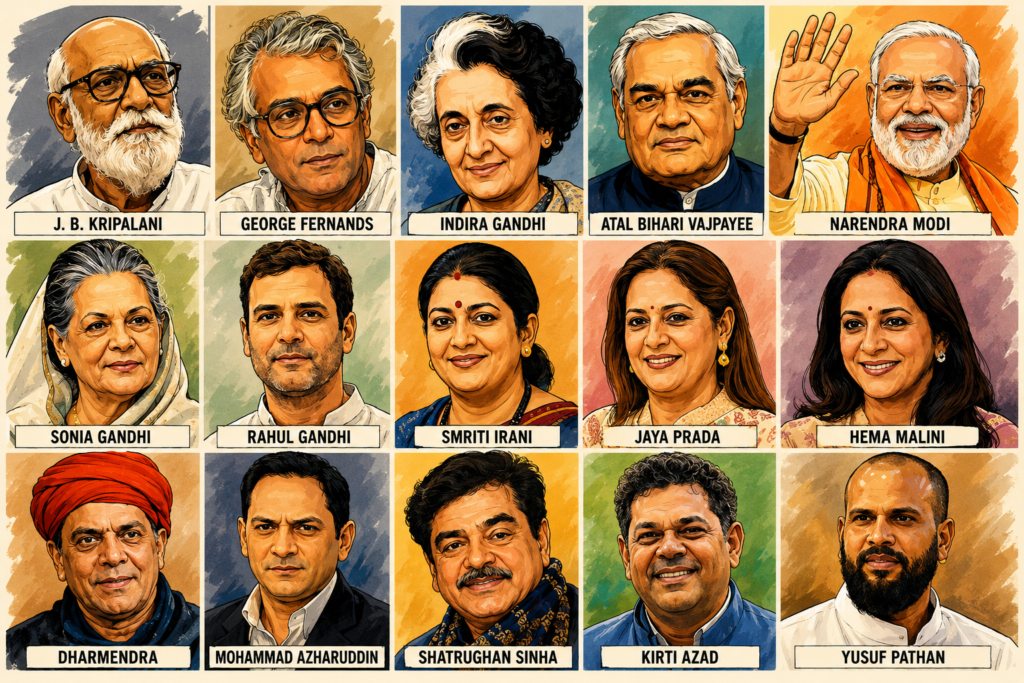
Madhu Limaye from Maharashtra, Sharad Yadav from Madhya Pradesh, and Ravindra Varma from Kerala all contested and represented constituencies in Bihar. More recently, Sonia Gandhi, Rahul Gandhi, and Priyanka Gandhi have contested from constituencies in Karnataka and Kerala outside their traditional bases. Smriti Irani contested from Uttar Pradesh. Sushma Swaraj contested from a constituency in Karnataka. Public figures such as Hema Malini, Jaya Prada, Dharmendra, and Mohammad Azharuddin entered Parliament from constituencies far removed from their cultural origins. Shatrughan Sinha, Kirti Azad, and Yusuf Pathan have represented. constituencies in West Bengal despite not being from the state.
None of them contested from their “home” regions. They contested from constituencies that chose them — and won. There is no reason why capable politicians from Karnataka or Kerala cannot build a base in Madhya Pradesh or Rajasthan, earn the trust of voters there, and enter Parliament through those constituencies. To restrict southern ambition to southern constituencies would be, in a quiet way, to diminish that ambition.
The Case Against an Expanded Parliament
One proposal has gained traction as a potential middle path: expand the Lok Sabha from 543 to roughly 848 seats, allowing northern states to gain representatives without southern states losing theirs. It sounds like a compromise. It is, in practice, a complication.
The value of a parliamentary seat lies partly in the relationship between an MP and a manageable constituency. As constituencies shrink — because more MPs serve the same population — accountability can diffuse rather than concentrate, creating more politicians without creating better politics. India’s legislative problem is not a shortage of voices. It is a shortage of quality debate. Data from PRS Legislative Research consistently shows that only a fraction of MPs actively participate in debates, raise questions, or scrutinise bills with any regularity. Adding more MPs to this environment may worsen outcomes by making coordination more chaotic.
We live in an era defined by connectivity and artificial intelligence. Democratic institutions should adapt by becoming more efficient and transparent — not by expanding their physical headcount. Mature democracies have largely resisted this impulse. The United States House of Representatives has held at 435 members for over a century, despite a population that has tripled. The United Kingdom’s House of Commons operates with 650 members for 67 million people. Democratic vitality has come not from adding seats, but from strengthening institutions.
Rebalancing Without Distorting
The tension between demographic equity and regional fairness is real. But it does not require dismantling proportional representation or the federal fabric of the union.
Phased adjustment over multiple census cycles, rather than one-time redistribution, would reduce the shock of rapid demographic-political shifts. More importantly, the argument that southern states deserve recognition for their developmental achievements is sound — but the appropriate channel is fiscal, not representational. Greater autonomy in tax devolution formulas, performance-based grants, and fiscal transfers can compensate southern states economically without distorting political equality. The Finance Commission’s framework is the right arena for these conversations.
A reinvigorated Rajya Sabha offers another avenue. India’s Council of States was designed, in part, to provide a federal check on the majoritarian tendencies of the Lok Sabha. Empowering it — through more substantive review powers, intergovernmental councils with real authority, and meaningful roles in policy coordination — can give smaller and more prosperous states influence without tampering with Lok Sabha representation. Finally, investing in parliamentary research institutions, expanding committee staffing, mandating minimum sitting days, and using technology to track legislative performance would improve the functioning of Parliament more than any expansion of its membership.
From Tamil Nadu to Uttar Pradesh, the battle over
parliamentary representation is shaping into a defining
test of Indian federalism, constitutional morality and democratic equality.
Demography Is Not Destiny — And Neither Is This Debate
There is a final point worth making, one often overlooked in the urgency of the current debate: demography changes.
The fertility transition that southern states experienced a generation ago is now beginning in northern states, driven by urbanisation, improving female literacy, and changing economic incentives. Fertility rates in Uttar Pradesh and Bihar have already declined substantially, though they remain higher than in the south. Simultaneously, the economic pull of southern cities will continue to draw internal migrants, potentially increasing the populations of Tamil Nadu, Karnataka, and Telangana even as their native fertility rates remain low.
The demographic advantage that currently favours northern states in a population-based delimitation formula is not permanent. It may reverse, partially or substantially, within two or three census cycles. Any constitutional settlement built on the assumption that today’s demographic map is fixed will face renewed pressure as that map shifts — arguing against any sharp, one-time redistribution of seats in either direction.
India’s delimitation debate can be framed as a dispute about seat counts. It is, more honestly, a dispute about what kind of democracy India wishes to be.
A democracy that ties political voice to economic productivity becomes, over time, a democracy of the wealthy. A democracy that ties political voice to population alone — without addressing the incentive structures this creates — risks penalising development. Neither is acceptable.
The ballot box is where citizens meet as equals. It is the one institution in Indian public life that does not know the difference between a taxpayer in Chennai and a daily wage labourer in Muzaffarpur. That equality is not an administrative detail. It is the promise on which the republic was founded and it must not be traded away for the convenience of arithmetic.
The delimitation question will return. When it does, the terms of debate matter as much as the outcome. India has navigated harder constitutional moments than this one. But it has done so by returning, always, to its founding commitments — not abandoning them in the name of arithmetic.
(The views expressed in the article are the opinion of the writer and not those of gfiles)

Bhuwan Mohan Prasad
An alumnus of Indian Institute of Technology Kanpur and University of Toronto, Bhuwan Mohan Prasad combines his professional work as an engineering consultant with his passion for independent writing. His writing spans political policy, the environment, public health, and energy.