











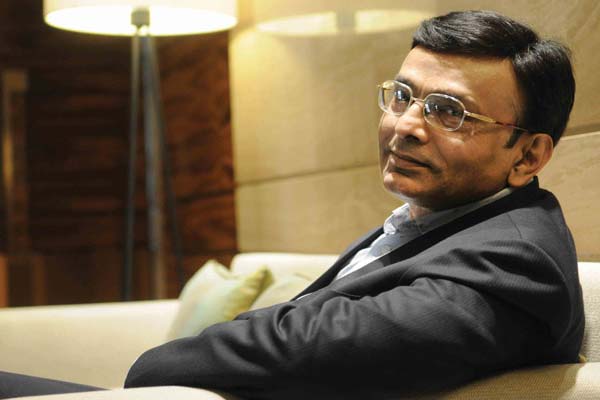

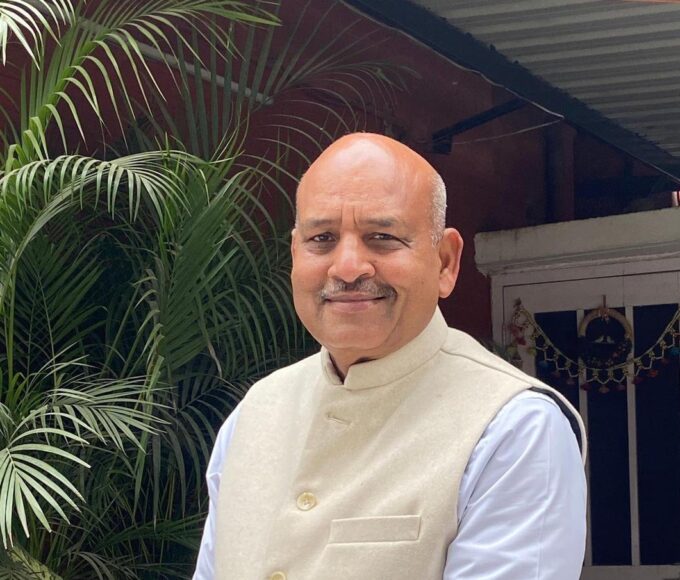








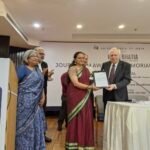
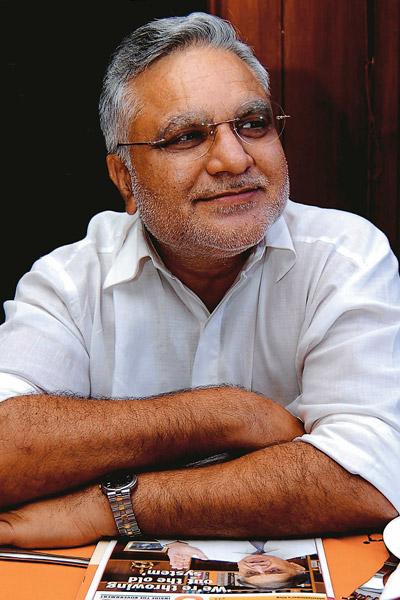
Though Dr Satyanarayana Dash belongs to the 1973 IAS batch from Kerala, his family is originally from Orissa. His father, Digambar Dash, was a revenue officer in the state. The young Satyanarayana travelled all over Orissa thanks to his father’s various postings. Holding a master’s in physics, doctorate in economics, and MBA in Human Resource Management and Business Administration Management, he was a college teacher in Orissa when he appeared for the Indian Forest Service examination. He was undergoing training but then appeared for the IAS examination and joined the IAS. Posted as assistant collector in Allapi, Kerala, language posed a major problem. On the advice of a senior, he watched Malayalam films to pick up the language. Speaking it fluently, he went on to learn to read and write as well.

gfiles: What is the state of affairs in the Ministry of Heavy Industry following liberalization?
Satyanarayana Dash: I must clarify that there is actually no industry defined as a heavy industry. Industry is defined in terms of micro, small and medium enterprises. The rest are all heavy industry. The limit of the financial investment for plant and machinery is defined in the forthcoming Micro, Small and Medium Enterprises Act. It defines investment limits in micro industry as below Rs 25 lakh, in small industry as Rs 25 lakh to Rs 5 crore, in medium as Rs 5-10 crore, and large is above Rs 10 crore. So there is nothing defined as heavy industry. There are large units in other departments like steel. The fertilizer Ministry has fertilizer plants, the oil sector has oil plants. We look after some of these large units, whatever is not looked after by other Ministries. We basically look after the capital goods sector like the machine tool sector, textile machinery sector, plant process machinery sector and automobile sector. For development of these sectors we have constituted Development Councils, consisting of industry and Ministry representatives. They give suggestions relating to fiscal concession, taxation concessions, and so on.
gfiles: The impression is that any heavy industry is governed by you, which is not the case. You are now not a regulatory body for heavy industry.
SD: We are now a facilitator ministry. We look after only some sectors like capital goods sector, machine tools sector, automobile sector, processing plant machinery. After liberalization, the government’s job shifted to facilitation. No longer do industries have to be set up in the government sector. In the Second Five-Year Plan, we stressed on heavy industries. We followed the model of the economist, Prof. Mahalanobis. All these heavy industries, like steel, oil started. In steel plants, we did not have heavy fabrication facilities for castings and forgings. That also we had to setup. The Heavy Industries Engineering Corporation at Ranchi was set up to facilitate the steel industry. It was mainly a process of integrated development because at that time the thinking was that the private sector will not have sufficient resources for heavy industry, so the government should come forward and set up heavy industries. Since 1991, the government is only encouraging industries to be set up by the private sector, and playing a facilitator’s role. We only plan what fiscal and tariff concessions can be given.
gfiles: How are you going to do this job?
SD: The job of facilitating and regulating is done through Development Councils. We have set up Development Councils for the automobile, heavy electrical equipment, textile machinery, and machine tools sectors. Meetings are held from time to time. We take the views of consumers, industry representatives, the concerned Ministry and discuss what has to be done to set up and facilitate the industry.
Another aspect to this is that there are certain facilities which don’t exist in the country. The government can think of one-time support for setting up such facilities. But such an institute or research organization should be capable of financing itself thereafter. Suppose we want to develop the automobile sector, to have the latest technology to reduce vibrations in vehicles, to reduce emissions to satisfy Bharat II and Bharat III norms. From April 2010, we will adopt Bharat IV. You’ve got to set up advanced technology, high-end testing and research facilities. These testing facilities are not available in India except on a small scale at the Automotive Research Association of India (ARAI), Pune. That is an industry organization. They have set up a laboratory on a small scale. When a company tries to develop a prototype model, they send it to this laboratory for emission testing. All emission testing facilities are being provided at seven locations. In the north, our main unit will be at Manesar, Haryana, called International Centre for Automotive Technology (ICAT). The second unit will be in Chennai, called Global Automotive Research Centre (GARC); the third in Indore, called National Automotive Test Track (NATT); the fourth is called Vehicles Research & Development Establishment, Ministry of Defence, at Ahmed Nagar. Here defence vehicles are tested. The sixth unit is in Silchar, Assam, called Hill Driving Mechanics Institute Inspection & Maintenance Centre. The seventh is in Rae Bareli, for off road vehicles like tractors and dumpers and for analysis of all accidents in the country. They also do Specialized Vehicle Training for off-road vehicles. This project, called National Automotive Testing & Research and Development Infrastructure Project, is worth Rs 1,780 crore and will be completed in three years.
It is required as large-scale automobile production facilities are coming up in India. We produce 10.8 million vehicles – 1.5 million passenger cars, 8 million two-wheelers, half a million three-wheelers, 5.5 million commercial vehicles, 2.5 million special utility vehicles. China produces 5.2 million passenger cars and 1.9 million commercial vehicles. Japan produces 9.8 million passenger cars, and 1.7 million passenger commercial vehicles. The US produces 4.4 million passenger cars, 6.9 million commercial vehicles.
gfiles: You have many Public Sector Undertakings and you govern and regulate those also. How do you deal with them?
SD: Out of 48 PSUs, 12 are closed. Two are actually the holding companies. So we don’t count them. So we have actually 34 operating PSUs now. Out of which 18 are loss-making and 16 are profit-making. Since I joined, my effort and focus has been the rehabilitation of sick units.
gfiles: Do you have any rehabilitation programme?
SD: The national Common Minimum Programme of the government is that we should try to revive loss-making units. If we find they cannot be revived, as a last resort we can close them after paying employees’ dues.
The government has set up a Board for Restructuring of Public Sector Enterprises (BRPSE). Out of these 34 PSUs, 26 have been referred for studies. Eight were not referred because they are marginally profit-making. Out of these 26, recommendations for 25 have come from BRPSE. Out of the 25, 17 PSUs’ recommendations for revival have been implemented and a decision on eight is pending with the government.
gfiles: How are you reviving sick units?
SD: We analysed the 34 PSUs and found some could be revived through Public-Private Partnership. We have one sick unit, Bharat Heavy Plates and Vessels, in Vishakhapatnam. They were manufacturing heavy pressure plates and heavy fabrications of the HPCL refinery in Vizag. We sent a team of Bharat Heavy Electricals Limited to see what they could manufacture for them and found that BHEL can give them orders for their requirements. BHEL has been assigned a high-capacity target in the Eleventh Five-Year Plan. So we recommended that this unit be taken over by BHEL.
Then, we had a unit manufacturing railway wagons at Mokameh, Bihar, called Bharat Wagon Engineering Ltd. We discussed with the Railways, told them here was a readymade unit, just take over and modernize it. They agreed. Now we have 16 loss-making and 16 profit-making PSUs. My biggest challenge is how to make these 16 loss-making PSUs profit-making.
gfiles: So, having stopped setting up units, you are truly only a facilitator now.
SD: Yes. During the licensing days, there was an Industrial Development and Regulation Act, 1951. Under this, we issued licences. There was a Director General, Technical Development (DGTD) who issued licences. Now the Act is amended. The licensing requirement is altered. The compulsory requirement for a licence is still there for the small scale sector. There were 856 items reserved for the small-scale sector, now only 14 items require licences. So, if some large unit wants to produce those items, they still need a licence.
Things like explosives, gunpowder, hazardous chemicals, and poisonous chemicals still need licences. Earlier, there was a restriction on industries within a 25-km radius of urban locations in 23 cities. Now that has been relaxed.
Only those licenced items which are under compulsory licensing come up for licensing. If they don’t come under this category, then the industry can be set up without any permission. There is another rule. If an industry is being set up with foreign investment then it can go the automatic route and through the Foreign Investment Promotion Board (FIPB). Those industries only have to inform the Reserve Bank of India. But those industries like some small-scale industry where more than 25 per cent foreign equity is invested will come for FIPB approval. Cigars and cigarettes, electronics, aerospace and any other industry that is already under FIPB all have to take permission. All that goes to the Ministry of Commerce and Finance. All capital goods industry comes to us.
gfiles: Is all infrastructure-producing machinery under you, especially the capital goods industry?
SD: If the economy is to grow at 9 per cent then infrastructure industry, especially the capital goods sector, should grow at 18-20 per cent.
gfiles: Have you achieved self-sufficiency in this sector?
SD: Each sector has its own parameters. The turnover of the capital goods sector is around one lakh crore rupees. Out of this, the heavy electrical equipment sector is only Rs 50,000 crore. The textiles sector turnover is around Rs 3000 crore but imports are Rs 9000 crore. We have been importing textile machinery from China. So the Planning Commission said one item of automatic looms will be allowed to be imported. There is a scheme called Technological Up-gradation Fund Scheme (TUFS). The idea is to give a fillip to our sector.
gfiles: Are the PSUs in your kitty performing as per world standards?
SD: We have fixed some benchmarks like financial, production and so on for performance and we monitor. If somewhere they require automation, upgradation and the like, we provide it. We have Enterprises Resource Planning (ERP), it is a comprehensive package which links all the manufacturing enterprises. We also monitor and appoint independent directors. If some enterprise has a Chairman and Managing Director, then 50 per cent of the board should be independent directors. If some enterprise has a Managing Director only, then one-third should be independent directors. The Department of Public Enterprises has a data bank which provides professionally qualified, technical, independent directors.
gfiles: You have 16 PSUs which are loss-making. How long are you going to bear the losses? The perception is that the government is in a mood to disinvest. But you say your approach is to revive PSUs.
SD: Our priority is to revive the PSUs. Earlier, the figure was 32. With our efforts, 16 are profit-making and 16 loss making. In some cases, the BRPSE recommended going in for a joint venture partner. Identifying a joint venture takes time as you have an inter-ministerial group, then you examine the potentiality of possible joint venture companies. Some units need parliamentary approval. It is a cumbersome process.
All the PSUs have tremendous wealth. The Common Minimum Programme states that the first attempt should be to revive. Revival can be through cash infusion, joint venture or takeover by other PSUs. We are also asking some state governments whether they would like to take over the PSUs located in their states. For example, we asked the Jammu and Kashmir government about the HMT factory at Chinar. They are willing.
gfiles: Isn’t it odd that the government produces watches?
SD: HMT was set up as there were no good watches. At that time the concept was of self sufficiency, whatever we don’t have we’ll produce. HMT was a brand once upon a time. People used to wait for HMT watches. Even I borrowed a watch for my exam. What happened is that they did not modernize as per the times. They keep producing mechanical watches whereas other manufacturers shifted to digital watches.
gfiles: BHEL is the major PSU under your Ministry. How is it contributing to the growth engine of the nation?
SD: BHEL has become a world brand. It has 14 manufacturing units, four regional power sector centres, 15 regional offices. Its turnover in 2007-08 was Rs 22,000 crore. It is continuously making profits for the last 32 years and also paying a dividend to the government. BHEL has a market cap of Rs 70,000 crore. It has kept updating itself with the latest technology. Three out of four bulbs come from BHEL. BHEL also produces electric locomotives. It not only produces power but is in distribution also. It manufactures 500 MW power project machinery. BHEL employs almost 40,000 people and is going to recruit more. It can supply 10,000 MW power machinery. It is going to increase this capacity to 15,000 MW by 2009.
gfiles: Do you plan to set up any heavy industry in the Northeast?
SD: We have the Northeast Industrial Policy which specially focuses on industries in that area. The Northeast, Jammu and Kashmir, Uttarakhand, Himachal Pradesh – these are special category states, they get many benefits. Three paper mills are in the Northeast – Cachar Paper Mills, Nagaon Paper Mills, Nagaland Paper and Pulp Mills. The Northeast has raw material to produce paper. We are expanding the capacity of Nagaland Paper Mills, and have sanctioned about Rs 500 crore for it. The Cement Corporation of India is setting up a cement grinding unit in Silchar.
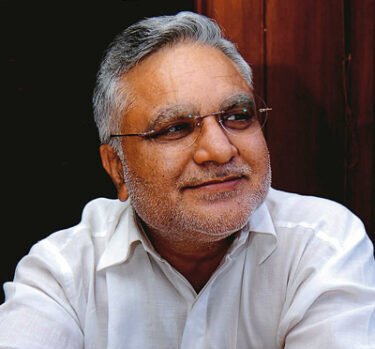
Anil Tyagi is a distinguished Indian journalist. An alumnus of the Delhi School of Economics (M.Com) and the University of Delhi (LL.B), he brings decades of rich experience to journalism. He presently serves as Editor of gfiles.