

























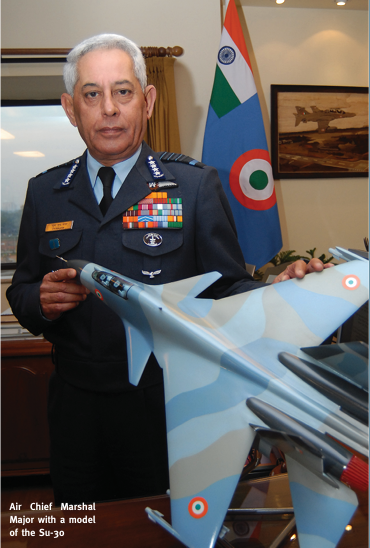
Air Chief Marshal Fali Homi Major, commissioned on December 31, 1967, has flown over 7,000 hours in the Sentinel, T-6G, Mi-4, Mi-8 and Mi-17 helicopters. He commanded the IAF’s first Mi-17 squadron, which operated at Siachen Glacier, and led another Mi-17 Squadron into battle during IPKF operations in Sri Lanka, winning the Vayu Sena Medal (Gallantry).
He has held a number of important staff and field appointments – Joint Director (Helicopter Operations) and Director Operations (Transport & Helicopter). In 1999, he took over as the Air Officer Commanding, Leh after the Kargil conflict. In 2002, he was awarded the Ati Vishist Seva Medal, promoted to Air Vice Marshal and appointed Assistant Chief of the Air Staff (Personnel Airmen & Civilians) at Air HQ.
On becoming Air Marshal in 2004, he moved to HQ Integrated Defence Staff as Deputy Chief of Integrated Defence Staff (Operations) and directed the operations of the Indian Armed Forces in India and abroad in the aftermath of the tsunami. In 2005, he was appointed Air Officer Commanding-in-Chief, Eastern Air Command and conducted exercises with the US, Singaporean and French Air Forces. He was awarded the Param Vishisht Seva Medal in 2006. He took over as Chief of Air Staff on March 31, 2007.
gfiles: Where does the Indian Air Force fit into the overall scheme of national security?
Air Chief Marshal Fali Homi Major: The Indian Air Force is an integral part of the national security apparatus and is responsible for the security of our sovereign airspace. Aerospace power today possesses immense capability and provides our national leadership with very viable response options, across the entire spectrum of conflict. The very presence of a credible and capable air force is a great deterrent and ensures stability and peace in the neighbourhood. What many do not realize is that air defence of our sovereign airspace is a 24×7 process for the IAF, even in peace time. We are responsible for monitoring air traffic over Indian airspace and for taking action to prevent any air violations. The IAF is one of the more important instruments of national power, and national security without aerospace power in today’s context would spell doom.
gfiles: Aren’t we focused a bit too much on the northern and eastern borders, to the neglect of the southern? What steps are being taken to overcome such lacunae, such as by positioning Su-30s in the Andamans?
‘Most of our airfields and infrastructure were put in place decades ago, based on the threat perception existing then. Today, with long endurance and very capable fighters and Flight Refueling Aircraft, we have flexibility as far as basing of our assets is concerned’
Air Chief Marshal FHM: Any air force is a capital-intensive service, be it in terms of equipment or infrastructure. Most of our airfields and infrastructure were put in place decades ago, based on the threat perception existing then. Today, with long endurance and very capable fighters and Flight Refueling Aircraft, we have flexibility as far as basing of our assets is concerned. Our basing philosophy has been worked out keeping in mind the costs involved for infrastructure, and the need to respond to potential threats in our areas of interest. Su-30 MKI fighters have regularly operated from the Andamans and continue to do so. Air defence and other measures are also in place to augment our capability in the southern peninsular region.
gfiles: The AWACS induction was scheduled for October last year. Is it on schedule? If not, what are the reasons for delay and when is the first aircraft expected in Agra? Which countries have finally contributed and in what areas in the making of the AWACS?
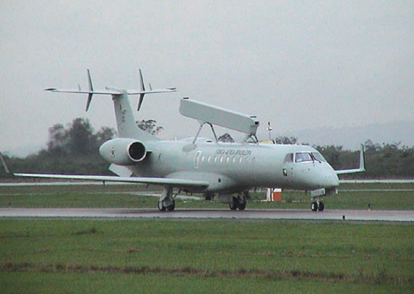
Air Chief Marshal FHM: There has been some delay in the arrival of the AWACS. I now expect it to be with us in late February/March. This is not a readily available “Commercially Off The Shelf” (COTS) purchase. It is a project of immense complexity, involving a number of players and is being built to our specifications. India, Russia and Israel are the major participants. We are willing to accept this minor delay rather than any shortcomings in the product.
gfiles: Regarding Rotary Lift Capability, when will you sign the contract for 197 helicopters? Are you looking at replacement as well as augmentation of Mi-26?
Air Chief Marshal FHM: A combined RFP, to cater to the requirements of the Army and the IAF, for the Light Utility Helicopter had been floated through a global tender. The responses have been received and the proposals are being technically evaluated. The IAF will acquire 125 aircraft in this class. We are also actively processing the case for the procurement of helicopters in the Heavy Lift class.
gfiles: What is the progress on the acquisition of attack helicopters? Has the IAF selected the VIP helicopter? How many numbers are being sought and when is the contract likely to be signed?
Air Chief Marshal FHM: The responses for our RFP for the attack helicopters have been received and are being evaluated. The process for selection of a helicopter for VIP communications duties is at an advanced stage. We intend to procure 12 of these helicopters.
gfiles: What is the progress on the MTA that is expected to fly around 2013? And what steps have been taken to upgrade the AN-32s or replace them?
Air Chief Marshal FHM: The MTA inter-governmental agreement was signed in 2008 between India and Russia. The designated agencies are engaged in discussions. The upgrade of the entire fleet of AN-32s is likely to commence very soon. It will undergo a very comprehensive refit, which will give it enhanced capabilities and a new lease of life.
gfiles: What is the UAV acquisition roadmap? Will more numbers be acquired by IAF or will it go to the Navy and Army? How much are BEL and others involved in TOT of better UAV payloads? Are there plans for HALE UAVs as well as Rotary UAVs?
Air Chief Marshal FHM: The UAVs are very versatile aerial platforms and additional platforms and payloads of various capabilities are being acquired by the IAF in requisite numbers in accordance with our overall plans. The involvement of our defence PSUs in this sphere is gaining momentum, especially with regard to the Rotary UAVs.
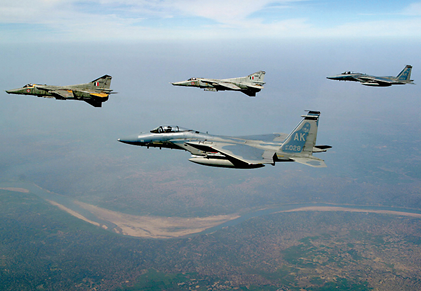
‘Red Flag provided us with a tremendous opportunity to deploy a sizeable combat complement across the world for more than two months. Whilst operating in a complex multi-national exercise with some very reputed air forces, we also got an opportunity to test our skills and exchange best practices with them. International exercises are an expensive proposition and that is why we are selective’
gfiles: What has been accomplished by the Red Flag 2008 exercise in terms of interoperability? Now that you have said further participation will be selective, will you participate in the transport Rodeo exercise?
Air Chief Marshal FHM: Red Flag provided us with a tremendous opportunity to deploy a sizeable combat complement across the world for more than two months. The message that this deployment conveys is obvious. Whilst operating in a complex multi-national exercise with some very reputed air forces, we also got an opportunity to test our skills and exchange best practices with them. We were able to operate together and fly operational missions in a near-realistic environment. International exercises are an expensive proposition and that is why we are selective. Decisions to participate in multi-lateral exercises are taken on a case-to-case basis.
gfiles: What is the time schedule for the MMRCA as per the DPP-2008? When will the flight trials commence and will all six applicants be participating? Where will the flying trials and weapon trials be held?
Air Chief Marshal FHM: The technical evaluation of the proposals is in the final stages. Flight trials will commence shortly. These trials will be conducted in three phases. The first phase will be conducted at the location of the vendor. Thereafter, the aircraft will be brought to India and evaluated under Indian conditions. In the third phase, the aircraft would be evaluated for weapons and systems, at the location of the vendor.
gfiles: What is the status of the Mirage upgrade and what will it involve?
Air Chief Marshal FHM: The final stages of contract negotiations are underway and the project of upgrading the Mirage-2000 should commence soon. The upgrade involves equipping the present aircraft with a completely new set of sensors, avionics and weapons to enhance operational relevance for present and futuristic air war fighting.
gfiles: Have the glitches in the Hawk been removed? What is the present status of the project?
Air Chief Marshal FHM: The Hawk programme is progressing well. Flying training on the Hawk has commenced. The second batch of pilots has commenced flying training. We have received all aircraft from BAe Systems, as planned. The delivery of HAL Hawks has fallen a bit behind schedule. There were a few glitches during the period of initial induction of the aircraft but with active involvement at the highest levels, most of the issues have been addressed, and the system has now stabilized.
gfiles: Is the IAF involved in acquisition of new engines of LCA by ADA?
Air Chief Marshal FHM: A Joint Engine Evaluation Team with members from HAL, IAF, RCMA and ADA has been set up to evaluate the new engine for the LCA. The IAF is very actively involved in the entire process.
gfiles: What is the status of the space-based surveillance? What has been achieved regarding the vision of an Aerospace Command?
Air Chief Marshal FHM: Space-based assets provide us with great operational advantages in many areas. At the moment, we don’t have any pure military asset to provide us such a capability. We obtain data from commercial assets which are already in space. The establishment of an Aerospace Command is an evolving concept. At the moment, we have a system in place wherein individual service requirements from space are consolidated at the Integrated Space Cell (ISC) under HQ IDS. The IAF has established a dedicated sub-branch at Air HQ, headed by an Air Vice Marshal, to look after all aspects concerned with the exploitation of space.
‘We have laid out a fibre-optic network called AFNET to link all Air Force users. The Integrated Air Command and Control System will ride over this network. Coupled with the Operational Data Link, all our sensors and combat assets will be integrated, thus reducing our decision cycles’
gfiles: What has been accomplished towards acquiring network-centric warfare capabilities?
Air Chief Marshal FHM: Networking our sensors, combat platforms and command and control systems creates a force-multiplier effect that can dramatically increase our operational effectiveness. It is our intention to integrate all our assets on a common architecture. We have laid out a fibre-optic network called AFNET to link all Air Force users. The Integrated Air Command and Control System (IACCS) will ride over this network. Coupled with the Operational Data Link (ODL), all our sensors and combat assets will be integrated, thus reducing our decision cycles and making the conduct of aerospace operations more responsive and effective. The physical component is in place and we expect the IACCS to be up and running in a short time from now.
Anil Tyagi is a distinguished Indian journalist. An alumnus of the Delhi School of Economics (M.Com) and the University of Delhi (LL.B), he brings decades of rich experience to journalism. He presently serves as Editor of gfiles.