

















Parties vie to catch voters’ fancy by making pledges they will not, and cannot, ever keep
Political parties face the need to win elections in order to get a mandate to be in the seat of power. For that they need popularity and hence they have to search for sources of popularity. War used to be one of the easy means of winning popularity. Now, wars beyond the borders have gone out of fashion because of their changed character and their prohibitive costs. A war within the borders by exploiting religious, communal and caste differences is equally unaffordable because the political legitimacy of such a regime or party is questionable in the international comity.
Remembered in his village as a poor boy who herded sheep after school, Deve Gowda studied by candlelight while in primary school… he learnt farming and civil engineering and worked briefly as a small-time contractor
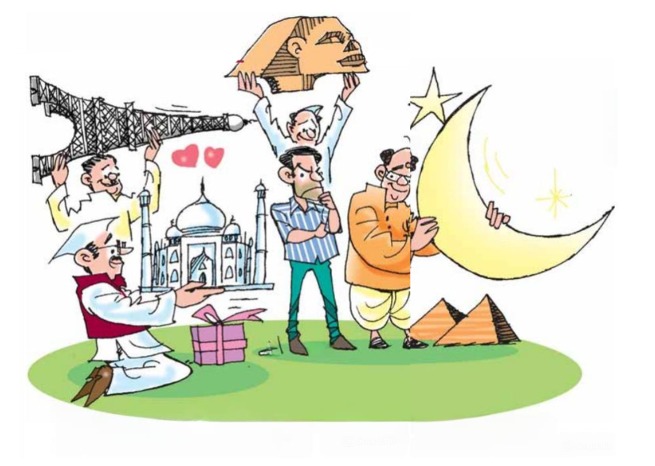
So, parties have found an easier source of popularity – the war of empty promises: of subsidized food, cheaper education, better health risk coverage, lower taxes and better pay scales for nominated employees who have to carry on administration and defend the nation. None shows any concern for the backbreaking burden of economic, social and cultural costs involved. The country would be economically insolvent if all their promises were to be implemented sincerely. They know these are empty promises that need not be kept. Even if they wanted to keep them, the delivery system would not let them.
For the first half of the last century, the test of political legitimacy was the capacity to protect the nation’s borders. However, another test of equal importance has gradually replaced it. By the end of the century, it has come to be the only litmus test for most parties. That significant test is the capacity to deliver the goods. It is known as the anti-incumbency factor and has come to dominate electoral politics. Its significance increased with spread of education, expanded spectrum of media, availability of means of communication and internet connectivity that bring the entire world into even lower middle-class homes.
Remember, Indira Gandhi’s promise of two meals a day for all as a right won her the massive mandate of March 1971. She trounced leaders who had sacrificed their youth to the freedom struggle and had maintained a patronage system as their foundation. But she could not deliver on her promises for various reasons, including her misreading of people and the need for the party to stand as an edifice in the political arena. In three years, she lost control over politics and even the nuclear explosion in May 1974 did not come to her rescue. Even after she converted her political crisis caused by the Allahabad High Court verdict into a Constitutional one by imposing the Emergency and abrogating political rights, she could not win back the masses and had to face electoral disaster.
The Janata Party that came to replace her regime had promised restoration of political legitimacy but it could not become a political alternative to the Congress as it got mired in the personal power ambitions of some leaders and disintegrated in less than 30 months.
Rajiv Gandhi came to power with an unprecedented majority. PV Narasimha Rao did not have a majority. Atal Behari Vajpayee had to ride on the back of an unstable coalition experiment. Each of these three governments completed a full term but none returned to power with a popular mandate in the last 25 years.
The main reason was that they could not meet the rising expectations of the masses for a better delivery system so that they could get what was their right without delay and without having to pay bribes. The delivery system got stuck in the yawning chasm caused by the checks and balances intended to provide corruption-free governance. Myopic politicians were led up the garden path by bureaucrats who convinced them that every evil – political, economic, social and cultural – can be cured only by legislation and the more prohibitive, the better. Even the right to education for children was sought to be implemented by prescribing punishment for parents who failed to send their children to schools and not by creating awareness about the benefits of education.
But such legislation created greater opportunities for corruption. The British Raj of a hundred years was replaced with a Licence Raj for the first 50 years of independence because of the economic development model adopted. The pursuit of self interest, as Adam Smith had perceived two-and-a-half centuries earlier, did not lead to improved economic conditions of all. It became an instrument in the hands of a few who could innovate methods to circumvent processes and prohibitions on economic activities in the private sector. It also resulted in keeping the growth rate at close to 3 per cent per annum for 50 years and came to be known as the Hindu Growth Rate – a pejorative term to describe India’s march towards economic independence.
In the economic reform era, even after 15 years, the per capita purchasing power of nearly three-fourths of the population remained stuck at Rs 20 a day. However, the rich managed to increase theirs five-fold. Every party that came to power or had a share in it, declared full adherence to the economic reform programme. LK Advani, now PM-in-waiting, toured the country to tell people how India was shining in the six years of the NDA regime that followed the same programme that Narasimha Rao had earlier adopted. The masses refused to believe him, as their mandate in May 2004 explicitly showed.
Today, both the main parties are in a mad race to shower empty promises of cheap and subsidized life for those below the poverty line and relief from the debt burden for farmers. Has either party considered the psychological impact of this on the man who honestly paid his debt? Or the financial burden it would entail on the national economy? Will any farmer repay his debts in future or wait for another waiver from the government in power before the next election? And what will be the consequence in the rural banking sector?
And who is going to implement the promises made by them in their manifestoes which do not reveal their thoughts on the need to improve the delivery system to keep these promises? Their cadres were not present at National Rural Employment Scheme worksites to ensure that workers got their legitimate dues. A visit as a common man by any politician to any office of the treasury, civic bodies, income tax, sales tax, VAT and service tax officers or any government office dealing with the public would serve as a shock for him. When six million tonnes of food grains stored in unhygienic conditions in Food Corporation of India godowns rotted in six years (1972-77) and was reduced to D category that was not edible even for cattle, no one was held responsible.
Throwing crumbs of subsidized food at the poor is hardly a solution because it makes them dependent on state charity and does not empower them or equip them with purchasing power that brings dignity to their life. Schemes for the welfare of the poor during the last 25 years did not achieve this. They merely kept the poor at the mercy of the administration.
Offering scholarships or financial assistance to poor students was also no solution without efforts to improve the quality of education in government schools. Only then would larger numbers need such assistance. Health risk insurance was yet another bogey because governments have not undertaken expansion of hospitals, facilities for outdoor patients and indoor bed facilities. No new larger government hospital has come up in Delhi in the last 30 years. A few have come up in the private sector where a patient has to dole out Rs 20,000 a day for a room and pay extra for visits by different medicos and consultants. Existing government hospitals cannot cope with the heavy rush of poor patients as they are under pressure to attend to patients recommended by politicians. Expansion of health care facilities is also a part of the delivery system.
Yet, political parties show complete ignorance of the failure of the state delivery system and also of the need for delivery. Nor are the poor taken in by these empty promises. Even they know it is not possible for politicians to keep their promises. They have enough experience of how parties have failed to implement their promises in the states.
Politicians’ major failure is their ignorance of how the poor live. No party has promised them cheaper salt. In 1931, Mahatma Gandhi had showed to the world through his Dandi March the importance of salt. Today, the poor are compelled to purchase their salt at Rs 14 a kg in the name of iodised salt because manufacturers convinced the rulers of its essentiality for mental growth. The fact is that iodised salt becomes common salt within hours if not stored sealed. The poor have no means of storing it sealed. So they consume common salt but pay seven times more for it. They are being fed on empty promises.