

















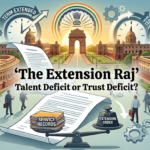
It’s all very well to read the charming anecdote about how this book came about. The author says his wife felt he was incapable of writing more than a page. Goaded by this, Verma ended up producing an entire book. Though this rouses our empathy, the question arises, was it worth it? As editorials in the Indian Defence Review, these pieces passed muster. But compiling them into a book is a different matter. Some are informative and thought-provoking, many more are just repetitive and dull. At the end, the reader is left with a feeling that, despite his genuine concern for the nation, Verma proffers few concrete suggestions backed by adequate analysis.
Not that he lags in strategic analysis. On the contrary, at times he puts things in brilliant perspective – as in the piece titled ‘Asia in a tailspin’, written in 2004
Not that he lags in strategic analysis. On the contrary, at times he puts things in brilliant perspective – as in the piece titled “Asia in a tailspin”, written in 2004. The problem starts when he refuses to restrict himself to the strategic discussion and tries to relate it to history or society at large. There he displays tiresomely naïve perceptions about complex problems.
Verma apparently envisages a situation when there will be no poverty, caste or religious discrimination, and the Indian Army will roam as a supreme entity, evoking awe from one and all. Now, how is this to be achieved? He merely states what “should” be done (for instance, money should be allocated for this and that, and education should be disseminated) without delving into the crucial socio-economic aspects of why these are not being done or failing to achieve their goals even after being done. Thus, at times the book reads like a sermon from a guru who loves the Army. For instance, “isolate the Jihadis ideologically” (p 274), “compel Pakistan to supplant madrassa with modern education” (p 274), “…further strengthen the relationships with the existing friends while adding new strategic partners to the list”, (p 238), “our political aim should be the dominance of Asia by 2020 as an economic power backed by a world class military” (pp 185-186).
More irritating is his faith in the Army as a panacea for every problem. This attitude has crept into the pieces in many places. He is most candid on page 133 where he states, “The military is the ultimate pillar of the state.” He also believes that all the four wars India fought were thrust upon it. As a corollary to this, he believes India has not done anything to disturb Pakistan ever! Can a defence analyst afford such self-delusion? Further, he believes that India can attack Pakistan and divide it into four or five states. Does he really believe that the world will sit back and watch this happen?
Yet, some articles, particularly in the latter half of the book, are far more analytical and mature. Edited to about half the number of pages, the book would have been more worthwhile.