






























As part of fast-tracking administrative reforms, the Government of India is evolving a “Performance Monitoring and Evaluation System” (PMES). This task has been put in mission-mode for preparing the Results-Framework Document (RFD) for every Department and Ministry in a time-bound manner. Several “Ad-hoc Task Forces” comprising management professors and retired mandarins have been set up and are busy working out “success indicators” and reporting formats.
The helmsman for this mission is a US hand – former Harvard professor and World Bank economist Prajapati Trivedi, who has been designated Secretary, Performance Management. This “most happening mission ever undertaken by the Indian government during the last 63 years” is reportedly driven by Prime Minister Manmohan Singh’s belief that nations and governments that do not perform are doomed, ultimately, to perish under the weight of their own inefficiency and bureaucratic sloth.
If performance and efficiency were the factors, Shailaja Chandra’s remedy of revamping the archaic 45-year-old Conduct and Disciplinary Rules is more appropriate than the PMES-RFD facade. Her contention hits the nail on its head: “By bringing in a new set of disciplinary rules, the government can change the way its officers perform. It can boost the morale of honest officers and restore lost initiative. Prompt punishment, if awarded to a (guilty) few, will straightaway work as a deterrent to wrong-doing and instil a respect for hard work and discipline–attributes which have become anachronisms.”
Obviously, the intentions of the “most happening mission” seem to be different. According to Trivedi, “RFD will be akin to a Bill of Rights for government functionaries. It will liberate the bureaucracy from the vagaries of ad-hocism, subjectivity and uncertainty.” The Indian Administrative Service appears to be the main target of this “mission” and the objective could be to incentivize its members to implement the ongoing MNC-driven “development agenda” without demur and show exemplary results.
This agenda, co-promoted by the government and the corporate sector, includes the Indo-US CEO agreement ;100 per cent FDI by real-estate MNCs; land-grab licence for SEZ-MNCs; surrendering tribal territories to mining MNCs; $100 billion nuclear bonanza and exemption from civil liabilities for energy MNCs; ramming GM cotton and food down the people’s throats to propitiate agri MNCs ; mortgaging India’s farming to US interests through “Knowledge Initiative in Agriculture” and “Agriculture Cooperation and Food Security” MoUs; and rampaging retail MNCs and the grand entry of foreign (read US) universities into India!
PM Manmohan Singh stated in Washington that development in India cannot be a carbon copy of what happens in China ‘because their system is very different’. By the same logic, development in India cannot be a carbon copy of that in the US
A few months ago, Prime Minister Manmohan Singh stated in Washington that development in India cannot be a carbon copy of what happens in China “because their system is very different”. By the same logic, development in India cannot be a carbon copy of that in the US also, because the American socio-economic system and ethos are very different from India’s.
In the vision of the Father of the Nation, Independent India would be sui generis, a society unlike any other, in a class of its own. Gandhi’s India would not go for gigantic, FDI-funded development projects and large-scale industry and mining – typical of market-led growth under capitalism. Instead, India would pursue an equitable, small-is-beautiful, need-based, human-scale, balanced development while conserving nature and livelihoods. It is to nurture this socio-economic ethos that the IAS has been established and covenanted in the Constitution.
The alien neo-liberal agenda is just the opposite, seeking an India of millionaires and billionaires “vibrant with wealth and business acumen” of the top 5-10 per cent of the population with the remainder of Indians serving that minority and surviving as a barely literate, malnourished multitude. This agenda is being driven by a new breed of “adhocracy” within the IAS that has come about through inbreeding, considered detrimental for any species! This adhocracy, which is antonymous to rule-bound bureaucracy, has substantially skewed and weakened India’s governance.
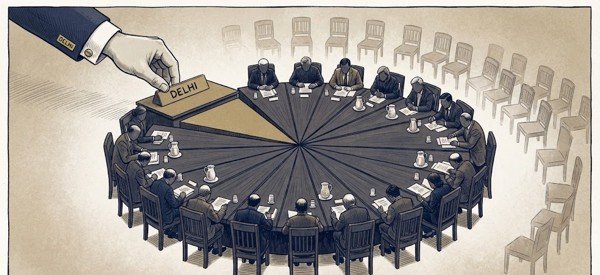
Two kinds of adhocracy are shaping. One is born of the “clan-within-clan” inbreeding being practiced by a linguistic-parochial group that has captured almost every top job in Delhi’s corridors of power, including Principal Secretary to Prime Minister, Secretary to President, National Security Adviser and Cabinet Secretary. The other is the loyalist core being put together to implement the alien agenda.
With the participation of PMO patriarchs the spread of clan-within-clan adhocracy has been fast and furious, capturing several key posts of Secretaries in the Ministries of Home, External Affairs, Telecommunication, Urban Development, Civil Aviation, Information & Broadcasting and a host of Secretaries to the Government of India in several other Ministries. Finance, Commerce and Agriculture were also in their hands till some time ago. The latest addition is the coveted portfolio of Petroleum & Natural Gas! Key UN positions are no exception.
Barring honourable exceptions, other coveted positions go to agenda-men anointed by the “Moneyed and the Mighty”. An unwritten rule prohibiting extension in service after retirement age of IAS officers was increased to 60 has been selectively breached to reward favourites and position some others in strategic tenure posts. Privatization now seems to have been formalized with Mukesh Ambani co-owning the Petroleum Ministry and Anil Ambani and others seriously bidding for the Power Ministry! With the IPL flavour catching up, one wonders as to which other top jobs are on the bidding block!
The bureaucracy was meant to administer through laid down rules. The ICS was called the steel frame precisely for this reason. ICS officers viewed any deviation from the rules as a misdemeanour. Its successor, the IAS, endeavoured to keep up the standards. Though there were hiccups, the bureaucratic system by and large ensured that men and women of merit were not denied their due promotions and postings.
But, in the past few years, the heads of the Indian civil services have been informally working on the adhocracy system by tinkering with processes and procedures to ensure that the top positions of Government – Joint Secretaries, Additional Secretaries and Secretaries – are held only by their clansmen or those willing to adhere to the alien agenda. Of course, the RFD exercise, with a Harvard-World Bank man at the helm, would formalize it. The foundation for this has already been laid with Ivy-League American University exposure a prerequisite for top Government of India positions.
In 2005, rules for empanelment as Additional Secretary were changed to ensure that some favourites who had spent many years out of India either on lucrative assignments with international organizations or on long leave of absence were empanelled. Originally, the empanelment of Additional Secretaries was based on a service record of eight years as Joint Secretary or equivalent. This was arbitrarily changed to 14 years. Earlier, a stray or vague remark in the Confidential Report in an otherwise consistent and outstanding service record was ignored. Since 2005, such remarks have been used to deny empanelment to deserving officers in order to accommodate the in-breeders.
Another rule stated that only those officers who had served a minimum three-year term on a Government of India posting would be considered for empanelment as JS, AS and Secretary. The rule is fair but its retrospective application was unfair
Taking things further, another rule stated that only those officers who had served a minimum three-year term on a Government of India posting would be considered for empanelment as JS, AS and Secretary. The rule is fair but its retrospective application was unfair, since many officers who would have opted for Central deputation if the rule had been in place, have been denied empanelment. To make matters worse, the decision-making coterie went on to empanel a chosen few without Government of India experience by managing a letter from the concerned State government saying the officer was willing to go on deputation but that the State could not spare him/her!
When the 1974 IAS batch was being empanelled, a restrictive rule was introduced to the effect that those with less than two years of service on the first day of the year would be eligible only for posting as Principal Adviser in the pay scale of Secretary to the Government of India. Pre-planned, the rule was used to eliminate four Tamil officers, of whom three were with the Government of India. Having served its purpose, the rule has been given a quiet burial in the empanelment of the 1976 batch as Secretaries.
Instead, a subtle device has been invented to subvert cadre management i.e. in situ promotion of an entire batch as Special Secretaries. The 1976 batch is the victim/beneficiary and the objective is to facilitate cherry-picking for appointment as full-fledged Secretaries to the Government of India. Optimization of domain knowledge and experience, given as the rationale for this undesirable practice, sounds hollow when one looks at the actual postings. Ignoring officers with considerable exposure and domain expertise in several sectors as JS and AS, the greenhorns of this batch have recently been “deep-selected” and posted as regular Secretaries.
While senior civil servants are seething, the Cabinet Secretary shoots off a missive to the State Chief Secretaries, saying, “Impartiality, transparency, accountability and devotion to duty are the core values which civil servants should cherish and which should form an integral part of their decisions and actions. We need to stand by and uphold our core values and senior officers must set an example and mentor their colleagues.”
In the scenario described, one wonders what to make of this exhortation. Perhaps, all one can say is, “Physician, heal thyself.”

IAS (retd) with a distinguished career of 40 years - worked in Army, Govt, Private, Politics & NGOs.