


























Public sector companies are distinguished from their private corporate sector counterparts by their pursuit of social goal. The private sector is solely guided by the interests of its direct stakeholders, but the public sector is also equally mandated to be accountable to the people – the ultimate owners. The top managements of Indian Central Public Sector Enterprises need to reflect on how the objective of meeting the social goal can be incorporated in addition to performing their business functions.
One way of securing and furthering this difference is through activities of corporate social responsibility (CSR). While the private players use CSR to promote their business directly or indirectly, the test of the public sector’s CSR should be the achievement of a social goal. The current efforts of Central PSEs in this direction fall short of their capability and the people’s expectations.
The Oil and Natural Gas Corporation allocates funds equivalent to 0 .75 per cent of its net profits for socio-economic development programmes. It has initiated “PURA – providing urban amenities in rural areas”. This programme includes roads, transport, and power, telecom and internet services, as well as education and income-generating projects. These PURA projects have been set up in Tripura, Assam, Nagaland, Andhra Pradesh, Maharashtra and Gujarat. ONGC has established a foundation called ONGC PURA with a corpus of Rs 10 crore. The first PURA project was launched in Maichara village in Tripura in 2005.
HPCL has taken up a number of programmes with names like Suraksha, Swablimban, Unnati, Nanhi kali, Vikas, Navjyot, Muskan and Naya Netratwa. Not much is known about the actual performance of these programmes. NTPC is involved in distributing generator sets in villages. It has also set up a foundation for the education of the physically challenged. There is a Navaratna company which uses its CSR funds for renovation and restoration of historical monuments.
Most PSUs are involved in social work in the field of education. They utilize NGOs to provide education to disadvantaged sections of the population. However, there seems to be no worthwhile outcome of these CSR activities of PSUs. On the contrary, the chief executives and boards regard them as a nuisance.
A fresh look is required for CSR activities by Central Public Sector Undertakings. Their CSR efforts have largely been confined to welfare and development, which is generally expected of government departments and agencies. Education, rural development, women’s empowerment and so on should essentially be the domain of the government. Since the state agencies are not capable of providing adequate resources and efficient delivery mechanisms for these needs of over a million citizens, there are attempts to fill in the gaps in a small measure by NGOs funded and supported by CPSUs.
The public enterprises try to do what state agencies are supposed to be doing as their legitimate work. They lack the domain knowledge of these projects and thus use the expertise of NGOs. Their contribution is limited to financing the projects and, to a small extent, providing administrative assistance through surplus staff.
The CSR activity of our PSUs is generally confined to earmarking a certain amount of surplus funds and deploying weary executives for the job. Most of the funds are used for publicity, salaries of executives and payment to experts and volunteers. Very little actually reaches the community. Besides, a few hundred crore rupees does precious little in adding to the government schemes and programmes.
The domain knowledge and expertise of the industrial or commercial management is hardly utilized in their CSR activities.
There are three areas in which innovative CSR initiatives can be taken up: setting up social businesses for the welfare of the poor; developing and propagating much-needed technologies for the poor in rural areas; and replicating best practices that have served the disadvantaged.
Speaking of social businesses set up and run by the Grameen Bank, Mohammad Yunus said, ‘The social business is a non-loss, non-dividend company dedicated entirely to achieving a social goal.’
In December 2009, Nobel Laureate Mohammad Yunus delivered the second Hiren Mukherji Memorial Lecture in the Central Hall of Parliament. Speaking of social businesses set up and run by the Grameen Bank, he said, “The social business is a non-loss, non-dividend company dedicated entirely to achieving a social goal.”
He spoke of joint ventures with successful companies like Danone of France and Adidas of Germany to meet the needs of Bangladesh’s rural communities. The joint venture with Danone supplies fortified yoghurt to malnourished children while that with Adidas provides a pair of shoes to every man, woman and child in impoverished villages. Yunus also said that BASF of Germany had signed a joint venture agreement to produce chemically treated mosquito nets in Bangladesh as a social business. The nets will be provided to the poor at affordable prices.
The beauty of these programmes is that they combine the multinationals’ technology-cum-management expertise with the passionate mission of Grameen Bank. The objective of these viable enterprises is not to maximize profits but to maximize welfare.
The concept of social business should be adopted by our CPSUs as part of their CSR. There are several areas in which a PSU can set up industrial enterprises in collaboration with well known technology holders to serve the public good.
We urgently need appropriate technologies for rural transport, stand-alone power systems, prefabricated low-cost housing and sanitation. Very little work has been done in these areas by PSUs.
CSR should also be used by the Navaratnas for exploring new technologies for rural areas. We urgently need appropriate technologies for rural transport, stand-alone power systems, prefabricated low-cost housing and sanitation. Very little work has been done in these areas by PSUs. If a PSU can develop a one-rupee sanitary napkin, it will create a revolution of sorts in rural healthcare.
Such people-centric work is being done in some places. BP Solar set up a project to instal 6,000 packaged solar systems under the Solar Power Technology Support (SPOTS) programme in the Philippines. In a joint venture with Tata, BP Solar is bringing power to rural Ladakh. It has installed 8,700 solar home lighting systems and delivered 6,000 solar lanterns to people in 80 remote villages.
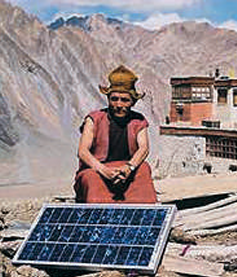
In Sri Lanka, the Sustainable Assistance Water Management Project (SAWMP) is an example of the use of solar power to drive large-scale irrigation facilities. It should not be difficult for the large PSUs in India to form a consortium and provide funding for sustainable power systems in remote areas.
The Ministry of Power has identified 25,000 villages which have no possibility of grid coverage in the foreseeable future. The expertise of small home and community solar power systems is available within the country. The Tilonia Barefoot College is involved in turning illiterate village women into barefoot engineers.
The third area of credible CSR activity can be replication of successful experiments in some parts of the country in other parts where they are badly needed. Three such experiments come to my mind. There must be scores of others. Anand Kumar, an IPS officer of Bihar, runs a programme called Super Thirty which prepares poor Dalit students for competitive examinations in Patna. Year after year, the selected 30 students qualify for IIT. Now he is extending it to Super Sixty. The model can be replicated by our PSEs in UP, MP, Orissa, Chhattisgarh, Uttarakhand and so on.
Bunker Roy, a former corporate executive, quit his job and dedicated himself to the welfare of rural women in Rajasthan. His Barefoot College in Tilonia is a rare model of women’s empowerment. It can be replicated in other states.
Dr Balasubramanian, a medico in Karnataka, gave up his flourishing career to set up an institution to train tribal youth in rural assets management. The effort has expanded into a medical college and youth movement, and has won several awards. It can be replicated in Chhattisgarh and Jharkhand – states with sizeable tribal populations.
The Central Public Sector Enterprises have government sanction for CSR activities. They have adequate funds, and they have the autonomy to take decisions.
Are they willing to think about it?

Prabhat Kumar is an Indian Administrative Service officer of the 1963 batch, he served as the Cabinet Secretary of Government of India between 1998 and 2000. Upon creation of the State of Jharkhand in November 2000, he served as the first Governor.