





























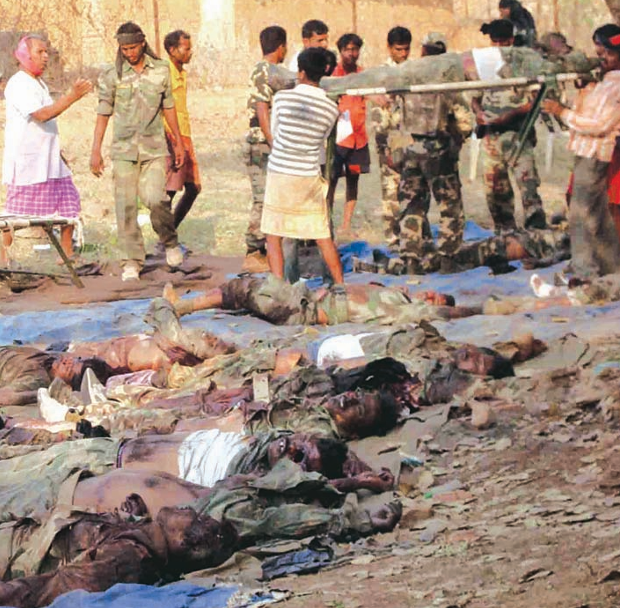
The massacre of the CRPF jawans at Dantewara is the first indicator of the dark fact that the state may lose the Naxal war. Losing here does not mean that the state will have to withdraw its forces from there. Losing means the state’s robust reaction may fail to yield tangible results. Ironically, it may end up in expanding the scale and geographical expanse of the conflict.
Though the reasons for why the government may lose this war are staring at the face of the government, no one seems to be in a mood to admit those. The reasons, clubbed together, can be depicted as ‘abysmal administrative failure’.
Let us go point by point to see why, strategically, the government is on a sticky wicket.
The Alienation Factor deliberately overlooked
There are various parametres that indicate to the unpardonable failure of the state as the root cause of spreading Maoist influence over a vast region of central-eastern India. However, we will not delve into that in this article. That this point is beyond any debate is proved by Prime Minister Manmohan Singh’s inaugural address at a Conference of Chief Ministers (on the Implementation of the Forest Right Act on Nov 4th, 2009). There he said, “The alienation built over decades is now taking a dangerous turn in some parts of our country,” Dr Singh also observed “The systematic exploitation and social and economic abuse of our tribal communities can no longer be tolerated.”
But the state did not take any measure to neutralise the alienation factor by innovating new modes of functioning (like, sending troops to provide food, clothes and medicines to every household). It went straight into a violent war by sending thousands of paramilitary forces to the tribal lands. The PM and the Home Minister P Chidambaram have thus started this war without making strong efforts to mitigate the ‘alienation factor’.
FICCI deciding the course of action
To put the record straight, it must be mentioned that following an alternative strategy of something like ‘military intervention for reaching food’ would have been economically costly and time-consuming. But, that was probably the only viable first step. It is true that the Naxalites at many places stall developmental initiatives. For collecting material for my novel written against the backdrop of the Maoist movement, I toured a large area under Naxalite influence in the early years of this century. Even then I came across unfinished bridges and roads, all stopped by the Naxalites. But, I also interacted with a lot many people who believed, out of ignorance, that the Naxalites are an alternative state power. If I came across a half-finished bridge even in Gadchiroli district of Maharashtra, I also found people who approached the Naxalites to set up tube-wells in their locality and got those installed in Latehar district of Jharkhand. Under the circumstances the Maoists could hardly fire upon para-military forces who were bringing food or clothes or medicines for the villagers.
Instead the government decided to act fast as though it was chased by some ghostly factors. Why? It adopted, following US foreign doctrine of ‘clear, hold and develop’ an enemy territory, a strategy to ‘clear and dominate’ the Naxalite lands. The government has closely followed what FICCI said in its Task Force Report on National Security and Terrorism. The report suggested (in the chapter titled. ‘A robust response to the Naxal challenge’) that ‘Determined and superior force application followed by repair of the faultlines will be critical to demolishing the myth of Maoist/Naxal invincibility and will set an example through state domination’. Thus, the war being an offshoot of the industries’ pressure on the government, failure to assess long-term effects was a natural corollary.
Failure to put Intelligence network in place
To win a war, which is more on the line of a civil war within a country, the essential ingredient is intelligence input about the opponent. But due to first two factors, the state did not even wait to see whether an intelligence network could be put in place. The state ignored the point that they are pitted against a force that has large intelligence network. From Lalgarh of Bengal to Gadchiroli of Maharashtra, they have developed this network over decades. The more the government will try to break this network, the more it will be accused of harassing the common men, poor dalits and tribals. It will further the alienation of the local people. And for itself the government will not get information from the locals to carry out targeted operations against the Naxalites. This is the main reason why the army or the Air Force is unwilling to join this war.
Without intelligences, troops working in dark
According to intelligence sources, no significant accurate input needed to hunt down the rebels is coming forth from the locals. And according to independent social activists who cannot be named, there are three factors why enough information will not be forthcoming: (i) many of the locals are Naxal sympathisers, (ii) even a greater number of people prefer to be neutral and wait to see who of the warring armed forces wins, and (iii) a large cross-section of people, mainly more affluent section (though by urban standard they are at best lower-middle class) are scared of the Maoists.
Thus, it can be assumed that even after three years, the period Chidambaram is harping again and again, there may not be strong tangible results. It must be mentioned that Naxalites were wiped out of Andhra earlier twice. First, during the early ‘70s(after the first rebellion), and again during late ‘80s—early ‘90s (a period when the Peoples War was plagued by internal differences). But they staged comebacks and had to be again washed out a decade later by late YSR. Indications are that they are regrouping in Telengana region and planning to wage large-scale offensive. So, destruction of some bases of the Naxalites may give Chidambaram (and the BJP or the Communists) reasons to celebrate, but it may not actually debilitate the Maoists ability to rise from the ashes like the Phoenix.
The Naxals may expand conflict-level
Despite some setbacks due to the war, the Naxalites may actually be incited to exploit the weakness of the opponent and expand the conflict zone. They had never before struck so hard to kill 74 jawans (some in the government circle believe the number was much higher) at one go. Probably the government has provided them an opportunity to prove their firepower over a very large swathe of land between the southern and the northern India. The security forces are fixed targets for them, while for the security forces their targets are neither fixed, nor demarcated. The Naxalites do not wander in olive green dresses all the time. They do not carry arms all the while. With almost four decade’s experiences, they have learnt to live among the people like fish in the water.
Probably the government has stepped on a booby-trap. It is essential for a democratic India that politics of violence be defeated. But, due to the reasons mentioned above, P Chidambaram’s Maoist war may create more problems than it will solve.
————
The writer is a journalist and author of the novel ‘A Naxal Story’.