


























Like Oscar Wilde, who famously declared his genius to a customs officer, SH Kapadia sees his integrity as his only asset
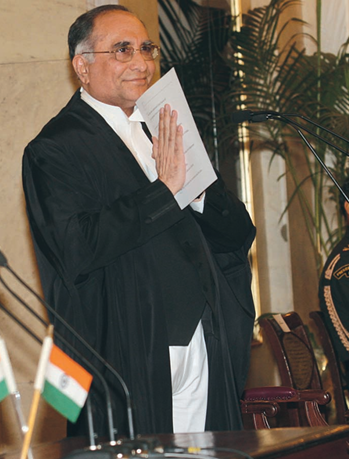
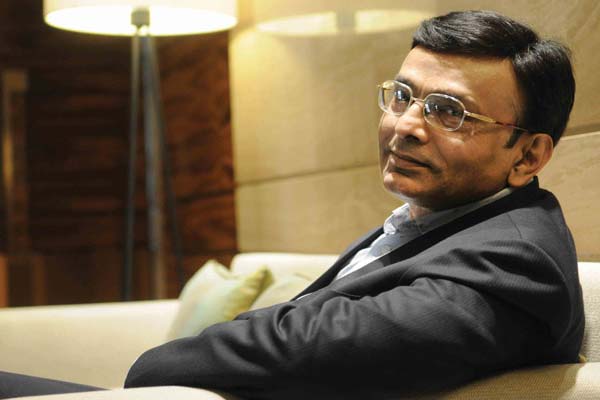
A judgment delivered last year in a case concerning the popular word-game of Scrabble perhaps best illustrates the astuteness of the intellect of Sarosh Homi Kapadia, recently appointed Chief Justice of India. The manufacturer of Scrabble had sought tax exemption on the plea that the product was a puzzle and not a game. Kapadia, after considerable research, stated that, in a puzzle, the outcome is pre-determined. Since this is not the case with Scrabble, he deemed it a game.
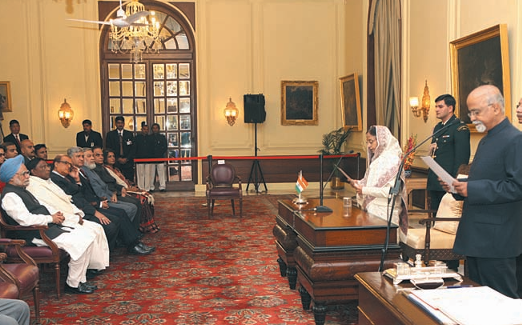
Kapadia, whose term will last two years and four months, is the first Chief Justice of India to have been born after the end of British rule in 1947. As a young man, long before he became a judge of the Bombay High Court, Kapadia believed that one day he would live in the area where judges live. In 1991, he became a judge and there has been no looking back since.
He was appointed a special judge to prosecute the 1999 stock and securities scam involving broker Ketan Parekh. Later, he also played a vital role in the proceedings of the Joint Parliamentary Committee constituted to investigate the stock scam.
On August 5, 2003, he was appointed Chief Justice of the Uttaranchal High Court. In December the same year, he was elevated to the Supreme Court.
A senior lawyer who has known the 62-year-old judge for many years says, “He believes in perfection and will tolerate no nonsense.’’ Soon after taking over as CJI, Kapadia made headlines for stating that frivolous petitions in the garb of PILs would not be entertained and, as a deterrent, would attract a hefty fine.
Yet, he is not unconcerned about legitimate issues raised in such petitions by the deprived sections of society. The commitment to society enjoined upon a judge and the concept of a socialist society, enshrined in the Preamble to the Constitution, are close to his heart.
When Classes III and IV employees of the Supreme Court narrated their tale of hardship and inhospitable working conditions as well as exploitation by superiors, Kapadia announced that he would not avail of the summer holiday but would visit their departments to determine what could be done. “I assure you that I am conscious of your problems. I also worked as a Class IV employee for a short time in a small office in Mumbai,’’ he said.
Not many months ago, he urged all the state governments, the Centre and other authorities to shed tardy procedures as “delay defeats equity’’. “The court helps those who are vigilant and do not slumber over their rights,” a bench headed by Justice Kapadia said while aborting the Maharashtra government’s bid to challenge certain land acquisition award cases after the last judgment passed 1,724 days earlier.
“Public interest demands that the State or the beneficiary of acquisition, as the case may be, should not be allowed to indulge in any act to unsettle the settled legal rights accrued in law by escorting to avoidable litigation unless the claimants are guilty of deriving benefit which otherwise are not entitled in law in any fraudulent manner,” he said.
Yet, as an expert in corporate law, taxation and investment, he is also conscious of the fact that the judiciary has its limitations and cannot meddle overly with other organs of the State.
While Kapadia upheld the prestigious position of a Governor, saying the latter cannot be treated like a servant by the Central government, he also upheld the majesty of parliamentary democracy. He held that the decisions taken by lawmakers inside the House cannot be adjudicated upon by the judiciary.
These judgments by a man who takes pride in his only asset – integrity – yield a glimpse of a “workaholic” mind. In addition, Kapadia believes in shunning media glare but also using opportunities such as functions to elaborate on issues of public importance.
Kapadia’s appointment as CJI has also come as a matter of relief for a large number of mediapersons who were denied interviews by his predecessor, Justice KG Balakrishnan. While Balakrishnan’s doors were open to only a select section of the press, an old Kapadia friend assures, “He doesn’t discriminate, that much I can say. He respects all readers and viewers.”
Humble beginnings
Justice SH Kapadia grew up in a lower middle-class Parsi family from the Khetwadi-Girgaum part of Bombay. His father was a clerk in a defence establishment, his mother a homemaker. The young Kapadia went to work immediately after completing BA and LLB. Higher education would have been a luxury.
“I come from a poor family. I started my career as a Class IV employee and the only asset I possess is integrity…,” he once wrote in a letter to Justice VR Krishna Iyer. He joined a law firm, Gagrat & Co, as a clerk. However, soon after he started working for reputed labour lawyer Feroze Damania.
Around the same time the family moved to Andheri and Sarosh married the girl next door, Shahnaz. Today, they have two grown-up children who have charted their own careers and are not even remotely connected to the legal profession.