
























India’s institutions are being replaced by individual or dynastic hegemony
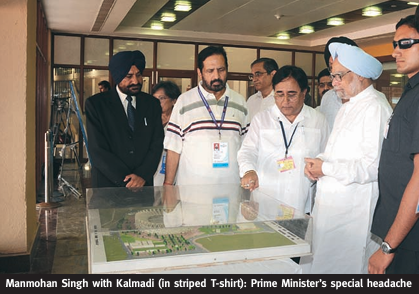
The 101-medal, Rs 71,000-crore “best-ever Commonwealth Games” have made India a “super-super power” dreaming of hosting the Olympics in the near future – perhaps at 50 times that cost! The Indian and global sports mafia, thriving on such dreams, must be salivating!
Amidst the euphoria, it was easy to miss the Global Hunger Index for 2010 ranking India 67th out of 84 developing countries, well below Sudan, North Korea and even Pakistan. And the “Commonwealth or Common Hunger” report of Save the Children says: “India may rank second in the medals tally, but it is on top among the Commonwealth countries as the home to the highest number of underweight children. About 43% of Indian children are underweight, and seven million under five are severely malnourished.”
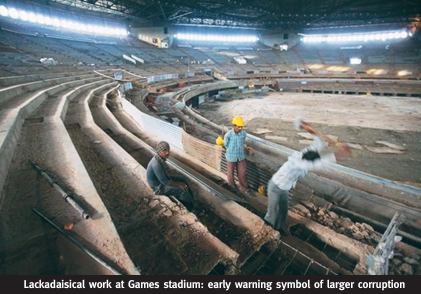
What the Games meant for the international media and the athletes was aptly put by Agence France-Press (AFP): “From ‘toxic’ pools to empty stadiums to faulty boxing scales, the first week of the Delhi Games has served up daily blunders that have deepened India’s embarrassment. The event is the most expensive in the history of the competition, but could set records for another reason: being the most accident and gaffe-prone.”
What the Games mean for India’s vast multitude has been best described by Arundhati Roy in Outlook: “What must they think, these people, about a government that sees fit to spend nine billion dollars (over Rs 35,000 crore) of public money (2,000 per cent more than the initial estimate) for a two-week sports extravaganza which, for fear of terrorism, malaria, dengue and New Delhi’s new super-bug, many international athletes have refused to attend?…….What must they think of the fact that most of those billions have been stolen and salted away by politicians and Games officials….”
The Global Financial Integrity Report authentically talks of a whopping $125 billion (Rs 575,000 crore) of this “stolen money” having been siphoned off from India by “corrupt politicians and officials” between 2000 and 2008. The Report goes on to say: “As money flows, however, the poor continue to stay poor…. Both corrupt political and corporate officers manage to siphon off funds – intended to aid the people – off to political and private sector elite. Recent efforts in India to challenge this corrupt affront on humanity have been met with severe violence.”
Corruption ranges from the level of the pettiest political party functionary working in tandem with the minions of government to the highest in the land, be it politics, bureaucracy, police or business. Volumes can be written about this rottenness of governance, ransacking of the state exchequer, ravaging of public funds and horrendous standard of public morality that has engulfed India. All this raises the question: Is India a kleptocracy?
Kleptocracy is a Greek-derived term applied to a ruling establishment that takes advantage of governmental corruption to extend the personal wealth and political power of government officials and the ruling class (collectively, kleptocrats) via embezzlement of state funds at the expense of the wider populace, sometimes without even the pretence of honest service. The term means “rule by thieves”. It is a pejorative term for governments perceived to have a particularly severe and systemic problem of misappropriation of public funds by those in power.
Judging by the shady goings-on in the corridors of power and the massive scandals involving 2G Spectrum, the Commonwealth Games, the Vedanta Group and the Civil Aviation Ministry, India does seem to have turned into a kleptocracy.
Judging by the shady goings-on in the corridors of power and the massive scandals involving 2G Spectrum, the Commonwealth Games, the Vedanta Group and the Civil Aviation Ministry, India does seem to have turned into a kleptocracy. Even GenNext is aware of this, as this blogger indicates: “Sadly, scams and frauds have become a part of everyday life. There’s the Commonwealth Games mess, judges in Andhra Pradesh were recently caught cheating during an exam, doctors are being accused of conducting unnecessary surgeries to earn some extra moolah, seven out of 10 businessmen in general are alleged to be involved in some fraud, there are scams in the abode of Lord Venkateshwara in Tirupati and let’s not even go into the political scams. From Madhu Koda to Telecom Minister A Raja, the Galli brothers in Karnataka and many more political biggies, nobody seems to be above board or on the right side of the law.”
The holders of political power, for the benefit of themselves and their cohorts, commandeer the resources of the state i.e. the resources produced by “we the people”, to a shocking extent.
This is kleptocracy in its rawest form that has a distinct modus operandi. The holders of political power, for the benefit of themselves and their cohorts, commandeer the resources of the state i.e. the resources produced by “we the people”, to a shocking extent. This is evidenced from the way a charade called “reforms” is being pursued by the government elite, throwing open everything – infrastructure, land, forest, beaches, farming, banks, insurance, mines, education, retail trade – for private/foreign ownership. The result is the loot described in the Global Financial Integrity Report.
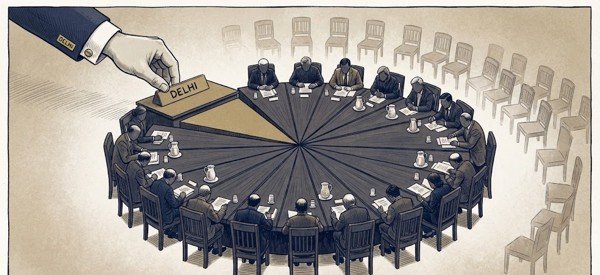
While democracy subsists on its vibrant institutions, kleptocracy thrives on their destruction and replacement by individual or dynastic hegemony. This is what is precisely happening in India. Constitution is the charter of India’s governance. It is a comprehensively written document that has established some of the finest institutions of democratic governance in the world. But six decades down the line each of these institutions has become moth eaten and is fast losing its capacity to govern.
The attention of the President of India is constantly drawn to the collapse of our Constitutional institutions. But the impression the nation gets is that the President does not have any role in stemming the rot.
The attention of the President of India, who is the custodian of the Constitution, is constantly drawn to the collapse of our Constitutional institutions. But the impression the nation gets is that the President does not have any role in stemming the rot.
Of late, the Prime Minister’s Office is facing the stigma of corruption and incompetence with the Prime Minister being forced to defend corrupt and criminal elements in the Union Cabinet. Running a cloistered and in-breeding establishment, the Prime Minister recently went to the extent of defending the indefensible in the selection and appointment of the CVC.
The institution of Parliament is the ultimate voice of the people of India, 70 per cent of whom live on Rs 20 a day. But this “temple of democracy” has become a “millionaires’ club”. Whose voice and will do they represent? What role have they played in protecting democracy and its institutions? At the best of times, not more than 10 per cent of the members attend its sessions. And, thanks to slogan-shouting and perpetual adjournments, Parliament has virtually become non-performing.
The higher judiciary is in ferment with a former Law Minister openly accusing former Chief Justices of India of corruption and the land-grab charges against the former Karnataka Chief Justice and a would-be Supreme Court judge facing an impeachment inquiry.
The Election Commission is in an unenviable situation with its hands bound. None of its recommendations to facilitate “free and fair elections” and ridding the system of criminal and corrupt elements is moving the lawmakers. As if to rub this in, a civil servant indicted by the Shah Commission on Emergency excesses was appointed Election Commissioner and, worse, elevated to Chief Election Commissioner despite severe strictures passed against him by his predecessor in the post. The appointment of the new Chief Vigilance Commissioner also smacks of arbitrariness.
With these institutions withering away it is little wonder that individuals and dynasties are holding sway and kleptocracy is getting entrenched in the country’s governance.
In such a system, merit and integrity are the first casualties and competent, honest civil servants are kept at arm’s length. Instead, an in-breeding, inward-looking bureaucracy takes over, dancing to the tunes of the klepto-lords and pursuing their agenda without demur. A select few are rewarded with coveted postings during service and plush post-retirement sinecures. Others are made “Independent Directors” in multinational and blue-chip companies with lucrative “sitting fees” running into lakhs of rupees. The only requirement is that the civil servant should be willing to sell his soul.
As for the Commonwealth Games scam, the Prime Minister has appointed a panel to look into the “organizing and conduct of the Games” and submit its report within three months. But preliminary investigations by the CBI and other agencies have already gathered credible evidence of massive loot and corruption.
Why cannot an FIR be registered straightaway, the main culprits arrested and subjected to custodial interrogation so that the truth emerges as it is? A small-time criminal is subjected to such treatment, so why not the mega-criminals? Is it because India is not a functioning democracy, but a dysfunctional kleptocracy? The people need an answer.

IAS (retd) with a distinguished career of 40 years - worked in Army, Govt, Private, Politics & NGOs.