



























India funds large-scale welfare programmes — yet benefits rarely reach the people they’re meant for.
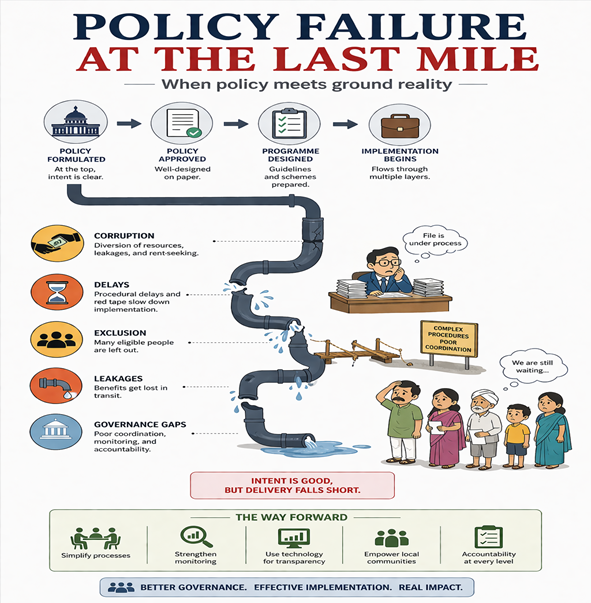
India funds large-scale welfare programmes, but audit reports consistently show that benefits do not reach the people they are designed for. A review of MGNREGA, PMAY, Ayushman Bharat, PMKVY, and the long-deferred Women’s Reservation reveals a recurring pattern: flawed data at the source, funds that stall mid-route, and an accountability chain that stops well before the last mile.
The Core Problem
Design Isn’t the Problem — Delivery is
India’s welfare schemes around 70-75% have reached its failure point. Scheme architecture, legislative backing, budget allocation and delivery are generally in place. Where the system breaks down — repeatedly, across governments of different parties, across decades — is in the final stretch of delivery: from the district office to the individual citizen.
₹one Sent. Paise 15 Received. For 40 Years.
In 1985, Prime Minister Rajiv Gandhi publicly acknowledged that of every rupee sent toward poor welfare, only 15 paise reached the intended beneficiary. The remaining 85 paise disappeared into a layered system with no effective mechanism for accountability. Four decades later, the Comptroller and Auditor General (CAG) — a constitutional body whose reports are tabled in Parliament — continues to document equivalent failures. The names of the schemes change. The structural gaps do not.
What the Auditors Found
What follows is drawn entirely from CAG performance audits, government dashboards, and Parliamentary committee records. The data covers five of India’s largest welfare programmes, each of which reveals a different dimension of the same underlying problem.
The JAM Trinity: A Digital Shortcut Around the Middleman
The JAM Trinity — Jan Dhan bank accounts, according to the 2025 assessment by Bluekraft Digital Foundation, around 56 crore Jan Dhan accounts were recorded Aadhaar-linked identity, and mobile connectivity — was designed to cut out the intermediary layer that absorbed most welfare spending. On the metrics that are directly traceable, it has worked. Between 2014 and 2024, the Direct Benefit Transfer (DBT) system generated cumulative savings of ₹3.48 lakh crore. Subsidy allocations dropped from 16% to 9% of total government expenditure. Beneficiary coverage grew sixteen-fold, from 11 crore to 176 crore individuals. (The figure is cumulative beneficiaries across all DBT schemes, not unique individuals — one person can be counted in multiple schemes like PM-KISAN, LPG subsidy, MGNREGS, etc.)
The Pipe Works. But What Goes Into It?
Under PM-KISAN, identifying and removing 2.1 crore ineligible beneficiaries were removed out of total of approximately 11.5 crore to 12 crore . The saving of ₹22,106 crore in the PMKISAN scheme and 1.85 crore in food subsidies(PDS) were achieved between 2014 and 2024 by plugging leakages through the public distribution system and Aadhaar-linked authentication. These outcomes confirm that direct, verifiable fund transfers reduce the leakage created by intermediaries but the DBT ( Direct Benefit Transfer) system is only as reliable as the data feeding into it.
Digitisation Without Accuracy Is Just Efficient Fraud
When beneficiary records contain fabricated bank accounts, ghost identities, or duplicate enrolments, the digital infrastructure does not catch the error — it processes it efficiently. The CAG simultaneously finds, within DBT-linked schemes, hospitals billing for deceased patients, trainers certifying unqualified candidates, and over 34 lakh PMKVY beneficiaries who received no payment despite being registered the pipe works. The problem is what goes into it.
| Metric | Figure | Source |
| DBT cumulative savings (2014–24) | ₹3.48 lakh crore | BlueKraft / MoF |
| Beneficiary coverage growth | 11 Cr to 176 Cr (16x) | DBT Mission, GoI |
| PM-KISAN: ineligible beneficiaries removed | 2.1 crore (saving ₹22,106 Cr) | DBT Portal, GoI |
| PDS savings via Aadhaar authentication | ₹1.85 lakh crore | DBT Mission, GoI |
| GST irregularities flagged | ₹21,695 crore | CAG, December 2025 |
MGNREGA(Mahatma Gandhi National Rural Employment Guarantee Act.) — The Right to Work That Rarely Pays on Time
Enacted in September 2005, active from February 2006. Ministry of Rural Development. Promised benefit: 100 days of guaranteed wage employment per rural household, at ₹193–318 per day.
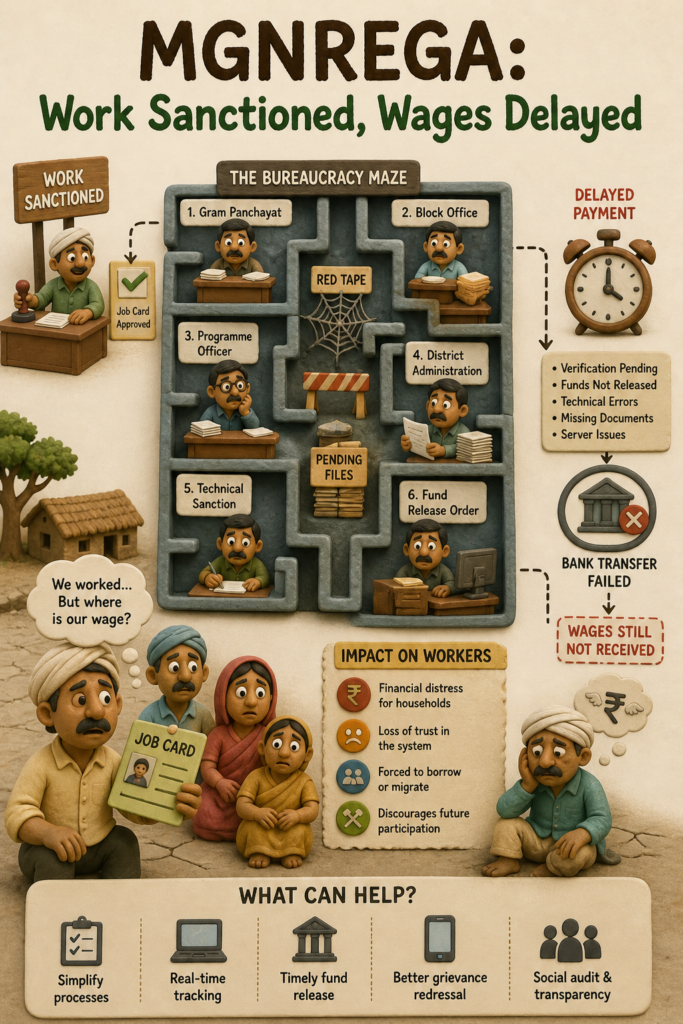
100 Days Promised. 7% Delivered.
MGNREGA is, on paper, one of the most powerful anti-poverty tools India has built: a legal guarantee of work, available on demand, with wages linked to the agricultural labour rate. In practice, the scheme functions as a partial guarantee at best. In FY 2024–25, only 7% of completed the 100 days the law guarantees them. Person days of employment actually fell by 7.1% even as registrations rose by 8.6% — meaning more people were entering the system and fewer were getting work out of it.
States That Broke the Law — And Faced No Consequences
A Parliamentary Standing Committee found in 2022 that Bihar, Karnataka, and Rajasthan had paid zero unemployment allowances since 2018. This is not an administrative grey area. Unemployment allowance is a statutory entitlement under the Act — owed automatically when work is not provided within 15 days of demand. Three states went five years without paying it. No consequence followed.
Workers Who Waited 90 Days for Wages They Had Earned
In FY 2024–25, ₹974 crore in wages remained unpaid at year end. The CAG’s Odisha audit (April 2025), covering 2019–24, found wages of ₹154.31 crore delayed by 1.44 crore man-days. Workers reported waiting 60–90 days after completing work to receive payment. The compensation legally owed to Odisha workers ₹1.02 crore was rejected by the government citing natural calamities, the very conditions that had driven those workers to seek employment.
Funded for Failure: A Budget Gap That Is a Policy Choice
The budget gap is structural. MGNREGA receives approximately 0.2% of GDP, against a demonstrated demand requiring 0.8–1% of GDP (IJLE research). The gap is not unknown to planners. It is a choice. the budget allocation for this scheme according to resources 2026-27 is 30,000 crore.
| Employment Level | Share of Households | Source |
| Completed full 100 days | 7% | LibTech India / MIS |
| Partial employment (30–99 days) | 36% | LibTech India / MIS |
| Fewer than 30 days or nothing | 57% | LibTech India / MIS |
MGNREGA Employment Outcomes — FY 2024–25 (households that demanded work)
The Pipe Works. But What Goes into It?
Under PM-KISAN, identifying and removing 2.1 crore ineligible beneficiaries were removed out of total of approximately 11.5 crore to 12 crore. The saving of ₹22,106 crore in the PMKISAN scheme and 1.85 crore in food subsidies (PDS) were achieved between 2014 and 2024 by plugging leakages through the public distribution system and Aadhaar-linked authentication. These outcomes confirm that direct, verifiable fund transfers reduce the leakage created by intermediaries, but the DBT (Direct Benefit Transfer) system is only as reliable as the data feeding into it.
Digitisation Without Accuracy Is Just Efficient Fraud
When beneficiary records contain fabricated bank accounts, ghost identities, or duplicate enrolments, the digital infrastructure does not catch the error — it processes it efficiently. The CAG simultaneously finds, within DBT-linked schemes, hospitals billing for deceased patients, trainers certifying unqualified candidates, and over 34 lakh PMKVY beneficiaries who received no payment despite being registered the pipe works. The problem is what goes into it.
| Metric | Figure | Source |
| DBT cumulative savings (2014–24) | ₹3.48 lakh crore | BlueKraft / MoF |
| Beneficiary coverage growth | 11 Cr to 176 Cr (16x) | DBT Mission, GoI |
| PM-KISAN: ineligible beneficiaries removed | 2.1 crore (saving ₹22,106 Cr) | DBT Portal, GoI |
| PDS savings via Aadhaar authentication | ₹1.85 lakh crore | DBT Mission, GoI |
| GST irregularities flagged | ₹21,695 crore | CAG, December 2025 |
Key DBT and Scheme Data — 2014 to 2025
PM Awas Yojana — Housing for All, Delivered to Some
Launched in PMAY-G April 2016; PMAY-U June 2015. Original deadline: March 2022. Extended to December 2024; new phase to 2029. Revised cumulative target: 4.95 crore houses. Completed as of March 2025: 2.72 crore houses. Gap: approximately 2.23 crore houses.
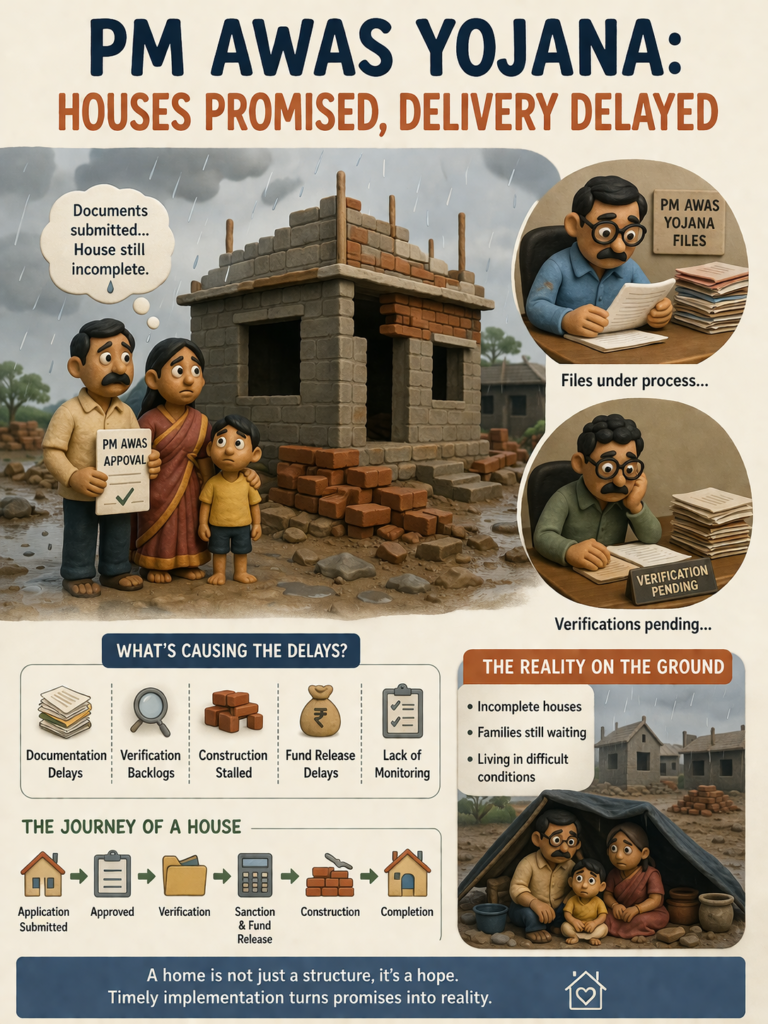
“Housing for All” — A Deadline That Came and Went
The scheme was announced as “Housing for All” by India’s 75th Independence year — March 2022. That deadline passed with 2.23 crore homes unbuilt. The deadline was extended. The new phase runs to 2029. The houses remain a target.
Walls Up, Roofs Missing, Families Waiting
In 2020, many states with held their matching share contributions totalling ₹2,915 crore, leaving hundreds of thousands of houses mid-construction — walls up, roofs absent, families waiting. The CAG’s Uttar Pradesh audit (December 2025), covering 2016–23, found that ₹40,231 crore was spent on PMAY-G across the state, yet 79% of beneficiaries received their first instalment after the prescribed 7-day timeline.
Under Pradhan Mantri Awas Yojana (PMAY), the original national goal was 2 crore houses by 2022 under the “Housing for All” mission. For urban areas under PMAY-Urban, the government has sanctioned about 1.22 crore houses, construction has started on around 1.14 crore, and nearly 96.65 lakh houses have been completed, with over 94 lakh already occupied.
For rural areas under PMAY-Gramin, as of late 2025, out of a target allocation of 4.14 crore houses, around 3.86 crore houses were sanctioned and approximately 2.92 crore houses completed. The government has further expanded the rural target to 4.95 crore houses by 2029, showing that initial estimates did not fully capture actual housing demand.
India began with a target of two crore beneficiaries, but over time the programme expanded to cover more than 5 crore households across rural and urban India combined, making PMAY one of the largest public housing programmes globally. The main policy lesson is that beneficiary demand was much larger than the government’s first estimate, which contributed to implementation pressure and last-mile challenges.
Money Frozen, Funds Diverted, Families Excluded
₹20.18 crore sat frozen for 11,031 individual beneficiaries as of August 2024 — not because they were ineligible, but because the disbursement process had stalled. Separately, ₹86.20 lakh meant for 159 beneficiaries was diverted to unauthorised accounts through cyber fraud.
A Pattern Repeated Across States
In Madhya Pradesh, untimely fund releases left houses in prolonged mid-construction states. In Tamil Nadu, 3.35 lakh of 4.19 lakh beneficiaries experienced payment delays (CAG). In UP, the Rural Development Department acknowledged in October 2023 that eligible beneficiaries had been wrongly excluded from the permanent waitlist — a data error the CAG described as arising from systemic flaws, not isolated mistakes.
Ayushman Bharat / PMJAY — Ghost Patients and Fraudulent Claims
Launched on September 2018. Coverage: ₹5 lakh per family per year for secondary and tertiary hospitalisation. Cards issued: 24.33 crore (August 2023).
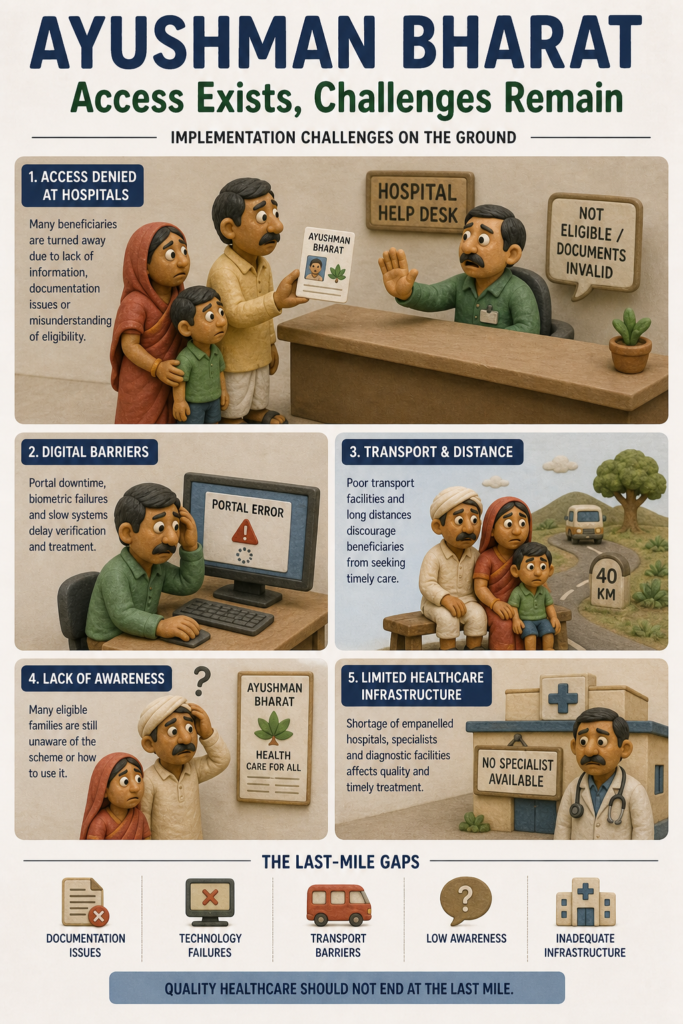
The World’s Largest Health Scheme — Haunted by Ghost Patients
Ayushman Bharat is the world’s largest government-funded health insurance scheme by intended beneficiary count. The CAG’s 2023 performance audit, tabled in Parliament, found that the scheme’s data infrastructure was compromised to a degree that calls its core claims into question.
Registered Under Phone No 9999999999: When Ghost Data Goes Digital
Over 7.49 lakh beneficiaries were registered against a single mobile number: 9999999999. Other dummy numbers used in the system included 8888888888, 9000000000, and the number 20. Of 88,760 patients who died during treatment, 2,14,923 subsequent claims were processed for fresh treatment under those same identities. Of these, 3,903 claims worth ₹6.97 crore were actually paid — to hospitals, for patients who were dead.
Impossible Surgeries: Operated on After Being Discharged
In 2.25 lakh cases, the recorded surgery date was later than the recorded discharge date. In Maharashtra alone, 1.79 lakh such cases were identified, with claimed amounts exceeding ₹300 crore. Excess payments of ₹57.53 crore went to hospitals across Andhra Pradesh, Madhya Pradesh, Punjab, and Tamil Nadu.
Cashless on Paper, Out-of-Pocket in Reality
The scheme was designed as cashless, but on the ground it frequently was not. In Himachal Pradesh, 50 beneficiaries were forced to fund their own diagnostic tests. In Jammu and Kashmir, 459 patients paid ₹43.27 lakh out-of-pocket, with reimbursement still pending for 75 of them. A 2019 government report identified 341 hospitals across 16 states involved in fraud. By 2022, a Times of India report indicated that 26% of PMJAY claims from Punjab and Haryana were fraudulent.
| Irregularity | Scale | Source |
| Claims paid for deceased patients | 3,903 claims (₹6.97 Cr) | CAG 2023 |
| Surgery-after-discharge cases | 2.25 lakh cases | CAG 2023 |
| Beneficiaries on ghost mobile numbers | 7.49 lakh | CAG 2023 |
| Excess payments (4 states) | ₹57.53 crore | CAG 2023 |
Ayushman Bharat — Key Audit Findings (CAG Performance Audit, August 2023)
PMKVY — ₹10,000 Crore Spent, 94% of Records Invalid
Launched on 2015 (Phase 1); Phases 2, 3, 4 through 2022 onwards. Ministry of Skill Development and Entrepreneurship. Budget released: ₹10,000+ crore across audited phases.
₹10,000 Crore Spent. 94.53% of Records: Invalid.
CAG Report No. 20 of 2025 on PMKVY is among the most detailed accounts of data failure in any Central scheme. Of 95.90 lakh beneficiaries examined, 90.66 lakh — 94.53% — had no valid bank account on record. Most of the provided email addresses bounced as undeliverable. Only 5.47% of beneficiary records were assessed as valid and complete.
Bank Account: 111111111. Phone: 9999999999. Name: Anyone.
In Phases 2 and 3 (2019–22), over one crore candidates shared the same email address or phone number. Bank account numbers were entered as “111111111” or “123456” — strings that any basic validation rule would reject. Duplicate photographs appeared against different beneficiary names across multiple states. Over 52,000 candidates were certified for roles that required a minimum age they had not reached.
Certified Without Qualifications — 8 Lakh Cases
4,361 candidates were certified without required technical qualifications. 8.09 lakh received certificates without meeting minimum schooling criteria. Trainer records for 61 lakh entries were flagged as incomplete. These are not edge-case anomalies. They represent most of the scheme’s recorded activity.
34 Lakh Registered. Trained. And Never Paid.
The outcome for actual beneficiaries: 34 lakh registered candidates received no payment at all. The Sharada Prasad Committee had flagged in 2017 that ₹2,500 crore had been spent without demonstrably serving skill needs or leading to decent wages. The CAG’s 2025 audit shows that the same failure continued across three more phases.
| Data Issue | Scale | Source |
| No valid bank account on record | 94.53% (90.66L of 95.90L) | CAG No. 20 / 2025 |
| Below minimum education criteria | 13.33% | CAG No. 20 / 2025 |
| Undeliverable email IDs | 36.51% | CAG No. 20 / 2025 |
| Received no payment at all | 34 lakh beneficiaries | CAG No. 20 / 2025 |
| Incomplete trainer records | 61 lakh entries | CAG No. 20 / 2025 |
PMKVY Beneficiary Data Quality — CAG Report No. 20 of 2025
Women’s Reservation: 27 Years of Deferred Implementation

Introduced in 1996. Still Waiting.
Of the legislative promises that have not reached citizens, the Women’s Reservation Bill has the longest paper trail. First introduced in Parliament in 1996, the bill lapsed repeatedly over two decades — not because it lacked support in principle, but because procedural manoeuvres, political disagreements over sub-quotas, and chaotic parliamentary sessions repeatedly prevented a vote.
Passed Unanimously, Implemented Never.
It was finally passed as the Nari Shakti Vandan Adhiniyam (106th Constitutional Amendment) in September 2023, with near-unanimous support: 454–2 in Lok Sabha, 214–0 in Rajya Sabha. The Act, however, tied implementation to a post-Census delimitation exercise. The Census, due in 2021, had not been completed. The elections returned 74 women — 13.6% of 543 seats — against a promised 33%.
The 131st Amendment: A New Roadblock in 2026
On April 16, 2026, the government introduced the Constitution (131st Amendment) Bill, 2026, linking women’s reservation to an expansion of the Lok Sabha to 850 seats, based on 2011 Census data. Opposition parties argued that using 2011 data — 15 years old — was both arbitrary and politically motivated, and that southern states would lose representation under the expansion formula. The 131st Amendment Bill was defeated in Lok Sabha.
A Constitutional Right with No Confirmed Implementation Date
A constitutional right unanimously voted for in 2023 now has no confirmed implementation pathway before 2029 at the earliest, and that timeline depends on a delimitation process whose constitutional validity is being contested. The bill was passed. The seats were not reserved. (Sources: PRS India, April 16, 2026; The Federal, April 2026.)
| Indicator | Figure | Source |
| Women elected in 2024 Lok Sabha | 74 seats (13.6%) | Election Commission 2024 |
| Promised under 106th Amendment | 33% (approx. 180 seats) | 106th Constitutional Amendment, 2023 |
| Gap to promised level | Approximately 107 seats short | Calculated |
| Earliest possible implementation | 2029 (contingent on delimitation) | PRS India / The Federal, April 2026 |
Structural Causes of Last-Mile Failure
Seven Reasons the System Fails — Every Time
The failures documented across these schemes share a common structure. Seven recurring causes appear across every CAG audit, every Parliamentary committee report, and every field survey.
1. The Toll Booths Between Policy and People
Each administrative layer between fund release and beneficiary creates an opportunity for diversion or delay. The persistent gap between national allocations and beneficiary receipts reflects the cumulative cost of these layers operating without audit exposure.
2. Garbage In, Rupees Out: The Data Problem
Ghost beneficiaries, dummy phone numbers, duplicate photographs, and fabricated bank details indicate that enrolment data is not verified at entry and not audited between enrolment and payment. The error does not surface until a CAG team arrives — often years later.
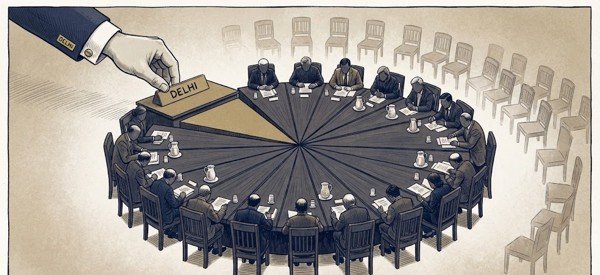
3. Delhi Designs, Districts Deliver — Nobody Is Accountable
Scheme design and funding originate centrally; delivery is the responsibility of states, districts, and panchayats. Where states delay their matching contributions or where district-level administrative capacity is limited, national targets become unachievable without consequence to any identifiable official.
4. Funded for Failure: The Gap That Never Closes
MGNREGA is funded at approximately 0.2% of GDP against a documented need of 0.8–1%. Underfunding forces rationing that never appears in scheme reports but shows up clearly in field data — 57% of MGNREGA households getting fewer than 30 days of work despite legally registering for 100.
5. Fraud on Paper, Freedom in Practice
Implementing agencies that certify fictitious beneficiaries, approve claims for deceased patients, or verify construction that has not occurred face CAG criticism in tabled reports. Criminal prosecution is rare to non-existent.
6. Rewarded for Announcing, Not Delivering
At every level of the delivery chain, rewards are attached to the wrong outcome. Politicians benefit from announcing schemes, not from delivering verified results. Senior bureaucrats are assessed on policy design and fund utilisation, not on whether beneficiaries received what was promised. Contractors are paid on paper completion. None of these incentives is tied to actual last-mile delivery.
7. The Last Filter: Caste, Gender, and Local Connections
Informal filters — caste, gender, local political allegiance, lack of documentation — determine who can practically access scheme benefits regardless of official eligibility. These barriers do not appear in enrollment data and are rarely captured in audits.
Solutions: A Structured Framework
These failures are not intractable. Each of the following interventions works within existing institutional capacity and has documented precedent.
1. Hyperlocal Governance Monitoring System
Indian bureaucrats should establish a real-time monitoring mechanism at district and block levels to track scheme implementation through geo-tagged photographs, beneficiary verification, grievance redressal, and fund utilization dashboards. This would reduce leakages, outdated beneficiary lists, and poor coordination between administrative levels
. The system can be piloted in 50 districts over 6 months and scaled nationally within 24 months. The estimated budget is ₹1,290 crore, covering software development, tablets for gram panchayats, staff training, and annual maintenance, ultimately improving transparency and service delivery efficiency.
2. Performance-Linked Accountability Framework
Administrative officers should introduce a performance-based evaluation framework for District Collectors, BDOs, and frontline workers based on grievance disposal, attendance, inspections, and citizen satisfaction. Designed with support from NITI Aayog and state governments, the framework can be piloted in 10 states within 9 months and integrated into promotions and incentives within 18 months. With an estimated initial cost of ₹850 crore, this reform would improve motivation, reduce absenteeism, and strengthen accountability.
3. Community Participation and Social Audit 2.0
Strengthening quarterly Gram Sabha reviews, public expenditure boards, beneficiary verification drives, and independent audits can improve citizen participation and transparency. Expanding models used under Mahatma Gandhi National Rural Employment Guarantee Act over 2 years would cost approximately ₹1,150 crore annually, helping reduce corruption and align schemes with local needs.
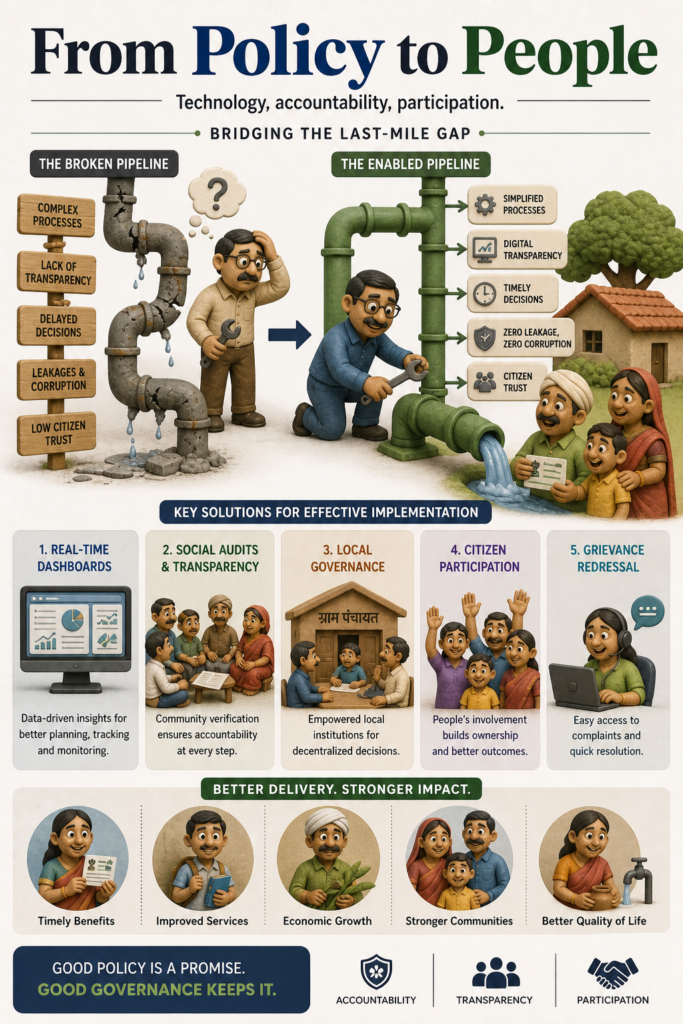
Conclusion
The System Is Working — Just Not for the Poor
The audit record is consistent across governments, across schemes, and across decades. MGNREGA has ₹974 crore in unpaid wages and 57% of households getting less than 30 days of work. PMKVY has ₹10,000 crore spent and 94% of beneficiary records invalid. PMAY has 2.23 crore homes unbuilt past a missed deadline. Ayushman Bharat has paid hospitals for 3,903 dead patients. These are not isolated failures in otherwise functioning systems. They are the system functioning as it is currently structured.
Digitisation Without Accountability Is Just Efficient Failure
The data from DBT confirms that structural intervention works — leakage can be reduced, coverage can be expanded, and savings can be verified. But digitisation does not self-correct; it requires accurate source data and accountable human processes behind it. Until accountability is attached to what actually happens at the last mile, the pipe will be built and the water will not flow.
Data Sources
- CAG Performance Audit Report No. 20 of 2025 — PMKVY (Phases 2015–2022), tabled December 2025. cag.gov.in
- CAG Performance Audit — Ayushman Bharat / PMJAY, tabled August 2023. cag.gov.in
- CAG Audit Report — MGNREGA, Odisha (2019–24), released April 2025. cag.gov.in
- CAG Audit Report — PMAY-G, Uttar Pradesh (2016–17 to 2022–23), released December 2025. cag.gov.in
- PIB Press Release — PMAY-G progress, March 17, 2025. pib.gov.in
- DBT Mission, Government of India — beneficiary and savings data. dbtbharat.gov.in
- LibTech India — MGNREGA MIS analysis, FY 2024–25, published May 2025.
- PRS India — 131st Amendment Bill update, April 16, 2026. prsindia.org
- Election Commission of India — 2024 Lok Sabha results.
- Constitution (106th Amendment) Act, 2023 — Nari Shakti Vandan Adhiniyam.
- Parliamentary Standing Committee — MGNREGA wage compensation data, February 2024.
- BlueKraft Digital Foundation report — DBT savings, endorsed by Ministry of Finance.

Lakshyaa Gehlot
Lakshya Gehlotis a Student, B.A. Liberal Arts, Shoolini University, Aspire to be a public policy analyst who have a keen interest in government policy implementation and impacts on society.