
























“Governance and leadership are the yin and the yang of successful organizations. If you have leadership without governance you risk tyranny, fraud and personal fiefdoms. If you have governance without leadership you risk atrophy, bureaucracy and indifference.” – Mark Goyder
India appears to be a heady concoction of both “governance without leadership” and “leadership without governance”. The result is there for all to see – tyranny in dealing with the poor; widespread fraud in every sphere; mushrooming political and personal fiefdoms; atrophying civil, police, judicial and military services; and gross indifference to democratic norms and public opinion.
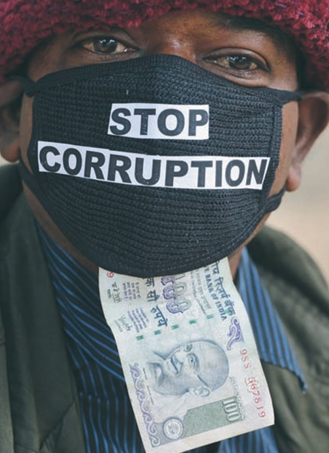
The root cause is the all-pervading corruption that has become the number one national security threat by eating into the vitals of the state, enfeebling internal security and crimping foreign policy. Corruption has stalled equitable development, undermined social progress, undercut the confidence of citizens in the fairness and impartiality of public administration, impeded good governance, eroded the rule of law, distorted competitive conditions in business transactions and fostered a black market economy. India could well be called a “scandal superpower” rather than the much-touted “economic superpower”.
Launching his massive movement against corruption in the mid-1970s, Jayaprakash Narayan had said: “As I diagnose the root cause of the country’s critical state of health, I identify it unhesitatingly as corruption and precipitous fall in the moral standards of our politics and public life.” In response, Prime Minister Indira Gandhi proclaimed that “corruption is universal” and crushed JP’s movement by imposing Emergency – destroying democratic governance to protect the corrupt.
In the event, sleaze has boomed and India is today among the most corrupt countries in the world. The irony is that this is the land where honesty and integrity in public and private life have been glorified and upheld in ancient epics such as the Vedas, Upanishads and in the scriptures and beliefs of every religion practised here!
The scenario, as it is unfolding, is frightening. Nevertheless, as the saying goes, it is better to light a candle than curse the darkness. Given the immensity of the problem, igniting a forest fire could well be an option. Since that is neither democratic nor a lasting solution, government and institutional integrity is the right place to start.
Where is the government and who forms it? If the Radia tapes are to be believed, the Centre is formed not by the Prime Minister or the representatives elected by the people but a motley crowd of fixers and freeloaders. Bureaucrat-turned-politician NK Singh aptly describes this government as a “Shivji ki baraat” (a reference to a kind of Noah’s Ark with many creatures, from scorpions and serpents to elephants and tame deer). Remember MS Gill’s description of the Commonwealth Games as “Kalmadi ki baraat”! Where do you find “integrity” in such muck?
What about institutions? Starting from the Emergency days, all institutions of governance have been systematically decimated and made impotent. The methodology adopted is to fill key institutions with pliable bureaucrats or “agenda-men” of questionable reputation. Three prestigious institutions – the Central Vigilance Commission, Prasar Bharati and the National Human Rights Commission – are in a state of turmoil. The Constitutional institution of the Election Commission went through a similar phase a couple of years ago.
The IAS and IPS are no longer coveted by the youth. A civil servant who took voluntary retirement laments: “I was a very proud youngster when I got into the IAS in1962. And when I voluntarily retired in 1995 most of that pride had vanished. Today, even that little pride has been replaced by an unspeakable shame.” Nothing more need be said about the crème de la crème of the civil services and even less so of the IPS. The integrity of the armed forces, the sword-arm of India, is also severely enfeebled by repeated scams and scandals surfacing at regular intervals.
The judiciary is a towering institution and its highest tier – the Supreme Court – is at present probing mega scams with the likelihood of many more in the offing. Yet this institution itself is in the throes of a crisis caused by the impeachment of judges, the “uncle judge” castigation by the apex court and the stinging affidavit by former Law Minister Shanti Bhushan alleging corruption among erstwhile Chief Justices of India, backed by his advocate son, Prashant Bhushan, with evidence. Despite all this, the higher judiciary has no rules to regulate the selection, appointment and conduct of judges and there is lack of transparency and accountability. The fallout is the unseemly public spat between a former Chief Justice of India and a sitting Supreme Court judge.
Be that as it may, if some candles are to be lighted, let us start from the basics: “leadership with governance” and “governance with leadership”. There is an ancient proverb: “A fish rots from the head down.” When the head is putrid, the body politic cannot be healthy. When those at the helm remain wedded to corruption, the rest of the body politic stinks. The Prime Minister is the head of the government and the person to provide leadership. The present incumbent has failed in this. His being personally honest is irrelevant. The fact is that he presides over a government that has the dubious distinction of being publicly named as the most corrupt and rudderless in post-Independence India.
In the past six years, Prime Minister Manmohan Singh has not lifted a finger to build or strengthen any institution of good governance that could combat corruption and decay in administration. In fact, in recent times he has weakened them and compromised their integrity. He has also severely debilitated the senior bureaucracy by patronising and promoting a cloistered, clannish and inbreeding system, which is largely responsible for the rot the country is in.
BOX
Lighting a candle to dispel the darkness
Where do we light the candle? To start with, the PMO, Cabinet Secretariat and upper echelons of the civil services should be revamped. Sycophants, time-servers and agenda-men should be replaced by mandarins with merit and scruples. Even with such rot in the system, such men and women are not difficult to find. The Union Cabinet should be reconstituted with at least some merit being counted as qualification. In this hour of crisis, a national government comprising men and women of merit, honesty and integrity, transcending political barriers, can be considered.
Opposition stalled Parliament for a month, but achieved nothing. If it is sincere about combatting corruption, it should insist that Parliament be re-convened immediately to transact the following business:
(a) Passing the Anti-Corruption, Grievance Redressal and Whistleblower Protection Bill, 2010. Drafted by Santosh Hegde, former Supreme Court judge and currently Lokayukta of Karnataka, and Prashant Bhushan, Supreme Court lawyer, it was submitted to the Prime Minister on December 1, 2010. It seeks to replace the mutually exclusive anti-corruption agencies with an autonomous Lokpal combining within it the powers and mandate of the CBI and the CVC and with jurisdiction over politicians, bureaucrats and judges. Besides being able to independently initiate investigation and prosecution without prior permission from any other agency, the body will act as an appellate authority in respect of public grievances linked to bribery.
Whistleblowers will also come under the protective purview of the Lokpal instead of the CVC. The 10 members and chairperson of the Lokpal will be selected by a transparent and participatory process and any complaint of wrongdoing against a member will be required by law to be investigated and acted upon within a month through a transparent process.
The Bill aimed at constituting the Lokpal has been pending since 1968. It was revived in 1971, 1977, 1985, 1989, 1996, 1998, 2001, 2005 and 2008 but was never passed by both Houses of Parliament. Its passage would be followed by amended State Lokayukta Acts.
(b) Amending the concerned laws or rules to provide for the inclusion of the Chief Justice of India and another eminent public figure in the Committees to select high-ranking independent or Constitutional authorities. Amendments should also be made to allow publication of the proceedings of the Committees, along with the particulars of persons considered for the panel and the reasons for which the final selection was made.
(c) Legislating the Judicial Standards and Accountability Bill, 2010 to bring about transparency and accountability in the selection and appointment of judges and punishing the corrupt and errant ones without going through the tortuous process of impeachment. Also, scrapping the colonial contempt laws under which the corrupt and deviant judges are at present taking cover.

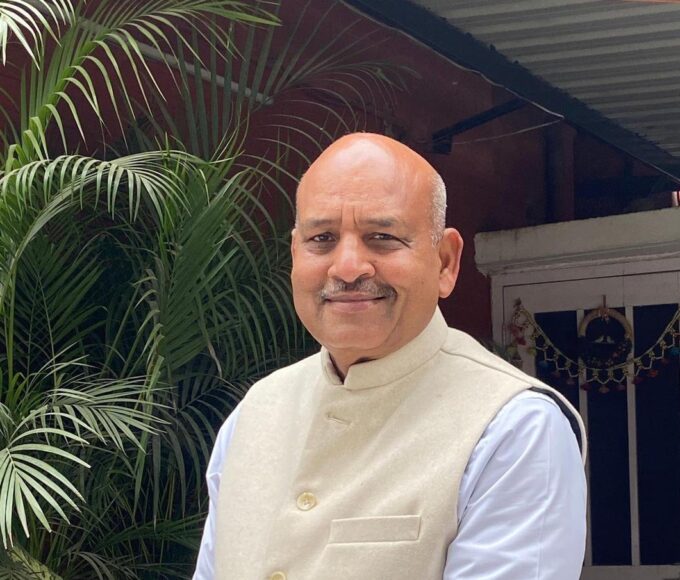
IAS (retd) with a distinguished career of 40 years - worked in Army, Govt, Private, Politics & NGOs.