



























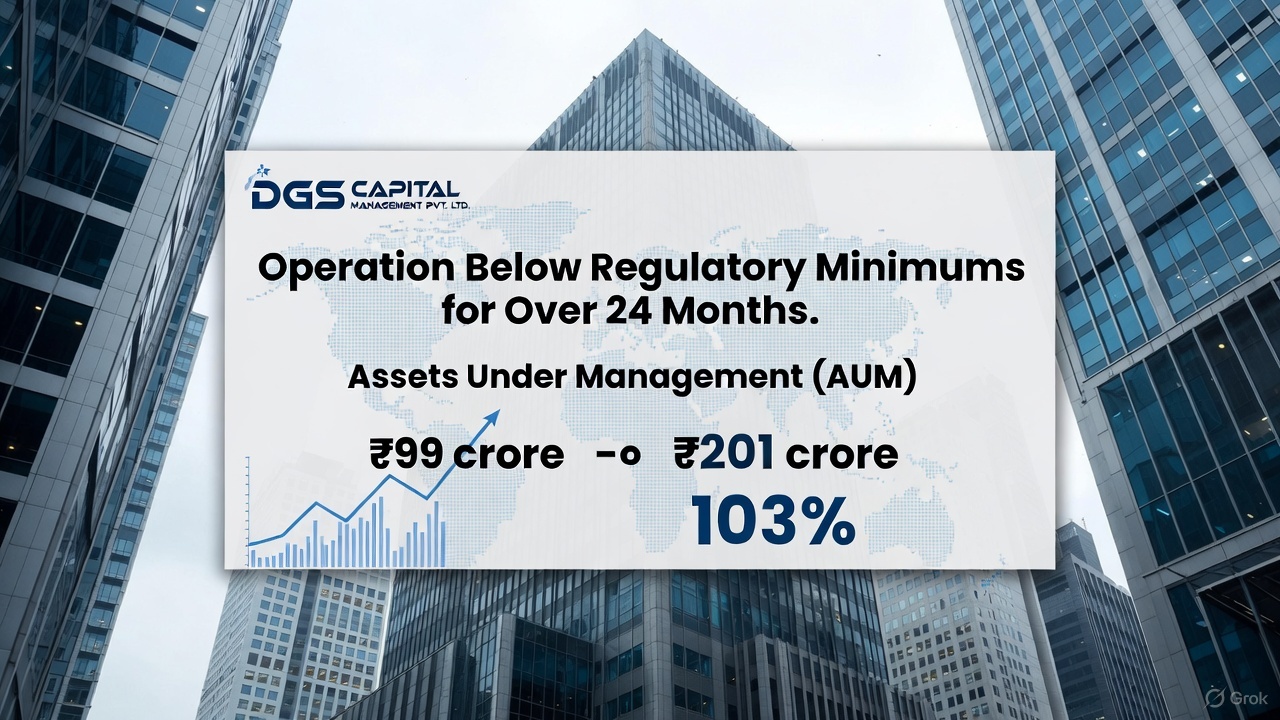
The DGS Capital Management Pvt. Ltd was operating below regulatory minimums for over 24 months, unchecked. Yet its AUM (Assets Under Management) surged from ₹99 crore to ₹201 crore — a dramatic 103% jump. The Judgement of Ananth Narayan G a Whole-Time Member of SEBI is like ‘a huge camel, a tiny cumin seed’ means the punishment appears disproportionately small compared to the scale of violations.
THE HOUSE BUILT ON ₹1.6 CRORE
For two years, a Mumbai-based portfolio manager DGS Capital Management Pvt. Ltd was doubling its assets under management, onboarding affluent investors, and projecting the image of a fast-rising wealth manager in India’s booming markets.Behind the glossy pitch decks and confident quarterly calls, however, SEBI discovered an uncomfortable truth:
DGS Capital Management Pvt. Ltd. was operating at barely 30% of the net worth required to legally manage public money.
DGS Capital Management regulatory filings were missing.
Its Principal Officer lacked the mandatory certification. And its booming business concealed a hollow compliance core. When SEBI finally intervened, the façade cracked open. This is the inside story — a case study of growth without guardrails.
THE RISE — AND THE ROT
DGS Capital wasn’t a fringe player.
It was a registered Portfolio Manager managing close to ₹200 crore — big enough to matter, small enough to avoid mainstream scrutiny.
But growth makes noise.
Which is why SEBI’s examination team began noticing silences:
No net worth certificate for two years.
No compliance report.
No corporate governance report.
In the world of regulated finance, silence is rarely innocent.
THE NET WORTH BLACK HOLE
The real shock came when SEBI analyzed the company’s financials.
Under SEBI’s 2020 regulations, every portfolio manager registered prior to the new law had to raise net worth to ₹5 crore by January 15, 2023.
DGS Capital’s numbers?
FY 2022–23: ₹1.63 crore
FY 2023–24: ₹1.59 crore
The firm was operating below regulatory minimums for over 24 months, unchecked.
Yet during this very period, its AUM (Assets Under Management) surged from ₹99 crore to ₹201 crore — a dramatic 103% jump.
It was the classic red flag: Ascending business, descending compliance.
A perfect recipe for regulatory intervention.
THE CERTIFICATION GAP — A LICENCE TO MANAGE, MISSING
SEBI’s findings didn’t stop at financial weakness.
The investigation revealed that the company’s Principal Officer — the individual responsible for key investment decisions — had failed to obtain the mandatory NISM XXI-B certification by the regulatory deadline.
He remained uncertified from September 2023 to October 2024, effectively making the firm’s fund management operations non-compliant for more than a year.
This is not a minor technicality. Certification ensures the officer understands risk, compliance, ethics, and portfolio strategy.Operating without it is like flying an aircraft without passing aviation school.
THE INTERIM ORDER THAT SHOOK THE FIRM

On February 17, 2025, SEBI issued an “Interim Order-cum-Show Cause Notice” — the regulatory equivalent of a red alert.
Only then did DGS Capital Spring into action: It infused funds to push net worth above ₹5 crore, barely crossing the threshold. It submitted all pending reports within 48 hours. It highlighted that the certification issue had been “resolved months earlier.” The timing spoke louder than the filings. The sudden burst of compliance merely confirmed the earlier lack of it.
WHY SEBI STOPPED SHORT OF A CRACKDOWN
Given the severity of the lapses, SEBI could have recommended:
Suspension of registration
Transfer of clients to another manager
Market access restrictions
Instead, the regulator chose a calibrated approach:
₹1 lakh penalty for failure to submit mandatory reports
₹2 lakh penalty for general non-compliance
Total: ₹3 lakh
Why so measured?
Because: DGS Capital ultimately complied with all the interim directions,
It had no previous SEBI violations, and
The regulator acknowledged its corrective action.
Still, the message was unmistakable.
Growth is not a defence. Compliance is not optional.
THE BIGGER PICTURE — AND THE UNCOMFORTABLE QUESTION
- TIMELINE OF EVENTS
- Jan 2023: SEBI examination period begins.
- Jan 2023–Dec 2024: Company operates below required net worth.
- FY 2022–24: No regulatory filings submitted.
- Sept 2023: PO’s certification deadline missed.
- Oct 2024: PO finally obtains certification.
- Feb 17, 2025: SEBI issues Interim Order + SCN.
- Feb 18–19, 2025: Company rushes to submit all pending reports.
- Feb 25, 2025: Net worth finally raised above ₹5 crore.
- Oct 3, 2025: SEBI passes final order with ₹3 lakh penalty.
This case raises a deeper, systemic issue:
How many fast-growing wealth managers are operating below regulatory radar, missing certifications, or delaying critical filings — even as they attract crores from unsuspecting investors?
DGS Capital may have escaped with a monetary penalty, but the investigation reveals a worrying trend in India’s expanding portfolio management industry:
A compliance culture that reacts only when the regulator knocks.
In the world of financial markets, that delay can cost investors far more than ₹3 lakh.
The violations were serious — but the punishment was mild
DGS Capital: failed to maintain mandatory ₹5 crore net worth for 2 years,
Operated at just ₹1.6 crore while managing ₹200+ crore AUM,
Skipped critical filings for two consecutive years,
Had an uncertified Principal Officer for over a year.
Objectively, these are major compliance breaches.
The firm’s AUM had doubled — yet only a symbolic fine
During the period of non-compliance: AUM (Assets Under Management) jumped from ₹99 crore to ₹201 crore (a 103% surge).
Despite handling large public funds while violating rules, the penalty is small compared to the financial scale of the operations.
“When a firm grows by ₹100 crore but pays ₹3 lakh in penalty, it feels symbolic, not deterrent.”
SEBI had harsher tools available — but didn’t use them
Under the law, SEBI could have:
Suspended the registration,
Frozen onboarding
Mandated client transfer,
Imposed higher financial penalties,
Initiated stricter enforcement proceedings.
Instead, SEBI closed with the lightest possible financial sanction.This fuels the perception of soft-gloved enforcement.
The company complied only after being caught
DGS Capital: infused capital only after the show-cause notice,
1. filed filings only after the interim order, 2. fixed certification gaps only after SEBI flagged it.
So, “Why SEBI reward reactive compliance with only a token penalty?”
The judgement appears lenient relative to industry expectations
Yet the outcome was: no ban, no suspension, No operational restrictions,
only a ₹3 lakh fine.
Hence the perception that the order lacks teeth.