























That’s only one of several aspects of the new legislation
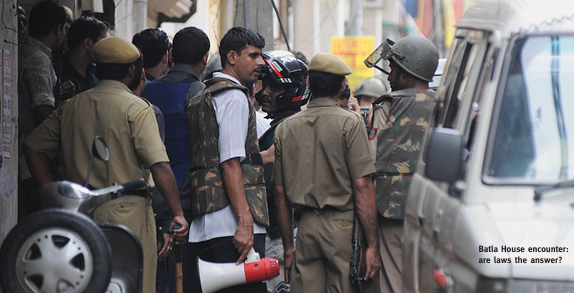
Management guru Peter Drucker once said, “Efficiency is doing things right; effectiveness is the right things.” Will the legislation enacted after the Mumbai terror attack contribute to efficiency and effectiveness in combating terrorism? I have doubts.
After spending over 14 years in the field in the unnatural world of fighting extremists, insurgents, and terrorists, or “non-state actors”, I am all for an exclusive law to fight terrorists. We need it to effectively fight terrorists because they belong to a different generic order than other non-state actors. The Union Government took just three weeks after the 26/11 attack to enact the Unlawful Activities (Prevention) Act, 2008 (UAPA) and the National Investigation Agency Act, 2008 (NIA). These two significant pieces of legislation are supposed to improve the State’s response to terrorism. If that was the intention, the semantics of the nomenclature of the former Act was incorrect. If the government clubs terrorist acts with other unlawful acts, the focus will not be on coming to terms with terrorism, but wishing it away.
At the same time, I am no great admirer of such laws which curtail the basic rights of citizens. Earlier governments had brought in similar laws for equally dubious reasons. These laws had not remarkably improved the state’s response to violent acts of terror and insurgency. In fact, it continues to be abysmal – and that is not due to the presence or absence of counterterrorism laws. After all, IPC Section 304 has not curbed murder. The moral of the story is that laws by themselves do not improve society; their implementation does.
I have seen, from a ringside seat, the application of the Armed Forces (Special Powers) Act, 1958 for over a decade in the Northeast. It is perhaps the longest surviving enactment of this genre. It has continued to be in force because the problem of extremism and insurgency has continued to flourish in the region. In most of the seven states there, the Army continues to be saddled with responsibilities relating more to policing than military craft.
Use of the Army for such tasks has continued in the Northeast for five decades. There are no visible political or administrative strategies there to make the three limbs of government – legislature, executive and judiciary – more responsible and efficient in ensuring security of person and property for ordinary citizens. This has become a self-defeating proposition as the police has been progressively marginalized regarding some of its basic responsibilities. Unless systemic improvement takes place, states will continue to adopt the easy but inefficient option of using the Army to curb terrorism and insurgency regardless of the nature of threat. Special laws have come in handy to make the job of the state easier rather than in improving the system.
Increasing assertion of corrupt and criminal elements in the corridors of legislatures and executive, served by servile law enforcement agencies, has vitiated the rule of law. There are suspicions of such malevolent influences affecting the highest organs of the judiciary also. As a result, efficiency and accountability of the executive has taken a back seat – benefiting criminal elements that thrive in such an environment. Special laws against crime and terrorism have been taken advantage of by a nexus of corrupt politicians and bureaucracy to perpetuate the existing scheme of things.
It will be a long haul to qualitatively improve the existing systems of administration. The physical process of going about it will require enlightened political and bureaucratic leadership to impart the will and determination needed to keep it going. At the operational level, it will involve extensive reform of the police system, an issue of great urgency that has been continuously ignored by politicians and legislatures, despite Supreme Court intervention. Updating of a whole range of obsolete laws, including the Indian Penal Code, the Criminal Procedure Code and the Evidence Act, has to be taken up to meet contemporary needs. Even if the process starts now, the results will not have an immediate impact.
Terrorist bodies like the Lashkar, aided and abetted from across the border, have taken advantage of the weakness of this murky law enforcement environment to act brazenly. The State can effectively respond in the present scheme of things only if it has an efficient operative system. Special laws like the UAPA are supposed to meet this specific need. But can it really contribute to this end?
There are very strong arguments against the enactment of such special laws. Our experience with other draconian laws, some extant and some in force, like the Disturbed Areas Act, the National Security Act (NSA) of 1980, the Terrorist and Disruptive Practices (Prevention) Act (TADA), Maharashtra Control of Organised Crime Act of 1999 (MCOCA), and the infamous Prevention of Terrorism Act of 2002 (POTA) have shown some major aberrations in their application.
The state machinery, especially in Tamil Nadu, Gujarat and Maharashtra, has grossly misused such laws to silence political opposition or to settle personal scores. A more dangerous trend is their widespread application to pressure critical media. Unfortunately, civil society in most of the states is ineffective to check such trends. Civil society also suffers from the same political and ideological schism that permeates other institutions of society.
One can see some disturbing aspects in the UAPA. Transparency and review procedures are basic requirements for any law to fight terrorism. These are absent in the UAPA. Another aspect is the sanction to special courts to presume that the accused is guilty under certain circumstances. This is against the spirit of criminal jurisprudence in which the accused is “innocent until proven guilty”. The increase of the detention period without charges from 90 to 180 days at the discretion of the court and the absence of witness protection are other troubling issues in the UAPA.
Lastly, there should have been sufficient deliberation and consultation before enacting such legislation that has far-reaching implications in the federal structure. This was pointed out in the latest Chief Ministers’ conference and Prime Minister Manmohan Singh reportedly indicated the possibility of making changes in the UAPA if required. Sadly, in India, deeds do not usually follow words.
The writer is a Military Intelligence specialist with the South Asia Analysis Group
Unless systemic improvement takes place, states will continue to adopt the easy but inefficient option of using the Army to curb terrorism and insurgency regardless of the nature of threat
Transparency and review procedures are basic requirements for any law to fight terrorism. These are absent in the UAPA. Another aspect is the sanction to special courts to presume that the accused is guilty under certain circumstances