



















The armed forces are reportedly considering grant of permanent commission to women. During Question Hour on March 12 this year, the Defence Minister informed the Rajya Sabha that the question of granting permanent commission to women would be re-examined positively. “I understand the sentiments in an era of women’s empowerment. Trends around the world are changing. The government will try its best to find a solution to the issue,” he added.
It is unfortunate that the government has reduced such a serious matter to an issue of women’s empowerment. All policy issues that concern the war potential of the armed forces must be dealt with in a dispassionate manner without succumbing to populist slogans like purging gender bias, women’s liberation and conquering the last male bastion.
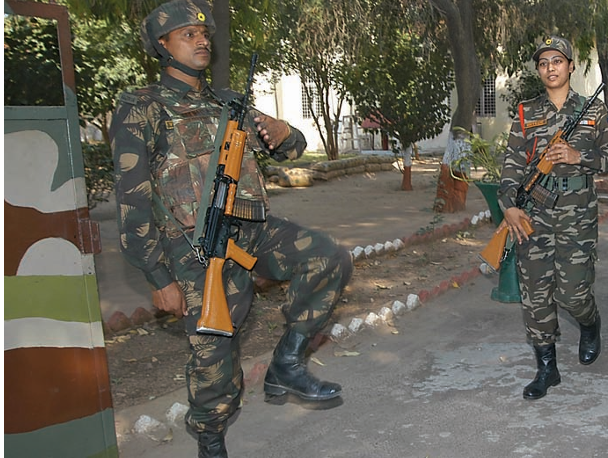
It was in 1990 that a decision was taken to grant Short Service Commission (SSC) to women in some select non-combat branches in the three services. The first batch joined in 1992. The current strength of women officers in the Army, Air Force and Navy is 4101, 784 and 252 respectively. These figures include Medical Corps, Dental Corps and Nursing Services wherein women are granted permanent commission (PC) as well.
The profession of arms is all about management of violence. Soldiers’ behaviour, ethos and attitudes are conditioned accordingly. The environment tends to acquire a certain degree of coarseness which many consider to be alien to women. That is the reason even countries professing equality of the sexes are wary of pitching their women into direct combat. Despite the much-touted huge presence of women in the US forces in Iraq, there has not been a single woman casualty so far whereas over 3,000 men have died.
Although women have been serving in the militaries of developed countries for a long time, they are still grappling with various functional, social, behavioural and psychological issues. Women’s absorption and adjustment has not been smooth in any military. However, with the deep understanding acquired over a period of time, it is now universally accepted that the extent of women’s induction in any military must be dictated by these parameters:
- What is the degree of shortage of suitable male volunteers? Some countries have to recruit women to make up deficiencies.
- Is the military technologically advanced enough to generate considerable requirement for highly skilled women for high-tech non-combat support functions? Low-tech militaries are always manpower-intensive and depend on extensive physical ground effort, and hence do not lend themselves to useful employment of women.
- Have the societal and cultural ethos reached a stage of maturity to facilitate integration of men and women to the desired levels of mutual comfort? It has been seen that traditional societies suffer from sexual prejudices and inhibit smooth induction of women in male majority organizations.
- What is the degree of involvement of a military in active combat duties? Countries with secure borders and peaceful environment (like Canada) can accommodate more women in their militaries and assign passive duties to them. On the other hand, militaries of countries facing hostile external and internal environment are hard-pressed to find safe appointments for women.
By these parameters, India does not lend itself to induction of women in the services. First, it is not short of suitable male volunteers. Second, it is still a second-generation technology force which is trying desperately to upgrade. Therefore, the number of high-tech appointments available is limited. Third, Indian society is passing through a phase of transition from traditionalism to modernity. The Indian soldier is drawn from rustic stock where women to date are assigned a lesser status. Last, and most important, a majority of Army troops are deployed in active combat duties and there are few soft appointments and peace stations.
Officers earn the right to command troops
by excelling both physically and
professionally. By having women only in
the officer cadre, an impression gets
conveyed that officers’ duties are soft
Not with standing the public posturing, overall feedback with the experience of the past 15 years has been mixed. Though commanders admire women for commitment, sincerity and enthusiasm, they show reluctance to have women under their command due to concern for their safety and dignity. It is not a question of chauvinistic male bias. It is just that they tend to be over-cautious in assigning duties to women lest they be exposed to harm.
“Women want equality only in officer cadre and not in other ranks” is an oft-heard remark. In all other countries, women are inducted both as officers and soldiers. India takes women only in the officer cadre. This is a major anomaly and a cause of concern for many officers. The Indian armed forces pride themselves on the fact that its officers lead from the front and hence have to be better than their soldiers in all respects. Officers earn the right to command troops by excelling both physically and professionally. But, by having women only in the officer cadre, an impression gets conveyed that officers’ duties are soft and can be carried out by women as well.
The standard for selection of women has been kept at a pedestrian level with the result that many women find it difficult to withstand prolonged physical and mental pressure of the service. Concerns have been expressed about the physical fitness of women officers and their being highly prone to back problems, pelvic injuries and stress fractures.
Most male officers understand and appreciate challenges faced by women in trying to adjust to a male-dominated environment. However, some feel that presence of women amongst them tends to make the environment “formal and stiff”. They miss the light-hearted banter which all militaries consider essential to release work tension and promote group cohesion. In some establishments, mutual comfort level between men and women colleagues has been found to be low. In a few cases, male officers have been seen to be resenting additional work load that they have to undertake as many tasks (like patrolling, night duty checks) cannot be assigned to women.
As regards feedback from women, most feel that their talent is not given due recognition and their competence remains under-utilized. As they cannot be assigned highly active duties, they get routine desk and administrative jobs which they resent. Many complain about lack of job satisfaction. Moreover, they feel that they have to work twice as hard as men to prove their worth.