













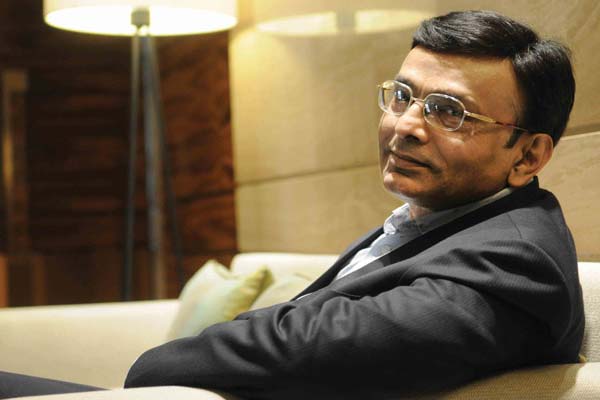



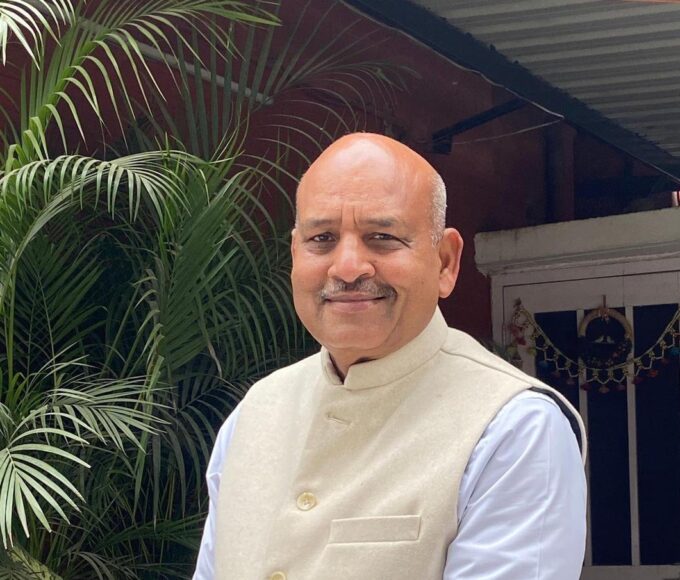










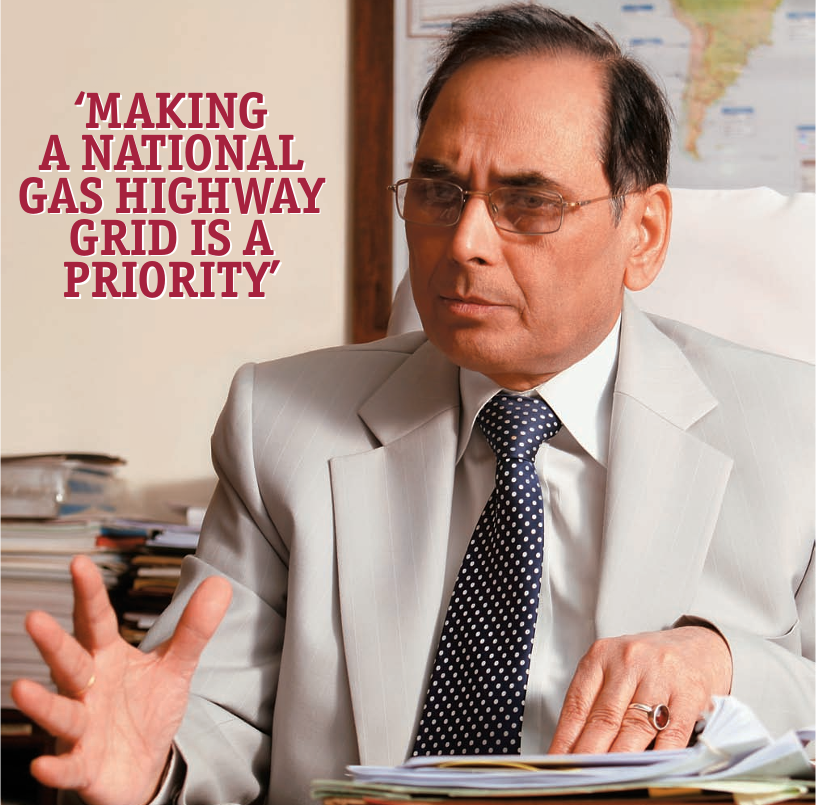
Petroleum, aptly called “liquid gold”, is one of the world’s most sought-after fuels. Ninety per cent of the world uses petroleum products for locomotion. Wars have been fought over petroleum and the economies of many nations are dependent on it. In India, petroleum is governed by Raghav Sharan Pandey. Originally from Bihar, the 1972-batch IAS officer from Nagaland has just implemented the conncept of gas cyclinder booking via SMS in Delhi. Pandey, who has built a reputation for innovation, won the Prime Minister’s Award for Excellence in Public Administration in 2007 for implementing the concept of communitisation or community participation in every aspect of administration.
gfiles: You have served in the national capital, the centre of socio-economic development and policy-making, and Nagaland, which is one of the remotest parts of the country. Has this diversified experience given you special insight into developmental challenges faced by the country?
Raghav Sharan Pandey: The experiences have been deep and extremely diversified. The underdevelopment in Nagaland, the situations created by insurgency, and the challenge at the national level to deal with the diversity of the country in different sectors have all presented learning experiences. Governance in Nagaland has a dimension very different from most other parts of the country. In the state you deal with the situation at grass-roots level. When I was Chief Secretary, Nagaland, there was a lack of financial resources and extreme cynicism in the society and in government circles. To manage day-to-day administration, we started “imagine Nagaland” – a motivational exercise which led to the experiment of communitisation. We utilized the strength of social capital to improve administration. The government schools improved to an extent that affected enrolment in private schools. Patients shifted from private to government doctors. There is hardly an example elsewhere in the country where a private school has closed because the government school nearby started delivering better results.
At the national level you have situations where you have to find commonalities. I was associated with drafting of the national horticulture mission programme, and the national bamboo mission programme. In most parts of the country there is a commonality of interest – to improve horticulture, to improve bamboo cultivation and we came out with that programme. I’ve been fortunate in having opportunities to work in the social, agricultural and economic sectors. In the general administration sector, there is hardly an area of activity with which I’ve not been associated.
gfiles: In August 2008, you moved from the Steel Ministry to the Petroleum & Natural Gas Ministry. You have been Secretary in two core Ministries dealing with mineral resources. Has this experience helped you find commonalty or divergence on royalty, allocation of iron ore mines, allocation of gas, pressure from consumer groups to control steel or gas prices, and so on?
RSP: There are commonalities and differences between the two Ministries. Both are economic sectors having a large number of public sector undertakings. Harnessing of natural resources for speedy industrialization and development is common to both. The difference is that steel price is not in the control regime. Key petroleum product prices are. Petroleum products are required on a daily basis by every household. With steel, that is not the case to that extent. Policies regarding the mines for iron ore and petroleum or natural gas are somewhat different. The procedure of allocation and exploitation are also different. Wherever you are, you have to see that the sector develops and contributes to the economy to the maximum possible extent and you have to develop vision specific to the sector within the overall ambit of national development.
gfiles: Between the Steel and Petroleum assignments, which is more challenging? Which offers more scope for policy innovation?
RSP: Challenges are everywhere but Steel is somewhat smaller than Petroleum. The ramifications of Petroleum & Natural Gas are wider and its contribution to the national economy is more. Yet Steel is an extremely important sector and there is scope for policies and innovations everywhere.
gfiles: You have been credited with the concept of long-distance gas highways. It figured in the Finance Minister’s Budget speech in July. Can you elaborate on this concept and the larger domain of the national grid, and the road map for realizing this vision?
RSP: The 21st Century is said to be the century of gas. Gas is going to assume a greater role in the national economy for development of our industries. The difficulty is that we don’t have adequate gas transportation arrangements. Only some parts of the country have a network. Large parts of eastern, central and southern India have no pipelines. Gas has no meaning for these areas. So, on the pattern of national highways, gas highways also need to be developed in a coordinated manner with required investment, leading to a national gas grid.
gfiles: Do you envisage Public-Private Partnership (PPP)?
RSP: Yes, PPP will be part of it.
gfiles: How much investment do you envisage?
RSP: It depends on how much of pipeline will be constructed.
gfiles: How many km?
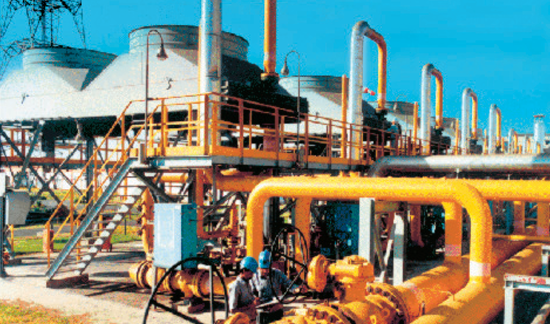
RSP: We have 10,000 km of existing pipelines. The sky is the limit as far as the future is concerned. It’s wrong to say that this will be our long-term target. We need to have a National Gas Highway Authority of India which will plan with continuity. The requirement of pipelines depends on the sources of gas and the likely demand. We have to think of ways, including PPP, to bring this about. At present, we produce about 141mms cmd of gas. This is expected to increase by about 70 per cent by 2012. But the real issue is demand and transportation. The more gas you access, the more places you take it to – then the industry will come up. After we got HP gas pipelines, a good number of industries have grown around that.
gfiles: So gas pipelines are needed for the future growth of India?
RSP: Availability of gas, availability of transportation network and setting up of industry is essential. And there the national gas grid is going to be extremely important.
gfiles: For smooth functioning of any grid of continental dimensions, a string of gas storage dumps is a must to ease any disruption or cut in gas production as well as for national energy security. The US has hundreds of gas storage dumps. What are your plans on this count?
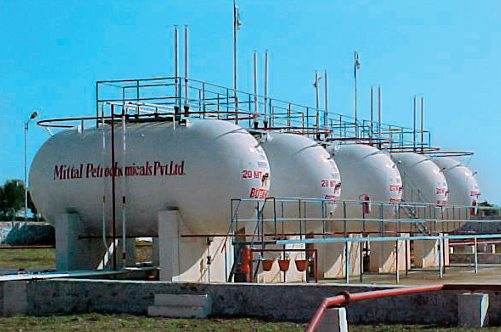
RSP: We’ve not done much work in the area of gas storage. We’ve initiated some work in the area of oil storage and, according to international standards, we have to have a storage for about 90 days of oil consumption. We are working towards that, including investments from abroad in oil storage infrastructure.
gfiles: Independently, or via tenders?
RSP: We’ve started making some oil storage tanks with investment and research particularly from Gulf countries. We want to have more oil storage which will help them also – to keep for consumption and also for export to South East Asia because we are en route. So a paper has been developed and shared with them. Some have responded favourably.
For gas, we have not really started storage yet. There are many countries which have gas storage but it involves huge investment. We are concentrating on constructing pipelines.
gfiles: What is the status of the Iran-Pakistan-India gas pipeline project? Apart from pricing, there is a larger issue of pipeline security, which even the superpowers won’t guarantee. And this applies also to the Asian Development Bank-backed Turkenistan-Afghanistan-Pakistan pipeline that can be extended to India.
RSP: We are very much for the Iran-Pakistan-India gas pipeline but are stuck because of security concerns and we are yet to reach an agreement on pricing. International negotiations take time but we need gas from abroad and Iranian gas is one possibility.
gfiles: What’s the bottleneck – Iran, security, Pakistan or international negotiations?
RSP: It’s the transit route. We need to have adequate security and for that negotiations will have to provide comfort. There is also the sea pipeline proposal but that has issues of expense. Let us see. Those who spend have to recover from the consumers. But the consumers have to get gas at reasonable price. Various possibilities are under consideration.
gfiles: With the Russia-Ukraine stand-off over pricing of piped gas and the consequent disruptions in supply to Europe, would it not be wiser to focus on import of gas as LNG and CNG, if the CNG shipping technology is viable?RSP: LNG import facilities are being augmented. We have taken steps to augment the existing terminal at Dahej in Gujarat and a new terminal at Kochi in Kerala. Private terminals are also coming up. So more LNG is going to be imported in due course. Regarding CNG import, there are questions of viability. I am told lower distances are more viable. With CNG, the biggest difficulty is pipelines. We have an ambitious programme. As against 35 cities today, we will take CNG to 202 cities by 2015. For CNG the requirement of gas is not so much. So may be we won’t need to import CNG. The domestic availability or the gas we are importing should do.
gfiles: In August, the P&NG Minister told the Rajya Sabha a study to consider the feasibility of a uniform cost price regime for natural gas is being undertaken. The report is expected within three months. Does this proposal envisage pooling of prices of various domestic fields with LNG, including spot purchases and, if so, will it not herald a new form of administered price mechanism (APM)?
RSP: The study has started. GAIL is getting it done. Electricity boards resource power from different sources but sell it at a uniform price in the state to a particular category of consumer. There are different gas pricing regimes. If there could be a uniform price, it would be good in many ways. Its feasibility, given the contractual arrangements which have been entered into with different categories of supplier and what could be the pulling mechanism, that is under study. Certainly the government can’t provide any subsidy. So to what extent it will work out has to be seen. If it comes in, excepting spot gas, the rest of the gas will be brought under its ambit.
gfiles: Are you moving towards setting up power and gas exchanges like BSE and NSE?
RSP: That has not been thought yet. One has to wait. We will study the proposal if somebody submits it.
gfiles: There is a trade-off between price of natural gas and subsidies such as fertilizer subsidy and LPG subsidy. From the government revenue standpoint, is it better to subsidize gas or essential products derived from it?
Let us take a hypothetical situation where the government buys gas from gas producers at a negotiated price of $4.2 per mmbtu and sells it at $1 per mmbtu to urea and LPG producers who are offered a fixed return of, say, 15 per cent on net worth. This would probably wipe out urea and LPG subsidy in one shot. Would that help the government reduce fertilizer and LPG subsidy as well as impart price stability to the economy because there would be no subsidy on value-addition that results during manufacturing? Has the government done any study on such or similar lines?
RSP: Subsidy is certainly a drain on the economy. But in case of items needed by vulnerable sections of the population, subsidies are provided by the government. There is no proposal to provide subsidy on basic raw material, that is, gas. Only some parts of gas which are known as APM gas are being sold at a price which is not determined by the market but is a cost plus price.
gfiles: There is the issue of subsidization of petrol, diesel and PDS kerosene by upstream companies such as ONGC through discounts on crude supplies by non-oil refineries and by oil marketing companies through under-recoveries on sale of these products. Has this problem been studied by the expert group on petroleum products pricing proposed in the Finance Minister’s Budget speech?
RSP: The Kirit Parikh Committee, set up after the speech, will go into all this. Into questions also about whether to subsidize and to what extent, the source of subsidy, whether it will be from upstream, and if so to what extent.
gfiles: After the dismantling of APM in April 2002, which included the decision to reduce and shift the kerosene and LPG subsidies to the Consolidated Fund of India, how come the hydrocarbons industry is burdened with these subsidies as well as subsidy of decontrolled petrol and diesel? Will the government again extend the kerosene and LPG subsidy, currently valid up to March 31, 2010, as per the Cabinet decision in October 2007?
[The Government Resolution dated November 21, 1987 on phased dismantling of APM by April 2002 clearly stated that subsidy on LPG would be reduced to 15 per cent of import parity price (IPP) and 33.33 per cent of IPP on kerosene and the subsidy would be borne by the government directly through the budget. In March 2002, the government reiterated its decision that the subsidy on LPG and kerosene would be borne out of the Consolidated Fund of India. It said: “After adjusting the flat rate of subsidy, the retail prices of these subsidized products will vary with the price of oil in the international market.” The government also expressed its resolve to phase out LPG and kerosene subsidies in three to five years. In October 2007, the government reviewed the position of fiscal subsidies on LPG and SKO and extended the schemes till March 31, 2010.]
RSP: As I mentioned earlier, at present subsidies are being given on four items, including kerosene and LPG. For this year, there is a decision by the government that for LPG and kerosene the subsidy burden will be borne by the government whether through budgetary process or through issues of oil bond that will be clear when the supplementary Budget is presented. In future what will happen I can’t say. Let us wait for the Kirit Parikh Committee recommendations.
gfiles: After dismantling of APM, at least three expert groups have grappled with the problem of taxation and subsidization of petroleum products and yet the problems remain as complex as ever. Does this suggest lack of political will to strike a durable solution that may hurt some stakeholders in the short run but would benefit the economy in the long run?
[The first committee was formed by the Finance Ministry in the last quarter of 2004 under Chief Economic Adviser Ashok Lahiri (who is now Indian director at ADB) to suggest a new tariff structure that could cope with the sharp rise in crude prices in the global markets. The second committee was formed at the PMO’s behest in October 2005 to study pricing and taxation of petroleum products under the chairmanship of economist C Rangarajan. The third committee was formed in 2008 under Planning Commission Member BK Chaturvedi to revisit the concept of under-recoveries by oil marketing companies in sale of petrol and diesel.]
RSP: There is no lack of political will. What is needed, and it is happening, is to understand the pros and cons of this decision. On the one hand, we have to ensure that the wild marketing companies get their due. On the other, we have to make sure that these are vital inputs to the economy and to the common man’s consumption. Therefore, we have to have appropriate pricing. So a kind of balancing is needed. There are three kinds of pricing regimes in the world:
First is the one including the US, UK and most of Europe belong. OSDC countries are in this group. There is total freedom on pricing, the companies decide the pricing.
Second is the one in developing countries, including India, China, our other neighbours, and Russia. The government fixes the prices. It’s not that it’s always controlled at a particular level, it goes up or down.
Third is the one in countries where kerosene and petrol are very cheap. These are mostly West Asian countries and some Latin American countries where production is in abundance.
What course India will take has been debated from time to time. There have been reforms like Diwal marketing companies are being given refineries gate price partly from upstream, partly from government, partly from consumers. Let’s wait for this committee’s report. The government has to balance the interest of the producing companies as well as of consumers.
gfiles: Aviation turbine fuel, whose price is fixed on the norms of import parity pricing, accounts for the largest component of variable cost of the airline industry. This product is over-taxed, especially by the States. It is also hard to import due to infrastructure constraints and foreign trade policy regulations. An empowered Group of Ministers on aviation is reportedly studying the problem of taxation and pricing. What does your Ministry offer in resolution?
RSP: ATF pricing is free pricing. When international crude price goes up or down, ATF price goes up or down. So the pricing is international but there is a huge element of taxation. Taxation is the domain of the state governments. It has been debated from time to time. Let’s hope some taxation reforms come about. The Ministry of Petroleum has little role. Our Minister has written to the Chief Ministers that the taxation on ATF has to come down. There has been no response. It has been debated in the Finance Ministry also. The standing committee of Finance Ministers also debated the issue. Let’s hope a solution is found.
gfiles: Your Ministry has drawn flak on the regulatory count from different quarters, including the Planning Commission’s Integrated Energy Policy (IEP) status update.
a) The upstream regulator, Directorate General of Hydrocarbons (DGH) is considered weak and controlled by the Ministry. Do you have any plans to grant it autonomy?
b) As for the downstream regulator, the Petroleum and Natural Gas Regulatory Board (PNGRB), the Ministry has not empowered it fully by not invoking certain provisions of the PNGRB Act. There is some ongoing litigation between PNGRB and the Ministry.
[In its IEP presentation before the full meeting of the Planning Commission chaired by the Prime Minister in September, the Commission said: “Regulatory regime in upstream and downstream in petroleum needs major overhaul.” In the separate detailed note on IEP implementation status, the Commission pointed out that IEP’s recommendation for making both regulators independent had not been implemented by the Ministry. The note said the Ministry was “exercising a strong control” over DGH and PGRB functioned with “curtailed powers”. It continued: “Several of its functions are yet to be notified.” The Board is so far authorized to regulate only natural gas pipelines. The notifications regarding oil pipelines and marketing of petroleum products is pending.]
RSP: There is a level playing field now under the New Exploration Licensing Policy (NELP) between private and public sectors within India and the foreign investors. There is no bias towards, say, ONGC as such in the NELP. Now DGH is in a way administering the NELP process. Even if it becomes fully autonomous, one has to see what difference it will make. At present, DGH is like a technical adviser to the Ministry and in some respects the Ministry takes decisions based on DGH recommendations. So if you make DGH independent, it will take all the decisions. But I don’t think that would make too much of a difference. Then, as far as the downstream regulator is concerned, there are certain lacunae in the Act. Therefore, all its sections have not been invoked. There are also areas where certain actions of the Board have to be speeded up. We are in the process of amending the Act. Legal opinion has been obtained.
gfiles: Can the dream of IEP be realized without making all energy sources tax-neutral and without creating a level playing field for all players in all sectors?
RSP: For investors, we have certainly created level fields. But it’s utopian to feel that the level of taxation will be substantially reduced. On petroleum, taxation is indeed high. Petroleum is the highest tax earner for the Central as well as State government. About a third of the State revenue comes from petroleum products. About 65 per cent of central excise revenue comes from petroleum.
gfiles: Is it impossible to reduce the taxes?
RSP: Well, it depends on the States. In the Central government some touching up can be done from time to time but then the income from such taxation is so high that if you reduce it, the revenues go down substantially.
gfiles: Don’t you think the pre-requisite for an IEP is an integrated energy regulator that should oversee coal, electricity, petroleum & natural gas, renewables and nuclear energy? Alternatively, should there not be a super-regulator in the energy sector comprising chairmen of all sector-specific regulators, including the proposed coal regulator, to integrate sector-specific policies and to balance conflicting interests, say, between coal producers and coal-based power generators?
RSP: Let us not expect too much of the regulators. There are regulators in different sectors in electricity, P&NG. The government is also, in a way, a regulator. Government policies do provide level playing fields to a great extent. If there is one integrated energy regulator, that can also work. If there are two, three regulators in different sectors, these are also working. It all depends what role you give the regulator and how the regulator functions. Merely having one regulator will not solve all the problems.
gfiles: Is there any move to restructure public sector oil and gas companies through mergers, demergers, holding company, and so on?
[The Ministry had explored the idea of restructuring through the Advisory Committee on Synergy in Energy that it constituted in January 2005 under the Chairmanship of V Krishnamurthy, who is currently Chairman, National Manufacturing Competitiveness Council.]
RSP: We are not pursuing the Synergy in Energy conceptat present. There are ways to make the existing companies more effective and these are being pursued. There could be some restructuring within the organizations.
gfiles: Is there a need for more PSUs in the oil sector to diversify?
RSP: No. Within the PSUs, there are varying needs. Like, can a big company have more subsidiaries of its own in certain areas? These are thoughts being explored. It’ll be premature to speak more on this now.
gfiles: Your Ministry had reportedly urged the Cabinet Secretariat to constitute a new EGOM on gas allocation. Has that been done to facilitate utilization of Reliance’s KG basin gas? Why can’t the government revive the inter-ministerial gas linkage committee which used to be chaired by the Petroleum Secretary and which did a commendable job?
RSP: The new EGOM has been constituted. It’s going to look into gas utilization. More gas is expected to be produced. This is going to be distributed sector- and company-wise and the matter will be put before the committee. The gas linkage committee was done away with in 2004. After that, most of the major production of gas has been from KGD6. For NELP gas, this EGOM was constituted which functioned in the last government. In this government also, the EGOM will decide on gas utilization.
gfiles: Is there any plan to modify the gas utilization policy by taking into account requirements of the petrochemicals sector and the pivotal role of gas in energy security that can be realized by converting gas into methanol for subsequent conversion into dimethyl ether, which is a perfect diesel substitute? The policy, in fact, does not factor in the role of domestic gas as a foreign exchange saver and substitute for imported crude. This can be done only by increased allocation of gas to CNG stations as they help substitute petrol and diesel.
RSP: The gas utilization policy which has been enunciated now has identified some areas of utilization of gas. The priority areas are fertilizer, power, LPG, city gas distribution system. The EGOM has also decided that in future we should allocate gas to sectors like refineries, petrochemicals. So far only four areas have been allocated gas – power, fertilizer, LPG and city gas. Let’s see which other areas get how much gas.
gfiles: How much gas are you expecting?
RSP: In the KG basin, from the present level of 40 it’s going to go up to 80 in due course.
gfiles: The just-completed international competitive bidding under NELP and under coalbed methane (CBM) has attracted a poor response from investors. Of the 70 blocks offered, 34 did not elicit even a single bid. What are the reasons and do you intend to address the pricing and marketing concerns of investors by modifying the model production sharing contracts for the next round of bidding?
RSP: Yes, it’s less this time. Out of 70 blocks under NELP, 36 received bids. Out of 10 blocks under CBM, eight received bids. This comes to a little over 50 per cent if you combine the two. Even under NELP, it’s a little over 40 per cent. Merely on this basis, can you say that it had a very poor response? You have to understand the international environment. When we started NELP and CBM bidding, we knew that this year there is a downturn in the global economy. Investment sentiment is not as ebullient as earlier. So, the choice before us was to go ahead with the bidding or stop it. If we had stopped it, we would not have bid any block or we would have waited for good times to return. When that would have happened, nobody knows. The best antidote to a downturn is to generate economic activity to the extent possible. Next, we decided to package a larger number of blocks so that even if some were bid for, at least exploration activity would start. We got bids for over 50 per cent. In no country this year have bids been higher than this. This includes Brazil, Norway, Indonesia, Uruguay and quite a few other countries.
Finally, all these are awarded, if exploration starts in all. This is a very large number itself, apart from the percentage. The minimum assured investment amounts to $1.3 billion in NELP alone. Compare this with NELP7, which many people would say was a very successful round. At that time, it was less than 1.7, it’s slightly more than $1.2 billion.
Third, in the last NELP how many blocks were put up for bidding, and finally auctioned, and for which you got investment. It varies between 20 to 30 for NELP1 to NELP5. In NELP6 and 7, it was higher. In NELP8, it’s 36.
Fourth, some people say ONGC made the maximum number of bids. ONGC is the single bidder in 19 blocks, this year in 21 blocks. So it’s in the same league. I don’t know on what basis people are saying it’s very poor. It’s poor in that sense, that you put up a much larger number of blocks and a little over half received bids.
What we’ve done was right. Let’s hope the number that got bids is awarded and exploration activity starts. If every year 20, 30 blocks are given out, it’s fine. If we had offered fewer blocks, maybe we would have got less bids. Also, we offered blocks for big and small investors, deep and shallow waters, all land, and so on.
There is no pricing and no marketing which really affected the bidding. The marketing and pricing principles have been broadly right from NELP1 to NELP8.
gfiles: How much oil do you import?
RSP: We import about 80 per cent of our requirement.
gfiles: How do you view the Petroleum Ministry in totality?
RSP: The Petroleum Ministry’s single objective is to provide energy security in the country. What is energy security? You get energy 24×7 for its industries and for its citizens at affordable prices. Many petroleum products are reaching every nook and corner of this country. Our demands are set to grow, we are set to grow by 3.6 per cent per annum up to 2030.
gfiles: What’s the energy consumption in India per capita?
RSP: It’s one-seventh of that in the US and about one-third of that in the world. But it will increase by 3.6 per cent per annum on an average against 1.6 per cent per annum for the world at large. It’s a function of growth in economy. We’ll be one of the major consumers by 2030. Beyond 2030, India will be among the largest consumers of energy even on a per capita basis.