































Before the First Rains Fall
India is about to plant millions of trees. Most of them will die.
As the monsoon draws near and plantation drives gear up across India, a familiar ritual is about to repeat itself: saplings planted, photographs taken, and trees forgotten. Unless we change the way we plant — not just the season, but the intention and the method — this year’s green promises will vanish as quietly as last year’s.
The skies over Indian cities are still a flat, merciless white. In Mumbai, the humidity is already oppressive. In Bengaluru, the pre-monsoon showers have teased but not delivered. In Delhi, the tar on the roads shimmers and ceiling fans spin on their highest setting without bringing relief.
Meteorologists are watching the Bay of Bengal carefully. Within weeks — possibly days — the southwest monsoon will begin its annual march northward. When it arrives, something else will arrive alongside it: India’s single largest tree-planting season.
State forest departments, municipal corporations, school children, corporate CSR teams, neighbourhood welfare associations, and well-meaning individuals across the subcontinent are already drawing up their plans. Targets will be announced. Saplings will be ordered in bulk. On a chosen morning, ministers and executives will pose with freshly dug earth on their hands, and the photographs will be filed as evidence of environmental responsibility.
And then, for most of those saplings, the story will quietly end.
"If even one-fifth of the trees planted each year during India's monsoon drives had survived, the country's cities would already be forests. The problem has never been the planting. It has always been everything that comes after."
This is not cynicism. It is a pattern so well-documented, so consistently repeated, that it has almost stopped generating outrage. India plants hundreds of millions of saplings every monsoon season. Survival rates in many states hover between 20 and 40 percent — and those are the figures governments report. Independent assessments are frequently grimmer.
20–40% reported sapling survival rate in many Indian states (official figures; independent assessments are often lower)
80% of tree roots grow in the top 18 inches of soil — making soil quality and depth critical to survival
400 yrs for nature to produce just 10 mm of topsoil — the resource we compact and seal under our roads
The Ritual and Its Ruin
A Season of Ceremony
Every year, before the first clouds gather, the machinery of plantation begins. NGOs block out weekends for green drives. Corporations earmark CSR budgets for saplings bearing their logo on small plastic tags. Government departments issue circulars with district-wise targets. Schools organise ceremonies. From a distance, it all looks admirable.
What Happens After the Cameras Leave
Look closer, and a different picture emerges. Saplings arrive in bulk from nurseries that prize growth speed over species suitability. They are planted in whatever soil is available — in most urban areas, compacted, nutrient-depleted earth that has been dug up and refilled for decades.
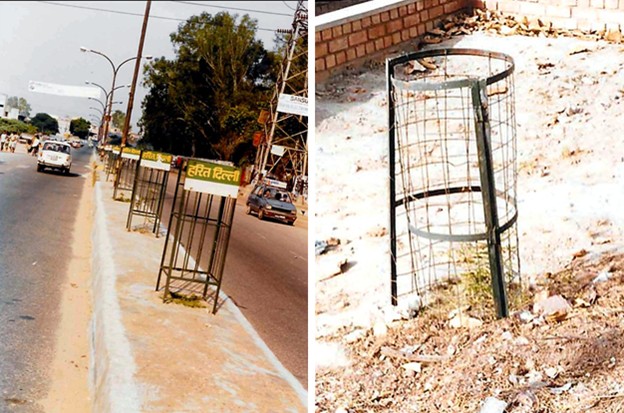
A steel guard is placed around the trunk. A bucket of water is poured. The cameras click. Everyone goes home.
Three weeks later, nobody comes back. No watering schedule has been set up. No one has been assigned responsibility. The municipal water tanker that was supposed to make rounds does not arrive. The sapling, never adapted to its soil, draws on its last reserves of moisture and quietly gives up. The guard remains — the logo still visible, the tree long gone.
The Common Failures
- Wrong species: Fast-growing exotics planted for visual impact; native, site-adapted varieties overlooked.
- Wrong soil: Urban topsoil is compacted, sealed, or stripped; saplings find no room for roots.
- No aftercare: Watering, weeding, and follow-up are unbudgeted and unassigned from day one.
- Wrong timing: Many drives plant in the first flush of monsoon excitement, before soil has stabilised.
- Harmful guards: Metal enclosures trap heat, collect garbage, and strangle trunks as they grow.
- Shallow soil: Road medians are back filled over old tarmac; roots hit the buried crust within inches.
The Tree Beneath the Concrete
A Common Urban Scene
On a burning July afternoon on any major arterial road in an Indian city — East Delhi, the Outer Ring Road in Bengaluru, the Western Express Highway in Mumbai — the scene is nearly identical. Traffic surges past a freshly painted median. Auto-rickshaws and buses add their fumes to the haze. And amid the mechanical mayhem stands a single tree, its branches bending under the weight of grime, its roots doing something invisible and critical: failing.
The Iron Guard Problem
The base of the trunk, once ringed by soft earth, is now encircled by an iron guard installed when the tree was a sapling — and never removed. The metal is now too small for the trunk it once protected, and whenever the wind blows, it creaks against living bark.
This is not a Delhi problem, or a Mumbai problem, or a Chennai problem. It is the condition of urban trees across India: planted with ceremony, abandoned to their fate, and slowly worn down by the infrastructure built around them.
Hidden Tombs Beneath the Median
The most consequential mistake — and the least visible — concerns where most urban trees are actually planted: the road median. These raised dividers between traffic lanes appear to be soil. In most Indian cities, they are not.
Almost every median was built over an earlier road surface — a lane of tarmac, a hardened sub-base, a compacted construction platform — that was never broken up when the divider was formed. Soil, sometimes only a foot or two deep, was back filled on top of this old crust. That is the bed into which we lower our saplings every monsoon season.
"The median looks like a garden. Underneath, it is a tomb. The old road is still there — buried under two feet of fill soil and planted over as if the roots will never know the difference."
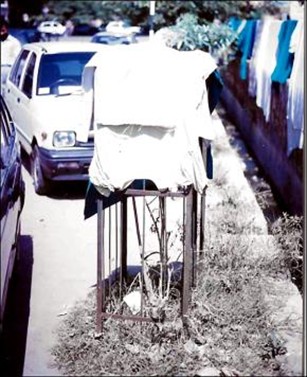
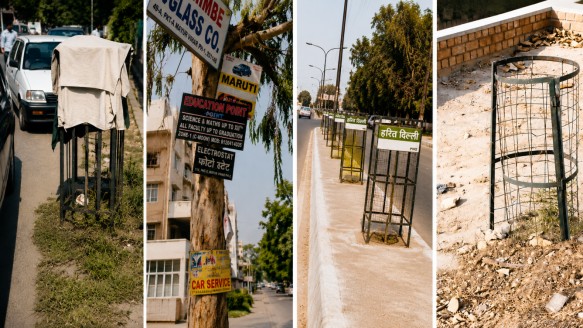
A tree guard repurposed as a clothes-drying rack. The sapling inside, surrounded by weeds and waste, has been left entirely to fend for itself. The guard outlasts the tree it was meant to protect.
How Roots Respond
A root system that cannot penetrate downward turns sideways, coiling in the shallow pocket of soil available to it. It cannot anchor the tree against monsoon winds. It cannot reach the deep groundwater that sustains a tree through the eight dry months that follow the rains.
For a few seasons the sapling draws on surface moisture, looks healthy enough for the annual photograph, then silently weakens. It falls during a storm that a properly rooted tree of the same species — on the same street, in the same wind — would have stood through without a shudder.
The Simple Fix
The remedy requires no new technology. Before any median is planted, the old road crust beneath must be broken up to a minimum depth of three feet and replaced with structured, aerated growing medium. A single line in a project specification. The difference between a tree and a stump.
The Compounding Logic of Doing It Right
A Fixed Canvas
There is an argument for getting this right that goes beyond ecology — it is a purely practical one. Indian cities do not have unlimited space in which to plant trees. The medians, road shoulders, parks, and open plots are fixed. The area available for urban greening does not grow year on year. Yet every year, the same targets are announced, the same quantities of saplings are ordered, and the same ground is planted over again, because so little of the previous year’s effort survived.
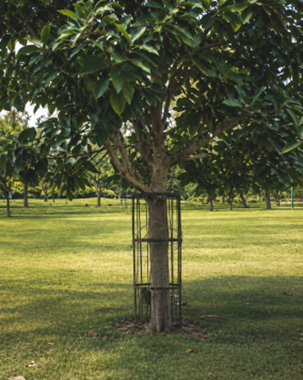
A mature tree in a public garden — its canopy now wide and full — with the original planting guard still clamped around its lower trunk. Installed to protect a sapling, the guard was never removed. It now digs into bark that has grown around it.
The Power of Compounding Green Cover
Consider what changes if survival rates improve. A city that plants ten thousand trees in a monsoon season and keeps eight thousand of them alive needs to plant only two thousand replacements the following year. In the third year, the replacement burden falls further. Within a decade of sustained, careful planting, the city’s green cover compounds — not because the city got larger, but because it stopped losing what it planted.
The trees already in the ground begin to do the work: cooling streets, filtering air, holding soil moisture, seeding the conditions in which the next generation of trees will establish more easily.
"Plant ten thousand trees, lose eight thousand, and next year you are not building on a forest — you are filling a graveyard. The city's green cover will never compound until its trees are allowed to survive."
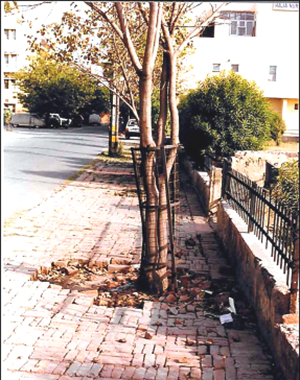
Tree roots fighting back: the surface paving around these street trees has been heaved up and fractured by roots seeking space and moisture. Nature asserts itself — but at the cost of the tree’s structural stability and the pedestrian’s safety.
The Treadmill We Are Stuck On
When survival rates are low, every monsoon season starts from nearly zero. The effort, the expenditure, the goodwill, the ceremony — all of it is consumed replacing what was lost, with nothing left over to actually grow the city’s canopy. It is a treadmill, not a forest programme.
The steel guard bearing a corporate logo is the most honest symbol of how this cycle perpetuates itself. It marks the spot where a sapling was placed, a photograph was taken, and responsibility ended. The logo will outlast the tree. Next monsoon, another sapling will be placed in the same spot, another guard installed, another photograph taken. The canopy never grows. The targets are always met. Nothing changes.
The Wrong Tree in the Wrong City
The Lure of Fast Greening
Fast-growing exotic species tempt urban planners eager to demonstrate instant greening, but such plants frequently destabilise local ecosystems. The impulse has been to plant what looks good quickly. Delhi’s Aravalli Ridge — once home to dhak, babool, and dhau — is now dominated by the invasive Prosopis juliflora, which has crowded out entire native plant communities.
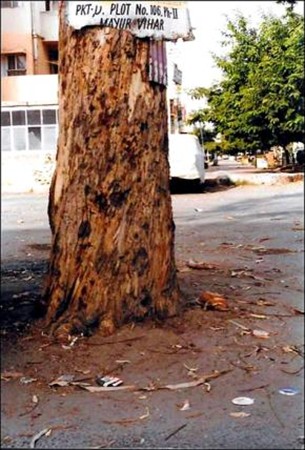
A tree trunk showing severe bark decay and dark scarring from long-term nail damage. Each wound site is an entry point for termites, fungi, and rot that progresses invisibly until the tree fails.
In coastal cities, non-native palms line promenades while indigenous species that would cool and clean the air are passed over for being insufficiently decorative. Imported varieties alter soil composition, disrupt microflora, and invite new pests and diseases.
When Ornamentals Fail Ecologically
Alstonia scholaris, once prized for its tidy canopy, now suffers from gall insect infestation in city after city due to unchecked proliferation. Nerium and Bougainvillea — still favourites of municipal landscaping departments from Chandigarh to Chennai — are shallow-rooted ornamentals that do almost nothing to purify air or retain moisture.
The Case for Native Species
True urban forestry must value endurance over exotica. Indigenous species — neem, jamun, peepal, tamarind, amaltas, kadamba, arjun — are resilient, pollution-tolerant, and deeply beneficial to local biodiversity. Their roots thrive naturally in local soils. Their flowers feed bees; their fruits feed birds; their shade cools streets by several degrees.
Crucially, they have survived Indian summers for centuries. They know the soil. They know the heat. They do not need us to nurse them past adolescence — they only need us not to kill them first.
"India does not lack trees. It lacks the will to let them
live."
Death by a Thousand Cuts
Nails, Paint, and Slow Decay
Every large tree bears scars — not all of them natural. Some trunks are coated in enamel paint applied for ceremonial beautification. Others are pierced with nails holding rusted advertisement boards. Each nail punched into living wood becomes an open entry point for termites and fungi. Within months, internal decay sets in — invisible at first, until one day the once-proud tree collapses during a light drizzle.
Reporters call it a tree-fall accident. Few call it what it is: a slow death inflicted by a thousand metallic spikes driven into living wood.
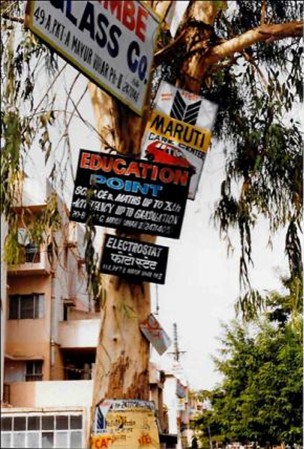
A different tree — its trunk buried under advertisement boards nailed at every height. The tree is still standing, but it is fighting the infrastructure nailed onto it at every level.
The trees standing on Mayur Vihar’s streets in Dellhi tell the full story. One trunk shows severe bark decay and dark scarring consistent with years of nail damage: wound after wound, each an invisible doorway for termites, fungi, and rot that progress unseen until the tree simply fails. A few metres away, a second tree has become a community noticeboard, buried under advertisement boards nailed at every height. It is still standing — but it is fighting the infrastructure hammered onto it at every level, and it is losing.
The Absence of Professional Care
Planting is not nurturing. Once a sapling is ceremonially placed, care stops. Municipal agencies seldom establish watering schedules, assign pruning responsibility, or protect trees from excavation damage during the road and cable works that routinely follow the monsoon season.
Countries such as the United States employ certified arborists, maintain digital urban tree inventories, and fund year-round pruning programmes. In India, we rely on untrained labourers armed with axes, cutting branches arbitrarily and leaving open wounds that invite infection and hasten decline.
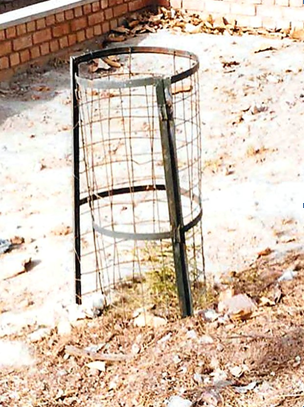
A lone steel guard stands in rubble and cracked earth — the only proof that a tree was ever planted here. No sapling, no soil, no life. Somewhere in a government record, this spot is counted as a success. On the ground, it is a monument to intention without follow-through: the planting happened, but the tree never did.
The Main Killers of Urban Trees in India
- Shallow median soil: Road dividers backfilled over old tarmac; roots cannot go deep, trees cannot anchor.
- No aftercare: No post-planting watering, weeding, or health monitoring after the ceremony.
- Reckless pruning: Unqualified cutting with no wound treatment; decay and infection follow.
- Advertisement nails: Each spike is an entry point for termites, fungi, and progressive internal rot.
- Ceremonial paint: Whitewashing trunks seals bark pores, blocking respiration and gas exchange.
- Guards never removed: Metal enclosures installed for saplings left in place as trunks swell around them.
- Construction damage: Excavation within root zones during road or utility cable works.
A Guard That Knows When to Let Go
Design Matters
Not all tree protection is harmful. The design of the guard matters enormously — and so does what happens to it over time. Steel guards installed for saplings and never removed become instruments of slow strangulation as the trunk swells beyond their diameter.
The answer is not to abandon protective enclosures altogether. It is to build ones that step back when their work is done.
Bamboo as a Better Protector
A bamboo-stake enclosure illustrates an approach that urban forestry practitioners have long favoured for exactly this reason. The stakes are lashed at intervals with biodegradable bindings. Over two to three monsoon seasons, as the sapling strengthens and its bark hardens, the bamboo weathers and the bindings loosen. By the time the tree no longer needs protection, the guard has quietly disappeared.
No removal crew is required. No metal cage digs into the growing trunk. The tree simply outgrows its scaffolding, as nature intends.
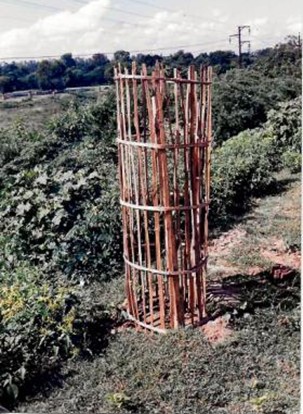
A sapling enclosed in a traditional bamboo-stake guard. Unlike steel, bamboo weathers naturally: as the tree grows and strengthens over two to three monsoon seasons, the wooden enclosure gradually deteriorates and falls away — freeing the trunk without any human intervention. The guard’s lifespan is matched to the sapling’s period of vulnerability.
The Problem with Permanent Steel
Steel guards must be actively removed on schedule — and they rarely are. Municipal workers have no reminder system, no maintenance calendar, and no accountability for guards installed years earlier by a different department or a CSR programme. The guard that was a kindness at planting becomes a cruelty at maturity.
Where steel guards are used, removal within three years of installation — or once trunk girth approaches the guard’s diameter — should be a mandatory, monitored condition of every plantation permit.
What This Monsoon Could Be Different
A Narrow but Real Window
The monsoon is not just a season. In the context of urban greening, it is an opportunity with a narrow window. Rainfall softens soil, reduces transplant shock, and gives a sapling its best chance of establishing roots before the next summer arrives. If there is a moment to get this right, it is now — before the clouds gather, before the saplings are ordered, before the press releases are drafted.
The reforms required are not radical. Many already exist as successful pilots. What they require is consistent practice rather than exception.
Eight Actions That Would Change Everything
- Plant native, not ornamental. Neem, jamun, peepal, amaltas, arjun — insist on indigenous species with documented provenance. Reject exotics without ecological justification.
- Guarantee open soil zones. A minimum 6×6 ft of unpaved earth around every roadside tree. No tiles, no tar, no exceptions. Make it a condition of every planting permit.
- Assign aftercare ownership. Every planted sapling needs a named responsible party — municipal worker, NGO, school, or RWA — for a minimum of three years.
- Remove or use biodegradable guards. Steel guards must be removed within three years of planting. Prefer bamboo or wooden stake enclosures that weather away naturally as the tree matures.
- Break the crust beneath medians. Before any divider is planted, break up the old road base to at least three feet and replace it with structured, aerated growing medium.
- Ban nails and decorative paint. Strict penalties for hammering advertisements into bark or whitewashing trunks for any ceremonial purpose.
- Require an ecological audit. Before any large plantation drive, an ecologist must sign off on species selection and soil suitability — standard professional practice, not a bureaucratic addition.
- Trade logos for stewardship. Corporate sponsorship should mean funding care teams and survival monitoring — not installing branded guards and walking away.
Proof That It Works
Where road projects have specified deep soil preparation in medians — breaking the tarmac crust, replacing fill with structured growing medium, and maintaining a minimum planting depth — tree survival rates improve dramatically. Ahmedabad’s urban forest initiatives and Pune’s native species corridors offer further proof that Indian cities can get this right when intention matches execution. These are not expensive experiments. They are better-specified decisions.
A Message to Every Actor in the Room
To Government and Municipal Bodies
The targets you announce are only as meaningful as the survival rates you can demonstrate two years later. Publish them. If you cannot, change the programme until you can.
To NGOs and Civil Society
The energy and goodwill in India’s green movement is real and enormous. Direct it toward species selection, soil preparation, and long-term monitoring. A hundred trees planted wisely will outlast and outperform ten thousand planted carelessly.
To Corporations
Your CSR rupees are a genuine resource. Stop spending them on guards that will strangle the trees they enclose. Fund arborists. Fund watering schedules. Fund public education. Fund years two through ten of a tree’s life — the years nobody photographs.
To Individuals and Resident Associations
Adopt a tree on your street. Not ceremonially — practically. Learn its name, note its health, water it in the dry weeks after the monsoon, and object loudly when a contractor’s excavator comes within three meters of its roots. One engaged citizen has saved more trees than a hundred plantation drives.
The monsoon will arrive whether we are ready or not. The rains do not discriminate between a well-planted sapling and a carelessly placed one. After the rains stop, only one of them will survive — and that will have nothing to do with the weather, and everything to do with decisions made in the weeks before the first cloud appeared.
When a tree flourishes, it asks for nothing — no cameras, no ceremonies, no applause. It simply gives: oxygen, shade, fruit, calm — quietly, unfailingly, for decades. The least we owe in return is the honesty to plant it properly, and the discipline to see it through.
The next time you pass a tree trapped in iron and sealed in cement, look closely. Beneath that tired bark lies persistence — an organism trying to coexist with your asphalt world. This monsoon, before you pose for the photograph, ask yourself what happens the morning after. That question is the difference between a sapling and a tree.
( All Pics : Bhuwan Mohan Prasad)

Bhuwan Mohan Prasad
An alumnus of Indian Institute of Technology Kanpur and University of Toronto, Bhuwan Mohan Prasad combines his professional work as an engineering consultant with his passion for independent writing. His writing spans political policy, the environment, public health, and energy.