





























EDUSAT is an ideal channel to reach proper education to rural schools but lacunae still need ironing out
Education, according to Paulo Freire, is conceived and practised as a form of “banking” in which the teacher as the communicator makes deposits that the students patiently receive, memorize and repeat. The latter, he believes, serves to increase the recipients’ dependence on the educator. He thus counterposes a liberating approach in which education functions more as a dialogue whereby the educator learns as well as teaches and the student gains knowledge that is truly self-fulfilling.
Teaching in India’s rural primary schools has quite often argued to be in the bind of such “banking education”. In addition, since Independence, rural primary schools have faced formidable challenges of constraints like infrastructure, maintenance, teacher recruitment, curriculum capacity and training. The modest gains of Operation Blackboard and the National Education Policy in the late 1980s have undoubtedly been carried forward under the Sarva Shiksha Abhiyan (SSA). Resultantly, enrolment has increased but critical issues of teacher abseentism, quality teaching and, more importantly, participation of marginalized girl children at the primary school stage continue to stare us in the face.
Interactive information and communication technologies were envisioned as be one amongst other panaceas to overcome these limitations. After decade-long deliberations, in 2004, EDUSAT was launched by the Indian Space Research Organization (ISRO) in collaboration with the Ministry of Human Resource Development and the Indira Gandhi National Open University (IGNOU) exclusively for the education sector.
EDUSAT (an acronym for Educational Satellite) has as many as 74 channels. It constitutes a technology network of uplink stations in selected national and state locations (to act as teaching ends) and downlink stations or facilities in various educational institutions (as learning ends) supported by satellite.
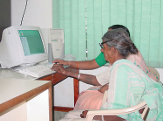
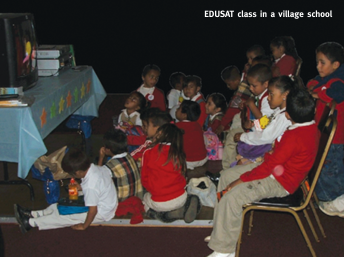
The classroom is ideally provided either with a 29-inch television, a camera and audio equipment, or a computer with an LCD projector. When a learner asks questions, the audio and visual signals get beamed to the satellite which in turn sends them to the teaching end. The network has the facility to record the lessons taught as well as questions asked and store the recording in digitized form to enable running of a virtual classroom. Lessons can thus be stored and retrieved by anyone with access to the computer. As a result, it is possible for a student to revisit and relive the classroom experience.
Andhra Pradesh and Karnataka have made pioneering efforts to generate a rich experience in use of virtual classrooms for capacity building in EDUSAT. Haryana initiated EDUSAT broadcasts on two channels (Science Senior Secondary Schools and College Channels) in 2006. In addition, in 2007, the state launched a full network comprising five channels and covering the entire gamut of education from primary to technical.
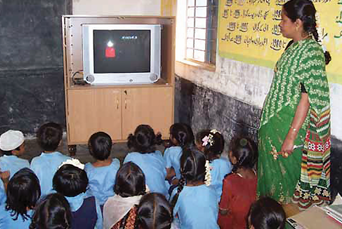
Interestingly, the Primary School Channel in Haryana – intended to cover 14.65 lakh children aged 6-14 in 9,080 schools – is a DTH (Direct to Home) receive-only terminal with 29” colour TVs. With the system having been installed in about 5,000 primary schools, the curriculum aims at English and maths teaching for Classes I, II and V.
The primary school of Aminabad village in Punhana block of Mewat district is one such school located in the socio economic ecology of backwardness, poverty and remoteness. It is largely inhabited by Meos – Hindus who converted to Islam in the 17th Century. My grassroots study of the EDUSAT project running in the Aminabad primary school highlights issues that could be addressed as policy interventions at a national level (see box).
There is tremendous scope for reputed civil society and voluntary communication organizations to enter into public-private partnerships with gram panchayats
Second-generation reforms are currently underway to devolve three Fs (funds, functions and functionaries) to gram panchayats. There is, thus, tremendous scope for reputed civil society and voluntary communication organizations to enter into public-private partnerships with gram panchayats and also dovetail EDUSAT with other forms of community and multimedia communication. In the backdrop of the collaboration between ISRO, IGNOU and HRDM at the national level, such a partnership at the local level alone will ensure that the time lag in operational and managerial hiccups in running EDUSAT in rural primary schools is curtailed.
The vision, undoubtly, is quality interactive teaching at the grassroots level that enables rural primary schoolchildren to become citizens of tomorrow.
Primary steps forward
- The logic of “receive only terminal” at the primary school stage is not understandable. This is the stage when foundational ideas, impressions and the intellect of children, especially from rural areas, in the age group of 6-14 years, are nurtured for higher learning against socio-cultural odds. Thus, there is more need for interactive learning to build their capacities and to enable them to use these communication technologies effectively at the middle and secondary school stages.
- With a “receive only terminal” the role of the class teacher becomes critical. While the audio-visual image on television is a step better than repetitive teaching for rote, the class teacher’s interaction with the taught in a dialogic mode is a must. Hence, with the project commencing in the primary school, the capacity of these teachers as communicators has to be enhanced in, at least, fortnightly orientation workshops at block or district level.
- A major constraint in the functioning of EDUSAT is frequent power cuts or failures. Hence the need to strengthen technical back-up for uninterrupted power supply. In the absence of the latter, classes cannot be held for days at a stretch – defeating the vision of interactive communication at the primary school stage. Often, the delayed response for such technical help comes from the equipment and service providers located at distant locations.
- EDUSAT classes need to be stringently monitored by the District Education Office both in terms of the daily dropout rate of girl children as also the impact on girl children of new workbooks that accompany the class modules. Such feedback studies need to be compiled and analysed in the fortnightly orientation workshops.
- It is extremely pertinent to devolve and decentralize the management, operation and ownership of EDUSAT at the primary school stage to the Constitutionally-backed third tier of rural local self governance, ie the gram panchayats.