

































A joint services approach to military hardware requirements is the solution
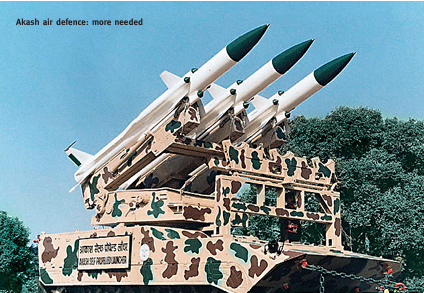
The Indian armed forces’ air defence capability is insufficient to meet all threats from the air is that our capability in this critical field is skewed towards the western border. Other areas do not have adequate air defence resources to provide desired levels of protection. This state of affairs is due to an absence of strategic culture in our country and the reluctance of decision makers to invest national resources in acquiring assets that have no visible impact on “progress” or “development” of the country at large. The fallacy of such a view, flowing from the fundamental misconception that national security is separate from national development, is driven home only when events like 26/11 jolt the nation.
“Air defence” is protection of Indian airspace, territories and territorial waters against hostile air action during both peace and war. During peace, air defence ensures that air activity in Indian airspace conforms to the laws of the land. During war, air defence aims to sustain national will by securing our strategic and military capability and preventing hostile air power from inflicting damage on India’s war-waging apparatus in own or enemy territory. Pre-emption or destroying enemy air power in enemy territory before it can be employed against us could be described as “offensive air defence”.
Air defence is highly time-critical due to the speeds at which modern fighter aircraft are capable of flying. Strike aircraft fly at 900 kmph or 15 km in a minute. That works out to a km every 4 seconds. Therefore an air defence element 45 km inside our border would have only 3 minutes to react to an ingressing hostile strike aeroplane attacking our bases or installations in that vicinity. Actually, with stand-off weapon availability, the time to take action is even lesser. In this short time the hostile ingress has to be detected, identified, intercepted and destroyed.
The air defence system has radars of various types for detection purposes, a friend-or-foe identification process, interceptor aircraft with air-to-air missiles, quick reaction surface-to-air missiles (SAM) or air defence artillery to intercept and destroy the threat. Hostilities complicate this entire process as our own friendly aircraft proceed for attacking enemy targets and on return must be clearly differentiated from enemy aircraft so that fratricide is avoided. These functions are carried out by the Indian Air Force which among the armed forces is primarily responsible for the entire air defence of the country. The Indian Army too has radars, air defence artillery (ADA) guns and missiles to provide organic air defence to strike corps, holding corps and some other national resources during operations. Similarly, Indian Naval ships have “on board” air defence assets to ward off hostile air threats at sea.
The air defence system in India is organized in a manner as to optimize use of all available resources of radars, communication systems, aircraft, SAMs and ADA to provide effective defence to our vital areas (VA) and vital points(VP) and other national resources critical to our war effort. Due to the vast area involved, India is divided into air defence regions in which responsibilities are clearly delegated. Ideally, integration between regions should be seamless and radar cover overlapping to provide continuity to air defence operations. Inadequacy in numbers of air defence radars with secure communication links does not permit this at present.
Air Headquarters is the apex body in the air defence management set-up. Under Air HQ are the five operational commands with delineated regions over which they have authority. Both Air HQ and command headquarters are resource-providing agencies which are kept “in the loop” of air defence activities in real-time through video-streaming of the air defence picture. Actual air defence activities are controlled by air defence direction centres (ADDC) located in the command air defence regions. Detection of ingress by hostile aircraft is carried out by the early warning radar stations under each ADDC or by the personnel of mobile observation flights who are deployed as close to the international border or line of control as is operationally feasible. Decision to get interceptor aircraft airborne or to alert the SAM units is taken by the ADDC as is the final decision to destroy the threat. Air HQ and commands have veto powers. In an ideal situation, radars belonging to the Army, Navy and civil aviation in each region should be integrated, so that a regional radar picture is available at each command and a comprehensive radar picture at Air HQ. Currently, such integration is possible only in a few areas, though integration on a much bigger scale is technologically feasible.
The ADDC has a high power radar (HPR) to continuously monitor the airspace in its area of responsibility. Most of the IAF’s HPRs are old and need to be replaced. In the last few years, the IAF has acquired two aerostat radars from abroad and more are in the pipeline. Except for these, which are in addition to the existing HPRs and deployed in regions bordering our western neighbour, none others are on order. The problem is acute in the Indian peninsular region which does not have a single HPR.
The IAF had to pull out Indra 2 radars from the northern sector and deploy them in coastal areas opposite Sri Lanka…more to shore up public confidence, as detection capability on a limited scale without a complementary ability to intercept and destroy, has little operational relevance
Our radars are ageing and need replacement. Our SAM units of Soviet/Russian vintage are dwindling in number and new flights ordered from Israel will barely suffice for the currently heated up western sector
The absence of a single-point authority for defence acquisitions, based on a joint appreciation of threats and capabilities required, will continue to sub-optimize our military purchases
In 1984 the Southern Air Command (SAC) was created with the specific objective of providing air defence cover to the burgeoning strategic assets in the south. It speaks volumes about our governance that SAC, even today, remains starved of assets like fighter compatible runways, HPRs, SAM units or permanently stationed fighter units to meet the challenges that have grown exponentially. No HPR has been established in this region and when the LTTE air wing began its operations against the Sri Lankan airbases, the IAF had to pull out some of its Indra 2 radars from the northern sector and deploy them in coastal areas opposite Sri Lanka. This move was more to shore up public confidence, as detection capability on a limited scale without a complementary ability to intercept and destroy, does not have much operational relevance.
The need to move radars from one area to another demonstrates the mobility of air defence assets in particular and of air power in general, but also indicates a weakness that we do not have enough assets to provide air defence to cover many areas where threats may develop. In a situation of scarce air defence resources, removing assets from one sector to another means creation of gaps in the sector from which radars have been moved out. It is not as if this problem has not been projected to the decisionmakers. The IAF has for long maintained that a two-front force strength, to meet simultaneous challenges from China and Pakistan, is a necessity for credible deterrence. But in our traditional and bureaucratically less contentious methodology of defence budget allocation, a focussed joint services approach to military hardware requirements for strengthening national security is difficult to achieve. There is a time-honoured way of allocation of resources, which could be tweaked here and there, but never altered significantly to meet emerging challenges. This often results in wasteful expenditure.
A case in point is acquisition of unmanned aerial vehicles (UAVs) by the Air Force, Army and Navy with each service entering into different contracts with the same vendor and losing out on the advantages of joint pressure to beat down costs of acquisition, maintenance infrastructure, spares and training. The absence of a single-point authority for defence acquisitions, based on a joint appreciation of threats and capabilities required, will continue to sub-optimize our military purchases.
China has already built up a formidable long-range air strike capability and our border issues with that country are far from resolution. But in our airbases in the Northeast, only rudimentary air defence resources are available. The IAF needs to strengthen its detection capability in that sector along with deployment of modern fighter aircraft like the Su-30. SAM units have to be located at major airbases and MOFs have to get familiar with the terrain and communications in the area.
But on the ground the situation is somewhat different. Our radars are ageing and need replacement. Our SAM units of Soviet/Russian vintage are dwindling in number and new flights ordered from Israel will barely suffice for the currently heated up western sector. New MOFs cannot be raised because of a ban on manpower increase. There is an urgent need to re-assess our air defence resource requirements and acquire these in a planned manner.
It is nobody’s case that only air defence has to be strengthened. The Army and Navy have their list of deficiencies and accretions based on their threat perceptions. What is needed now is positive governance and a futuristic approach to capability-building. The time has come for India to abandon its archaic approach to military acquisitions, dogged by accusations of kickbacks and underhand dealings. There is a need to look at military capability-building based on what the nation and its security imperatives demand at the cost that the individual service asks for. The priorities have to be jointly decided and acted upon. It is said that nations usually prepare for the last war fought. We need to get out of that mindset and prepare to deal with future threats which are bound to be more complex and challenging. The military must keep a keen eye on our neighbourhood while honing its capabilities. And decisionmakers must ensure that visionary governance transcends all but national interests.