













The heartwarming irony is that he aims to remove the importance of dynasty in Indian politics
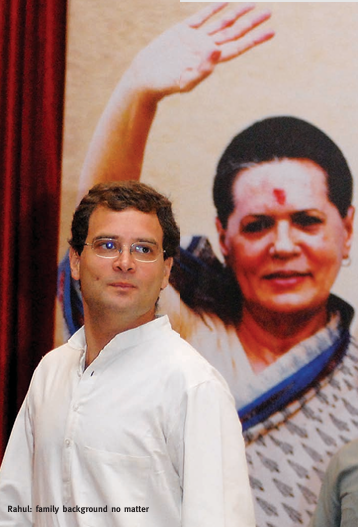
Rahul Gandhi, a fifth generation politician from the Nehru-Gandhi dynasty, has truly arrived on the political scene. Highly perceptive and a quick learner in the cut-throat world of politics, he has earned his spurs with his role in the leadership of the Congress paying rich dividends in the Lok Sabha elections.
Rajiv Gandhi was pitchforked into the nation’s highest office overnight at the age of 40 but it is obvious that Rahul is in no hurry to become Prime Minister. He is more keen on restoring the Congress to its past glory and wants the party to govern on its own rather than being saddled with a disparate coalition. The Congress, which was in the vanguard of the freedom struggle and ruled the country for four-and-a-half decades, has witnessed steady erosion of its pan-India base with, among other factors, its traditional vote-bank of minorities, the poor and the oppressed migrating to what they believed were greener pastures under the patronage of regional satraps.
Rahul’s mission is to put the Congress on a strong footing in UP and Bihar, which account for 120 seats in the Lok Sabha. Simultaneously, he wants to focus on Gujarat and see the back of the BJP’s Narendra Modi as Chief Minister. Repeatedly asserting that he is not ready for the top job, he wants to build a strong second-rung leadership. He insists he has unfinished work which might take a few years. He wants to undertake an extended Bharat yatra to “rediscover” India and assimilate what its youth has to say. As for taking it one step at a time by becoming Congress president first, it seems that, like Indira Gandhi, he would prefer to hold both posts together. He became General Secretary of the Congress in 2007 and took charge of the Indian Youth Congress and its students wing, the National Students Union of India (NSUI).
His abiding characteristic is his outspokenness even if, at times, some politicians and political pundits detect an underlying political naivete. Yet the Congress leadership feels his press conferences all over the country have shown he is Prime Minister material. Sister Priyanka notes that he is not given the credit he truly deserves. She also recalls how Indira Gandhi doted on him.
His steely determination is reminiscent of Indira Gandhi. Rahul began planning for the 2009 election soon after the general election in 2004. Now, he has set his sights on the 2014 election. There is ample indication that if the Congress wins comfortably five years hence, he might become Prime Minister. Till then, he prefers to work for the youth and endeavour to transform the politics of this country. Part of the system in which the Congress is still led by a Gandhi, he is aware that his position in the party affords him certain privileges. He emphasizes that success in politics in this country depends on “who you know or are related to”. “I want to change that system,” he says, and the sincerity and humility are striking.
That is where Rahul believes he can play his most contributory role in galvanizing the Congress, involving the youth – especially the meritorious – from all backgrounds. This energetic brigade will be in the forefront of bringing about a qualitative change in the political environment and giving impetus to development.
Part of the Congress’ success in these elections was Rahul’s calculated gambit to go it alone in Uttar Pradesh, jettisoning the Samajwadi Party which was upping its ante time and again. And the Congress won 21 seats out of the 80 in UP. He may not have created a storm in UP or set the Yamuna on fire in Delhi but this was the first time in 18 years since 1991 that the party was well ahead of its tally in the last general election. Its vote share has nearly doubled from 10 to 18 per cent. Voters also saw through Bahujan Samaj Party supremo Mayawati and Samajwadi Party chief Mulyam Singh Yadav pandering to Dalits and Muslims. The latter community found it was only being exploited for political gain and switched to the Congress. The Brahmins too left the BSP high and dry and threw their weight behind the Congress.
Perceived as a new ray of hope for the Congress, Rahul is endowed with charisma. The dimpled and bespectacled boy came to terms with grief at an early age, when his grandmother was killed. At 21, he faced another family tragedy – the assassination of his father. Schooled at his father’s alma mater, Doon School, he did History honours at St Stephen’s College. He attended Trinity College at Cambridge and has an MPhil in development economics. Before returning to India in 2002, he worked in a strategy consultancy firm.
Rahul has inherited his father’s love of speed. He often travels 25 km out of Delhi to race a Yamaha R-1 on a specially built and camouflaged racing track. He is believed to be fond of Kawasaki Ninjas also.
The country’s most eligible bachelor guards his privacy zealously. There is a veritable iron curtain around him. Even his friends and immediate family are unwilling to give out details about his personal life. It is said that his mother and sister are keen that he marry soon. But, just as he is in no hurry for Prime Ministership, neither is he for matrimony.
The Rahul brigade
This handpicked team includes economists, those with a pulse on politics, MBAs from Wharton, media-related pointspersons, political mentors, lawyers and a biochemist.
The political group includes Congress General Secretary Digvijay Singh and economist-cum-politician Jairam Ramesh. Madhya Pradesh CM for two terms, “Diggy Raja” decided to work for the party for the next decade. He defeated his brother, Lakshman Singh of the BJP, from Rajgarh. Digvijay is embarrassed at being described as Rahul’s political mentor. He says Rahul has a mind of his own. Ramesh has worked in various capacities in the party and government. He resigned as an MOS in the previous UPA government to be in the Congress war room for the general election, where Sonia Gandhi wanted him. He is also economic adviser to several state governments.
Kanishka Singh, who came to Rahul’s notice through a magazine article, is the son of SK Singh, Governor of Rajasthan and former Foreign Secretary. Sachin Rao is the son of an IAS officer. Kanishka studied at Wharton while Sachin went to Michigan Business School.
Meenakshi Natarajan, who became an MP from Mandsaur in Mandhra Pradesh at Rahul’s insistence, is an NSUI activist. She has a degree in biochemistry. Jitendra Singh is MP from Alwar and two-time Rajasthan MLA. Rahul sent him on a grinding tour of 17 states to change the image of the Youth Congress to a meritocracy. Filmmaker Pankaj Sharma made a documentary on the Gujarat riots. He oversees media-related matters.
Rahul’s friends Milind Deora and Jitin Prasada organized informal workshops on politics. Jitin played a key role in UP.
Veerappa Moily is believed to be close to Rahul even though he was shunted away to Bangalore for attacking Bihar CM Nitish Kumar. Sources say this was playing to the gallery. He is now a Central minister.
Among those handpicked by Rahul to contest is PM Sayeed’s son, Mohammad Humdullah Sayeed, who is now MP from Lakshadweep, which his father represented for eight terms. He is a graduate of the Indian Law Society, Pune. Ravneet Singh Bittu, grandson of former Punjab CM Beant Singh, is the MP from Anandpur Sahib. Last year, he was elected president of the Punjab Pradesh Youth Congress. Vijay Inder Singla is the MP from Sangrur. He was instrumental in going through with the democratic election in the Pradesh Youth Congress. Jyoti Mirdha, MP from Nagaur in Rajasthan is the granddaughter of Congress veteran Nathuram Mirdha who represented Nagaur five times in the Lok Sabha. Mausam Benazir Noor (Malda North) is the niece of ABA Ghani Khan Choudhury.