













The gentle, diligent Bengali has proved himself a great survivor as well as an invaluable member of party and government
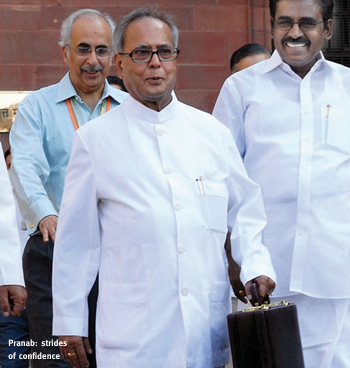
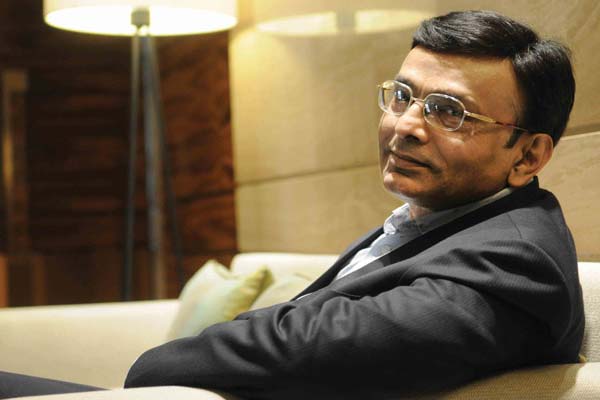
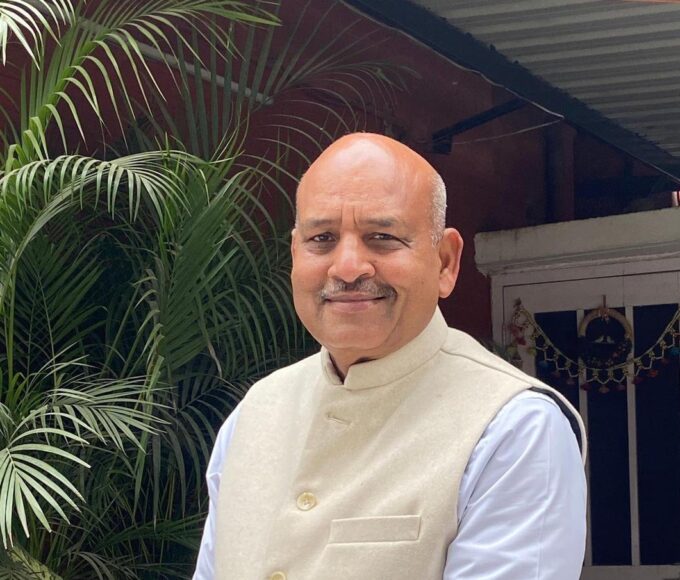
Union Finance Minister Pranab Mukherjee is, to use an unavoidable cliché, truly a man for all seasons. Peering at decisions through the prism of a politician, he is reliably present to extricate the Congress party from any situation. But his greatest asset is his knack for taking calculated risks for, when something catches the people’s fancy, the party romps home at the hustings. Though Pranabbabu continues to be a strong votary of single-party rule, he has adapted easily to the reality and compulsions of coalition politics, articulating government policies in a manner that secures the political advantage for his party. A workaholic, he has headed over 50 Groups of Ministers dealing with crucial issues.
Simply put, Pranabbabu is such an indispensable part of the Congress-led UPA government that impartial observers accuse him of virtually running it. The lurking doubts about his loyalty to the Nehru-Gandhis is buried in the past. Today, Pranabbabu is acknowledged as a party apparatchik and highly respected, with a reputation as a number-crunching politician with a phenomenal memory and unerring survival instinct. After Sonia Gandhi reluctantly decided to join politics, he was one of her key mentors – citing instances of how Indira Gandhi functioned.
But the path to attaining this was at times littered with thorns. The mild-mannered politician from Bengal faced such setbacks with equanimity, without lifting a finger at anyone. After the assassination of Indira Gandhi and the installation of an unwilling Rajiv Gandhi as Prime Minister, Pranabbabu suddenly found himself in the political wilderness. The Rajiv coterie perceived him as harbouring Prime Ministerial ambitions and posing a threat. Remaining low key and free of controversy, Pranabbabu floated his own party – Rashtriya Samajwadi Congress. Later, he merged it with the Congress after convincing Rajiv that the suspicions about him were unfounded. His political career revived with PV Narasimha Rao becoming Prime Minister in 1991. Pranabbabu was appointed Deputy Chairman of the Planning Commission. He was given the External Affairs portfolio for the first time in 1995-1996. In 1997, he was voted “Outstanding Parliamentarian”.
Loyalty as well as competitiveness has led to his proximity to Sonia Gandhi and Prime Minister Manmohan Singh. After the Congress returned to power in 2004, he became Defence Minister but his crowning moment came during the passage of the Patents Amendment Bill. The Congress was committed to passing it while the Opposition and Left parties supporting the UPA government from outside opposed the monopoly aspects of the Intellectual Property Rights. Roped in for negotiations, Pranabbabu drew on old friends like CPI(M) stalwart Jyoti Basu and formed new intermediary tie-ups. He also had to convince some Congress Ministers like Kamal Nath. Memorably stating at one point that “it is better to have imperfect legislation than none at all”, his efforts were rewarded when the Bill was finally approved in March 2005.
He still expresses regret, privately, that the Left withdrew support over the Indo-US nuclear agreement at the fag end of the UPA’s first tenure. It has been his only failure
Noticeably, Pranabbabu has excellent relations with leaders across the political spectrum and thus has been the Congress’ main trouble-shooter. He has been consistently in the forefront in evolving consensus within the Congress as well as with its allies, especially the Left. Tasked with keeping the Left on board during the first UPA government, he managed to do it for four-and-a-half years. He still expresses regret, privately, that the Left withdrew support over the Indo-US nuclear agreement at the fag end of the UPA’s first tenure. It has been his only failure. He says the parting of ways was due to the Left’s adamant stand, which did not become it especially as it is unable to implement its ideology.
After the UPA’s return to power this year, Pranabbabu’s good offices were again sought to keep Trinamool Congress chief Mamata Banerjee in good humour and impress upon her to join the government. Sonia Gandhi praised his contribution in bringing the UPA back to power and Leader of the Opposition LK Advani said that without Pranabbabu in their ranks, the UPA would not have completed its five-year term. Former Union Minister and key election strategist for the BJP Arun Jaitley added that Pranabbabu is one of the country’s best politicians.
Now a septuagenarian, he is the son of Kamada Kinkar Mukherjee, who was a member of the AICC and also of the West Bengal Legislative Council from 1952-64. President of the Birbhum District Congress Committee, Kamada Kinkar was a freedom-fighter who spent 10 years in prison. Pranabbabu acquired postgraduate degrees in history and political science, and also became a lawyer. He began his career as a college teacher and then dabbled in journalism, working for the Bengali publication Desher Dak (Call of the Motherland). His political and parliamentary career has spanned nearly four-and-a-half decades. He first became a Rajya Sabha member in 1969, and was re-elected in 1975, 1981, 1993 and 1999.
Rated as the world’s best Finance Minister by Euromoney magazine, his term became notable when India did not withdraw the last instalment of $1.1 billion of an IMF loan. Manmohan Singh was then RBI Governor
In 1973, he joined the Union Cabinet as Deputy Minister of Industrial Development – by accident. He had gone to Rashtrapati Bhawan to attend the swearing-in and was included when the number of Ministers was found inauspicious. He made a mark and rose through a series of Cabinet posts to become Finance Minister in 1982. Rated as the world’s best Finance Minister by Euromoney magazine, his term became notable when India did not withdraw the last instalment of $1.1 billion of an IMF loan. Manmohan Singh was then RBI Governor.
Pranabbabu has been president of the West Bengal Congress Committee since 1985. In 2004, he became Lok Sabha leader, having won his first Lok Sabha election from Jangipur, West Bengal. He retained the seat this year. He has headed a host of high-profile Ministries such as Defence, Finance, External Affairs, Commerce and Industry, Economic Affairs, Revenue, Shipping, Transport and Communication. He also leads the Congress Parliamentary Party as well as the Congress Legislature Party.
His distinguished legacy includes the historic Indo-US nuclear agreement. He has been a member of the Board of Governors of the IMF, the World Bank, the Asian Development Bank and the African Development Bank. In 1984, he chaired the Group of 24 attached to the IMF and the World Bank. He has also presided over the Saarc Council of Ministers Conference. Known for his clean image, during a 1998 interview he was asked about sleaze in the Congress government and observed that corruption was an issue and not confined to the Congress.
Ironically, he was considered for the office of President of India but then left out as his contribution to the Cabinet was indispensable. He was awarded the Padma Vibhushan in 2007.
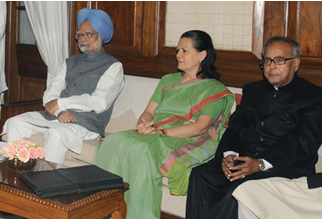
Today, he visualises a bright future for Rahul Gandhi, who calls on him frequently to discuss political strategies and learn from his vast experience as a quintessential politician. His innate ability to articulate policies in simple but meaningful political language and to take risks in the larger interest of the aam aadmi has added a new dimension to the Congress. Like Rahul, he feels the Congress should go it alone in the Hindi heartland.
Pranabbabu had at one time envisioned being Chief Minister of West Bengal. Now, with the Left Front crumbling in its bastion after over three decades, the Assembly elections in 2011 are likely to bring the Congress-Trinamool combine to power. Will destiny at last fulfil Pranabbabu’s wish?
A conscientious politician
Pranabbabu pushed for the loan waiver for farmers amounting to Rs 75,000 crore despite widespread scepticism in the Cabinet. As Finance Minister now, by his own admission he has taken another risk by pumping in a huge sum for social welfare schemes, infrastructure and the like to kickstart the economy in the wake of the global financial meltdown. He belied the expectations of coming forward with radical proposals to turn things around but instead preferred a sober approach and expressed confidence that the returns will be commensurate with the investments.
Given the freedom to pick a Ministry, he chose Finance in order to ensure continuity as he had presented the interim Budget before the April-May general election.
Pranabbabu describes his election to the Lok Sabha late in his career as a late marriage. And he nurtures his constituency like a baby. He is in Jangipur every weekend barring the odd occasion when he has crucial work in Delhi. He does not like his supporters and others from West Bengal being seen in Delhi and makes it a point to meet them in Kolkata. This has led to the joke that there can be no side-stepping the Bengal connection as everything must begin from Jangipur.
He has steered clear of having a coterie around him. His friends are people outside politics. A religious person, he is upset by people not understanding him.