




















Or, how the drama at Jantar Mantar was stage-managed
The simmering public anger against the massive scams and horrendous corruption in the country had unnerved the powers-that-be and their patrons. Something needed to be done to water down the fury before it boiled over. A play had to be enacted for the purpose and a “messiah” manufactured to deflect the people’s attention.
The play had all the trappings of a Bollywood blockbuster. With well-choreographed hype, orchestrated by the electronic media, a bunch of anti-corruption “heroes” converged on Jantar Mantar in Delhi. What followed was singing, chanting and candle-lighting across cities and towns with socialites and movie stars rooting for the Jan Lokpal Bill! The villain – the Government of India – went through the motions of a fight and capitulated with the notification setting up a joint drafting committee. It all happened in a jiffy!
The media declared victory in the “war against corruption” and proclaimed “Armyman-turned-Gandhian” Anna Hazare a messiah. He in turn declared that the Bill alone will “eliminate 95% corruption in the country”. Days later, still seemingly under the effect of the media hypnotism, he boasted that if he had continued his fast for three more days, the government would have fallen.
For the newly ordained messiah it is nothing less than the “second freedom struggle”. If only he had elementary knowledge of India’s post-Independence history, he would have known that the country’s original freedom, achieved on the midnight of 14-15th August, 1947, ended on the midnight of 25-26th June, 1975, when the President of India signed a crisp four-line proclamation imposing a state of Emergency in the country, stating, the “security of India is threatened by internal disturbances.”
He should have at least known that the Emergency was a direct sequel to the massive movement against corruption and maladministration started by the students of Bihar and Gujarat in 1973, and later spearheaded by Loknayak Jayaprakash Narayan or JP. The Emergency and the snuffing out of freedom in the country brought about a direct confrontation between Prime Minister Indira Gandhi and JP, who was jailed. While the former was the epitome of power and pelf, the later abjured all desire for power but wielded immense moral authority. By the time the confrontation ended in March 1977, JP had won with India regaining its freedom.
Acknowledging this, veteran journalist Kuldip Nayar writes: “He (JP) wasn’t built to be a hero: slight of figure, racked by illness, battle-worn. Yet, he proved to be the outstanding hero who won us the second freedom in 1977, 30 years after the first one.”
So how could Hazare claim to spearhead the “second freedom struggle”? Since when do we need a “freedom struggle” to draft a legislative Bill? Have the freedom movements led by the first and second “Mahatmas” become so cheapened? Is Hazare so naïve that he does not know about JP, his movement, the resultant Emergency and the regaining of freedom in 1977? Or is it just a media ruse to take the sting out of the anti-corruption movement and in the process wipe out memories of Emergency, which is a standing stigma on the ruling dispensation?
Be that as it may, on the table is civil society’s “Anti-Corruption, Grievance Redressal and Whistleblower Protection Bill, 2010” that aims to replace the existing, mutually exclusive anti-corruption agencies with a single, autonomous Lokpal combining within it the vast powers and mandate of the CBI and the CVC, and having jurisdiction over Ministers, bureaucrats and judges. Eleven members of the Lok Pal will be selected by judges, citizen-representatives, Constitutional authorities and Magsaysay awardees and not by politicians. Whistleblowers, currently under the supervision of the CVC, will also come under the protective purview of the Lokpal.
Prominent civil society leaders have already pointed out serious flaws in the draft Bill and have expressed fears that the proposed Lokpal could turn into a Frankenstein’s monster. Former Chief Justice of India JS Verma wondered if the envisaged draft would not amount to amending the basic structure of the Constitution. Chief Information Commissioner Satyananda Mishra is of the view that “prima facie the Bill appeared to have been drafted without any understanding of how the government functioned”. There is consensus that the Bill should take into account “the concerns and priorities of as many individuals and groups as possible” and not just the conflict-ridden five-member drafting committee.
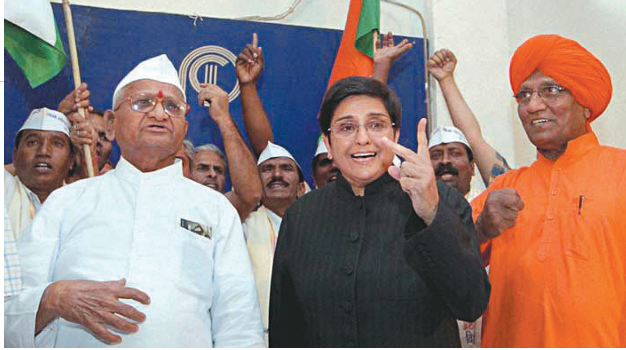
But India Against Corruption (IAC), the makeshift outfit that propped up Hazare, is not interested in such consensus-building. It has hijacked and short-changed the on-going anti-corruption movement. For over a decade, the Gandhian Seva & Satyagraha Brigade (formerly Lok Seva Sangh) led by the 93-year-old Shambu Datt (who participated in the Quit India and JP movements) has been pursuing a three-point anti-corruption agenda. Besides enactment of a stringent and deterrent Lokpal Act, the agenda included disqualification of corrupt or criminally charged candidates in Parliamentary and Assembly elections as well as confiscation of illegally acquired property of politicians, bureaucrats and businessmen.
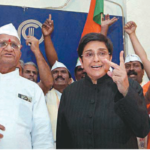
In pursuance of these demands, Datt and four octogenarian colleagues commenced a fast unto death on January 30 this year. They were dissuaded by an IAC team comprising Swami Agnivesh, Arvind Kejriwal and Kiran Bedi with the promise that they would work with the Satyagraha Group in chalking out and pursuing a comprehensive anti-corruption agenda and launching a common struggle. Based on this promise, the Gandhian fast was postponed for three months. The IAC proponents then went ahead and created a “messiah” through the media-hyped fast unto death by Hazare with just a single point agenda.
The ruling Congress party facilitated this task by appearing gracious, and the BJP too appeared pious and condescending. In the process, the current ruling elite stage-managed its own triumph by crafting a “sensitive” response to a television-media conjured popular upsurge, thus expending the public fury against corruption. Having done do, this elite, with the help of the same media, set upon demolishing the credibility of the civil society representatives in the joint drafting committee by indulging in character assassination. The motive is obvious: to derail the Lokpal Bill. The cumulative effect is the weakening of people power and the strengthening of state power. What a travesty!
With the kind of governments we have, “manufactured messiahs” cannot combat corruption. India could do better without them!
(The views expressed are personal)

IAS (retd) with a distinguished career of 40 years - worked in Army, Govt, Private, Politics & NGOs.