















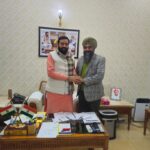


THREE things distinguish Naveen Patnaik in the highly uncertain and changing political map of India. First, he entered politics as a novice and unknown entity through his unexpected succession to the legacy of the legendary Biju Patnaik who never projected any of his three children—Gita, Prem, Naveen—as his political heir. Second, he is the only elected leader and head of a government for a decade, who does not speak or write the language of the people he represents.
Third, he is the most popular Chief Minister, untouched by corruption. His popularity matches that of his father in the 1960s. However, Biju was dogged by corruption charges for which a Commission of Inquiry was appointed. The qualitative difference between Biju’s and Naveen’s popularity is that people loved Biju even though he was not always successful in securing votes. Naveen is successful in bagging votes.
On the basis of this, he is expected to emerge after the general election as a regional force, which his father unsuccessfully attempted under the banner of the Utkal Congress in 1971. He has stunned the saffron brigade by severing his decade-old links with the BJP and joining hands with the Left Front in the run up to the Parliamentary election coupled with the Assembly polls in Orissa. It was a calibrated move in tune with the pulse of the people and can lead to the Biju Janata Dal’s presence being felt in Delhi in the critical numbers game (the Third Front with the Left in the vanguard will also benefit). And, even though Naveen has kept his counsel to himself about any Prime Ministerial ambitions, his confidants and supporters insist he has the credentials and the lineage to aspire for the office on Raisina Hill.
The adieu to the BJP was waiting to happen after the Sangh Parivar’s carnage in Kandamal following a sadhu’s killing. He initially did not take firm action because of the alliance with the BJP, provoking the worst criticism of his political career. When the Centre threatened intervention, Naveen finally moved.
In hindsight, the BJP could not have been anything but a strange bedfellow for Naveen. He has never been its fan but appears to have been impressed by Atal Behari Vajpayee’s charm and liberalism. Yet, he had not bargained for the Sangh Parivar trying its Hindutva experiments in Orissa as in Gujarat and Rajasthan.
The adieu to the BJP was
waiting to happen after
the Sangh Parivar’s car
nage in Kandamal follow
ing a sadhu’s killing. He
initially did not take
firm action because of
the alliance with the BJP

The Left too had a role in Naveen’s decision. West Bengal CM Buddhadeb Bhattacharya had been reiterating that the BJP’s game was to gobble the BJD. On the sidelines of the CMs’ meet following the Mumbai terror attack, he reminded Naveen that his father was secular to the core and anti-BJP. This was followed by CPI(M) General Secretary Prakash Karat saying the same thing. Interestingly, while Naveen has embraced the Left in 2009, his father lost a second term as CM in 1995 because he ejected the Left Front as a partner.
Naveen is also convinced that, owing to proximity to West Bengal, there is progressive thinking among educated people in Orissa and a farmers’ movement akin to that in the Left Front-ruled state. A section of people in Orissa have Communist leanings. The combination of such factors has resulted in Naveen losing clout with a sizeable section of the people. After Kandamal, he would have lost the confidence of the people if he had not broken free from the BJP.
His decision to part company with the BJP risks splitting the anti-Congress vote. The BJP had no alternative but to go it alone in Orissa. It had a vote share of 18 per cent in 2004 and is unlikely to win enough seats in these Assembly polls to force the BJD to do business with it once again. Meanwhile, the Congress replaced old warhorse Janaki Ballabh Patnaik with former Union Minister KP Singh Deo as PCC chief. This is bound to have a positive impact on the erstwhile princely provinces and cut into the BJP vote share in tribal areas. Tribals who have traditionally backed the Congress constitute 27 per cent of the population.
Naveen is also convinced
that, owing to proximity
to West Bengal, there
is progressive thinking
among educated people
in Orissa and a farmers’
movement akin to
that in the Left
Front-ruled state
If Naveen is perceived as comfortably placed ahead of the polls, it is because he has earned the respect of the people, not just by virtue of lineage but also due to his personal qualities and by returning to his father’s ideals of secularism, communal harmony and upliftment of the weaker and oppressed classes through sustained development. Yet, there are lessons for him in his father’s career. Biju had statesmanlike qualities that endeared him to the electorate of Orissa. Nevertheless, the same voters trounced him in 1967 and in subsequent elections when they felt he was taking them for granted! So the current saying, “Naveen is the boss, even a dog will win in his name” has to be taken with a pinch of caution.


