

















Caution is advisable in our dealing with US intelligence, as much as with Pakistani intelligence
Indian intelligence officers feel (visit of ISI official) would enable the ISI to gain knowledge of Indian tactics and procedures, and enable it to cover up its tracks
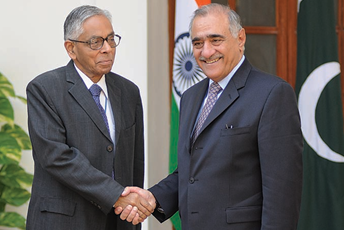
The demand by Prime Minister Manmohan Singh that Pakistan send the Director General of its Inter Services Intelligence (later watered down by President Asif Ali Zardari under pressure from the Pakistan Army to mean a Director-level officer of ISI) has been opposed by a section of Indian intelligence officers who feel this would enable the ISI to gain knowledge of Indian tactics and procedures, and enable it to cover up its tracks.
After the Mumbai blasts of March 1993, both the US and China proposed a meeting between the chiefs of ISI and India’s Research and Analysis Wing to settle RAW’s allegations of ISI involvement. But then Prime Minister PV Narasimha Rao rejected this proposal on the advice of intelligence officers who argued that the ISI would be able to find out what evidence the Indian police had been able to collect – and how – and then cover up its tracks.
While the visits to India of US Deputy Secretary of State John Negroponte (who was the first head of the Directorate of National Intelligence) and current Director of US National Intelligence Mike McConnell are gratifying, India should keep in mind that US intelligence agencies are primarily interested in protecting their own interests. As soon as India ceases to serve their purposes, they will no longer take any interest in our welfare.
Indeed, cooperation between US and Indian intelligence agencies has gone through several ups and downs through the decades, and several old-time Indian intelligence officers are wary of relying too much on US intelligence agencies.
Indian and American intelligence agencies began cooperating in a limited way in the early 1950s on issues such as communist and secessionist activities in and around India. This intensified after the 1962 China War. US intelligence agencies had long been interested in the unstable and secession-prone Northeastern states for several reasons. In addition to pursuing their own agenda of destabilizing India while ostensibly cooperating to fight communism, from the early 1950s to the late 1970s they used the Northeastern region as a base for electronic and signal surveillance of the communist regimes of China, Laos, Cambodia and Vietnam. Their influence faded in the 1980s due to the degradation of their HUMINT (Human Intelligence) capabilities.
India has had some unfortunate experiences with US intelligence agencies.
Immediately after the Mumbai explosions of March 1993, India sought the assistance of experts from Austrian and US agencies for examining hand grenades of Austrian origin and a chemical timer of US origin recovered from the blast sites.
The Austrian experts examined the grenades at the blast sites itself. The Austrian government gave India a signed official report that these grenades had been manufactured in a Pakistani ordnance factory with technology and machine tools sold by an Austrian company to Pakistan’s Defence Ministry. Austria also told India that it was free to use this report to build its evidence about the complicity of Pakistan’s Inter Services Intelligence in the Mumbai blasts.
But the US experts insisted that the chemical timer could be examined only in a particular specialized forensic laboratory in the US. They repeatedly insisted that Indian forensic laboratories lacked the necessary technology and equipment. Indian intelligence officials became suspicious because the US claims were excessively vehement, and were therefore reluctant to cede possession of the timer. Then senior functionaries of the US government gave their personal word of honour to their counterparts in the Indian government that the timer would be returned intact to India after examination, whereupon India permitted them to take it.
After several weeks, they sent India an unsigned report which stated that the timer was indeed of US origin and was part of a consignment given by the US to Pakistan’s ISI for being passed on to the Mujahideen during the anti-Soviet campaign in Afghanistan in the early 1980s. But the US specified that India should not use this unsigned report for any purpose.
India pointed out that this timer was the clinching incontrovertible evidence which it had long been seeking about ISI sponsorship of terrorism in India.
But the US officials retorted that there were widespread diversions or thefts of weapons from Pakistani Army arsenals to hundreds of arms dealers, and that Dawood Ibrahim and the other suspects in the Mumbai blasts “very probably obtained the timer from one of these hundreds of arms dealers without even one single ISI officer being aware of it”.
When the Indian officials asked the US officials to return the timer, the latter claimed that the timer had been ‘accidentally destroyed during testing by a young scientist’
When the Indian officials asked the US officials to return the timer, the latter claimed that the timer had been “accidentally destroyed during testing by a young scientist”.
Several Indian intelligence officials were of the view that this timer was not of Afghan war vintage of the early 1980s but was made around 1990-92, and would have exposed to India the close involvement of US agencies with ISI.
In sharp contrast to this experience with the US was that of the cooperation India received from the West German government when Dubai captured the Khalistani hijackers of an Indian Airlines flight. The revolvers recovered from the Khalistani hijackers were of West German origin. India and Dubai sent these revolvers to Germany for forensic examination. The German government provided India a signed report that these revolvers were part of a consignment which a West German company had sold to the Pakistani Army.
Like the Austrians, the German government told India that it was free to use this report to build its evidence of ISI complicity in the Khalistan secessionist movement.
Soon after the timer incident of 1993, Indian intelligence officials, under the orders of then Prime Minister PV Narasimha Rao, provided the US a detailed dossier of Pakistan’s involvement in terrorism in Kashmir and Punjab. India had then wanted the US to notify Pakistan as a state sponsor of terrorism.
But the US officials refused to accept this dossier, stating that a large portion of the evidence collected by India was based on interrogation of captured militants: “We all know how your Indian police use torture to extract confessions.”
After the embarrassment of the defection of the Joint Director of RAW, Ravinder Singh, to the US in 2004, another unhappy experience was the utilization of the Indo-US Cyber Security Forum, a subgroup of the Joint Indo-US Working Group on Terrorism, to penetrate the Indian government.
In the summer of 2006, Shib Shankar Paul, a systems analyst at the National Security Council Secretariat, his superior, Commander Mukesh Saini, and Brigadier (Retd) Ujjal Das Gupta, head of the computer section of RAW, were arrested under the Official Secrets Act, for allegedly passing on information to Rosanna Minchew, an American diplomat.
Minchew, a coordinator of the Indo-US Cyber Security Forum, was reportedly an intelligence officer under the diplomatic cover of third secretary in the US embassy in New Delhi. She left India in the summer of 2006.

The Indian government would do well to recall the guidelines which Ram Nath Kao, the founder of RAW, had formulated to govern cooperation with foreign intelligence agencies:
- Each and every instance of intelligence cooperation with a foreign country should be with the personal clearance of the Prime Minister, who should be kept constantly informed of all actions taken.
- All intelligence cooperation should be only through the Research and Analysis Wing, which would act as the nodal agency, maintain written records of all contacts with foreign intelligence agencies, and act as the interface between foreign intelligence agencies and Indian agencies needing their assistance.
- Foreign intelligence agencies should not be allowed to interact directly with any government department, agency or individual officer, bypassing RAW under the pretext of facilitating counter-insurgency or counter-terrorism cooperation.
Following Kao’s guidelines, RAW maintained detailed records of all interactions with foreign intelligence agencies in one secure location, periodically reviewed the usefulness of the intelligence cooperation, and kept the Prime Minister continually informed.
The writer, an alumnus of Carnegie Mellon and IIT, Kanpur, heads a group on C4ISRT (Command, Control, Communications and Computers Intelligence, Surveillance, Reconnaissance and Targeting) in South Asia

Ravi Visvesvaraya Sharada Prasad is a computer scientist and author. He writes on technology and historical events in post-independent India. He is Associate Editor at gfiles.