



























The commando force needs some state-of-the-art equipment
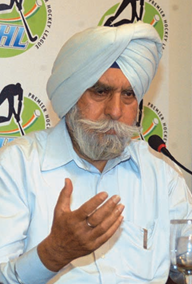
Just as the entire nation was showering adulation on the National Security Guards, they came in for harsh criticism from former Director General of the Punjab Police KPS Gill, who has been credited with ending militant activities in Punjab.
Widely hailed for leading Operation Black Thunder, carried out by the NSG at the Golden Temple in Amritsar in May 1988, Gill said: “I am deeply ashamed of the role of the NSG. The operation to free the Taj hotel lasted for over 60 hours, and still the commandoes failed to nab any of the terrorists alive. The shoddy conduct of the operations to ferret out a handful of terrorists ensconced in built-up areas had taken too long a time, and had failed to prevent the casualties of hostages.”
Gill contrasted the Mumbai operations with Black Thunder: “I am reminded of Operation Black Thunder, which was a very successful NSG operation under me at the Golden Temple. The terrorists surrendered and not a single life was lost.”
However, Sarabdeep Singh Virk, currently Director General of Police in Maharashtra, who had been seriously injured in Black Thunder, had this tosay about the Mumbai operations: “There was absolutely no way in which we could have assessed the capacity of the terrorists. Nobody was ready for such a sustained operation by a suicide squad.”
Indeed, the major difference between Black Thunder and the Taj and Oberoi operations was the amount of preparation. Gill, Virk, and MK Narayanan (then Director of the Intelligence Bureau) had years to prepare for Black Thunder after Blue Star in 1984 and another small operation in 1986. Moreover, they had detailed maps of the Golden Temple, and were able to formulate a three-stage plan – 1) Clear the Serai building; 2) Then enter the langar and clear it, and 3) Then attack the Khalistani terrorists holed up in the sanctum sanctorum. They were also able to formulate an exit plan.
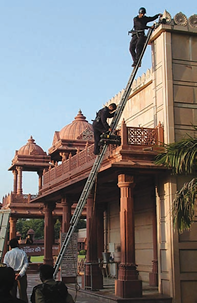
One of the key factors for the outstanding success of the NSG during the Akshardham siege in September 2002 was that the priests were able to immediately provide the NSG with detailed layout maps
In contrast, the NSG did not have time to plan for the Taj and Oberoi attacks. In fact, the NSG has claimed that they were not provided detailed layout maps of the Taj hotel. It is shocking that the management of the Taj could not provide its layout maps promptly. In fact, one of the key factors for the outstanding success of the NSG during the Akshardham siege in September 2002 was that the priests of the Swaminarayan temple were able to immediately provide the NSG with detailed layout maps and telecommunication facilities.
Indeed, the Indian Army’s expertise in urban warfare has been hailed all over the world, since they have handled more incidents than Britain’s Special Air Services or the US’ Berets. Over 1,500 foreign soldiers from 26 countries have been trained at the Counter Insurgency & Jungle Warfare School (CIJWS) at Vairengte in Mizoram. In July of this year, 30 US soldiers underwent a three-week training programme in low-intensity guerrilla warfare at the CIJWS. The US soldiers shared their experiences in tackling urban terrorism in Iraq and Afghanistan, while the Indians passed on the tactics used in Jammu and Kashmir, and the Northeast. Earlier, in 2003, 100 US commandos had completed a three-week anti-insurgency combat training course at CIJWS.
While the Indian Army’s Tactics, Techniques, and Procedures (TTPs) for dealing with urban terrorism are among the best in the world, where it can learn from the US is in developing equipment and technologies for the urban warfighter (see box).
The Defence Research and Development Organization (DRDO) should immediately begin to develop new technologies specifically suited to Indian urban warfare conditions, as well as strong, flexible, light-weight body armour; acoustic sniper detection devices; and optical equipment that will allow commandos to look around corners.
Tactics, Techniques, and Procedures (TTPs) for Military Operations on Urbanized Terrain
• Helicopter assaults are vulnerable to shoulder-fired surface-to-air missiles and rocket-propelled grenades….
• Artillery and air-to-ground shells fall at too shallow an angle to be effective in densely built-up areas….
• It is preferable to attack at night since terrorists do not usually possess night vision equipment….
• Streets and open spaces between buildings are killing zones. Use smoke cover when moving through these areas….
• Avoid windows, doors, and hallways….
• Deciding where to enter a building is critical. The rule of thumb is to enter at the highest floor possible to minimize the amount of upstairs fighting and to avoid enemy heavy-weapons positions, which will usually be located on lower floors….
• Avoid entering through doors and windows because they are usually covered by sniper fire or boobytrapped. It is preferable to breach walls by explosives, and then enter….
• Once inside the building, the first task is to cover with automatic
weapons the staircases leading to upper floors and the basement; and,
second, to seize rooms that overlook approaches to the building….
• Avoid, unless absolutely necessary, throwing grenades at upper windows or upstairs; they may bounce back….
• Frequently, stairways will be boobytrapped…Stairs are usually covered by enemy fire, and defenders can throw grenades into the stairwell…Avoid stairways whenever possible….Select rooms that have ceilings intact and place an explosive charge against the ceiling…The resultant explosion should kill or stun defenders and provide access to the next floor….
• When entering a room do not open doors by hand or attempt to kick
them open…Shoot the door open by firing several rounds through the
lock or blow the door in with explosives…Throw a hand grenade into the room…After detonation, one man should quickly enter, spray the room with automatic fire, and take up a position from where he can observe the entire room…. A second man should then conduct a systematic search….
THE URBAN WARFIGHTER OF 2025
Colonel Robert F Hahn, director of the US Army’s Urban
Warfare projects, listed the futuristic technologies that have to be
developed and provided to the US Urban Warfighter Corps by 2025:
1. C4ISR: “The Urban Warfighter of 2025 should be provided with comprehensive situational awareness capabilities, easy-to-use integrated communications and navigational systems that can provide him real-time updates, the capabilities to connect with and employ a wide variety of robotic systems, unmanned aerial vehicles, and other sensor systems to determine who or what is in the buildings or streets around him – day or night. He needs to be able to communicate and see through walls.”
2. Lethality: “The Urban Warfighter of 2025 must possess precision lethal fire assault weapons, and should be able to access digital, voice activated fires from a variety of robotic systems operating semi autonomously…He also must have direct access to precision fire support from distant platforms.”
3. Mobility: “The Urban Warfighter of 2025 will require enhanced individual mobility in both the horizontal and vertical dimensions.” (US defence researchers are already working on developing unmanned ground vehicles, individual aerial assault systems, and a Vertical Assault Urban Light Transporter that will give a soldier the ability to leap to the top of a four-storey building.)
4. Survivability: “By 2025, uniforms themselves must guarantee Survival. Uniforms must be light, offer protection from bullets, chemical-biological agents, cold, and heat; they must also provide low signature and chameleon camouflage.”
5. Sustainability: “The Urban Warfighter of 2025 needs to carry lighter and more concentrated rations, and individual water purification kits, enabling him to subsist for at least a week.”
The writer, an alumnus of Carnegie Mellon and IIT, Kanpur, heads a group on C4ISRT (Command, Control, Communications and Computers Intelligence, Surveillance, Reconnaissance and Targeting) in South Asia

Ravi Visvesvaraya Sharada Prasad is a computer scientist and author. He writes on technology and historical events in post-independent India. He is Associate Editor at gfiles.