











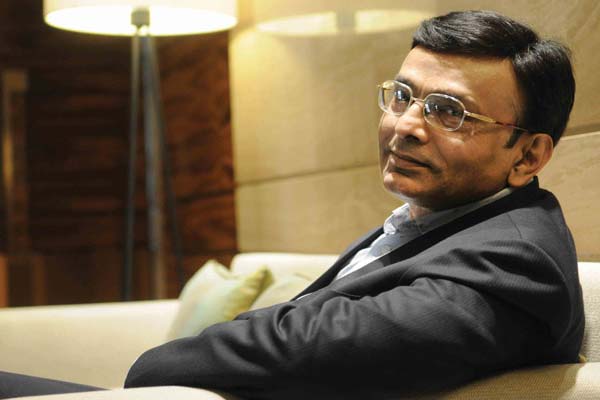











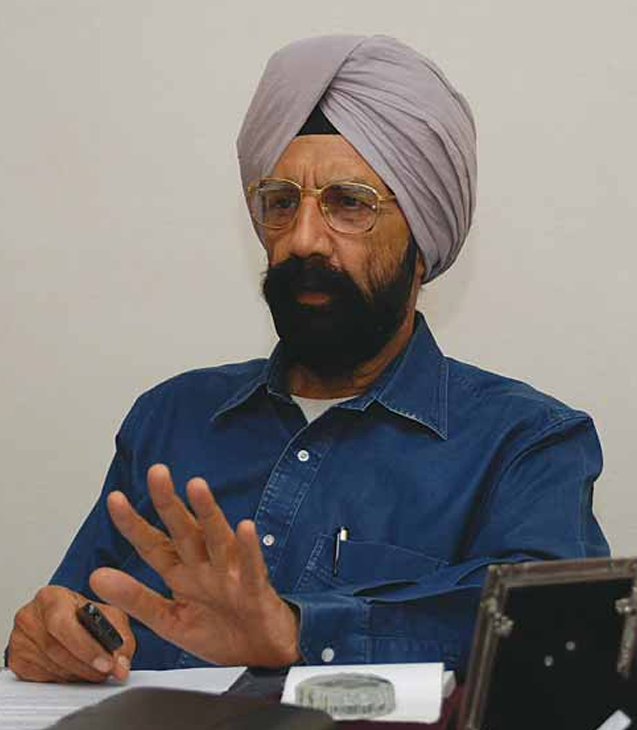
I was born and brought up in a police family My father, Naurang Singh Bains, who participated in World War II, was in the Punjab State Police Service and retired as DIG, Jalandhar Range. He was also the Chief Investigation Officer of the Nuremberg War Crimes Trials.
I got a BA degree from Government College, Ludhiana and then a BE from IIT, Kharagpur in 1958. Thereafter, having qualified in the Central Engineering Service exam in 1959, I joined the Ministry of Transport. I appeared for the IAS exam in 1960 and got selected for IPS. I took the exam again the next year and qualified to become an IAS officer. I got the news while undergoing training at Mount Abu. My dream of becoming an IAS officer was fulfilled as I always considered it to be far better than any other service After training, I was allotted to the Punjab cadre in then undivided Punjab, under Chief Minister Pratap Singh Kairon. My first posting was as Sub-Divisional Magistrate of Patti in Bhiwani district and it was here that I first met Bansi Lal when he appeared in my court as an advocate.
Kairon was a visionary leader. He would consult the officers, especially young ones, about their preferred postings. When I requested a posting in Lahaul and Spiti, I was unaware that it would be the most memorable period of my career. The area has very difficult terrain, snow-covered peaks and a most inhospitable climate. The elevation varies from 2575 to 6700 metres.
After joining as Deputy Commissioner of Lahaul and Spiti, I found that the locals grew a crop called kuth which they would sell to the Chinese. What the Chinese did with it remains a mystery. The rate was Rs 800 per 40 kg. In 1962, it dropped to Rs 200 per 40 kg due to the India-China war and ultimately the Chinese stopped buying.
During my stint in Spiti, I came to know of a crisis the potato-growers of Punjab were facing due to viral infection of the crop I used to visit the potato research centres and had acquired knowledge about potato cultivation. I started applying my mind to find a solution to the problem. This was also the time when Spiti was facing an economic crisis because kuth was the only crop they grew and the Chinese were no longer buying it.
It was the extreme cold of Spiti that provided me the clue to a solution. I thought that it was not possible for the potato virus to survive in the freezing temperature of this area for so many months in the year. For almost six months, the area remains cut off from the rest of the world.
Although it was very difficult to obtain virus-free seeds, I managed some from the potato research centres of Jalandhar and Shimla and got them planted in Spiti. The Spiti-grown potatoes were virus-free. And the stage was set for Lahaul and Spiti to become a huge production centre for virus-free potato seeds.
I went to Ludhiana and convinced nine farmers to buy the disease-free potatoes of Spiti and sow them in their fields to get rid of the virus. I called everyone concerned in Spiti, briefed them about the plan and told them that these nine farmers would buy the entire crop As the road to the valley was officially going to close by October 15, I had to complete everything before this deadline. Lack of communication facilities like telephones and helicopters made it more difficult. The only mode of communication with Chandigarh was the telegram.
Lahaul and Spiti farmers did not know how to grow potatoes. We brought some equipment from Punjab Agriculture University, Ludhiana and taught them about potato cultivation. Once marketing was initially assured through the Punjab farmers, Lahaul and Spiti embarked on a journey that transformed the economy of the area.
We formed the Lahaul Potato Growers Society in May 1966. It is the second largest primary cooperative society after Amul. The prosperity owed to it can be seen everywhere: petrol pumps and four-star hotels. The area is the world’s largest supplier of virus-free potato seeds Two years ago, I was on a visit and a schoolgirl recognized me and said, “You’re Kanwaljeet Singh Bains.” I was told that every house in the area has my photo.
I also served as Deputy Commissioner in Ropar, Ferozpur and Amritsar Serving every district in Punjab is a unique experience. I was posted as Deputy Commissioner, Amritsar in 1969-71. The real challenge came when politician Darshan Singh Pheruman went on a hunger strike in August 1969 to atone for what he termed as backtracking by some Sikh leaders from the pledges they had taken at the Akal Takht and their inability to secure inclusion of Chandigarh and some other areas in the newly-demarcated Punjab state.
He went on a fast inside the Central Jail at Amritsar on August 15, demanding amalgamation with the new Punjab of Punjabi-speaking areas left out. On October 27, the 74th day of his fast, he died.
I worked as Additional Secretary General for the ninth Asian Games in 1982. That was when colour television sets were introduced and Delhi had a massive facelift. A number of flyovers, bridges and stadia came up in Delhi I worked
with Rajiv Gandhi at the time and was able to observe him closely. He was very quick in decision making. We were
able to complete the task within a very limited time frame of only 19 months – from August 1981 to November 1982 As
Vice-Chairman of the Delhi Development Authority, I have contributed significantly to its sports infrastructure.
I had the opportunity to work with Kairon, Sardar Gurnaam Singh, Gopi Chand Bhargava, Ram Kishan, Prakash Singh Badal, Laxman Singh Gill, and Giani Zail Singh Sardar Gurnam Singh was a far sighted man. He was an Akali and, for the first time, forged an alliance with the then Jan Sangh. It is still continuing in Punjab as the Akali-BJP alliance The Akalis have been active in Punjab since the freedom movement. Their influence, once confined to Tarn Taran district, has now spread.
I have learned a great deal in the IAS. It teaches a variety of subjects and provides vast experience and exposure in life.