























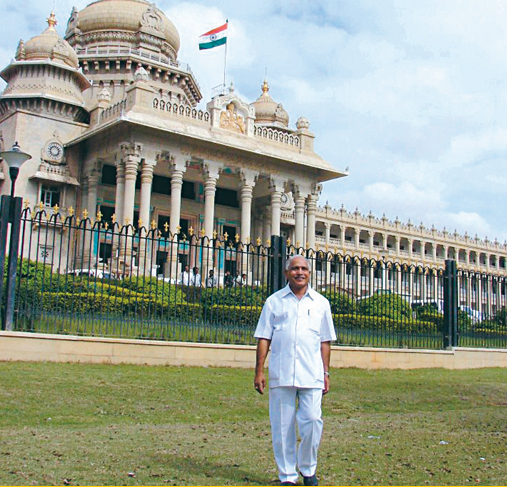
Having built the Bharatiya Janata Party singlehandedly in Karnataka and become the saffron brigade’s first Chief Minister in the South, Bookanakere Siddalingappa Yeddyurappa has taken giant strides over less than four decades to achieve his dream of becoming the political numero uno of his home state.
A simple and god-fearing person, though short-tempered, he has restored the pride of the Lingayat community which constitutes about 15-16 per cent of the population in Karnataka. The installation of a Lingayat Chief Minister after 19 years was significant as this dominant community had been insulted by Rajiv Gandhi’s summary dismissal of Veerendra Patil in the early 1990s. What had rubbed salt into the wound was that Patil was seriously ill at the time. The Lingayats bided their time and waited to settle scores with the Congress.
Yeddyurappa, who emphasizes the fact that he is a son of the soil and does not belong to the English-speaking elite, noted the vulnerabilities of the Lingayats and realized that consolidation, was the need of the hour. He set out to achieve this by stating artlessly that he knew the pulse of the people. That rallied the Lingayats in the state, irrespective of earlier affiliations and loyalties, and paved the way to the Chief Ministership. It helped the BJP secure an unbelievable majority on its own in the Assembly. And Yeddyurappa was in place to enjoy a five-year term as Chief Minister without hiccups.
This was all the sweeter as he had earlier had a seven-day stint as Chief Minister in November 2007, when his tenure was cut short due to the Janata Dal (Secular) refusal to support his government. There had been much drama as the Assembly was kept in suspended animation before the JD (S) legislators agreed to support the BJP government. But that was not to be. On the day Yeddyurappa was to prove his majority in the Assembly, the JD (S) withdrew support. The CM was compelled to resign and the House was dissolved.
In February 2006, Yeddyurappa had become Deputy Chief Minister after former Prime Minister HD Deve Gowda’s JD (S) snapped ties with the Congress and formed a coalition government with BJP support. The Chief Ministership was of such disproportionate importance that moral niceties were jettisoned. Even Deve Gowda’s son, HD Kumaraswamy, achieved this short-term objective. The JD (S)-BJP coalition agreed on a swap of the Chief Ministership after 20 months. However, at the end of its term, the BJP withdrew support to the Kumaraswamy government because, in October 2005, the JD (S) had failed to keep its side of the bargain of transferring power to the BJP.
Another calculated move by Yeddyurappa was to win over disenchanted Lingayats from the Congress fold. Several resigned their Assembly seats and joined hands with him. He gave them tickets to contest again. Most returned to the House and have become Ministers.
Yeddyurappa has set a trend in Karnataka which can be replicated in other States if the Congress alienates key castes. Their role in backing their own nominee for Chief Ministership has been overlooked
In this year’s general election, Yeddyurappa ensured that his and his family’s imprint was stamped on Shimoga district – former bastion of veteran Congress leader and former Karnataka Chief Minister S Bangarappa for four decades. Yeddyurappa was overjoyed when son Raghavendra defeated Bangarappa in Shimoga and debuted in the Lok Sabha. The credit goes to the Lingayats for closing ranks.
Yeddyurappa has set a trend in Karnataka which can be replicated in other States if the Congress alienates key castes. Their role in backing their own nominee for Chief Ministership has been overlooked. The Vokkaligas are the other significant caste in Karnataka, accounting for 13-14 per cent of the electorate.
His political career began in 1970 when he was appointed secretary of the Rashtriya Swayamsevak Sangh’s Shikarpur unit. He became a legislator for the first time in 1983 from Shikaripura and now represents the constituency for the sixth time. Having lost the Assembly election in 1999, he entered the Karnataka Legislative Council in 2000 and remained an MLC till 2004.
He reduced the interest rates of cooperative loans to farmers to 7 per cent and subsequently to 4 per cent. Karnataka is the only State in the country to do this….Yeddyurappa is probably the only CM in the country to take the oath of office in the name of farmers
He has waged a relentless struggle for farmers’ welfare, especially as Leader of the Opposition. It paved the way to Chief Ministership. As Finance Minister – a portfolio he retains even as Chief Minister – he reduced the interest rates of cooperative loans to farmers to 7 per cent and subsequently to 4 per cent. Karnataka is the only State in the country to do this. He also fought tenaciously for waiver of the farmer loans as Leader of the Opposition. He described his 2009-10 Budget as unique because all sections of society will benefit. Yeddyurappa is probably the only Chief Minister in the country to take the oath of office in the name of farmers.
In another first, he presents a report to the people after every 100 days of his government. Two reports in the form of booklets have already been released about the achievements of his government and the third one is in the pipeline. He emphasizes that anyone having doubts about his government’s achievements can use the Right to Information Act.
But Yeddyurappa is not without critics – within the BJP and without. His ministerial colleagues are not too happy with the fact that Cabinet member Shobha Karandlayje is his girlfriend. At all crucial meetings, she has pride of place next to the Chief Minister. She travels with him and briefs the media about Cabinet meetings. Karandlayje has the reputation for able administrator that Yeddyurappa lacks. Like him, she has risen from the ranks. She worked with the BJP’s frontal organization in the Mangalore area to which she belongs. Yeddyurappa has put every Minister in charge of a district and she is the overseer for Mangalore. Recently, she won praise for the manner in which she conducted the famed Dussehra celebrations in Mysore.
The Chief Minister has also been criticized for allocating funds to various religious organizations and charities in an obvious bid to seek support.
Born on February 27, 1943, in a farmer family, he was schooled in Mandya. Relatives recall that he was good in studies and kabaddi was his favourite sport. He began contributing to the family earnings at an early age by selling lemons on a cycle. He had marketing skills as he was able to convince people that lemons added taste to curry. He graduated in arts from Bengaluru. During the Emergency (1975-77), he spent 45 days in the Shimoga and Bellary prisons.
Yeddyurappa also has his share of controversy. His wife, Maitradevi, was the daughter of a rice mill owner in Shimoga where Yeddyurappa worked briefly. She died under mysterious circumstances. She is said to have fallen into a sump (an underground water tank) in their Vinoba nagar house and drowned. This is suspicious as sumps are not very deep. A criminal complaint filed against him in a Shimoga First Class Judicial Magistrate’s court in February is pending. The original complaint, filed by HV Manjunath, stated the deceased died after she fell into a sump on October 16, 2004. However, another complaint by a Seshadri alleged that Yeddyurappa assaulted his wife.
Though he has five children, two sons and three daughters, a recent visit to China has made him a convert to the two-child norm.
Yeddyurappa’s popularity with the people has had its ups and downs. He has earned public wrath by cutting down nearly 3,000 trees in the name of widening Bengaluru’s roads and to accommodate the proposed metro rail project.