






























The IAF’s attack helicopter deal has pitted the US’s Boeing against the Russia’s Mil. Here’s the lowdown on the Apache Longbow and the “Havoc”
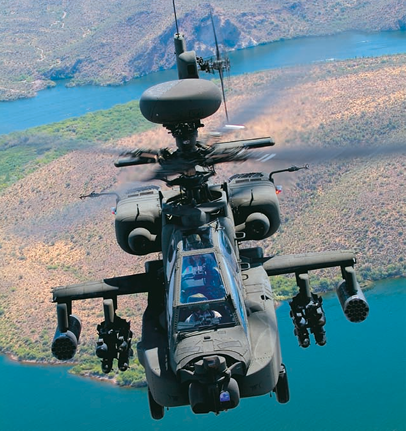
In its efforts to further secure the northern and northeastern frontiers, the Indian Air Force (IAF) is set to invest $500 million (Rs 23,000 million) on 22 combat/attack helicopters. These helicopters are meant to replace/augment the two IAF squadrons comprising 30 Mi-25 and Mi-35 attack helicopters.
Originally, when India went into the market in May 2008, there were seven contenders for this deal. They included the Augusta Westland AW129, Bell AH-1Z Super Cobra, Boeing AH-64D Apache Longbow, Eurocopter Tiger HAD, Kamov Ka-50, Mil Mi-28 NE, and Hindustan Aeronautics Limited (HAL)’s Light Combat Helicopter. However, most either backed off or failed to qualify, leaving only the Boeing AH-64D Apache Longbow and the Russian Mil Mi-28 NE ‘Havoc’ in the fray.
AH-64D Longbow Apache
The AH-64D Longbow Apache is an attack helicopter produced by Boeing Defense, Space & Security in the US. Its maiden flight took place in1975. It has been in production since 1983 but was introduced in 1986.
The primary users of this helicopter are the US Army, the Israeli Air Force, the Egyptian Air Force and the Royal Netherlands Air Force. More than 1,700 Apache helicopters have been delivered to customers in 12 nations. The other users include Greece, Saudi Arabia, Kuwait, Japan, Singapore, the United Arab Emirates and the UK. The US Army alone has logged two million flight hours since the first Apache flew in 1975.
Originally developed as Model 77 by Hughes Helicopters to replace the AH-1 Cobra helicopters, it has a nose mounted sensor suite for identifying and locking the target along with night vision systems.
The next generation version of the AH-64A is the multi-mission AH-64D Apache Longbow, which is in the running for this deal. This version is fitted with fire-control radar. The model without the radar is called AH-64D Apache. These helicopters were tested in the 1990s and delivery began in 1997.
The Boeing AH-64D Apache Longbow is a twin-engine attack helicopter with four-blade main and tail rotors and tail wheel-type landing gear. It is powered by two General Electric T700 turboshaft engines with high-mounted exhausts that branch out on either side of the fuselage. The cockpit can accommodate two crew members. The seating arrangement is such that the pilot sits behind the co-pilot/gunner on a slightly raised platform. The crew compartment and fuel tanks are reinforced with sufficient armour to withstand 23-mm gunfire.
The Apache Longbow comes with long-range weapons accuracy based on laser, infra-red and other systems and all weather/night vision fighting capabilities. It is capable of detecting moving as well as stationary objects without being detected itself. It can classify and prioritize threat of up to 128 targets in less than a minute. Integrated sensors, networking and digital communications for situational awareness, management of the combat arena in real time, and digital transmission of images and target locations to joint operations battlefield commanders are some of the other features.
The weapons systems of the AH-64 Apache include a 30-mm M230 Chain Gun between the main landing gear. It can carry a mixture of four AGM-114 Hellfire/Hydra 70 rocket pods. It also incorporates double and triple redundant aircraft systems to enhance the chances of survivability for the aircraft and crew.
The AH-64D Apache Longbow is 58.17 ft in length and 15.24 ft in height. It weighs 6,838 kg. The loaded weight could be 8,000 kg and the maximum takeoff weight is 10,433 kg. The wing span is 17.15 ft. The rotor diameter is 48 ft. The Hover In-Ground Effect (MRP) varies from 14,845 ft to 15,895 ft depending upon weather conditions. Hover Out-of Ground Effect (MRP) varies from 11,215 ft to 12,685 ft depending on weather conditions. These effects are lower on warmer days. The service ceiling of AH-64D is 21,000 ft.
The Vertical Rate of Climb (MRP) varies from 2,050 to 2,175 ft per minute according to weather conditions while the Maximum Rate of Climb (IRP) varies from 2,890 to 2,915 ft per minute, depending on weather conditions. The rate of climb is slower on warmer days.
The Maximum Level Flight Speed varies from 279 to 284 km per hour and the Cruise Speed (MCP) also varies from 279 to 284 km per hour. The speed is more on warmer days.
A revolutionary feature of the Apache is the Integrated Helmet and Display Sighting System (IHADSS) which enables the pilot or gunner to calibrate the 30 mm automatic M230 Chain Gun to his helmet so that the gun tracks head movements and points at where he looks. Alternatively, the M230E1gun can be locked into a forward firing position or controlled by the Target Acquisition and Designation System (TADS).
The AH-64 can endure frontline environments and is suitable for day as well as night operations. It can also operate under adverse weather conditions with the help of high-tech avionics such as the Target Acquisition and Designation System, Pilot Night Vision System (TADS/PNVS), passive infrared countermeasures, GPS and the IHADSS.
Within Close Combat Attack (CCA), the AH-64D Apache Longbow can be adapted to play a variety of roles. It has a customizable weapons loadout to suit the desired role.
The Apache supplements the 30-mm M230E1 Chain Gun witha range of weapons mounted on its stub-wing pylons. These include a mixture of AGM-114 Hellfire anti-tank missiles and Hydra 70 general purpose unguided 70mm rockets. In addition to these, it has provisions for carrying Stinger or AIM-9 Sidewinder air-to-air missiles and AGM-122 Sidearm anti-radiation missile. The stub-wing pylons could also be used for carrying external fuel tanks to enhance range and mission time.
Mi-28 NE ‘Havoc’
The Russian Mi-28, manufactured by Mil, is an all-weather, day and night attack helicopter known by the NATO reporting name: “Havoc”. It is a tandem two-seater anti-armour military helicopter. It is equipped with a single gun which is mounted in an undernose barbette. It can carry external loads on pylons beneath its stub wings.

Marat Tishchenko started designing the Mi-28 in 1980. In 1981, a mock-up was ready. The prototypes were completed by 1983. The first stage of state trials took place in 1984. The production of Mi-28 was approved in 1987.
The Mil Mi-28 took its first flight in January 1988. The primary users of this attack helicopters are the Russian and Venezuelan Air Forces. So far, some 43 Mil Mi-28s are believed to have been built.
The Mi-28NE was introduced in 1995 and took its first flight in 1996. “N” stands for “night”. The export version of this helicopter is called Mi-28NE.
The most significant feature of the Mi-28N was a radar mounted above the main rotor like the US-made AH-64D Apache Longbow.
Improved features on the Mi-28N included Tor vision and an aiming device under its nose along with a TV camera and FLIR. Paucity of funds interrupted the development of this helicopter. In 2003, the chief of the Russian Air Force declared that the Mi-28N would become the standard Russian attack helicopter. Another prototype with an improved rotor design followed after that in 2004. An all-weather action ability, lower cost and similarity to the Mi-24 made this helicopter a popular buy.
The Mi-28 comes with two heavily armoured cockpits and a windshield which can withstand 7.62 to 12.7mm gunfire, a nose equipped with electronics and a narrow X-tail rotor with reduced noise characteristics. It is powered by two 2,200 hpIsotov TV-3-117VM (t/n014) turboshaft engines.
Though the Mi-28 is an attack helicopter, it includes a small passenger compartment with the capacity to transport three passengers. The purpose of providing this compartment is to rescue downed helicopter crew. The helmet mounted display for the pilot enables him to guide the Navigator/Weapons officer with regard to the target and the weapon to be used for the task.
The 30 x 165 mm Shipunov SA42 Autocanon is the main gun of the Mi-28. It is a select fire, dual-feed gun, which allows for a cyclic rate of fire between 200 rounds per minute to 550 rounds per minute. The effective range of this gun varies from 1500 m for ground vehicles to 2500 m for air targets. Rounds from High Explosive Incendiary (HEI) to Armour-Piercing Discarding Sabot (APDS) can also be fired. The penetration level of 3UBR8 is 50mm of RHA at 1,500 m.
In addition, the Mi-28 can also use unguided S-8 and S-13 rockets. The most common configuration uses 40 S-8 or 10 S-13 rockets. Both these rockets come in variants of HEAT warheads to Thermobaric warheads. The S-8 has a shorter range and smaller warhead than the S-13 which is compensated by numbers.
The Russian Air Force is upgrading the S-8 and S-13 into guided rockets, that will use laser or optical (TV screen) to guide the rockets to their targets. This will allow the rockets to be fired at their maximum kinematic range, while maintaining an accuracy of 0.8-1.6m Circular Error Probable (CEP).
The Mi-28s are armed with twin 8 Ataka missile racks and 2 B-13L rocket pods each of which can carry 5 S-13 rockets. Other rocket options include two B-8 rocket pods, each of which can carry up to 20 S-8 rockets.
There are four types of Atakas meant for different tasks. The 9M120 Tandem High Explosive Anti-Tank (HEAT) warhead is for use against tanks fitted with Explosive Reactive Armour (ERA). The penetrative ability is 800 mm Rolled Homogeneous Armour (RHA). The 9M120F comes in handy against infantry, buildings, bunkers and caves. The 9M120O expanding rod warhead may be used against other helicopters. These three variants have a range of 6 km. The 9M120M improved version has a longer range of 8 km and better penetration (up to 900 mm of RHA). All the above variants use SACLOS missile guidance systems.
The Indian Air Force wants a modified version of the Mi-28 NE with French and Belgian avionics.
Whether Boeing’s AH-64D Apache Longbow or Mil’s Mi-28NE is more suited for Indian conditions will be known only when the deal is finalized. Ironically, the deal pits the US against Russia in a throwback to Cold War days.