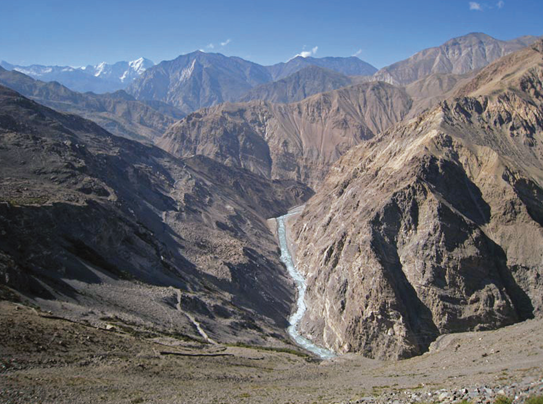




























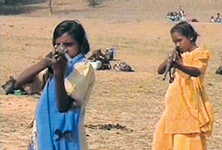
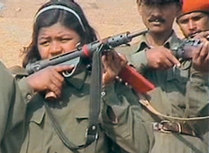
In the three dozen tribal hamlets that dot the Kaimur hills of Bihar’s Rohtas district, killings – mass killings – are a way of life. The area’s dense forests and gushing waterfalls form a beauteous panorama that belies the Naxalite menace it cradles. This is the place where, under the tutelage of tribal Maoists deprived of governance and its concomitant benefits like development, 13-year-olds are trained to operate SLRs, light machine guns, Insas rifles, AK-47s and .303s. All over the 2,500-sq km area of the Kaimur hills and the lowlying area that is skirted by a sandy ravine created by the Sone river, villagers recall the brutal killing of Divisional Forest Officer Sanjay Singh by women guerrillas four years ago in the dense forest near Rehal village.
Kaimur’s dense forests have harboured some of India’s most backward and impoverished tribes, who are now fuelling the Naxalite inferno. The region’s remoteness kept the organs of government machinery at bay while providing Naxalism a haven. For two decades, while the government made unsuccessful attempts to root them out, the Maoists spread their tentacles until they could declare the entire region a liberated zone.
The extremist Maoist Coordination Committee holds sway here, through its subgroups – an underground party unit, Krantikari Kisan Committee (KKC), the Red Defence Corps, and the Youth and Women Fronts. The General Secretary, the top functionary of the organization, heads the Central Committee, the highest decision-making body. There are Zonal Committees, Sub-Zonal Committees, Regional Committees and Village Committees. There is also a military wing.
The squads on the ground, consisting of some 15-20 cadres each, are estimated at about 50 by the police. The police is on the backfoot here, outdone by the guerrillas. “They use hit-and-run techniques to attack police stations and pickets,” said Vikas Vaibabh, Superintendent of Police, Rohtas.
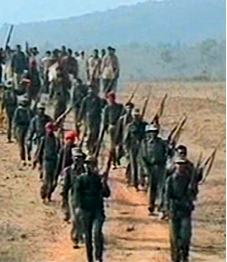
The police is also deterred by landmines. “The MCC acquired technology for manufacturing and implanting landmines from the People’s War Group (PWG), which in turn had got it from the Liberation Tigers of Tamil Eelam (LTTE) of Sri Lanka,” says the SP.
The guerrillas generally target contractors, government officials and, sometimes, senior officials of rural banks. They are involved in kidnapping, arson and sabotage of public property.
The Maoist leaders are unchallenged. Kameshwar Baitha alias Udheshwar Singh, chief of the CPI (ML), operated in these hills for 12 years before he was nabbed by the police. Sudama Oraon holds sway over a 40-sq km area in Nauhatta and Rohtas, while Birendra Rana wields influence in the 30 sq km from Adhaura to Chenari. “Sudama is our leader, our godfather, who is very sympathetic to the plight of Kaimur’s tribals. If he tells us to die, we are ready to obey,” declared a Kharwar tribal woman of Piperdih village, with blazing eyes.
“The children of Kaimur tribals learn lessons in Naxalism before they learn the alphabet. They may not know of the heroes in Indian history or even the name of the Prime Minister but they know the leaders of various outfits,” said Rajendra Oraon, a tribal of Chandodih village who is a graduate.
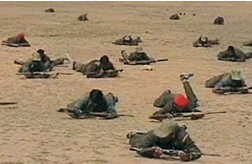
This makes recruitment and training easy. And, in an area that lacks a girls’ school, women are easy prey for recruiters. “Had they been educated, they would have thought twice before joining the ultras,” says Rajbansh Singh of Hansadi village. And Mrityunjay Singh of Govindapur adds, “They are unaware of what these outfits really are.” There are about 1,000 Naxalites, of whom 80 to 90 are women. The notorious Vinita (26), Sabita (19) and Lilawati (18) have been arrested but there are others being groomed to take their place. According to Triloki Singh of Tippa village, girls are also sexually used by the male members. Teenage girls are lured with gifts of cosmetics, sweets, chocolates and clothes. Once recruited, they are regularly given weapons training to repulse police attacks.
The training camps are in the settlements of Kuba, Rehal, Korhans, Soli and Jonha under Chutia and Nauhatta police stations, and Bhavantalab, Budhua, Tardih and Nagatoli of Rohtas police station.
Villagers say a general feeling of isolation from the national mainstream prevails. The region is untouched by development. The tribals have to hike 14 km to Chutia Bazaar to procure edible salt. The barter system is still in force and 1 kg of chiraunji (Buchanania latifolia) is exchanged for the same quantity of salt. There is no infrastructure for communication, drinking water, irrigation, and electricity has yet to reach these one lakh voters. These factors and the non-existence of a market, the Public Distribution System, a dispensary, a primary health centre and a primary school for girls are fodder for Naxalites.
Drought, poverty and corruption are rampant. A huge population is barely subsisting on cultivation, food gathering, animal husbandry and Kendu leaf collection during the scorching summer. In such circumstances, they cannot achieve food security.
The Kaimur hills have only one thing – a road, built for transport of Kendu leaves by truck during summer. During the rains, from mid-June to start of September, the road is unused.
The tribals were always governed by the upper castes of the plains, who were timber traders. They also exploited the tribal girls. In tribal society, it was considered prestigious to have sexual relations with outsiders. This turned the region into a virtual redlight area. Today, in the age of Panchayati Raj, the exploitation and human degradation is unabated. “In the Kaimur hills, the pace of development was painfully slow. So, first dacoits and then the Naxalites captured the area,” recounts Bashishth Kumar Singh, a Sasaram-based lawyer.
“We are trying our best to bring the tribals into the mainstream,” says District Magistrate M Saravanan but neither he nor the Chief Minister has visited the area to see for themselves the sight of gun-toting tribals. The previous DM, Bishwanath Singh, had never heard of the Kaimur hills and was unaware that Maoists were running a parallel government in parts of his district.
“Through the Sarkar apke dwar (government at your doorstep) programme, the government plans to bring development to the people, particularly to the underprivileged sections,” says the current DM airily. The government’s stated intention is rehabilitation in the mainstream and income generation, but the local administration has no blueprint to achieve this.
The police is less indifferent. One of the main hurdles it faces is the topography. The Kaimur hills touch the borders of UP and Madhya Pradesh and across the Sone lies Jharkhand, whose formation triggered a migration of Naxalites from there to this region. After Chutia, where the Sone demarcates Bihar and Jharkhand, no sign of development can be perceived. With communication very poor as a result, the Naxalites roam freely and boldly. Now, says the police, awareness campaigns are being conducted among the villagers to bring them into the mainstream. The police is also being more sensitive. “We found out that the villagers were being made scapegoats. So we started going in for qualitative arrests rather than quantitative. At once, the people’s faith was restored and they are joining hands with the police against the Naxalites,” says Vaibabh.
But the police faces a long haul. No outsider can enter Barkhoh and Jogi Kund, the places where huge stocks of arms and ammunition are stored. These places are encircled by jungle-covered hills and snaking rivulets. “We cannot establish any police post in these hills since they will be looted in broad daylight. The Naxalites move in huge numbers with sophisticated arms. They will come just to loot our weapons.” A police party visits the region once or twice a week – unannounced in order to avert planting of landmines.
“There is no police in the area so once the police enters, it will become a war zone like Bastar district of Chhattisgarh,” points out Prabhat Pandey, a journalist from Bandu village in Rohtas.
Till the end of the 1970s, development agents in the guise of teachers, contractors, Village Level Workers (VLWs), vaidyas of government dispensaries, and social workers were the sole elements who accessed the Kaimur hills and stayed there to serve – or exploit. The Octavius Steel Company and, after Independence, ML Dalmiya & Company Limited used to run a narrow gauge railway from Dehri-on-Sone to Tiuara Piparadih (68 km, 14 stations). The track transported the cheapest tribal labour and limestone for cement production from quarries in the Kaimur hills to the Kalyanpur Cement Factory of Banjari and Jain Cement Factory at Dalmianagar. No other visitors came to the region.
The Forest Policy of 1952, a revised version of the first Forest Policy of 1894, sounded the death knell for this region. Private contractors began to plunder the rich forests. The contractors were influential Brahmins and Rajputs, who overran the area with firearms. They felled timber by day and exploited tribal girls after sundown. Legends abound of the dancing to the music of harmoniums and drums in the timber traders’ camps. There were also instances of teachers of the State Welfare Department-sponsored schools taking concubines and passing them off as unwed mothers.
During the First and Second Five-Year Plans, some buildings for residential schools, animal husbandry dispensaries, and houses for officials of the State Forest Department were constructed. A grain warehouse and a Khichhdi Centre came into being in the late 1960s. Vanvasi Sewa Kendra, an NGO, arrived to propagate sustainable economic growth of the locals with Gandhian philosophy for rural development and revival of self-dignity. Government officials would visit, ostensibly to inspect residential schools, minor relief work and plantation activity but actually to holiday in scenic Kaimur with wine and women provided by subordinate staff.
The first seeds of Naxalism were sown when Dr Vinayan, the famous Naxalite leader, came to the Kaimur hills and held several public meetings, promising the tribals justice. It was to be yet another betrayal. The Naxalites captured the forests, valley and ravines, supported by the gullible tribals who mistook them as harbingers of a better tomorrow.
The Brahmin-Rajput influence also played a role in the Kaimur saga. It spawned caste-based criminals Chhatu Chaube, CID Mishra, Baban Mishra and their ilk while, on the other side of the divide, the dominant Koiri, Dusadh, Kurmi and Kahar communities used to capture polling booths and control the crime-graph of the entire district for the Brahmin and Rajput godfathers. The Brahmins of Bandoo, Manjhigawan, Nauhatta, Khairwa and Singhpur villages would despatch arms and ammunition to other districts to abet gang robberies and get a share of the booty. The Rajputs of Tippa, Balbhadrapur and Bhadara villages imposed a reign of terror with their rifles. In retaliation, Koiri, Dusadh, Kurmi and Kahar youngsters united and stockpiled sophisticated arms to wipe out the influence of the upper castes. Some youths also took up arms against government-supported Brahmin clout and sought shelter in the Kaimur forests, descending into the lowlying areas to kill Rajputs. A report says they killed over 160 Rajputs within six years.
Then there were dacoits like Mohan Bind or Raja, Bhim, Ghamari Kharwar and Dadwa. They were eccentric rebels who killed a number of innocent people from the plains. Eventually, they became exploiters of the forests and tribals, and hindered development. They also became infamous for sexual exploitation of the tribal women. In the 1990s, after Raja’s death, development work was forced to a halt as the rebels began to demand a huge slice of the development fund. In 1987, Sudarshan Prasad Singh, then SP, took the initiative to analyse the psychology of these rebels and, within three months, Kaimur became free of crime. The Rohtas police also killed Chhangur Dusadh, a dreaded criminal close to a Lok Dal leader.
In general, Rohtas’ agrarian society was known for brutality. Prior to the 1980s, the Kaimur tribals were forced into bonded labour for Brahmin and Rajput landlords. The latter had connections with national politicians and a vice-like grip at the local level. Mass killings, rape, hooliganism and booth-capturing were commonplace. A virtual curfew would be declared on election day and the public would be told there was no need to come to the polling booths since “your vote has already been cast”.