

























The prospect of a change in government has encouraged the people to vent anger
If Dinabandhu Mitra were alive today he could have written a sequel to Neel Darpan (The Blue Mirror), his play about how British planters tortured poor farmers and forced them to cultivate indigo.
A century and a half later, Bengal has unearthed a parallel in a mafia gang led by Gaffar Mollah. The modus operandi was to bring unwilling peasants to a room in a resort called Vedic Village and coerce them to give away their land. According to the police, initially they were coaxed. When the coaxing failed, force was resorted to. The resort is in a Kolkata suburb, on the other side of the city’s Eastern Metropolitan Bypass, called Rajarhat which is being developed as a township as Salt Lake has reached saturation point.
The racket, reportedly a decade old, came to light after over 10 people who lost their land moved court. They had remained quiet earlier due to fear because the local police, administration and political leaders were all in league with Raj Kishore Modi, the owner of Vedic Village and the kingpin of the racket. Gaffar Mollah was merely a henchman who had been allotted a room inside the resort to carry out his mission. The move to resist was triggered by a local football match. Gaffar’s team lost and his goons started beating up people. This sparked anger which led to arson in the resort.
Had all this occurred six months earlier, chances are the outcome would have been different. However, the government swung into action owing to fears that the Trinamool Congress could turn the tide against it. The local media was quick on the uptake, revealing that some young Ministers had close connections with Vedic Village, and that even Minister Rezzak Mollah was a regular visitor. Rezzak, who garnered the limelight a few years ago for his opposition to largescale transfer of agricultural land to industry, presides over a department, Land and Land Reforms, that illegally gave land to Vedic Village. However, Rezzak claimed it was done during the tenure of his predecessor, Surjakanta Mishra.
Trinamool Congress chief Mamata Banerjee expelled three local leaders for involvement in the racket. The party’s local MLA, Arabul Hossein, is also linked to it as his brother, Khude, was Gaffar’s righthand man. Gaffar was arrested while on the run weeks after the football match but Khude is still absconding.
Another government department was also involved. The IT department had acquired land in that area for Wipro and Infosys through Gaffar, who had used the same modus operandi. Even the land transfer was not done in a transparent manner. The department stated that the projects were being cancelled, as the government did not want to be involved with illegal activities. In the process, Minister Debesh Das earned the wrath of the Chief Minister. To appease the CM, the Left Front then decided that the project would not be cancelled, but kept in abeyance.
Next, it was discovered that Gaffar and his men had grabbed even land belonging to the Rajarhat Development Authority in Bhangar.
All this is proof of the extent of the scandal. First, Gaffar – as Modi’s henchman – could acquire land anywhere and manipulate government records. The administration was working as a subsidiary of the land mafia. Second, the local police was also in league with the mafia
All this is proof of the extent of the scandal. First, Gaffar – as Modi’s henchman – could acquire land anywhere and manipulate government records. The administration was working as a subsidiary of the land mafia. Second, the local police was also in league with the mafia. The reign of terror prevented the farmers from lodging complaints or holding protests. According to sources, top police officials are investigating the extent of involvement of the local thana and trying to pinpoint the policemen who were hand-in-glove with Modi and Gaffar. Third, the political connection, which is not likely to be unearthed, played a significant role.
West Bengal has plunged into total non-governance. The government appears to have withdrawn from the scene in every sphere. All major investment plans have been shelved. Over a dozen bureaucrats have sought transfer outside the State and more are thinking of following suit
In recent months, the mafia had become so bold that they did not hesitate to flex their muscles over just a football match. This was probably because, since the Lok Sabha election, West Bengal has plunged into total non-governance. The government appears to have withdrawn from the scene in every sphere. All major investment plans have been shelved. Over a dozen bureaucrats have sought transfer outside the State and more are thinking of following suit. Another section has crossed over to the Mamata Banerjee camp. These bureaucrats, like some police officers, are not willing to do anything that might irk the Trinamool leader. Chief Minister Buddhadev Bhattacharya appears resigned to fate.
The situation is taking its toll on the lives of the people. Supporters of the CPI(M) and Trinamool or Congress supporters regularly clash in various parts of the State. Murders are commonplace. Despite the offensive launched by the State police and the Central paramilitary against the Maoists in Lalgarh and other adjacent areas, no big catch has been made. On the contrary, since the offensive started, over 30 CPI(M) cadres have been butchered by the Maoists. In rural areas, allegations abound of non-payment of wages in the “100 days work” project, and every week sees a labourers’ revolt or gherao of panchayat leaders or administrative officers somewhere. In Narayanpur, Murshidabad district, labourers recently claimed they had not received wages for seven months.
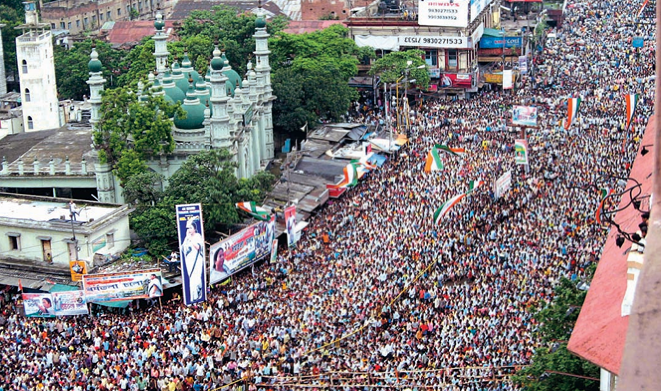
The power situation is so bad that Congress workers have started an agitation. But what they are doing is regularly humiliating the office workers of the State Electricity Board who have little role to play in either deterioration or improvement of the situation. Other government workers are similarly heckled. In each case, the police is a silent spectator.
An old High Court order bans public transport over 15 years old but the government has failed to plan or execute an alternative. Commuters are paying the price. People are also revolting against the pitiful public health system. In one instance, the authorities of a district government hospital have put up a notice asking doctors to show empathy with patients.
These recent signs of unrest do not mean that the State was better off earlier. It is just that the prospect of a change in government has encouraged the people to protest. But the current dispensation will continue till May 2011 and the situation could worsen even further, into complete anarchy.