






















In 1995, addressing the AICC session, Prime Minister PV Narasimha Rao had lamented the fact that the economic reform regime lacked a human face. Four governments and 15 years later, it is still missing. The economy has taken rapid strides, raking in wealth for the upper strata but the lower strata has remained at the same level. Socioeconomic justice for the deprived classes is still a cause to fight for.
It is ironic that wealth is generated at one end and violence at the other by the same liberal economic regime. The problem is that it has failed to ensure equitable distribution of generated wealth. The government and the political system are unable to find a solution to the ostentatious display of newly-gotten wealth. To compound the problem, a number of social and cultural aberrations have crept in.
Economist Arjun Sengupta, a member of the Congress party, had warned the political system about increasing economic inequality. The upper strata was exploiting its vantage position to widen its access to the growing world market, and using innovation to maximize productivity through cheap labour in a country burdened with widespread unemployment and dispirited labour unions. The upper strata multiplied its income by 55 times while the lower strata remained at more or less the same level as before. The latter’s purchasing capacity was further reduced because of the price spiral and inflation.
In this societal transition period, several aberrations sprang up – causing social and cultural distortions. Mumbai stockbroker Harshad Mehta took advantage of the greedy side of human nature to make a quick fortune. He introduced a modus operandi for industrialists to mobilize their resources without any obligation to repay if they went in for public issue for their ventures. The rising graph on the index board of stock markets induced the middle and lower middle classes to invest more than Rs 93,000 crore in public issues in a single year, using up their lives’ savings and liquidating other assets for the purpose. Most of the money was lost as there was no control over those who vanished with it.
The then Finance Minister, Manmohan Singh, had refused to lose sleep over heavy fluctuations in the stock markets. He is an economist who feels the movements of prices but not the pangs of pain of those who lost their savings. The only consolation was that the Narasimha Rao government was forced to accept the joint parliamentary probe into the securities scandal. But it did not assess the investors’ loss. The government’s response was routine – yet another law was enacted and a bureau for investigation set up. Both were punitive but not preventive.
The IPL has shortchanged the game of
cricket. It was turned into a money
minting machine for those who could
invest a few hundred crore rupees.
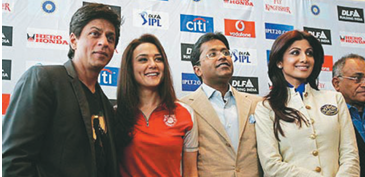
Turn from bourses to stadia. The IPL was an aberration for it shortchanged the game of cricket – for more than 150 years considered a gentleman’s pastime. It was turned into a money-minting machine for those who could invest a few hundred crore rupees in buying talented players for their teams. While cricket was rolling in wealth, other sports were starved of even basic facilities. Empty stadia did not bother either organizers or players because the big bucks were flooding in through a different conduit. Exclusive television rights were sold at unbelievable prices. When big money comes in, corruption and other evils cannot be far behind.
Next, the expansion of communications facilities and the visual media made it easy to introduce gambling in an entirely new form. A reality music talent show minted nearly a hundred crore rupees simply by encouraging its viewers to vote for the show’s participants by sending text messages at a special rate. The booty was shared between the show producer, the network and the mobile service providers. Did it occur to anyone that all this encouraged parochialism which can be lethal for national integrity?
The transition of Indian society from an agrarian to a modern one ought to have sounded the death knell for centuries-old feudal concepts. But some families that have benefited from the liberal economic regime still want to retain their feudal symbols of status. In the old days, a mujra was considered the most coveted form of entertainment. A reputed tawaif would be assigned the task of titillating guests on festive occasions for her mujra was symbolic of the exalted status of the family. Today, the tawaif has been replaced by a filmstar but her task is still titillation.
The vulgar and ostentatious displays of wealth provoke radical elements to use violence to seek socioeconomic justice for the poor. The logjam over the mode of the parliamentary probe into the spectrum auction served as further incitement for these elements. It will only complicate the battle to curb their activities.
The government does not need a specific law to curb such vulgar displays of wealth. Many existing rules and regulations can serve the purpose, provided the government wishes to act. But technocrats always find it difficult to understand aberrations that distort culture and value systems.
So, over 15 years, various governments and political parties have been unable to devise a model for economic development that will suit the diverse social conditions of India. The kind of aberrations that have crept in could have been tolerable in a country of lesser population and not so stark economic inequality.
The pity is that these aberrations do not denote modernism, they are merely symbols of vulgarity. And even the intellectuals of contemporary India have not raised their voices on this issue.