























Rajasthan gets its first community radio service to further education and development of the rural hinterland
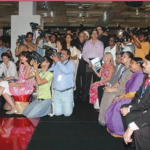
Barefoot College, Tilonia was recently the venue for a two-day State-level consultation on Community Radio Awareness, organized by the Union Ministry of Information and Broadcasting. More important, the occasion also saw the launch of the “Barefoot Community Radio Station” – the first of its kind in the backward State of Rajasthan. The radio service will cater to the educational, developmental and socio-cultural needs of the local community in a radius of 6 to 10 kilometres through indigenously created broadcast programming.
Located in the remote rural hinterland of Ajmer district, the Barefoot College, run by Bunker Roy, is a global initiative that reaches out to the rural illiterate poor by using traditional media such as glove puppetry and street theatre. Its awareness and training modules explore themes such as access to safe drinking water, solar lights engineering, hand craft skills, pre-school education and night classes. The College has, over the years, trained over 340 semi-literate men and women from 16 States in India. A recent initiative has been to train semi-literate middleaged rural women from Gambia, Sierra Leone, Mali, Mauritania, Ethiopia and Cameroon as barefoot solar engineers who will in turn solar electrify over 50 rural communities in nine countries in Asia, Africa and South America.
The consultation workshop at Tilonia was one of a series being organized by the Ministry in various parts of the country to inform and educate non-profit civil society and voluntary organizations/NGOs to develop communication skills for establishing and running community stations. The objective is also to create awareness amongst communities about relevant programming content for community radio stations by locating such workshops in global rural initiatives such as the Barefoot College in Tilonia. The workshops are attended by both potential civil society organizations from the region as well as representatives of functional community radio stations. Seventy such civil society organizations attended the Tilonia workshop.
The community radio policy announced in 2000 focused on campus radio stations in educational institutions. After its reformulation in 2006, it allows greater participation by non-profit rural civil society organizations that have a proven record of at least three years of service to the local community relating to development and social change. Besides, at least 50 per cent of the content has to be generated with the participation of the local community, preferably in the local language and dialect.
While funding from multilateral aid agencies can be availed of by the community radio station licensed by the Ministry, limited advertising or announcements relating to local events, businesses, services and employment opportunities are allowed. The maximum duration of such limited advertising has been restricted to 5 minutes per hour of broadcast in a day. To seek advertisements from Central and State government organizations, the rate of airtime for an empanelled radio station with the Directorate of Advertising and Visual Publicity (DAVP) is Re. 1per second. A critical question, in the above context, is the cost of operation of a community radio station. On an average, with an initial capital investment ranging from Rs 6-15 lakh, the operating cost could be Rs 50,000-70,000 per month. Surplus, if any, after meeting the financial needs of the radio station, has to be ploughed back into the primary activity of the civil society organization for which it was established.
Rural workshops such as these constitute a “hands-on” platform to brainstorm, experience and apply the domain knowledge about community radio policy, its operational issues and management problems. It is also a window for effective participatory appraisal by potential NGOs to learn about communication modes that the marginalized and impoverished in rural India already possess. To a great extent, it also generates the much-desired “bottom-up” push to seek expression of interest from non-profit civil society organizations to set up community radio stations.
An interesting aspect of the workshop structuring is its Public-Private Partnership mode. The Ministry of Information and Broadcasting is assisted by Commonwealth Educational Media Centre for Asia (CEMCA) in locating the workshops at “glocal” destinations in the rural Indian hinterland. At Tilonia, the workshop was further partnered with the Digital Empowerment Foundation, an organization that offers linkages, networks and solution platforms to villages across India through innovative interventions of information communication technology (ICT) and digital media.
It has already set an example in participatory management by making Raghav the project head of the community radio station. Raghav is an illiterate youth who was arrested for illegally operating ‘Raghav Radio’ that broadcast messages against exploitation, discrimination and injustice
The Barefoot Community Radio Station would indeed benefit from the e-NGO expertise of the Digital Empowerment Foundation for its narrowcasting and digital networking endeavours with the help of the local community. It has already set an example in participatory management by making Raghav the project head of the community radio station commissioned. Raghav is an illiterate youth from Bihar who was arrested for illegally operating and running “Raghav Radio” that broadcast social messages against exploitation, discrimination and injustice.
The process of generating awareness amongst civil society organizations about the tremendous potential of community radio for rural empowerment has to be gradual to enable them, first and foremost, to build capacities. Once the latter is achieved, it will be possible for them to carve a niche for themselves in the “public sphere” that is already being catered to by All India Radio and the profit-oriented FM radio stations.
(The writer is an IAS officer. The views expressed are personal.)