


















KCR might be astute and an opportunist, but he is no Potti Sriramulu
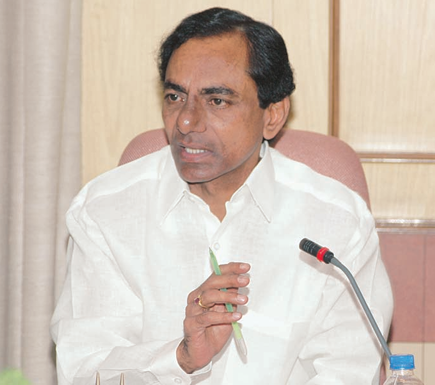
KCR. K Chandrasekhar Rao. A quiet man for whom the hungerstrike is as natural a weapon as it was for Congressmen a few decades ago. KCR cannot fight any other way. He is not one who can shout at the top of his voice. Nor can he lead a violent protest. Rather, he would shudder at the prospect. He fights for a cause, but in the old Gandhian way.
The fast can be interpreted as political opportunism; the fight for a cause as chasing an ambition. But then that is characteristic of politicians. At the moment, KCR has achieved great heights. His diminishing political career is soaring.
All this happens to be thanks to Sonia Gandhi, with whom he has cordial relations. Most Congress bigwigs opposed the formation of a new state. Yet, Sonia decided that KCR’s demands had to be conceded. During his fast, the BJP jumped into the fray to get a foothold in Telengana. But when Sonia’s emissaries contacted KCR and his partymen, they were told that he would remain with the Congress if the party took the initiative to form Telengana. Hence, the Congress president asked the government to initiate the process of formation of a new state.
KCR knew Telengana would not be created overnight. He informed Sonia, whom he referred to as “Mother” after breaking his fast, that he would wait till 2014. That is the year when the next Assembly election will be held in Andhra Pradesh. With this assurance giving her enough space, Sonia instructed her party managers to send a stern message to all concerned in the State Congress that the decision to create Telengana was final. The message had already travelled home and, but for a handful, the rebel MPS and MLAs had started to fall in line. However, they demanded an escape route to save their constituencies.
It is not clear whether, at this stage, Sonia Gandhi backtracked. But, without consulting KCR, senior Central Ministers prepared a statement that said, “The situation in Andhra has altered.… There is a need to hold wide-ranging consultations with all political parties and groups in the state.” This statement was interpreted as indicating that the process of formation of a new state had been kept in abeyance.
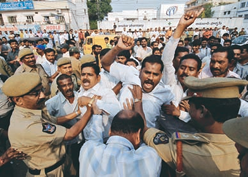
The result: It not only gave the Telengana movement a fresh boost, but also provided ammunition for KCR. Just days after Sonia was called “Mother”, her credibility in the Telengana region plummeted to near-zero. Students were back on the streets, the campus of Osmania University again turned into the epicentre of the movement, and attacks took place on the assets of non-Telengana leaders in the region. While KCR appealed for calm, Congress MPS from the area were compelled to threaten resignation. At the moment, the future is uncertain. The movement may die down or take a nasty turn.
KCR has played a brilliant game, renewing his demand for Telengana at a time when Telegu Desam Party supremo Chandrababu Naidu had already passed a resolution for a separate Telengana in his party’s Politburo and sent it to the Centre. That was before the last general election, which Naidu fought along with KCR’s Telengana Rashtra Samiti. The Praja Rajyam Party had not opposed the demand then. The BJP was in favour of it. Only the Congress, then under YS Rajasekhara Reddy, kept silent. Reddy opposed it. So did various Congressmen with business interests in the Telengana region. Yet, at her three election rallies in the Telengana region, Sonia declared that the Congress was “sympathetic” to the demand for a separate state.
Thus, those who are currently arguing that the Congress victory in the Telengana region nullified the demand for a separate state are erring in analysis.
KCR went in for the fast to compel the Congress to take a stand. Sonia had promised him in 2004 that she would back the Telengana issue if there was broad unanimity. But YSR had stood in the way of unanimity
KCR went in for the fast to compel the Congress to take a stand. Sonia had promised him in 2004 that she would back the Telengana issue if there was broad unanimity. But YSR had stood in the way of unanimity. It is not strange that his son, Jagan Mohan, Tirupati MP Chinta Mohan, and the richest MP, Rajagopal Lagadapati, are now trying to stoke anti-Telengana sentiment. All of them are trying to secure their future by playing on the “united Andhra” sentiment. These people have compelled Naidu to “review” his stand. However, he is currently non-committal while Chiranjeevi, the sole leader of Praja Rajyam, has thrown his weight behind the pro-Andhra forces.
KCR has already won the game. He has played it on his terms, securing Telengana and upsetting the politics of the others. It is unclear whether he did it with foresight or if he is a man reluctantly becoming a martyr
Thus KCR has already won the game. He has played it on his own terms, securing Telengana and upsetting the politics of the others. However, it is unclear whether he did it with foresight or if he is a man reluctantly becoming a martyr.
Whether he will be able to carry his popularity forward is a moot point. He has no organizational network to support his political campaign. If nothing emerges in the next six months or a year, the movement may pass into the hands of the other, more radical elements. It is believed that the Maoists are supporting and infiltrating the movement.
Quick-fix solutions are not going to resolve the Telengana issue. The six-point formula evolved by Indira Gandhi in 1973 for accelerated development of backward regions and preferential treatment to local candidates in employment has failed to redress the grievances of the Telengana region. The Centre did anticipate trouble in Andhra Pradesh with the announcement of a proposed Telengana state. That is why the Congress Core Group threw the ball in Chief Minister K Rosiah’s court regarding getting a resolution adopted in the Assembly for creation of a separate state. This assumes significance as the Core Group did not hold consultations beyond its closed doors nor was such a crucial matter referred to the Cabinet.
The proponents of a separate state argue that the Centre had asked the political spectrum in Andhra Pradesh to grapple with the issue and evolve a consensus. Considering KCR’s deteriorating health owing to the fast, the Manmohan Singh government could not afford to waste time in making its stand clear. The Centre was willing to back the creation of Telengana provided the Assembly took an unambiguous stand on it. Those favouring Telengana believe the Centre is now backtracking on its pledge. The matter need not have been referred to the Assembly; what is required is amendment of Article 3 of the Constitution, dealing with formation of new states and alteration of areas, boundaries or names of existing states.
Like all politicians, KCR is an out-and-out opportunist. He began his political career as a Congress student leader and then switched loyalties to the Telegu Desam Party. He has served as a Minister in Andhra Pradesh and Deputy Speaker of the Assembly. He severed relations with the TDP after Naidu refused to make him a Minister during his second term as Chief Minister. Immediately thereafter, he launched the TRS in 2001. Three years later, he was elected to the 14th Lok Sabha. He had six MPs and became an ally of the UPA and got the creation of Telengana state included in the National Common Minimum Programme. It was political expediency that led to the TRS becoming a UPA ally to boost the arithmetic in the game of numbers for securing a simple majority in the Lok Sabha. Initially handed the shipping portfolio in Manmohan Singh’s Cabinet, he offered to relinquish it when the DMK sought it. The Prime Minister appreciated the sacrifice and subsequently gave him Labour and Employment.
However, in 2006 KCR bid adieu to the UPA government because it was dragging its feet with regard to Telengana state. The Centre had constituted the Pranab Mukherjee Committee to talk to all sections in Parliament and the stakeholders in Andhra Pradesh. Around this time, there was also talk of setting up the second States Reorganization Commission due to the increasingly shriller demands for new states. It was evident to all that the creation of Telengana could not be undertaken in rapid-fire manner with a definitive decision. No deadline had been issued to the Pranab Mukherjee Committee to complete its task.
At the culmination of all this drama, with KCR being the main leader but one who did not want to put his life at stake a la Potti Sriramulu, and with some pulling strings from the sidelines for their own political gain, it seems unlikely that Telegana will be formed any time soon. It is also unlikely that the ailing KCR will be able to achieve his dream of being the political numero uno of the new state as his party has suffered serious erosion of trust. The people’s support is for Telengana state, not for KCR. So this burning issue, which flares up during every decade, will once again die out in due course for evolving a consensus on it in Andhra Pradesh is akin to chasing a mirage.