















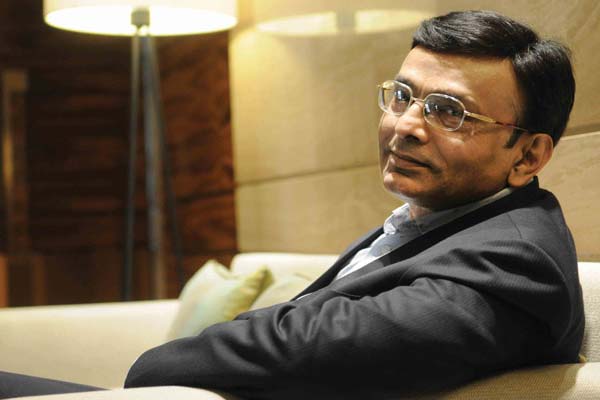

















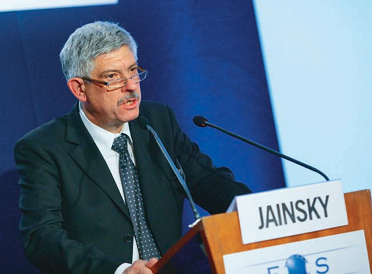
Jean Paul Jainsky joined the Sagem Group in 1975, with Société Anonyme de Télécommunication (SAT) – a subsidiary of Sagem and a pioneering company in infrared technologies. He quickly became Production Manager of the Poitiers plant. In 1993, SAT merged with Sagem and Jainsky soon became responsible for industrial coordination within the electronics division. He led a 1,600-strong global team at the Montluçon and Poitiers plants as Managing Director. In 1999, he was put in charge of overall security. A stint in the automotive division followed as Activity and Industrial Managing Director (2001- 2002), before he became Executive Committee Member and Managing Director of the Sagem Défense Sécurité security division. Since July 2007, he is the Chairman and CEO of the new company, Sagem Sécurité – named Morpho since May 2010.
gfiles: What is Morpho’s role in the UIDAI project?
Jean Paul Jainsky: Mahindra Satyam will look at systems integration of the final solution, while Morpho will deploy its biometrics technology. The techniques used in the field of biometrics, which are the core activity of Morpho, are development of the acquisition and processing of 10 fingerprints, of facial recognition and iris recognition, the combined use of these technologies in multi-biometrics, and also the progress in matching algorithms.
gfiles: What are Morpho’s key strengths which will help it deliver the world’s largest biometric project in India?
JPJ: Morpho, Safran Group, as a group leader, has implemented more than 450 biometrics systems in more than 100 countries for applications such as digital national population register, multipurpose ID card, driving licence, e-passport. We have implemented our solutions in each continent, facing every environmental and geographical challenge in countries such as the US, Canada, UK, France, Germany, Brazil, Colombia, Mexico, South Africa, the Cote d’Ivoire, the UAE, Malaysia and Australia.
gfiles: What is the key technology differentiator of Morpho as opposed to the other consortia in the UIDAI project?
JPJ: We have the widest proven field experience. Our technology is constantly improving through experience in the field. We have been in the biometrics market for 35 years. Our R&D force is composed of 1,300 engineers dedicated to the improvement of identification and biometrics solutions. As a high-tech company within the Safran Group, Morpho is the only company today that covers the entire technological chain of identification solutions and data security systems – biometrics enrolment, biometric algorithms, smart cards, pattern recognition, data and image processing, secure embedded software, secure electronic transactions, e-authentication, cryptography, secure printing, smart cards production and personalization, and advanced system architecture. We are the only company with end-to-end solutions in identification and biometrics.
Morpho has superior technology and know-how in the field of acquisition and processing of high quality images and shape recognition algorithms in order to capture, analyse and compare biometric data that guarantee identification. In fact, Morpho’s fingerprint-based personal authentication technology was recently ranked number 1 in the Proprietary Fingerprint Testing (PFT) competition organized by the US’ National Institute of Standards & Technology (NIST), a global benchmark for the measurement of biometric algorithms. Unlike other consortia involved in the UIDAI project, we are the only consortium led by an Indian firm – Mahindra Satyam.
gfiles: What kind of work has Morpho done with organizations like BEL, NREGA and the like in India, prior to the UIDAI project?
JPJ: Morpho is involved in a number of e-governance programmes in India. Our subsidiary in India is a market leader in this space and has been active in a number of e-governance programmes – providing smart cards, technology and also field implementation such as driving licences in various States, the RSBY programme and a large number of other e-governance initiatives. Morpho has been implementing biometrics and smart card-based programmes worldwide and we have a lot of experience in various cultures, countries and contexts. For this reason, Morpho has been very successful during the pilot ID card programme supplying Bharat Electronics Limited, while providing the hardware and software needed to capture biometric data. We are also involved in many social schemes like the National Rural Employment Guarantee Act (NREGA), the Rashtriya Swastya Bima Yojna, the Public Distribution System, the Employee State Insurance Corporation and the Multipurpose National Identity Card scheme.
gfiles: Post-UIDAI, does Morpho plan to invest/be part of social schemes like PDS, employee pension
JPJ: Most of the Indian e-governance programmes have a significant impact on the social context and are bringing great value to both the government and the customer. For this reason there is a lot of interest and active take-up at the field level. Morpho will be glad to participate in future Indian social schemes.
gfiles: How is the technology in India, compared to other countries where Morpho has worked before?
JPJ: India is an advanced technological country. It offers very good training in the technological sectors. Thus, implementing such a challenging project is not very surprising. In addition, understanding the biometrics technology is a key element in the project for all the actors involved (the government, the firms, and the residents). The main challenges are infrastructure, climate and geographical conditions. However, setting up the UIDAI project in some remote areas will be like in other countries where we worked. We will use our experience and adapt the solutions to India to create a highly reliable customized solution. The major logistical issue we faced was during the submission of the EOI. In fact, the volcano cloud in Iceland cancelled so many flights that it made it difficult to send to India some of the administrative work done in the headquarters in France.
gfiles: How was the experience of dealing with bureaucrats in India? Was it a big challenge for an international organization to be a part of India’s largest project?
JPJ: Another key strength of Morpho is our presence in India. We have been present in India for a long time. Almost 1,200 people work for Morpho in India, and this represents about 20% of our worldwide strength. Apart from being a significant commitment towards India, this represents our faith in the UIDAI programme as well as being a key factor that will help deliver success. Therefore, Morpho has long experience with Indian bureaucrats. Indian bureaucrats are not so different from elsewhere. They are dedicated to their job. So, they tend to be extremely meticulous in the process they adopt. Dealing with bureaucrats in India has been eased by our experience in India and our partner’s experience too. Plus, being an Indian consortium is a really good asset.
gfiles: While Morpho is already one of the key partners (along with Mahindra Satyam) for the biometric contract in the UIDAI project, what are the other large State/Central or public sector contracts/projects that the company is eyeing or is going to bid for?
JPJ: Partnering with Mahindra Satyam, Morpho has had the opportunity to be part of the prestigious UIDAI project which is a major technological challenge since very few companies in the world are capable of successfully implementing such a large database. As we are already involved in the project, we will certainly be present in the e-governance projects that may come about soon in India.
