



















Category – Individual
Initiative – The Turnaround of Bihar Rajya Pul Nirman Nigam
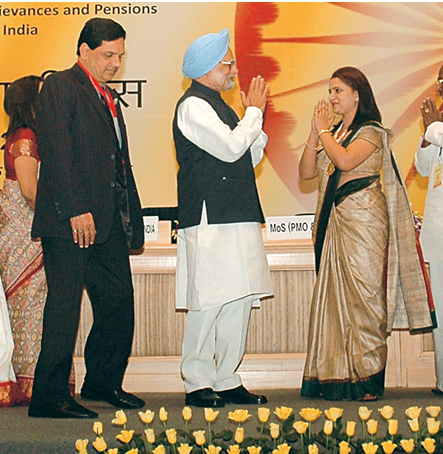
Awardee – Pratyaya Amrit, IAS, Secretary, Rajya Pul Nirman Nigam, Patna
Rajya Pul Nirman Nigam (RPNN), established in 1975, was a defunct organization by 2005. It was plagued by problems such as excessive non-Plan expenditure, budget constraints, few projects, and poor execution, which resulted in low profitability. By 2006, the government decided to wind up the organization, owing to losses of Rs 17 crore.
Pratyaya Amrit took charge as Chairman of RPNN in April 2006. The first three months were spent in interacting with employees, field visits, studying successful organizations and so on. Based on the findings, two steps were initiated – withdrawal of the petition for liquidation and revival of the Board of Directors. As the employees were paid irregularly, the state Cabinet approved the fixing of the percentage charge. Aptly-skilled engineers were posted. A few new divisions were created without imposing extra cost. The engineers were provided vehicles, General Packet Radio Service (GPRS)-enabled mobile phones and administrative freedom, which motivated them. The phones were installed with Mobile Inspector software, through which pictures of the actual work at the site could be accessed at the headquarters. Online monitoring was started at the headquarters and officers down to the rank of Assistant Engineers were provided laptops. Monthly review meetings were held with the engineers in the presence of contractors and third-party quality consultants. The quality laboratory was modernized and third-party quality checks were introduced. Professionals were roped in to motivate the engineers. Other motivation efforts included community launches, celebration of major festivals, yoga camps, Art of Living sessions, setting up of gyms and so on. Brain-storming sessions were conducted regularly. Several incentives were introduced, including vacations abroad, for completing pending projects speedily.
All the pending bridges were completed by December 2008 and the loss-making corporation came out of debt. RPNN became an ISO 9001 and ISO 14001 certified company with overriding commitment to timely completion and quality maintenance as primary goals. On June 12, 2008, 140 bridges built by RPNN across the state were inaugurated. RPNN posted a profit of Rs 80 crore in the last fiscal year. It has diversified into roads and building construction, irrigation projects, beautification of the State capital, and the Patna Roads Projects.
Category – Team
Initiative – The Malkapur 24×7 Water Supply Scheme
Awardees – Rajendra Ganeshlal Holani, Chief Engineer, Maharashtra Jeevan Pradhikaran, Regional Aurangabad; Sadanand Kashinath Bhopale, Section Engineer; Sunil Yashwant Basugade, Section Engineer; Uttam Pandurang Bagade, Section Engineer, Office of the Executive Engineer, Maharashtra Jeevan Pradhikaran, Works Division, Karad, District – Satara.
The Malkapur town piped water supply scheme, commissioned in 1988, was envisaged as supplying 40 litres per capita per day (LPCD) on the basis of an estimated population growth of 14,000 by 2010. But the town’s population increased 50% more than the estimated growth and 10 years earlier than the projection. This resulted in poor and unreliable supply of water and untimely service. To overcome this, a distribution network was designed with Water Gems software ensuring 24×7 availability. The transparent process of manufacturing pipes involving panchayat members ensured quality. The methodology regarding the resin for the pipe manufacture was tendered and accredited by an international agency. Third-party inspection, an essential prerequisite as per the tender, was carried out and certified by an inspection agency. Thus, it was ensured that the pipes used for connections conformed to relevant ISO standards. Similarly, Automatic Meter Readers (AMR meters) used in the project were third-party inspected. Laying the pipelines was properly planned, and phased zone-wise execution was completed in time. Local residents and stakeholders, including the public’s representatives, undertook a special drive to convince people to fix proper stop-cocks. Progressive/telescopic water tariff system was introduced to curb excessive usage of water.
This initiative improved the delivery time and services of water supply. It also contributed to better quality of water delivery as a result of pressurized water throughout the day and night. A 30% reduction in wastage of water was ensured with the telescopic tariff structure and with gradual decrease in the number of hours of water supply from 19-20 hours to 13-14 hours per day. Simplification of billing procedure with AMR-type meter installation ensured that readings could be taken remotely by driving through the streets with radio frequency-driven hand-held devices. As pumping of water to the water tank on terraces was not required, use of electricity was remarkably reduced leading to energy conservation and reduction in pollution to an estimated extent of 450 tonnes of carbon dioxide. The system of automation using GSM technology reduced the cost of operation and eliminated the requirement of pump operators.
Category – Team
Initiative – Education and Training Centre (ETC)
Awardees – Vijay Shantilal Nahata, IAS, Municipal Commissioner, Navi Mumbai Municipal Corporation (NMMC); Varsha Vishwajeet Bhagat, Director, ETC
An Education and Training Centre for children with hearing impairment was started in 2007 and later expanded to cater to other types of disabilities. This led to formation of Education and Training Centre (ETC). A Management Committee chaired by the Commissioner of Navi Mumbai designed strategies for ETC. Students seeking admission were observed and assessed, and the parents counselled about their role in educating their children. Home visits were made to validate the information received and check the environment at home. Based on several requests for therapeutic treatment, units for OPD and remedial education were built and various sections for children with hearing impairment, intellectual impairment, multiple impairments and learning disability were started. A remedial education unit and pre-vocational unit were also started. The Centre provided uniforms, teaching-learning material, appliances and so on. Door-to-door transport was provided for children with special needs, and nutritious and tasty meals were served to them, considering their requirements. Auditory verbal therapy, speech-language therapy, physiotherapy, occupational therapy, parent training and guidance were also provided. The process of issue of disability certificates was also revamped.
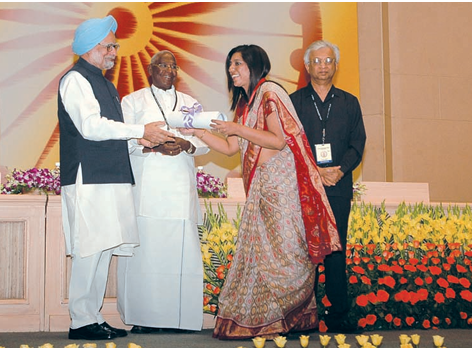
ETC organized community-based rehabilitation programmes, rallies, workshops and street plays, and also distributed booklets, articles and pamphlets to create awareness among the public. Awards and reward schemes were implemented during 2009-10 and several implant and corrective surgeries undertaken. Financial help for the marriage of handicapped people and funding for self-employment and education were also provided. Exhibitions of articles made by these children were held and disabled persons were recruited by NMMC and ETC.
Category – Organization
Initiative – Sickle Cell Anaemia Control Programme, Government of Gujarat
Awardee – Commissionerate of Health, Medical Services & Medical Education, Gandhinagar, Gujarat
Sickle Cell Anaemia (SCA) patients suffer throughout their lives right from birth. According to a survey conducted by the Indian Council for Medical Research (ICMR), amongst the tribes of south Gujarat, namely, Kolcha, Kotwadia and Kathodi, 30% of SCA-affected children die before they reach 14 years and the remaining 70% die by the age of 50. In 2005-06, the Department of Health & Family Welfare of the Government of Gujarat passed a resolution to initiate the Sickle Cell Anaemia Control Programme in four districts of south Gujarat. In 2010, it was extended to all 12 tribal districts of Gujarat.
Initially, 78 government and NGO institutions were involved in the programme in the four tribal districts of south Gujarat. By December 2010, there were 414 centres across the 12 tribal districts of the State that were involved in comprehensive care of SCA patients. The government has undertaken mass sickle cell screening of the 61-lakh tribal population of Gujarat within five years at a cost of Rs 24.76 crore. This work was initiated with Government-NGO public-private partnership – ie partnership with the Indian Red Cross Society and Valsad Raktan Kendra, an NGO. The screening included all age groups with special emphasis on adolescent screening, ante-natal screening and newborns’ screening. The government installed a High Performance Liquid Chromatography (HPLC)-based NBS-Variant machine at Valsad and initiated newborns’ screening from dry blood samples collected on filter paper by pricking the heels of newly born babies. The government signed an MoU with GIOSTAR, a US-based company, for setting up stem cell faculties at the Government Medical College, Surat. Stem cell transplantation gave hope for survival of these patients. Consistent supply of basic items like folic acid and painkillers were assured through PHCs, CHCs and sub-centres. IEC (Information, Education and Communication) materials like banners, pamphlets, movies, and jingles were created in local languages and made available at all levels.
From February 2006 to June 2010, a total of 10,69,475 tribals benefited from this programme by way of diagnosis for sickle cell disease. A total of 8,116 (0.76%) SCA patients were identified, treated and provided counselling. A total of 1,36,759 (12.79%) individuals with sickle cell trait were provided counselling. Marriage counselling was also done among youngsters. As a result, tremendous awareness is noticeable among the tribals of Gujarat, reducing mortality due to this genetic disorder.
Category – Organization
Initiative – Sustainable Plastic Waste Management in Himachal Pradesh
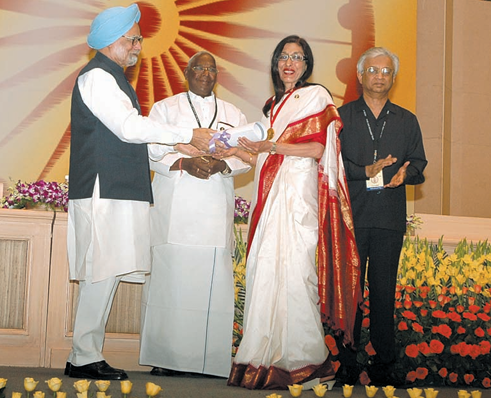
Awardee – Department of Environment, Science and Technology, Government of Himachal Pradesh
In April 2009, the Government of Himachal Pradesh decided to work towards a comprehensive Sustainable Plastic Waste Management Plan to control use of plastic and its disposal. The initiative was undertaken in three stages:
Stage-I (April-November 2009) – Creating an enabling framework: The Department of Environment, Science and Technology (DEST), with experts from the Central Road Research Institute, New Delhi, developed a cost-effective technology for use of plastic in road construction as a result of which roads showed increased strength and resistance to water. To make it sustainable and replicable, a comprehensive plan was also developed. Draft notifications banning use of polythene/plastic carry-bags were issued.
Stage-II (December 2009-March 2010) – Enhancing awareness and broad-basing the initiative: A two-phase “Polythene Hatao – Paryavaran Bachao” campaign was conceived. In Phase-I, voluntary cleaning was carried out. The public was sensitized through jingles, videos and documentary films. In Phase-II, an evaluation of the performance of Phase-I was submitted to the State government by the Deputy Commission. Based on it, the best-performing districts/panchayats were identified.
Stage-II (April 2010 onwards) – Consolidation and Sustainability: Meetings were held between the Public Works Department (PWD), DEST and the Additional Chief Secretary (Environment) to decide on (a) Notification of all collection centres by the Deputy Commissioners; (b) Registration by the Deputy Commissioners of the NGOs, organizations, institutions, door-to-door waste collectors affiliated with the collection centres; (c) Nomination of junior engineers by the PWD for overseeing the lifting of waste from the collection centres with payment terms for lifting having been decided; (d) Records of the quantity of waste collected; (e) Identification by the PWD of stretches of road to be metalled throughout the state; and (f) Collection of plastics/ cleaning of hotspots.
Total disappearance of plastic carry-bags was achieved. Cost-saving in road construction up to Rs 35,000-40,000 per km of road was an additional benefit.