
























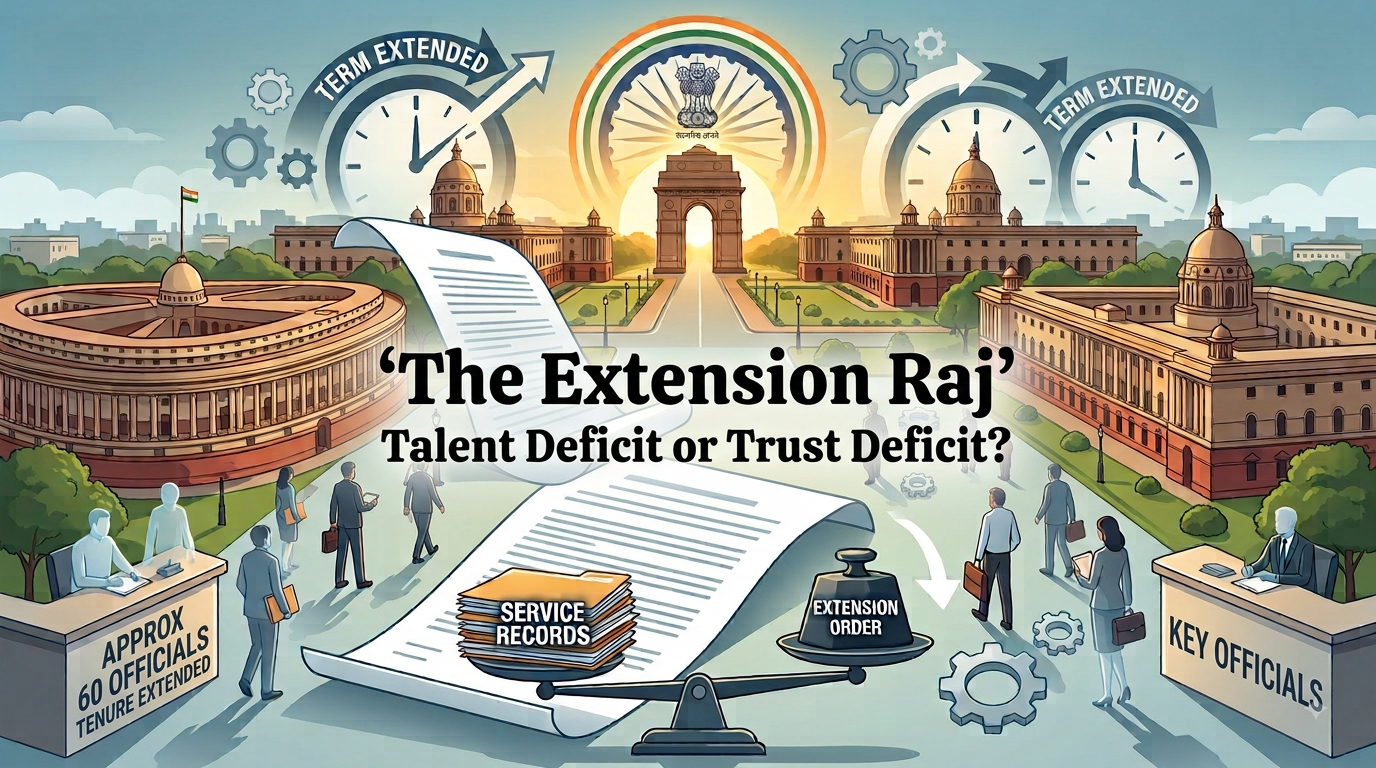
From Rajiv Gauba to T. V. Somanathan, the retirement calendar has acquired a new meaning in India’s bureaucracy
There was a time when a bureaucrat’s retirement date was one of the few certainties in the otherwise unpredictable world of government. An officer could be powerful, influential and indispensable, but eventually the calendar prevailed. The officer retired, another officer took charge and the system moved on. Extensions existed, but they were understood as exceptions. Today, that certainty has begun to disappear. In Delhi’s administrative corridors, retirement is increasingly being treated not as the end of an assignment but as a point from which the government can decide whether the incumbent should continue.
The latest signal came on August 5, 2026, when the government extended the tenure of Cabinet Secretary T. V. Somanathan by another year. On the same day, Union Home Secretary Govind Mohan was also given a one-year extension. Somanathan, the 1987-batch Tamil Nadu cadre IAS officer, had taken over as Cabinet Secretary in August 2024 and was due to complete his initial two-year tenure this month. He will now continue for another year. Govind Mohan, who became Home Secretary in August 2024, has similarly been retained for another year. Two of the most powerful bureaucratic positions in the country therefore continue under the same leadership. The remarkable part was not that the extensions were granted. It was that there was little surprise in Delhi.
That lack of surprise may be more revealing than the orders themselves. Extension is no longer necessarily news; it is becoming a feature of the administrative landscape.
The story, however, did not begin with Somanathan. To understand the present moment, one has to go back to Rajiv Gauba. The 1982-batch Jharkhand cadre IAS officer became Cabinet Secretary in August 2019 and went on to serve for an exceptionally long period, receiving successive extensions before finally demitting office in August 2024. His tenure stretched across some of the most consequential years of the Modi government, including the Covid pandemic and its aftermath, major economic disruption and a period of extraordinary administrative centralisation. There was a strong continuity argument for retaining him. But Gauba’s tenure also demonstrated how far the government was prepared to move away from the traditional two-year rhythm of the Cabinet Secretary’s office.
The Home Ministry offers an even more striking example. Ajay Kumar Bhalla, the 1984-batch Assam-Meghalaya cadre IAS officer, became Home Secretary in August 2019. His normal retirement came in November 2020, but he remained in office through successive extensions and finally left the post in August 2024. By then, his tenure had become one of the longest in the recent history of the Home Ministry. When he eventually departed, the question was not simply who would replace him, but what had happened to the succession queue during those additional years.
His successor was Govind Mohan. And now Mohan himself has received an extension. The government had already extended his service beyond his normal retirement date, and the latest decision keeps him in the Home Ministry until August 2027.
This is where a pattern begins to emerge. One extension can be explained by circumstances. Two can be defended by continuity. A series across successive office-holders begins to tell a different institutional story.
The same phenomenon is visible in the investigative establishment. Praveen Sood, the 1986-batch Karnataka cadre IPS officer, became CBI Director in May 2023. His original tenure was followed by a one-year extension in 2025. In May 2026, the government granted him another one-year extension, taking his tenure into May 2027. It was his second extension. The CBI is one of India’s most politically sensitive investigative institutions, and there is a legitimate argument for continuity in its leadership. But two extensions also make the succession question impossible to ignore. The government has effectively chosen to retain the incumbent beyond the original tenure rather than move immediately to a new director.
The intelligence establishment provides another important example. Tapan Kumar Deka, the 1988-batch Himachal Pradesh cadre IPS officer, was appointed Director of the Intelligence Bureau in June 2022. His original tenure was followed by a one-year extension beyond June 30, 2024, and another one-year extension beyond June 30, 2025. In the world of intelligence, where institutional knowledge and personal networks are considered valuable assets, continuity has a powerful administrative argument. Yet the very sensitivity of the position makes the question of succession even more consequential.
The Enforcement Directorate provides another important dimension to the Extension Raj, and this time the issue is not merely the number of months added to an officer’s service. Rahul Navin, a 1993-batch Indian Revenue Service officer of the Income Tax cadre, became Director of Enforcement in August 2024 after serving as Director-in-Charge from September 2023. His tenure as Director was due to end on August 13, 2026. At that point, the normal bureaucratic route was open to him: he could have returned to his parent Income Tax cadre and continued in an Additional Secretary-equivalent position, such as Chief Commissioner of Income Tax, before eventually retiring from that service. Instead, the government has extended his tenure as Director of Enforcement by another year, up to August 13, 2027. The significance lies not simply in Rahul Navin continuing in office. It lies in the fact that a post that could have become available to a new incumbent on August 13, 2026, will now remain occupied for another year.
There is no question here about Rahul Navin’s competence. He is a capable and experienced officer, and nothing in this argument should be read as casting aspersions on his professional record. The issue is not the individual; it is the institutional consequence of retaining the individual. In any bureaucracy, an extension given to a competent officer can be perfectly justified. But the same decision inevitably has a second consequence: the appointment of the next incumbent is postponed. What is an additional year for the serving officer becomes an additional year of waiting for the officer who might otherwise have entered the post.
Had Navin returned to his parent cadre, his career would have moved towards its natural conclusion in the Income Tax Department. Instead, the extension keeps him at the head of one of the country’s most powerful financial investigation agencies. The difference is therefore not merely between retirement on one date and retirement on another. It is between returning to the parent cadre and completing his career as Director of Enforcement. More importantly for the Extension Raj, the decision postpones the moment at which the government must choose a new Director of Enforcement.
And this is the point that often disappears behind the name of the officer receiving the extension. The extension is about one person, but its consequence is about another person who is not named in the order. The government sees continuity; the bureaucracy sees a vacancy that has not opened. Both perceptions can coexist. There is nothing inherently wrong with retaining a competent officer. But when such decisions accumulate across the senior bureaucracy, the succession calendar begins to move differently from the retirement calendar.
The Enforcement Directorate’s earlier history makes the present case even more interesting. Sanjay Kumar Mishra, the former Director of Enforcement, had received repeated extensions after his original appointment. The matter eventually reached the Supreme Court, which intervened and placed limits on the government’s ability to continue his tenure. The Mishra episode remains important because it demonstrated that the extension of senior officials in sensitive institutions is not simply a matter of administrative convenience; it can raise questions about statutory safeguards, institutional independence and the constitutional balance between executive discretion and fixed tenure.
The extension phenomenon is not confined to IAS and IPS officers. At NITI Aayog, B. V. R. Subrahmanyam, a retired 1987-batch Chhattisgarh cadre IAS officer, was appointed Chief Executive Officer in February 2023. His initial tenure was subsequently extended by a year, taking him beyond the original term. He eventually completed that extended tenure in February 2026. The case demonstrated another mechanism through which governments preserve continuity: retaining a senior officer beyond the initial period even after he has technically crossed the normal boundaries of service.
The public-sector sector provides another version of the same story. Gurdeep Singh, who has headed NTPC since 2016, was retained beyond his scheduled retirement through re-employment and subsequent extension. Here again, the justification was linked to continuity and the search for a regular successor. The argument may be administratively sound. But it also exposes a larger weakness: if an organisation as important as NTPC repeatedly needs its incumbent to remain because a successor has not been finalised, then the problem may lie as much with the succession mechanism as with the availability of talent.
The phenomenon has also travelled into the states. In Madhya Pradesh, Anurag Jain, a 1989-batch IAS officer, received a one-year extension as Chief Secretary. His case followed extensions granted to Iqbal Singh Bains and Veera Rana, creating a sequence in which three successive Chief Secretaries remained beyond their normal retirement dates. Again, the individual cases may each have had their own justification. But when the same administrative instrument is used repeatedly, it begins to change the character of the succession system itself.
Haryana offers perhaps the most politically interesting example because the impact of extension can be seen not merely in one post but in the career calculations of an entire cohort. Chief Secretary Anurag Rastogi’s continued tenure has altered the succession equation involving several senior officers, particularly the 1990 batch. Sudhir Rajpal, Sumita Misra and Raja Shekhar Vundru have all figured in discussions around Haryana’s senior administrative leadership, while earlier changes had affected the prospects of officers such as Anand Mohan Sharan. None of these officers has an automatic right to become Chief Secretary. The political executive has the authority to choose the officer it believes is best suited to lead the administration. But bureaucratic careers are governed by time as much as by seniority or performance. When the incumbent stays longer, the succession window of everyone behind him inevitably becomes narrower.
That is the part of the Extension Raj that government orders never reveal. An order records the name of the officer who has been granted another year. It does not record the officer who has just lost another year of opportunity. It does not record the senior bureaucrat who may now retire without ever occupying the chair for which he or she spent three decades preparing. It does not record the younger officer whose own career progression has been pushed further down the line. The extension is visible; its opportunity cost is invisible.
This is why the debate cannot simply be about whether a particular officer deserves an extension. Many of them probably do. The real question is what happens to an institution when continuity repeatedly takes precedence over succession.
There is a perfectly respectable argument on the government’s side. India today is operating in an unusually complicated environment. National security, economic management, artificial intelligence, digital governance, global geopolitical tensions, large infrastructure projects and major regulatory changes all require administrative continuity. A government is not obliged to remove an experienced officer simply because the retirement calendar has arrived. If an officer is performing well and possesses knowledge that is difficult to replace, keeping that officer for another year may be entirely rational.
The problem begins only when exceptional continuity starts becoming normal practice.
India certainly does not lack bureaucratic talent. The country recruits some of its brightest young people into the civil services every year. The senior bureaucracy contains officers with decades of experience across finance, home affairs, infrastructure, industry, defence, social policy and state administration. The bench is deep.
So if the country does not suffer from a shortage of capable officers, the question inevitably becomes sharper.
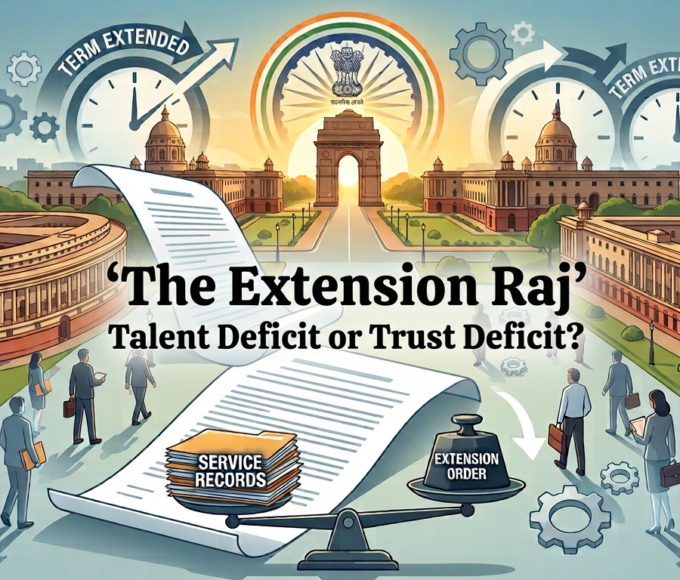
Is the problem a talent deficit—or a trust deficit?
Perhaps the government would reject both formulations. It would say that every appointment and every extension is case-specific, based on performance, experience, administrative necessity and national interest. That is a legitimate position. A government must have the freedom to choose the people it believes can deliver its programme.
But the bureaucracy watches patterns, not explanations.
An officer sees Rajiv Gauba stay longer. Then Ajay Kumar Bhalla. Then another senior official. He sees Tapan Deka receive successive extensions. He sees Praveen Sood receive another year. He sees Rahul Navin being retained as ED Director when he could otherwise have returned to his parent Income Tax cadre. He sees Gurdeep Singh retained while the search for a successor continues. He sees a Chief Secretary retained beyond retirement while another senior officer’s retirement date approaches. He sees the government repeatedly choosing continuity over a change at the top.
The lesson may not be what the government intended to communicate. But the bureaucracy is likely to understand it nevertheless.
Professional competence gets an officer into the senior ranks. But at the very top, political confidence becomes decisive.
That has always been true to some extent. The difference today is the increasing visibility of the consequences.
The danger is not that extensions automatically demoralise the civil service. A deserved extension can have the opposite effect. It can tell officers that expertise and performance are valued. The danger emerges when the system begins to appear unpredictable to those waiting behind the incumbent. If an officer knows that the normal retirement cycle can repeatedly be altered, then seniority becomes less certain as a career-planning instrument.
The result may be subtle rather than dramatic. There will be no protest, no memorandum, no public rebellion. The Indian bureaucracy does not work that way. Instead there are quiet calculations: Who is trusted? Who is being promoted? Who is being retained? Who is being moved? Who is being given the sensitive assignment? Who is likely to get another year?
That psychological shift may ultimately be more important than the extension order itself.
A strong bureaucracy should certainly preserve institutional memory. But institutional memory should ideally belong to the institution, not to one individual. The government’s own Anubhav initiative recognises this principle by encouraging retiring civil servants to document their experiences so that knowledge is not lost when an officer leaves office.
That distinction is fundamental. Experience belongs to the institution. An office belongs to the institution. An individual occupies it temporarily.
If the institution is strong, it should be able to absorb the departure of even its most experienced officer.
That is why the Extension Raj deserves scrutiny—not because extensions are wrong, and certainly not because every extended officer is undeserving, but because repeated extensions change the balance between continuity and succession.
The ultimate question is therefore not why T. V. Somanathan has been retained, or why Govind Mohan, Praveen Sood, Tapan Deka, Rahul Navin, Gurdeep Singh, Anurag Jain and others have been given additional time. Their individual records will have to be judged separately, on their own merits and circumstances.
The larger question is why the system so frequently finds compelling reasons to retain the incumbent while the successor waits.
That takes us back to Talent Deficit or Trust Deficit?
Maybe it is neither. Maybe it is simply the natural consequence of a powerful government choosing the officers it trusts most. But if that becomes the dominant principle of administration, it carries a second obligation: the government must demonstrate that it is also building institutions capable of producing successors whom it can trust.
Because every extension has two faces. One belongs to the officer whose tenure has been extended. The other belongs to the officer who was waiting for the chair.
The first appears in the government notification. The second appears only in the silence that follows.
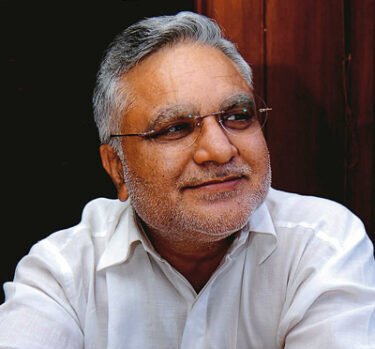
Anil Tyagi is a distinguished Indian journalist. An alumnus of the Delhi School of Economics (M.Com) and the University of Delhi (LL.B), he brings decades of rich experience to journalism. He presently serves as Editor of gfiles.
- Ajay Kumar Bhalla
- bureaucratic extensions
- bureaucratic succession
- Cabinet Secretary
- CBI
- Civil Services
- Enforcement Directorate
- Extension Raj
- government extensions
- Govind Mohan
- IAS officers
- Indian Bureaucracy
- Intelligence Bureau
- IPS Officers
- IRS officers
- Modi government
- Praveen Sood
- Rahul Navin
- Rajiv Gauba
- T V Somanathan
- Tapan Deka