



















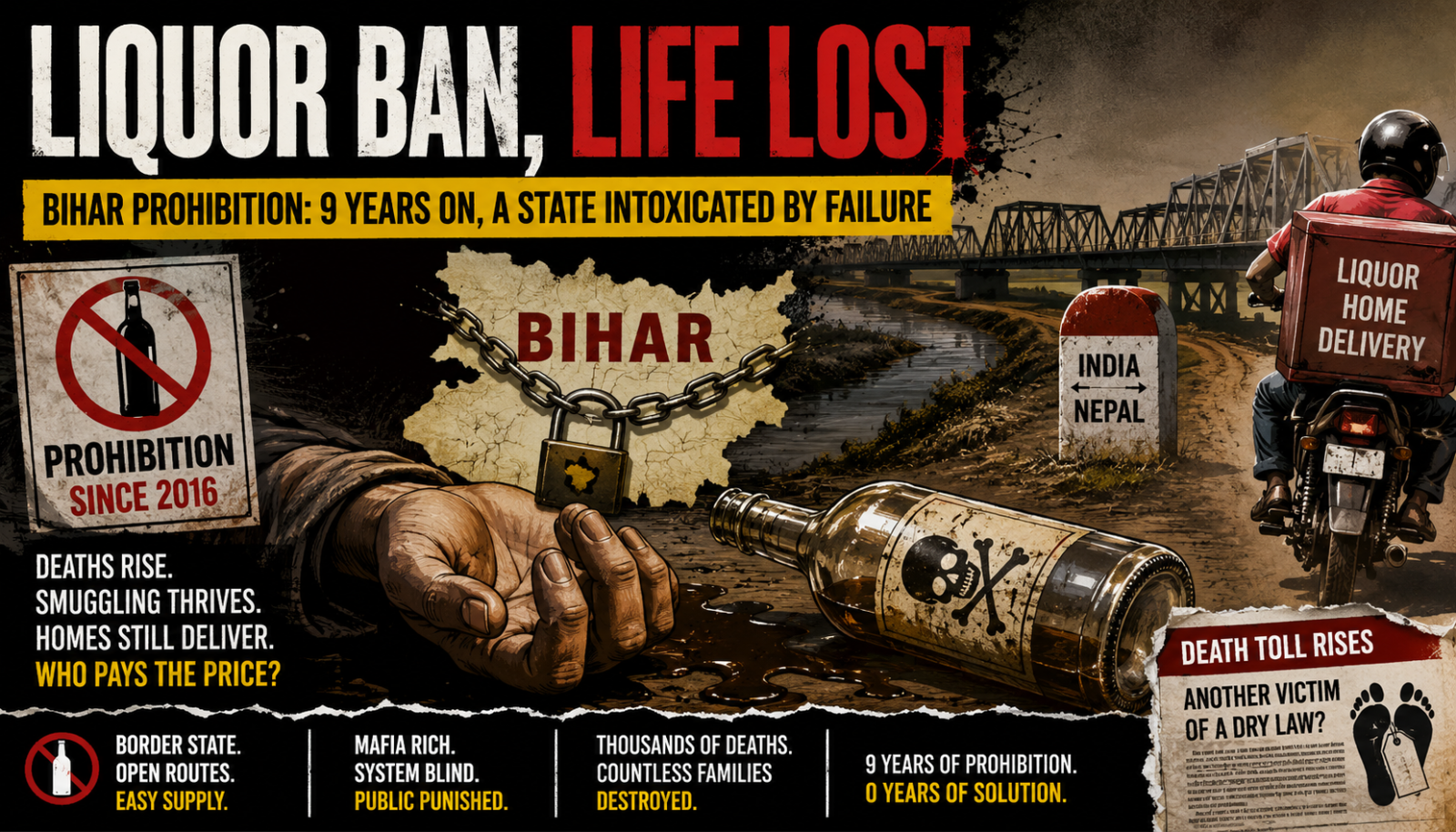
Nine years into prohibition, the evidence is no longer anecdotal — and it is time to ask what tribute to Gandhi was ever meant to look like.
A Widow’s Wait
Lalmunni Devi did not need an NCAER report to tell her that Bihar’s prohibition had failed. In 2022, she lost her husband to toxic liquor — one of the many quiet casualties of a black market prohibition itself created — and has spent the years since piecing together a household income and a family’s stability without him. Nine years after the ban was meant to protect households like hers, she is still waiting for the protection it promised.
Transformational, in Name Only
When Chief Minister Nitish Kumar enacted the Bihar Prohibition and Excise Act on April 5, 2016, he called it “transformational.” A decade on, the word looks less like a description and more like a wish. It was clear from day one that the experiment carried the seeds of its own failure.
A Wall Built of Sieve
Bihar shares a long, porous border with Uttar Pradesh, Jharkhand, West Bengal — and with Nepal, where alcohol flows freely and cheaply. A prohibition regime surrounded on almost every side by legal liquor markets was never a wall; it was a sieve.
“A prohibition regime surrounded on almost every side by legal liquor markets was never a wall; it was a sieve.”
A Century of Precedent
The world had already run this experiment once, at far greater scale. The United States tried nationwide prohibition from 1920 to 1933 and dismantled it after watching organised crime, bootlegging deaths, and a thriving underground economy make a mockery of the law. Bihar did not need a decade of American history to see this coming — it had only to look at Gujarat, Haryana, Mizoram, and Nagaland, states with prohibition laws of their own and much the same story of failure.
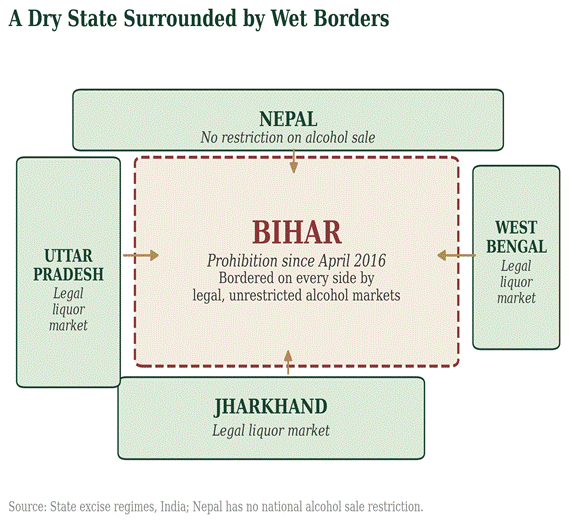
Bihar’s prohibition regime is boxed in on every side by legal, low-friction alcohol markets — Nepal to the north, and Uttar Pradesh, Jharkhand, and West Bengal on the other three.
What the Numbers Actually Say
Nine Years, Millions of Litres
Nine years in, the state’s own record undercuts the case for the ban. Roughly 21 million litres of liquor had been seized by early 2022, with around 450,000 arrests made under the Act — a scale of enforcement that speaks less to deterrence than to the sheer volume of liquor still moving through the state.
Saran’s Deadliest Night
The human cost has been sharper still. In December 2022, hooch poisoning in Saran district killed 73 people, the deadliest single incident since the ban began, a grim marker of how prohibition pushed drinkers toward denatured spirit and illegally distilled liquor rather than away from alcohol altogether.
“Prohibition did not empty the glass. It just made what filled it more dangerous.”
An Audit That Can’t Be Ignored
And now the most rigorous audit yet has confirmed what field reporting had long suggested. A research paper from the National Council of Applied Economic Research (NCAER), released this month and titled “Macro Perspective of Bihar’s Development Achievements, Unfinished Agenda, and the Way Forward,” examined the ban’s social and economic record and recommended that the state government revoke it.
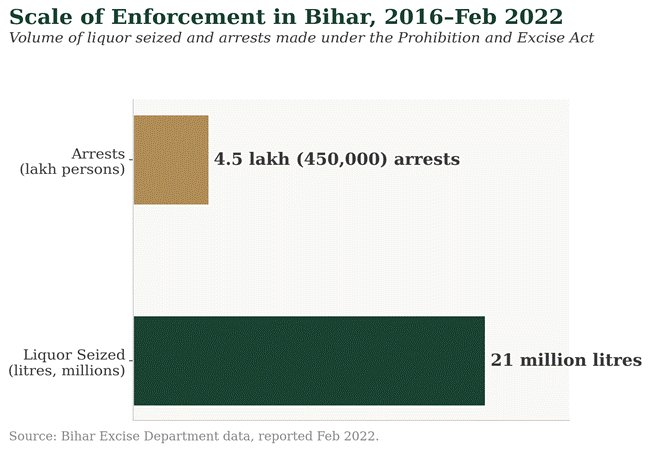
The scale of enforcement since 2016 — 21 million litres seized, 4.5 lakh arrests — reflects the volume of liquor still moving through the state, not the ban’s success in stopping it.
Bihar’s First Prohibition, and How Fast It Died
Jan Nayak’s Ban
Bihar has actually tried this before. In 1978, during his second term as Chief Minister, the socialist leader Karpoori Thakur — later awarded the Bharat Ratna, and still revered as “Jan Nayak,” the people’s leader — imposed a statewide ban on alcohol alongside his landmark reservation policy for backward castes. It was Bihar’s first serious brush with prohibition, decades before Nitish Kumar’s.
Undone Within Two Years
It did not last. Thakur’s reservation formula triggered fierce backlash from Bihar’s dominant castes, and his government fell within about two years, taking prohibition down with it. Nitish Kumar, who considers Thakur his political mentor, has himself publicly recalled this history — noting that the ban was “scrapped by the subsequent regime” almost as soon as the political winds shifted against its architect.
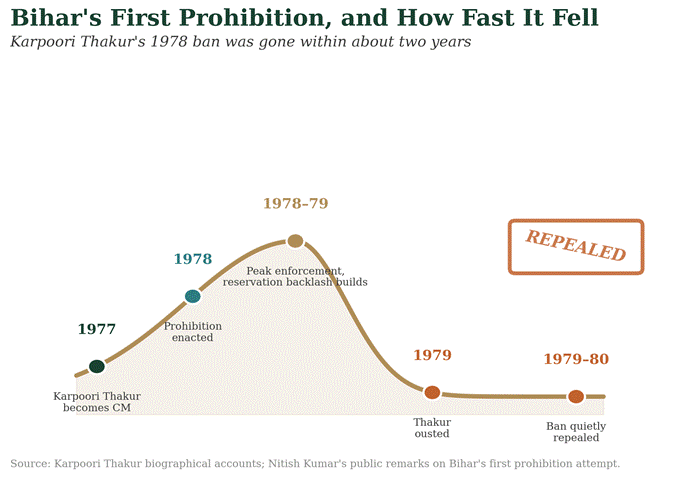
Bihar’s first prohibition experiment, under Karpoori Thakur, collapsed within roughly two years — not because the policy was reversed on its own merits, but because the government that imposed it fell.
A History Worth Remembering Honestly
The precise politics behind Thakur’s fall remain debated — his reservation formula for the most and more backward classes drew organised opposition from upper and dominant castes, and prohibition was never clearly the central issue. What is well documented is simpler and just as instructive: Bihar’s first attempt at a liquor ban did not fail on policy grounds, it was undone by the ordinary churn of state politics before anyone could properly evaluate it.
“Bihar’s first attempt at a liquor ban did not fail on policy grounds — it was undone by the ordinary churn of state politics.”
A Ban Full of Holes
The Taari Exemption
The 2016 prohibition was never even total. Taari, the local toddy tapped from palm trees, was exempted from the ban — a carve-out that quietly conceded what the rest of the law refused to admit: that Bihar’s relationship with intoxicants could not simply be legislated away.
From Bottle to Something Worse
What the ban did manage to do was redirect demand, not extinguish it. As liquor became harder to find, consumption shifted toward solid and smokeless forms of nasha — gutka, marijuana, and other substances that carry their own, often worse, health consequences. A policy built to reduce intoxication ended up trading one set of harms for another, frequently a more dangerous one.
“A policy built to reduce intoxication ended up trading one set of harms for another, frequently a more dangerous one.”
The Bihar-Specific Numbers
The Bihar-specific numbers bear this out with unusual precision. A cross-sectional study of 372 patients in the state’s tertiary care facilities found statistically significant increases in opioid and cannabis consumption after prohibition, along with a marked rise in how often and how much patients were using. Within the ban’s very first year, the state’s own de-addiction centres recorded roughly a quarter of all admissions shifting from alcohol to other substances.
A Trend That Has Compounded, Not Reversed
A decade in, the trend has not reversed — it has compounded. Liquor seizures, the very metric the state cites as proof of enforcement, have nearly doubled from 21.25 lakh litres in 2016-17 to 37.75 lakh litres in 2025, with cases under the Narcotic Drugs and Psychotropic Substances Act climbing in parallel. A policy meant to shrink Bihar’s intoxicant economy has instead watched it diversify and grow.
Sookha Nasha, and Bihar’s Udta Punjab Warning
A Trade That Doesn’t Need a Bottle
There is a term for what has replaced the bottle in Bihar’s small towns and villages: sookha nasha, literally a “dry high” — ganja, opium, and a widening menu of synthetic substances that do not need a bottle, a smell, or a place to hide. Reporting from Bihar’s own towns describes a trade so normalised that schoolgirls have reportedly been used as couriers outside schools in North Bihar, precisely because they draw the least suspicion.
“Sookha nasha — literally a ‘dry high’ — does not need a bottle, a smell, or a place to hide.”
Reaching Every District
This is not a fringe phenomenon confined to a few districts. Field accounts describe the sookha nasha trade reaching small and large towns alike, with intoxicants available even in Bihar’s most underdeveloped districts — Saharsa, Madhubani, and Purnea among them — alongside branded liquor that reportedly reaches consumers within thirty minutes despite the ban, smuggled in from Nepal and the neighbouring states.
What Punjab Already Learned
This is precisely the trajectory that should worry Bihar’s policymakers, because India already has a state that shows where it leads. Punjab’s decade-long slide into what popular culture now calls “Udta Punjab” — a state estimated to have roughly 230,000 opioid-dependent residents and a 2022 survey finding that 15.4 percent of the population reported some form of substance use — did not happen because Punjab banned alcohol. It happened through the same ingredients now visible in Bihar: porous borders, weak enforcement, easy smuggling routes, and a population pushed toward whatever intoxicant was easiest to move quietly.
The Mechanism, Not Yet the Scale
Punjab recorded the country’s highest number of drug overdose deaths for two consecutive years running, and by 2024 accounted for nearly 45 percent of India’s heroin seizures despite holding barely 2 percent of its population. Bihar does not yet have Punjab’s scale of heroin trafficking, and the comparison should not be overstated. But the underlying mechanism — a state driving demand toward whatever substance is hardest to police, without building the health infrastructure to handle what follows — is already running in Bihar, and prohibition is its engine.
“A state driving demand toward whatever substance is hardest to police, without building the health infrastructure to handle what follows — the engine is already running in Bihar.”
A Warning Bihar Cannot Afford to Wait Out
Punjab took decades to arrive at a crisis serious enough to warrant a state-wide door-to-door drug census. Bihar has had nine years of prohibition and a rising NDPS caseload to show for it, and does not have the luxury of waiting for its own version of that census before acting. Sookha nasha is not a curiosity to be footnoted; it is the warning Bihar’s own streets are already delivering.
The Class Divide Prohibition Built
How Bootlegging Actually Works
The mechanics of bootlegging deserve to be spelled out, because they explain why prohibition’s death toll looks the way it does. Denied any legal, quality-controlled supply, people turned to home-brewed liquor — often distilled in makeshift setups with no way to control methanol content, the very contaminant that turns a bottle of country liquor into poison.
Binge to Avoid the Raid
Policing made this worse in a specific, underappreciated way. Because storing liquor at home invited raids and arrest, many drinkers took to consuming an entire batch in one sitting rather than keeping any of it around — a pattern that turns an already toxic brew into a near-guaranteed overdose. Saran’s 73 deaths and Gujarat’s 125-in-Baroda, 150-in-Ahmedabad tragedies are the predictable output of a system that pushed people toward unregulated brewing and then punished them for holding onto the evidence.
“A system that pushed people toward unregulated brewing and then punished them for holding onto the evidence.”
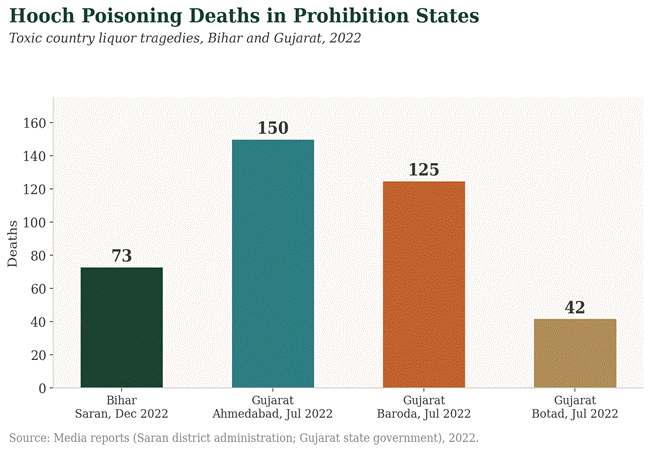
Toxic country liquor has proved lethal at scale in both Bihar and Gujarat — a direct consequence of pushing drinkers toward unregulated, unquality-controlled brews.
A Public-Health Bill Nobody Budgeted For
What follows is a public-health burden that prohibition was supposed to prevent, not manufacture. Methanol poisoning does not simply kill; it blinds and disables many who survive it, leaving families to shoulder years of hospital bills and lost income for a breadwinner who can no longer work. The state that banned the bottle to protect households has, in a grim number of cases, ended up bankrupting the same households through the very hospital wards its policy filled.
Gujarat’s Quiet Escape Hatches
And the burden has never fallen evenly. Gujarat’s own workaround makes the class divide explicit: health permits, tourist e-permits, and licensed hotel bars let the well-off drink branded beer and whisky without ever breaking the law, while GIFT City’s tax breaks quietly carve out legal alcohol access for the financial elite. The poor, lacking the money for a permit or a hotel bar tab, are left to the bootlegger and the backyard still.
“The poor, lacking the money for a permit or a hotel bar tab, are left to the bootlegger and the backyard still.”
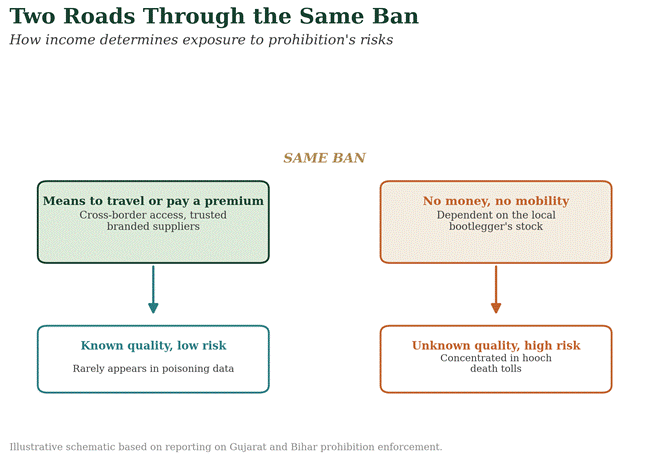
The same ban produces two very different levels of risk, depending entirely on what a household can afford.
Bihar’s Version of the Same Sort
Bihar’s version of this divide is less codified but no less real. Those with means cross into Nepal or a neighbouring state, or simply pay a premium to a trusted supplier who deals in genuine, branded stock; those without money or mobility take what the local bootlegger has on hand, at whatever quality he offers. Prohibition, in practice, has not eliminated drinking so much as it has sorted drinkers by income.
The Forbidden Fruit Problem
Why Bans Create Cravings
There is a psychology to prohibition that Bihar’s policymakers seem never to have reckoned with. Ban something outright, and it acquires a mystique; people who might never have sought it out begin to gravitate toward it precisely because it is forbidden. Make the same thing freely available, by contrast, and much of that charge disappears — consumption tends to settle into moderation, or into indifference altogether.
Gen Z’s Quiet Rebellion
Nowhere is that pattern clearer today than among Gen Z, in India and across the West, where alcohol is legal, unrestricted, and increasingly unwanted. Nearly two pubs a day closed across England, Scotland and Wales in the first quarter of this year alone, and Britain’s social scene has visibly turned toward running clubs, padel courts, and daytime “coffee raves” in their place. This is not a generation straining against a ban; it is a generation with total legal access, choosing, in large numbers, to walk away.
“This is not a generation straining against a ban; it is a generation with total legal access, choosing, in large numbers, to walk away.”
Where alcohol is fully legal, Gen Z is choosing differently — marathon running has drawn a growing share of young Britons even as pubs close at a rate of nearly two a day.
The Comparison Bihar Should Sit With
Where alcohol is banned, it becomes an object of curiosity, status, and illicit thrill — smuggled, spiked, and sometimes fatal. Where it is simply available, as in London or Manchester today, an entire generation is losing interest in it on its own terms, without a single prohibition order.
What Neighbouring States and Regions Actually Do
Telangana and Kerala: High Consumption, Managed Differently
Two southern states complicate the prohibitionist case further. Telangana has India’s highest per-capita alcohol spending, and Kerala has long ranked among the country’s heaviest-drinking states by volume. Neither has followed Bihar’s path. Kerala flirted with phased prohibition in 2014 and quietly abandoned it; alcohol use among Kerala’s men has instead fallen by nearly half since 2005, driven not by a ban but by BEVCO’s state-monopoly retail, tighter regulation, and sustained awareness campaigns.
Himachal’s Quiet Tolerance
Himachal Pradesh, where cottage brewing of drinks like lugdi and angoori is a long-standing part of rural life — including among women — offers a different lesson again: public drunkenness there remains rare, even where home brewing is common and largely unpoliced. Panchayats headed by women have at times voiced symbolic opposition to new liquor shops, but no organised prohibition movement has taken hold, suggesting a tolerated, regulated-by-custom drinking culture can coexist with social order.
But a Drug Crisis of Its Own
That said, the picture in Himachal is not as settled as it once was. Recent reporting counts 66 drug overdose deaths and roughly 1,200 arrests there over three years, with police mapping 234 “red-zone” panchayats and describing a trajectory now “increasingly resembling the crisis witnessed in Punjab.” Much of this traces to Himachal’s proximity to Punjab and Haryana, whose traffickers and users cross the border for narcotics — but the state’s own youth are no longer untouched bystanders, a caution against assuming any regional model is permanently safe.
Sikkim, Ladakh, and the Liberal Alternative
At the other end of the spectrum, Sikkim and Ladakh have leaned into liberal excise policies rather than restriction. Ladakh’s government liberalised its liquor regime in 2026 specifically because official reviewers found the old, restrictive framework was fostering “smuggled and spurious liquor as well as narcotic substances” — the same dynamic driving Bihar’s sookha nasha trade — and moved to widen legal, taxed access instead. Sikkim, similarly, draws a large share of its state revenue from liquor excise without the illicit-market chaos prohibition states report.
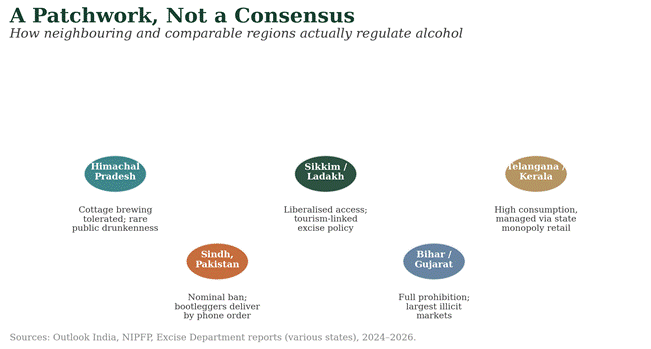
India’s states — and Bihar’s own precedent — do not agree on how to handle alcohol; the ones that regulate rather than ban report fewer of the harms prohibition states struggle with.
Sindh’s Cautionary Mirror
Pakistan’s Sindh province offers the starkest parallel of all. Alcohol has been formally banned there since 1977, yet Karachi’s bootleggers deliver liquor to customer doorsteps by phone order, “like riders delivering fast food,” according to Dawn’s reporting, with prices for smuggled and moonshine liquor spiking under enforcement crackdowns and hundreds of deaths recorded from toxic homemade liquor over the years. Nearly five decades of prohibition in Sindh has produced a functioning, open bootlegging economy — not sobriety.
“Nearly five decades of prohibition in Sindh has produced a functioning, open bootlegging economy — not sobriety.”
What Gandhi Actually Argued
The Curse of Civilization
It is worth returning to the man most associated with India’s temperance movement, because his position is more often invoked than understood. Gandhi never drank, and he called alcohol “that enemy of mankind, that curse of civilization.” He also spent decades campaigning for provincial governments to shut liquor shops by law — the very lineage that eventually placed prohibition in the Constitution’s Directive Principles.
Compelled Versus Chosen
But Gandhi drew a line that Bihar’s policymakers have quietly erased. He held that a man who gives up drink only because the law forces him is not, in any meaningful sense, virtuous — it is the person who abstains of his own free will, as a matter of duty, who has actually changed. Law, in his framework, was scaffolding at best.
“A man who gives up drink only because the law forces him is not, in any meaningful sense, virtuous — it is the person who abstains of his own free will who has actually changed.”
Inverting Gandhi’s Logic
Bihar’s prohibition inverted that entire logic. It substituted the coercive apparatus of the state — raids, seizures, arrests — for the slow, unglamorous work of persuasion, and expected the same moral outcome. Nine years of enforcement data suggest it does not work that way: forced abstinence tends instead to breed evasion, resentment, and a black market — precisely the dynamic Gandhi warned against when he insisted that legislation without voluntary buy-in was “doomed to failure.”
Gen Z as Gandhi’s Vision, Realised
The Gen Z pattern discussed above is, in an odd way, the closest thing India or the West has produced to Gandhi’s actual vision: young adults arriving at sobriety or moderation not because a law forbade the bottle, but because they no longer wanted what was in it. That is self-prohibition by rational choice — exactly what Gandhi asked for, and exactly what Bihar’s law never gave its people the chance to practise.
The Injustice Done in Gandhi’s Name
Gujarat’s Six Decades
Bihar is not even the most instructive case here. Gujarat has carried prohibition since 1 May 1960 — the day Bombay State was split in two. The policy owed as much to Morarji Desai, a lifelong Gandhian who championed prohibition first as Gujarat’s Home Minister and later enforced it nationally as Prime Minister, as it did to Gandhi’s own memory; Desai’s austere, teetotal convictions shaped the law as much as any homage to the Mahatma did.
The Record Gujarat Can’t Escape
The record is damning by any honest reading. Gujarat police seized 82 lakh bottles worth ₹144 crore in 2024 alone. Illicit liquor killed 125 people in Baroda, 150 in Ahmedabad, and 42 in Botad in a single wave of poisonings, and even Gujarat’s own High Court has publicly conceded that the policy has failed to produce results.
“Sixty-five years of enforcement have not made Gujarat dry; they have made it a state where alcohol moves through WhatsApp orders and doorstep delivery as smoothly as any legal commodity.”
Gujarat’s prohibition predates Bihar’s by more than five decades; Mizoram tried and abandoned its own ban, and Nagaland’s is now under review — a pattern, not an exception.
A Tribute Gandhi Never Asked For
The deeper problem with Gujarat’s prohibition is not that it failed operationally — Bihar shows every ban can fail that way. It is that the failure was committed in Gandhi’s name. Gandhi never asked for what Gujarat built: he considered coerced sobriety morally empty and placed his real faith in persuasion and a person’s own free choice to abstain.
Shrinking a National Legacy
There is a second injustice buried inside the first. By treating prohibition as a Gujarat-specific act of homage, successive governments have implicitly shrunk a man who belonged to the whole of India, and arguably to the world, into a regional mascot. Gandhi’s fight against alcohol ran through his writing on freedom, dignity, and self-rule for every Indian, regardless of province.
“Gandhi’s fight against alcohol was never conceived as a Gujarati cause; it ran through his writing on freedom, dignity, and self-rule for every Indian, regardless of province.”
The Same Error, Twice
Reducing him to a single state’s prohibition law is the same error, in miniature, as reducing his politics to Sabarmati Ashram or his image to a currency note. It takes a legacy meant for a nation and quietly parochialises it — and then compounds the insult by attaching his name to a policy that has, by the state’s own courts and crime data, failed to deliver the moral transformation he actually wanted.
Regulate the Choice, Don’t Erase It
Not an Argument That Alcohol Is Harmless
None of this is an argument that alcohol is harmless — it plainly is not. A 2026 U.S. government-commissioned review concluded that even what is popularly considered “moderate” drinking carries meaningfully elevated risk, and a large global “Burden of Proof” analysis published the same year found no safe threshold for alcohol’s contribution to several cancers. Nobody serious is arguing that a daily habit is good for you.
The Comparison Nobody Makes
But that is a different question from whether an adult should be allowed the occasional beer, glass of wine, or peg of whisky at a wedding or a weekend gathering. The honest comparison is not between alcohol and abstinence; it is between alcohol and the long list of other indulgences Indian society already tolerates in moderation while quietly ignoring their cumulative harm — smoking, gutka and paan masala, deep-fried snacks, sweets consumed without restraint.
“The honest comparison is not between alcohol and abstinence; it is between alcohol and the long list of other indulgences Indian society already tolerates in moderation.”
What Actually Keeps Drinkers Safe
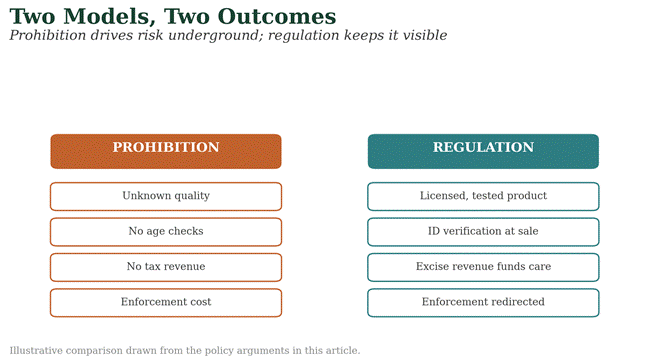
A society that permits over-indulgence in food, tobacco, and areca-nut products while criminalising a glass of beer is applying a selective logic, not a consistent one. What keeps most Western drinking cultures from spiralling into chaos is not the absence of alcohol; it is the presence of firm, consistently enforced rules around it — strict drunk-driving laws, real penalties for serving minors, and policing that actually shows up.
Prohibition and regulation are not equally imperfect options — one drives risk out of view, the other keeps it visible and manageable.
Redirecting the State’s Energy
That, and not prohibition, is the model Bihar’s government should be studying. Directing enforcement energy toward drunk-driving checkpoints, licensing discipline, and age verification is considerably cheaper than the current apparatus of raids and seizures. It also converts a liability into an asset: a regulated, taxed liquor market could lift state revenue by 14 to 15 percent, funding exactly the public-health infrastructure prohibition has spent nine years failing to deliver for free.
The Case the Ban Was Sold On, Undone
The Promise Made to Women
Prohibition was pitched, above all, as protection for women — the belief that alcohol was a significant driver of domestic violence, and that money spent on liquor would instead go toward the household. The NCAER team, led by economist Ratna Sahay, tested that premise against the data and found it did not hold.
The Data That Contradicts It
Reported crimes against women in Bihar have not declined since 2016; the total has, in fact, risen over the post-ban period. The study attributes this partly to the expansion of illicit liquor networks, weak enforcement, and corruption that grew up around the ban itself.
“The policy sold as protection for women has left them facing the same risks — through channels the law never anticipated.”
A Shift Nobody Budgeted For
The report also points to a rise in the use of alternative intoxicants, including illicit drugs, as prohibition pushed some consumers away from alcohol and toward substances the state polices even less effectively. This mirrors what Bihar’s own health administration flagged years earlier, when medical officers were sent to NIMHANS for training to handle rising substance-use disorders linked to the ban.
The Government’s Defense, and Why It Doesn’t Hold
Dismissed as ‘Data Manipulation’
Bihar’s ruling party has not taken the NCAER findings quietly. Within days of the report’s release, the JD(U)’s chief spokesperson dismissed it as “data manipulation,” insisting the ban reflected “the resolve of the people of Bihar” and had driven a significant decline in domestic violence — the same claim the study’s crime data directly contradicts.
A Refusal to Look
That response is itself revealing. Dismissing a rigorous, peer-reviewed institutional study as fabrication, without engaging its data, is not a rebuttal — it is a refusal to look. If the government believes the NCAER’s numbers are wrong, the honest response is a competing study with better data.
“Dismissing a rigorous, peer-reviewed institutional study as fabrication, without engaging its data, is not a rebuttal — it is a refusal to look.”
“Jo Piyega, Woh Marega”
The posture is not new. When more than a hundred people died from illicit liquor in Bihar’s early prohibition years and the opposition demanded compensation for victims’ families, Chief Minister Nitish Kumar rejected the demand from the floor of the House with five words: “Jo piyega, woh marega” — whoever drinks will die. It was a line that blamed the dead for the state’s own policy failure.
Taking Women’s Safety Seriously Means Following the Data
Women’s safety was the ban’s founding justification, and it deserves to be treated as one, not waved aside. But treating it seriously means following the crime data where it leads — and the data, audited by one of India’s most credible research bodies, says the protection never materialised.
The Fiscal Bill
What Restoring Excise Would Mean
Beyond the human toll, prohibition has cost Bihar money it can ill afford to lose. The NCAER paper estimates that restoring the liquor excise tax to pre-ban levels would raise the state’s own revenue by 14 to 15 percent, even as it lowers what the state currently spends chasing smugglers and running enforcement operations that have visibly failed to stop the trade.
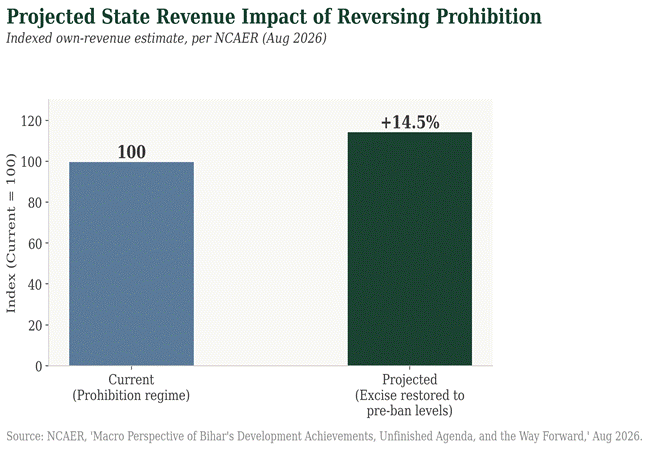
NCAER estimates that restoring the liquor excise tax to pre-ban levels would lift Bihar’s own revenue by roughly 14.5 percent — money currently forfeited to enforcement and lost trade.
Money Bihar Cannot Afford to Forfeit
That is not a small number for one of India’s poorest states, still working through what the same report calls its “unfinished agenda” of development. Money currently spent policing a market that continues to operate anyway is money not spent on the health, education, and infrastructure gaps prohibition was, in part, meant to help close.
It Is Time to Act — Without Further Delay
No More Excuses for Delay
Every argument in this piece points toward the same conclusion: Bihar should end prohibition, and it should do so as soon as the state assembly can convene to repeal the Act. Nine years is not a trial period anymore; it is a decade of accumulated evidence, and there is no honest reading of that evidence that counsels patience.
The Case for Waiting Doesn’t Survive Contact with the Evidence
The usual case for going slow — study it further, wait for more data — does not survive contact with what the state already has in hand. Bihar does not lack information. It lacks only the political will to act on the information it has.
“Bihar does not lack information. It lacks only the political will to act on the information it has.”
Every Month of Delay Has a Body Count
Delay carries its own body count. Every month prohibition continues is another month of unregulated brewing, another month of families burying breadwinners lost to methanol, another month of the state’s own revenue haemorrhaging into an enforcement apparatus the NCAER paper itself says is not working.
No Credible Political Cover Left
Nor is there a credible political excuse left. A government that reverses prohibition is not abandoning Gandhi, women, or public health — it is correcting a policy that has failed all three. The honest position for Bihar’s leadership is to say so plainly and repeal the Act.
What a Responsible Exit Should Look Like
A Phased, Licensed Reopening
Ending prohibition well matters as much as ending it quickly. A phased, licensed reopening — starting with regulated retail in urban centres before extending to rural areas, each stage tied to verified age checks and licensing discipline — avoids the chaos of an overnight reversal while still moving with urgency.
Ring-Fencing the Revenue
A fixed share of the new excise revenue, ring-fenced by law, should fund de-addiction infrastructure and NIMHANS-style clinical training. The same funding stream can finance the enforcement Bihar actually needs: drunk-driving checkpoints, license suspension for repeat offenders, and penalties for selling to minors.
“Ending prohibition well matters as much as ending it quickly.”
Bringing Taari Producers Into the Fold
Taari and other traditional, low-alcohol local brews should be formally integrated into the regulated economy rather than left in their current grey-market limbo. Dry days around elections, examinations, and major religious observances can continue, preserving the parts of the old policy that had genuine, non-punitive public support.
An Exit That Audits Itself
Finally, the reform should be self-auditing. An independent body should track reported crimes against women, hooch deaths, and substance-use trends for five years after repeal and publish the results without political filtering. If regulated access performs better, the data will say so — and if it does not, Bihar will have the evidence to correct course again.
A Decade of Evidence, One Conclusion
The Failure Is No Longer Anecdotal
None of this should surprise anyone who has watched prohibition regimes rise and fall across a century of Indian and global history — including Bihar’s own, in 1978. What is notable now is not that the policy has failed, but that the failure is no longer anecdotal. It is documented, quantified, and endorsed by one of India’s most credible economic research institutions. The question facing Bihar’s government is no longer whether the ban works. It is how much longer the state can afford to pretend that it does.
References
Sahay, R. et al., “Macro Perspective of Bihar’s Development Achievements, Unfinished Agenda, and the Way Forward,” National Council of Applied Economic Research (NCAER), presented at the India Policy Forum, August 2026.
“Alcohol Ban in Bihar Failed to Prevent Violence against Women, Govt Should Revoke it: NCAER Study,” PGurus, August 8, 2026.
“Alcohol Ban In Bihar Failed To Prevent Violence Against Women, Govt Should Revoke It: NCAER,” Outlook India, August 2026.
“JD(U) Rejects NCAER Findings As ‘Data Manipulation’, Defends Bihar Liquor Ban,” Free Press Journal, August 12, 2026.
“NCAER report sparks debate over Bihar’s liquor ban; JD-U defends prohibition, leaders seek review,” IANS / The Hawk, August 12, 2026.
“Bihar: A Botched Booze Ban,” Deccan Herald (includes Chief Minister Nitish Kumar’s “Jo piyega, woh marega” remark and related political reaction).
“BJP’s Bihar Ally Demands Ending Prohibition in State, Slams Nitish Kumar for Hooch Tragedy,” Deccan Herald.
“Six Die in Two Days After Ban on Liquor in Bihar,” Gulf News (early prohibition-period de-addiction centre admissions).
“Drug Abuse Jumps After Liquor Ban in Bihar,” The Asian Age, April 2017.
“Drug Abuse Is Replacing Alcoholism — Another Warning That Prohibition Is Not Working in Bihar,” The Indian Express (NIMHANS training of Bihar medical officers).
“An Evaluation of the Changing Trends in Substance Use Behavior Among Patients in the Tertiary Care Setting After the Implementation of Liquor Prohibition in Bihar, India: A Cross-Sectional Study,” PMC / National Center for Biotechnology Information.
“India’s Battle Against Addiction: From Liquor Ban To ‘Dry Drugs’, Bihar’s Youth Trapped In A Growing Narcotics Crisis,” ETV Bharat, June 22, 2026.
“Bihar — A Dry State to Drug State,” Newsd, 2018 (Directorate of Revenue Intelligence survey on post-prohibition substance switching).
“Behind Bihar’s Booming Prohibition Cash Flow Lies a Crumbling Moral Order,” The Federal, December 2, 2025 (origin of the term “sookha nasha”).
“Bihar’s Dry Spell: Booze in Bags, Smoke in Streets,” The Pioneer, 2025.
“After State BJP Chief, Top India Liquor Body Urges Bihar Government to Reconsider Alcohol Ban,” Gulf News (Confederation of Indian Alcoholic Beverage Companies letter).
“Prashant Kishor: Prohibition in Bihar Has Been a Complete Failure,” Deccan Herald.
“Punjab’s War on Drugs Fell Victim to Abuse. 8 Years On, an Overhaul Begins,” ThePrint, November 1, 2025.
“India’s Battle Against Addiction: Can Punjab’s Drug Census Show India the Way Forward Through Data-Driven Policy,” ETV Bharat, June 20, 2026.
Chahal, S.S., “Punjab’s Drug Crisis: A Comprehensive Overview,” Punjab Outlook, December 6, 2025.
“A Narrative Review of Trends and Challenges of Substance Use in Punjab: A 10-Year Analysis of Data from 2015 to 2024,” Discover Public Health, Springer Nature, 2025.
“Urgent Need to Revisit the Current Approach Towards De-addiction in Punjab,” Herald Open Access.
London Marathon under-29 participation trend, cited via CNN, July 2026; British Beer and Pub Association pub closure data, Q1 2026.
U.S. government-commissioned review of moderate alcohol consumption and health risk, 2026; “Burden of Proof” global alcohol risk analysis, Nature / Institute for Health Metrics and Evaluation, 2026.
Bihar Excise Department enforcement data (liquor seizures and arrests, 2016–February 2022), as reported in Indian media, February 2022.
Media reports on Gujarat prohibition enforcement, 2024 seizure data, and July 2022 hooch poisoning deaths in Ahmedabad, Baroda, and Botad; Gujarat High Court commentary on prohibition’s effectiveness.
Karpoori Thakur biographical accounts, Wikipedia and Grokipedia; ThePrint, “Karpoori Thakur, the other Bihar CM who banned alcohol”; Deccan Herald, “Nitish calls for fresh survey to study impact of Bihar’s alcohol ban” (Karpoori Thakur’s 1978 prohibition and its collapse).
Deccan Herald, “Strict action to be taken against those found violating liquor prohibition law: Bihar CM” (Nitish Kumar’s remarks on Morarji Desai and Bihar’s first prohibition).
Grokipedia, “Morarji Desai” (Desai’s role as Gujarat Home Minister and later as Prime Minister in championing prohibition).
NewsMeter and The Hans India, “Telangana tops in consuming alcohol in South India” (2023-24 per-capita consumption and revenue data, Telangana, Andhra Pradesh, Kerala).
Kerala Kaumudi, “Kerala trails far behind as another state tops the list in alcohol consumption” (NFHS-6 data, June 2026); Gulf News, “India’s wettest state to go dry in 10 years” (Kerala’s 2014 phased-prohibition attempt).
Outlook India, “Between Prohibition And Regulation: Himachal Grapples With Spurious Liquor Menace” (cottage brewing culture, women panchayat heads); Outlook India, “Himachal’s Dark Reality: 66 Drug Overdose Deaths, 1200 Arrests In Three Years.”
The News Mill and Travel And Tour World, coverage of Ladakh’s 2026 liberalised excise policy; Sikkim Express and Quora/Indian Cooperative Federalism, Sikkim liquor excise revenue data.
Scroll.in / Dawn, “How a Pakistani bootlegger survived (and thrived) during Sindh’s alcohol ban”; Dawn, “Alcohol in Pakistan: The prohibition and after”; Dawn, “Deadly cocktails” (Sindh moonshine deaths and Sindh High Court intervention).

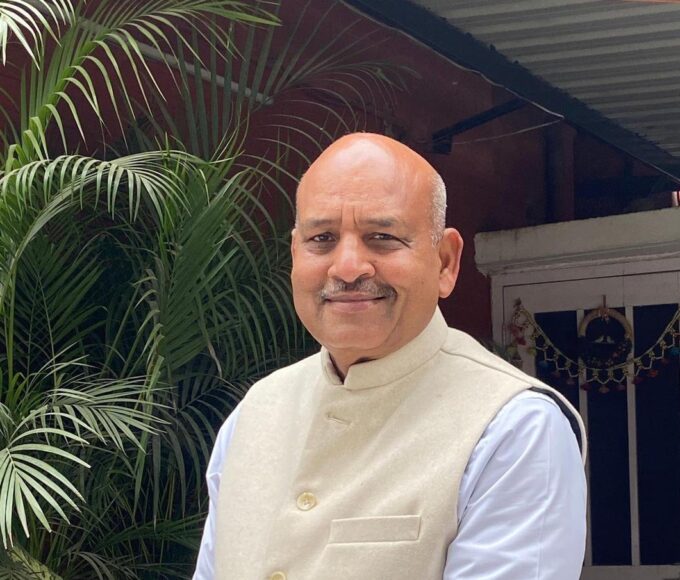
Bhuwan Mohan Prasad
An alumnus of Indian Institute of Technology Kanpur and University of Toronto, Bhuwan Mohan Prasad combines his professional work as an engineering consultant with his passion for independent writing. His writing spans political policy, the environment, public health, and energy.