

















- President of the Editors Guild of India, distinguished members of the Guild, awardees, journalists, friends, ladies and gentlemen,
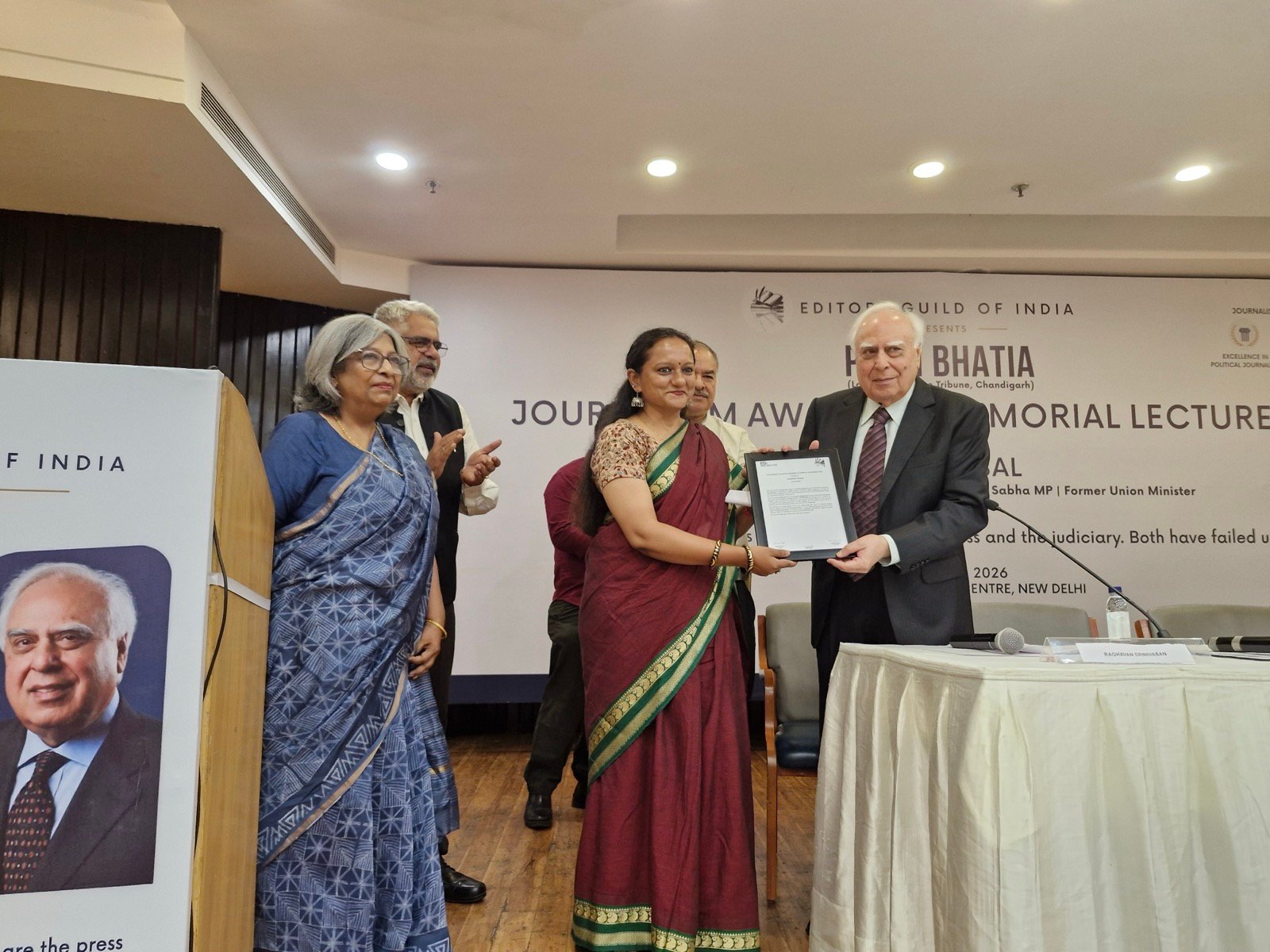
- It is an honour to deliver the Prem Bhatia Memorial Lecture this evening under the auspices of the Editors Guild of India. Prem Bhatia— one of the most distinguished journalists and public figures, political editor of The Statesman, editor of The Tribune, Delhi editor of The Times of India, and later editor of The Indian Express—was known for his incisive political reporting, independence of judgement, and unfaltering objectivity. He travelled the world with Jawaharlal Nehru covering many of Nehru’s important foreign tours in the formative years of independent India, served as India’s High Commissioner to Kenya and Singapore, and returned to edit The Tribune in Chandigarh with the same integrity that marked his entire career. He embodied the ideal that the press must serve the citizen, not power. The awards conferred tonight continue to honour excellence in political and environmental journalism—work marked by depth, rigour, and public impact. In the achievements of this year’s recipients, and in Prem Bhatia’s enduring memory, we find both inspiration and a sobering indictment of the times we inhabit.
- The topic for today’s lecture is stark: “The two strongest pillars of democracy are the press and the judiciary. Both have failed us. Why?”
- I state this not as an indictment, but as a diagnosis of institutional failure. A democracy does not survive on elections alone. It survives on institutions that keep a check on power, expose excess, and protect the citizen from the State and from majoritarian passions. The press and the judiciary are those institutions. When they stand upright, the Constitution lives. When they bend, the Republic hollows out from within.
The Press: From Watchdog to Managed Narrative
- The press once punched above its weight. It forced accountability in the 1970s and 1980s, and helped shape public reason through rigorous, independent reporting. Today that tradition is under sustained assault. What was once a watchdog has, in large measure, been reduced to a managed narrative—sometimes through intimidation, sometimes through co-option, and often through the quiet calculus of survival.
- India’s ranking on the World Press Freedom Index tells part of the story. In 2026 the country stands at 157 out of 180, a further drop from 151 the previous year, and firmly in the “very serious” category. Reporters Without Borders attributes this decline to rising violence against journalists, highly concentrated media ownership, overt political alignment of major outlets, and the intensifying judicial harassment of independent voices. The Free-Speech Collective documented over 14,800 instances of free-speech violations in 2025 alone, including the killing of 8 journalists, 117 arrests linked to expression, and widespread censorship. These are not abstract statistics; they describe the lived reality of the profession.
- The instruments of control are multiple and interlocking. Criminal defamation remains a potent weapon. In February 2026 a magistrate’s court in Mansa, Gujarat convicted investigative journalist Ravi Nair and sentenced him to one year’s simple imprisonment plus a fine of ₹5,000. The private complaint was filed by Adani Enterprises Limited over a series of social-media posts and writings between 2020 and 2021 that alleged political patronage, financial irregularities and unethical conduct. The court held that the publications went beyond neutral reporting, used “declaratory and accusatory” language, and lowered the company’s moral and commercial standing. Nair’s defence of fair comment on matters of public interest was rejected. The sentence was later suspended for a month to allow an appeal, but the conviction itself stands as a chilling marker: powerful corporate interests closely associated with the ruling establishment can still use the criminal process to punish critical journalism.
- In Assam, the pressure has been more visceral and systematic. In April 2026 the Lakhimpur office of the Assamese daily Asomiya Pratidin was attacked by unidentified persons who pelted stones, shattered windows and damaged the newsroom. The assault occurred less than twenty-four hours after polling for the state Assembly elections and roughly twelve hours after Chief Minister Himanta Biswa Sarma publicly criticised the newspaper and, according to multiple reports, threatened that media figures like its owner would be “politically and intellectually destroyed” if his government returned to power. Earlier, in March, bundles of the same newspaper were set ablaze in Upper Assam. Press bodies across the state and the Press Club of India condemned the attack as a direct assault on press freedom. No swift arrests followed.
- In 2025, Assam police registered multiple FIRs against The Wire and its journalists, including founding editor Siddharth Varadarajan and consulting editor Karan Thapar for “acts endangering the sovereignty, unity and integrity of India.” The complaints arose from coverage of the military escalation with Pakistan following the Pahalgam attack. Freelance journalist Abhisar Sharma faced similar proceedings after criticising the Chief Minister on YouTube. In March 2025 Dilwar Hussain Mozumder of the independent site Cross Currents was arrested and held for four days after attempting to cover an alleged bank fraud. In July 2026 India Today journalists holding valid session passes were barred from the Assam Assembly; reporter Hrijoy Das Kanungo was physically assaulted by a member of the Assembly press committee, his phone seized and the video of the incident deleted, while the Chief Minister was speaking inside.
- Elsewhere the pattern repeats. In Madhya Pradesh, also BJP-ruled, two News24 journalists investigating alleged corruption in the issuance of driving licences and vehicle registrations at a Regional Transport Office were assaulted in November 2025, held by a group of men, and had their equipment vandalised. Despite video evidence and an FIR, arrests lagged. Freelance journalist Rupesh Kumar Singh has spent more than four years in prison for reporting on the disastrous effects of industrial pollution. Across the country, journalists covering rural and semi-urban issues face the highest risk of physical attack; online harassment, especially of women journalists and young protesters, has become industrial in scale.
- Structural factors deepen the crisis. Media ownership is highly concentrated in the hands of business houses with commercial and political interests aligned with the central government. Economic vulnerability – advertising dependence, tax scrutiny, and the threat of regulatory action—encourages self-censorship. The Information Technology (Intermediary Guidelines and Digital Media Ethics Code) Amendment Rules, 2026 notified in February, 2026 along with further draft amendments to these rules released by the Ministry of Electronics and Information Technology (MEITY) in March, 2026 seek to give the executive sweeping powers: treating ordinary social-media users who comment on news as publishers, shortening compliance windows for takedowns to as little as three hours, and requiring platforms to obey a wide range of executive advisories, SOPs and guidelines under pain of losing safe-harbour protection. The Editors Guild and multiple journalist bodies rightly warned that these proposals would constrict dissent and enlarge the space for authoritarian control. Large-scale blocking of accounts, including those of international news agencies, has become routine.
- The cumulative effect is visible in the public sphere. A significant section of television and digital media has been reduced to what citizens now openly call “Godi Media”—outlets that amplify official narratives, marginalise opposition voices, and treat scrutiny of power as disloyalty. The Prime Minister has not held a single open, unscripted press conference in more than a decade. Officials justify this silence by claiming a preference for direct communication with a rural electorate – an argument deeply flawed and chilling.
- During the July 2026 youth protests against examination-paper leaks, public anger spilled over onto sections of the media itself. Reporters from channels widely perceived as close to the government were heckled, jostled and, in some cases, assaulted by protesters at Jantar Mantar and other sites. The Editors Guild of India rightly condemned the violence, affirming that no amount of public rage can justify attacks on journalists. At the same time, the Guild was compelled to acknowledge an uncomfortable truth: flawed, one-sided and overtly partisan reporting had itself eroded the media’s credibility and thereby weakened its claim to be a pillar of democracy. When large sections of television news function less as platforms for independent scrutiny and more as amplifiers of official narratives, the public ceases to see them as watchdogs and begins to see them as part of the power structure they are meant to hold to account. The hostility that erupted in July 2026 was therefore not merely spontaneous disorder; it was also a symptom of the deeper legitimacy crisis that results when the press abandons its constitutional role and becomes, in the eyes of citizens, an extension of the very authority it is supposed to question.
- This is the failure of the press as a constitutional institution. A free press is not a privilege granted by government; it is a structural necessity for democracy. When journalists are jailed for critical reporting on corporate-state proximity, when newspaper offices are vandalised after public criticism by chief ministers, when digital rules are rewritten to enlarge executive control, and when large sections of the profession internalise fear or commercial convenience, the watchdog ceases to bark. The citizen is left with noise instead of information, and misuse of power is left largely unexamined.
The Judiciary: The Last Citadel Under Strain
- The judiciary is the final guardian of fundamental rights. It possesses neither the purse nor the sword; its authority rests solely on public faith and fidelity to the Constitution. That faith is visibly eroding. What was designed as the last citadel of constitutional morality is under severe strain—not from open assault alone, but from prolonged hesitation, selective application of principle, and the quiet accumulation of institutional compromises.
- Consider the most stark contemporary illustration. Umar Khalid has been in custody since September 2020—nearly six years as of August 2026—under the Unlawful Activities (Prevention) Act in the Delhi riots “larger conspiracy” case arising from the February 2020 violence. Charges have still not been framed. The trial has not begun. In January 2026 a Supreme Court bench denied him and Sharjeel Imam bail while granting relief to several co-accused, holding that Khalid and Imam stood on a “qualitatively different footing” because the prosecution material attributed to them central roles in planning and mobilisation. A review petition against that judgment was dismissed on merits in April 2026. Fresh bail applications filed in the trial court in June 2026 again highlight the constitutional injury: prolonged incarceration without trial, in the face of the Court’s own repeated observations that bail is the rule and jail the exception, even under special statutes. When pre-trial detention stretches into half a decade under a law whose design invites abuse, the distinction between investigation and punishment collapses. Liberty becomes contingent on the convenience of the executive.
- This is not an isolated failure. The same pattern of delayed justice and restrictive bail jurisprudence under UAPA and other special laws has affected other activists, students and journalists. The Prevention of Money Laundering Act (PMLA) has emerged as another powerful special law whose stringent provisions have been used against political opponents and businessmen. Section 45 of the PMLA imposes the notorious “twin conditions” for bail—requiring the accused to prove that they are not guilty and that they are unlikely to commit any offence while on bail—effectively reversing the fundamental principle of criminal jurisprudence. Both the UAPA and the PMLA illustrate how special laws have been deployed to dilute the ordinary protections of personal liberty under Article 21 and to create a parallel system in which prolonged incarceration often precedes, or even substitutes for, a full trial.
- Structural problems compound the crisis. The collegium system, once defended as the essential shield of judicial independence against executive interference, is itself under severe criticism from within the profession. Senior members of the bar—including those who once argued for its creation—have publicly described it as having turned into a “total disaster,” marked by opacity, insufficient resistance to executive pressure, and, at times, complicity in the targeting of independent judges through transfers or delayed appointments. The executive’s influence over the process of elevation, confirmation and post-retirement assignments remains a persistent concern. When the political executive commands a decisive parliamentary majority and controls the investigative agencies, the incentives for judicial caution multiply.
- Selectivity in institutional response further damages credibility. Notices for impeachment proceedings against High Court judges have moved at markedly different speeds depending on the nature of the allegations and the political context. One set of proceedings is expedited; another remains pending. The Supreme Court’s own decision in early 2026 to ban a Class 8 civics textbook chapter that discussed judicial corruption—while blacklisting its authors from publicly funded work—sent a troubling signal about the institution’s tolerance for public examination of its own vulnerabilities. Public faith, as I have said on earlier occasions, is eroding because the judiciary has, in critical moments, brought the erosion upon itself.
- The anti-defection law offers another revealing window. The Tenth Schedule was intended to protect the integrity of the electoral mandate. In practice, the merger exception has been interpreted in ways that allow large groups of legislators to switch sides without attracting disqualification, thereby overturning electoral verdicts without fresh elections. Governments have been toppled or stabilised through such manoeuvres in multiple states. In July 2026 the Supreme Court itself acknowledged that there are “enormous issues” with the Tenth Schedule while hearing a petition I filed in person challenging the prevailing interpretation of the merger provision. Yet the Courts have largely left corrective action to Parliament—the very body whose members benefit from the status quo. When the judiciary declines to read down an interpretation that has made a mockery of the anti-defection law’s purpose, the constitutional scheme of democratic accountability suffers.
- These failures do not mean that every judge has abandoned independence or that every bench has surrendered. There remain judges of courage and constitutional conviction. The Court has, on occasion, intervened to protect journalists from arrest and to restrain certain excesses. But the larger pattern under the present concentration of executive power is one of institutional hesitation where firmness is required—on the weaponisation of investigative agencies, on the prolonged use of special laws to keep dissenters in custody, on the erosion of legislative integrity through engineered defections, and on the steady narrowing of the space for constitutional challenge.
- A judiciary that appears more concerned with institutional self-preservation than with the citizen’s liberty, that treats bail under special statutes as an exceptional grace rather than a constitutional right, and that leaves systemic distortions of the democratic process to the very political class that benefits from them, ceases to function as the robust check, the Constitution envisaged. Public faith is not an abstract resource; it is the only foundation of judicial authority. Once it erodes, the last citadel stands on increasingly uncertain ground.
The Deeper Why
- Both institutions have failed us for interlocking structural reasons that have intensified under the present concentration of power.
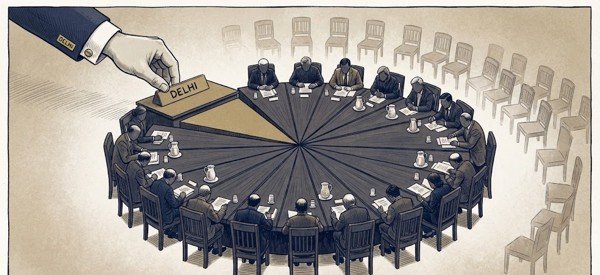
- First, the unprecedented concentration of executive authority. When one political formation commands a decisive parliamentary majority, controls the bulk of state governments, dominates the investigative agencies, shapes the regulatory environment for media and digital platforms, and enjoys the near-constant amplification of a large section of the press, the classic checks and balances of a parliamentary democracy weaken. The legislature, already diminished by the decline of deliberative culture and the rise of engineered majorities through defections, offers little effective resistance. In this environment the press and the judiciary are left standing largely alone. When they hesitate, power faces almost no institutional restraint. The events of the last several years—selective prosecutions, the rewriting of digital rules, the prolonged use of special laws, and the physical and legal targeting of critical journalism especially in BJP-ruled states—illustrate how concentrated power systematically narrows the space for independent institutions.
- Second, the capture of incentives. Independent journalism requires economic viability and professional security. When ownership is concentrated in business houses whose commercial interests intersect with the ruling establishment, when advertising and government contracts become instruments of influence, and when critical reporting invites tax notices, regulatory scrutiny or criminal process, the rational choice for many media organisations is compliance rather than confrontation. The same logic operates within the judiciary. Career progression, the timing of appointments and transfers, post-retirement assignments, and the broader atmosphere of political polarisation create powerful incentives for caution. Courage becomes costly; conformity becomes a prudent option. Over time the institutional culture shifts. What begins as individual calculation hardens into systemic behaviour.
- Third, the erosion of professional solidarity and ethical norms. A free press and an independent judiciary depend on internal cultures that protect dissent within their own ranks. When journalists who still pursue independent work are isolated—professionally, financially and socially—and when judges who speak bluntly find limited institutional support, the capacity for collective resistance diminishes. The rise of highly polarised media ecosystems and the weaponisation of public discourse against critical voices further fragment professional communities. Solidarity is replaced by competitive alignment with power.
- Fourth, the normalisation of the exceptional. Special laws originally justified by extraordinary threats—terrorism, money-laundering, threats to sovereignty—have become routine instruments of governance. The Unlawful Activities (Prevention) Act, the Prevention of Money Laundering Act, criminal defamation, the revised provisions that replace the old sedition law, and the expanding architecture of digital content regulation are deployed not only against genuine threats but against dissent, investigative journalism and political opposition. Once the exception becomes an everyday tool, the ordinary language of rights loses force. Courts begin to treat liberty as a discretionary concession rather than a constitutional entitlement. The press begins to treat certain subjects as too dangerous to examine. The citizen learns that constitutional guarantees are contingent.
- These four dynamics—concentration of power, capture of incentives, erosion of solidarity, and normalisation of the exceptional—are mutually reinforcing. They explain why a journalist in Gujarat can be sentenced to prison for critical posts about a corporate house close to power; why a newspaper office in Assam can be vandalised after public criticism by a chief minister; why an activist can spend nearly six years in prison without trial under a special law; and why the judiciary, facing these realities, often responds with hesitation rather than firm constitutional push-back.
- None of this is the product of a single decision or a single individual. It is the cumulative outcome of a political culture that treats institutional autonomy as an inconvenience rather than a constitutional necessity. The result is a democracy that still holds elections but whose intermediate institutions—the very pillars meant to make those elections meaningful—have been progressively hollowed out.
- Yet, democracies have recovered from deeper institutional crises when citizens, professionals and the remaining independent voices within institutions rediscovered their spine. The press must reclaim its independence not by shouting louder but by reporting more carefully, more rigorously and more courageously. The judiciary must decide cases which violate Constitutional rights and values, not on the prevailing political weather. Civil society must support both. And those of us in public life must stop treating the autonomy of these institutions as a negotiable inconvenience.
- Prem Bhatia would have recognised the moment. He practised journalism when the stakes were high and the pressures real. The awards given tonight honour those who still try. The question before the rest of us is whether we will make their work less lonely.
- The two pillars have bent under the weight of concentrated power. They have not yet broken. The choice of whether they straighten rests with those who inhabit them—and with a public that still demands they stand upright.
https://www.facebook.com/editorsguildindia
(This lecture was delivered at the Prem Bhatia Awards for Journalism, hosted by the Editors Guild of India at the India International Centre (IIC) in New Delhi on 11 August 2026.)
(“The views and opinions expressed in this article are those of the author and do not necessarily reflect the official policy or position of any agency or employer.”)
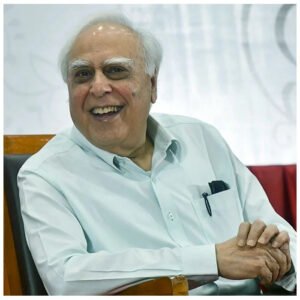
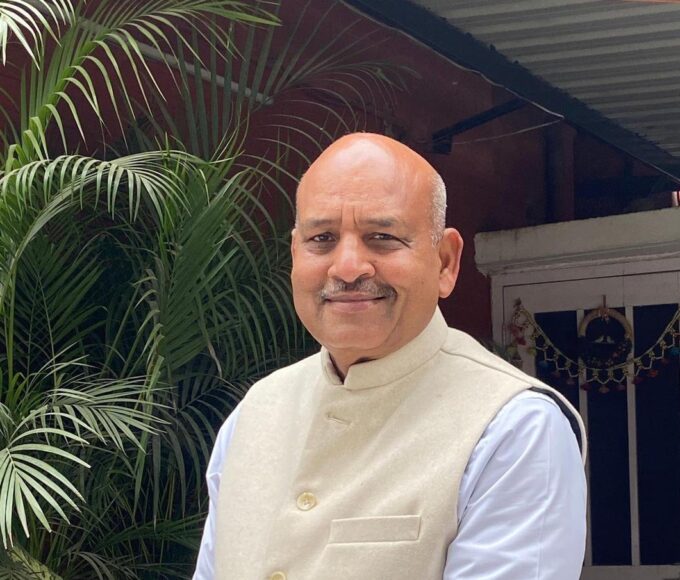
Kapil Sibal
Kapil Sibal is one of India’s most distinguished lawyers, parliamentarians and public intellectuals, whose career has straddled the courtroom, Parliament and the highest levels of government. Born on 8 August 1948, Sibal studied at St. Stephen’s College, Delhi, before pursuing law at the University of Delhi and an LL.M. at Harvard Law School. He joined the Bar in 1972 and was designated a Senior Advocate of the Supreme Court of India in 1983.
His legal career has placed him at the centre of some of the country’s most consequential constitutional and public-law debates. He served as Additional Solicitor General of India in 1989–90 and has represented a wide range of high-profile matters before the Supreme Court. He has also served multiple terms as President of the Supreme Court Bar Association, reflecting the standing he has acquired within India's legal fraternity.
Sibal's public life has been equally varied. He entered the Rajya Sabha in 1998 and subsequently served two terms in the Lok Sabha from Chandni Chowk. During the Congress-led UPA governments under Prime Minister Manmohan Singh, he held several major portfolios, including Science and Technology, Human Resource Development, Communications and Information Technology, and Law and Justice. His ministerial tenure brought him into the centre of debates ranging from education and technology to telecommunications, scientific research and legal reform.
His political career has never been confined entirely to party politics. In 2022, after nearly three decades in the Congress, Sibal left the party and entered the Rajya Sabha as an Independent member with the support of the Samajwadi Party. He has since continued to occupy an unusual position in Indian public life: politically independent, yet deeply engaged with questions of constitutional governance, institutional accountability and the functioning of democracy. He is currently a member of the Rajya Sabha. (ThePrint)
Sibal is also a prolific writer and public commentator. His books, essays, public interventions and more recently his digital conversations have reflected his interest in law, politics, society and the changing character of Indian democracy. His ability to move between legal argument, political analysis and public commentary has made him a distinctive voice in contemporary India.
For more than five decades, Kapil Sibal has therefore occupied a rare intersection of law and public life—appearing before the country's highest court, legislating in Parliament, administering major ministries and engaging directly with some of the most difficult questions facing the Republic. His perspective is shaped not merely by political experience, but by a lifetime spent examining the relationship betweenpower, law, institutions and individual rights.