






















Stretching Delimitation to its Limits
The controversy over seat redistribution, and India’s federal balance.
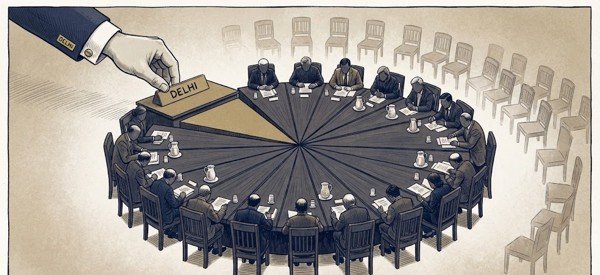
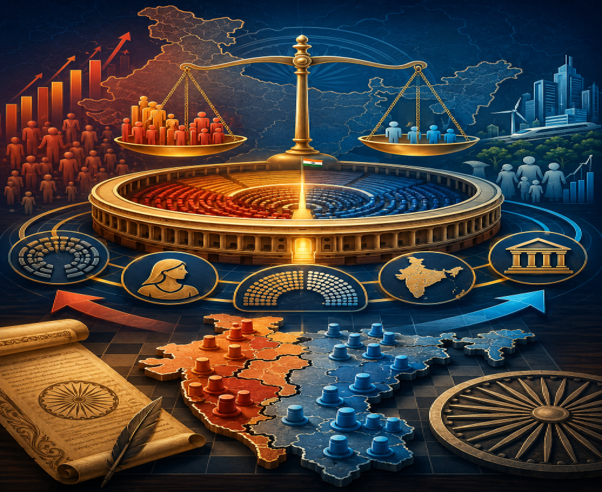
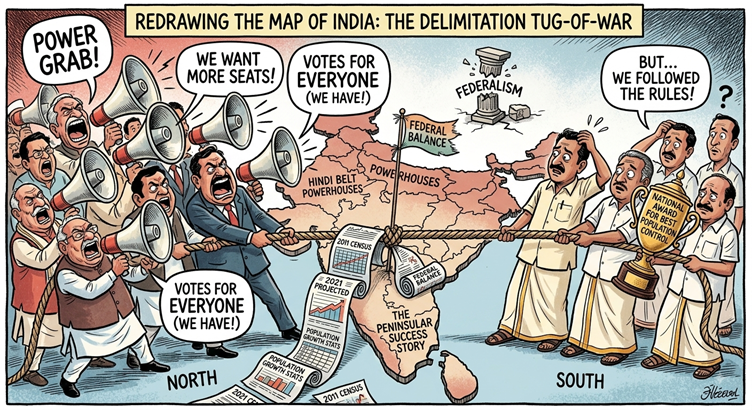
Delimitation – redrawing the boundaries of electoral constituencies and deciding how many seats each state gets in Parliament and in its assembly – has turned into one of the sharpest political fights in recent memory. Delimitation sits at the crossroads of population growth, federal fairness, gender representation and the raw arithmetic of power. Southern states fear losing their voice. The government insists the exercise is about fairness and about finally giving women their promised seats. The Congress party and much of the opposition call it a disguised power grab. This article walks through where delimitation came from, what the Delimitation Commission actually is, its constitutional footing, the one recent delimitation exercise India has already carried out in Jammu and Kashmir, the present standoff over the Women’s Reservation law, the specific worry in South India, the parallel fight over federal funding, the caste census angle, and where every major party, from the ruling BJP to Congress, the DMK, the Left, Trinamool Congress and the NDA’s own southern allies, currently stands.Any workable path forward likely needs a proportional safeguard for slower growing states written into the bill itself, an agreed and updated census base, and a completed caste enumeration before quotas are finalised, so the reform gains broad federal consent rather than being forced through on arithmetic alone.Delimitation is not a technical footnote. It decides whose vote counts for more and who gets heard in Parliament, and how India resolves this will likely shape its politics for a generation.
What delimitation actually means
A definition rooted in the Constitution
At its simplest, delimitation is the process of fixing the boundaries of territorial constituencies for the Lok Sabha and for state legislative assemblies, and of deciding how many seats each state and union territory receives.
Article 82 of the Constitution requires Parliament to pass a Delimitation Act after every census, while Article 170 does the same for state assemblies.
The idea of an equal vote
The idea behind this rule is simple in theory. As population shifts over time, a constituency that once had five hundred thousand voters might grow to two million while a neighbouring one stays much smaller.
Redrawing boundaries after each census is meant to keep the value of every vote roughly equal across the country, an idea often summed up as one person, one vote, one value.
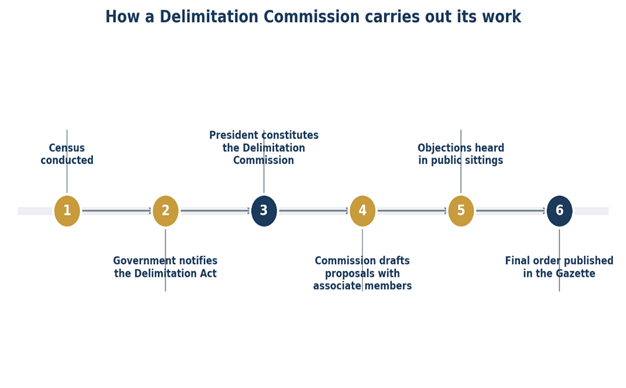
The formal steps a Delimitation Commission follows once it is set up.
A freeze instead of a redraw
In practice this exercise has been paused for exactly the opposite reason. Since 1976 India has frozen the total number of seats allotted to each state.
A state’s share of Parliament has stayed fixed even while its population has changed a great deal. That freeze, and the argument over when and how to lift it, is the real heart of the present controversy.
What exactly is the Delimitation Commission
An independent but temporary body
The Delimitation Commission is an independent statutory body set up by the central government under a specific Delimitation Act passed after each census.
It is not a permanent institution. A fresh Commission has to be created each time delimitation is due, and it dissolves once its work is done.
Who typically sits on it
Under earlier laws the Commission was typically chaired by a sitting or retired judge of the Supreme Court, and included the Chief Election Commissioner or a nominated Election Commissioner.
State Election Commissioners of the states concerned also sit on it. Members of Parliament and of state assemblies from the states being redrawn assist the Commission but cannot vote on its decisions.
The 2026 Proposal
The newly proposed Delimitation Bill of 2026 keeps this basic shape. It would let the central government constitute a Commission led by a person who is or has been a judge of the Supreme Court, along with the Chief Election Commissioner or a nominated Election Commissioner and the relevant State Election Commissioner.
Ten associate members per state, five from the Lok Sabha and five from the state assembly, would assist the process without a vote.
Funding and Independence
The Commission’s expenses, including the salary and allowances of the Chairperson, are met from the Consolidated Fund of India and administered through the Election Commission of India.
This underlines that this is meant to function as a neutral, well-resourced body sitting outside routine ministry control, even though it is the central government that decides when to set it up and who leads it.
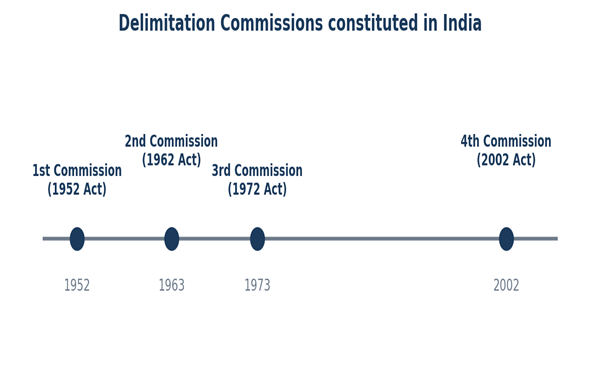
Delimitation Commissions have been formed only four times since independence.
The constitutional status of the Commission and its orders
Orders that cannot be challenged
Once a Delimitation Commission finalises its order, that order becomes law in a very unusual way.
It cannot be challenged in any court, and it must simply be laid before the Lok Sabha and the concerned state assemblies for information, without any power to amend it.
Why this finality was built in
This finality is deliberate. Constituency boundaries would never be settled if every order could be dragged into litigation for years.
So the framers gave the Commission’s final decision the force of law, immune from judicial review, subject only to the constitutional provisions under which it was made.
Constitutional Foundations
The constitutional hooks for all this lie in a handful of provisions. Article 81 fixes how Lok Sabha seats are distributed among states. Article 82 requires readjustment after each census through a Delimitation Act. Article 170 mirrors this for state assemblies.
Article 330A and 332A, inserted through the 2023 women’s reservation law, and newly proposed Articles 239AA, 334A and others, layer on the promise of reserving one-third of seats for women once a fresh delimitation is carried out.
Article 368 governs how any of these provisions can themselves be amended, and it is this article that has become central to the current fight because expanding the Lok Sabha and unlocking delimitation before 2026 both require a constitutional amendment passed by a two-thirds majority.
The Jammu and Kashmir precedent
Formation of the Commission
Before the national debate of 2026, India had already conducted one contemporary delimitation exercise, and it offers a preview of how contentious the process can turn.
After the abrogation of the special status of Jammu and Kashmir in 2019 and its reorganisation into a union territory, the central government set up a Delimitation Commission in March 2020 under Justice Ranjana Prakash Desai.
A retired judge of the Supreme Court, with the Chief Election Commissioner and the State Election Commissioner of Jammu and Kashmir as ex officio members.
The Commission was initially tasked with redrawing constituencies in Assam, Arunachal Pradesh, Manipur and Nagaland as well, though the north-eastern states were later dropped from its mandate.
After delays and a term extension, the Commission finalised its order in May 2022, raising the number of assembly seats in Jammu and Kashmir from eighty-three to ninety.
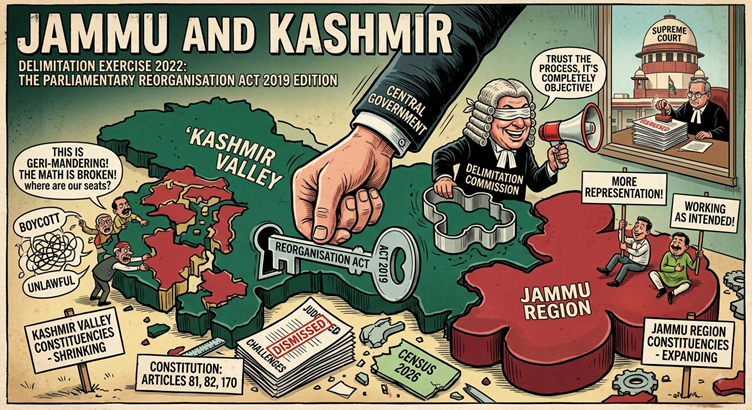
Controversies and Challenges
The exercise was immediately controversial. The National Conference and the Peoples Democratic Party, the two main regional parties, boycotted early meetings and argued that the Commission had been constituted unlawfully.
Since the Constitution itself provides that delimitation would only resume nationally after the first census following 2026.
Petitioners took the matter to the Supreme Court, contending that the exercise breached Articles 81, 82, 170, 330 and 332, but the Court dismissed the challenge and let the new boundaries stand.
A precedent both sides now cite
Kashmir based parties also alleged the redrawn map had quietly shifted representation toward the Jammu region, a claim the government denied.
The episode is now frequently cited by critics of the 2026 proposals as evidence that a Commission, once constituted, can produce results that are difficult to contest afterwards.
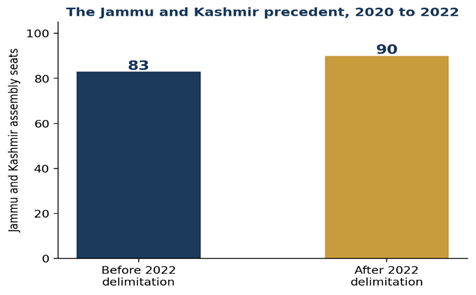
The one recent delimitation exercise India has carried out, in Jammu and Kashmir, expanded the assembly and proved highly contested.
Historical Evolution of Delimitation
Four Commissions Since Independence
Delimitation Commissions have been constituted four times since independence. The first came in 1952 under the Delimitation Commission Act of the same year, followed by further Commissions in 1963 and 1973 under their respective Acts, and a fourth in 2002.
Each of these bodies redrew constituencies to match the census immediately preceding it. Through most of this period the underlying principle was straightforward. States that grew faster in population gained more seats over time.
The 1976 freeze
That principle broke down in 1976. The government of the day worried that states pursuing aggressive family planning would end up punished with fewer seats.
It passed the forty second constitutional amendment freezing seat numbers at the 1971 census figures, initially meant to last until the first census after the year 2000.
Extended again in 2001
In 2001, the eighty fourth amendment extended the freeze further, until the first census conducted after 2026.
As a result, no Commission was set up after the 1981 or 1991 census, and the 2002 Commission only readjusted boundaries within states without changing seat totals.
.
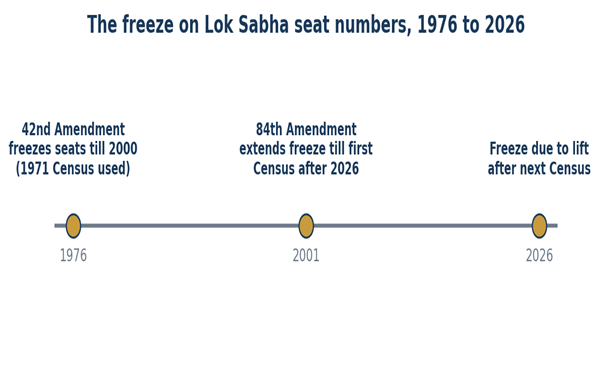
Two amendments, in 1976 and 2001, have kept state seat shares frozen for half a century.
Why the freeze has become so contentious
Constituencies of wildly different sizes
The freeze has left India with constituencies of wildly different sizes. Some Lok Sabha seats now contain more than three million electors while others hold under two hundred thousand.
This quietly undermines the equal value of a vote that Article 82 was meant to protect.
A reward that some fear losing
The freeze has functioned as a reward for southern and western states that slowed population growth through investment in education, healthcare and family planning.
Northern states with faster growth have not seen their seat share rise to match, and lifting the freeze threatens to shift dozens of seats northward.
A parallel fight over money, not just seats
The Finance Commission’s own shift
Seats in Parliament are not the only thing tied to population figures. The formula that the Finance Commission uses to divide central tax revenue among the states has moved through a similar argument.
For decades, that formula leaned heavily on the 1971 census, which effectively protected states with slower population growth from losing out on funds.
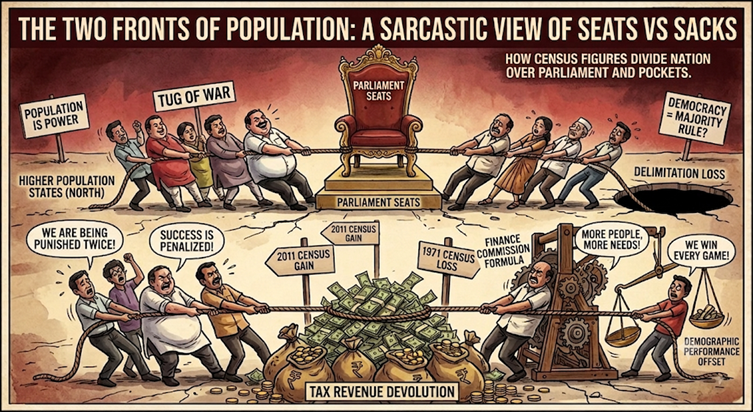
Why southern states remain wary
The Fifteenth Finance Commission broke with this pattern and introduced a weight based on the 2011 census alongside other factors such as income distance, forest cover and demographic performance.
A change that southern states argued would quietly punish them a second time for the same success in controlling population growth, even though the commission added a demographic performance criterion specifically intended to soften that effect.
This dispute is smaller in scale than the seats fight but draws on the same grievance, making southern leaders wary of any formula tied to current population.
Devolution formulas have already shifted toward newer population data once, a pattern southern states do not want repeated for Parliament seats.
The Delimitation Bill and the Constitution Amendment of 2026
The Three-Bill Package
In April 2026, the government convened a special sitting of Parliament and introduced three connected pieces of legislation together.
The Constitution (131st Amendment) Bill, 2026 sought to remove the constitutional requirement that delimitation wait for the first census after 2026, letting Parliament instead decide by ordinary law.
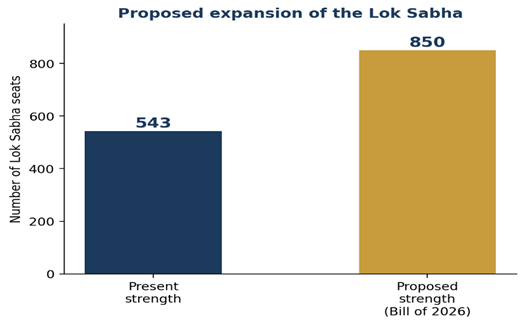
It also proposed raising the maximum strength of the Lok Sabha from five hundred and fifty to eight hundred and fifty members, eight hundred and fifteen from the states and thirty-five from the union territories.
Alongside it came the Delimitation Bill, 2026, an ordinary law that would repeal the Delimitation Act of 2002 and set up a fresh Commission using whichever census is most recently published, which in practice means the 2011 census rather than waiting for the ongoing 2027 census.
A third Bill, the Union Territories Laws (Amendment) Bill, 2026, extended similar changes to Delhi, Puducherry and Jammu and Kashmir.
Women’s Reservation Linkage
The stated purpose behind all three Bills was to unlock the thirty-three per cent reservation for women promised under the Nari Shakti Vandan Adhiniyam of 2023, which had explicitly tied the reservation to delimitation carried out after a future census.
Since that future census will not be published until 2027 at the earliest, with the results almost certainly unavailable before the 2029 general election, ministers argued that women would otherwise be made to wait years longer than necessary.
The 2026 package proposed enlarging the Lok Sabha by more than half.
Why the Bill fell short in April 2026
A high constitutional bar
Because it amends the Constitution, the 131st Amendment Bill needed a special majority under Article 368, meaning both an absolute majority of the full membership of the House and a two-thirds majority of members present and voting.
When the Lok Sabha voted on 17 April 2026, two hundred and ninety-eight members supported the Bill, and two hundred and thirty voted against it.
A defeat, then a withdrawl
It fell well short of the roughly three hundred and fifty-two votes needed for a two-thirds majority among those present, so the amendment was defeated.
The government then withdrew the companion Delimitation Bill and the Union Territories Laws Bill rather than let them lapse in a half-finished state.
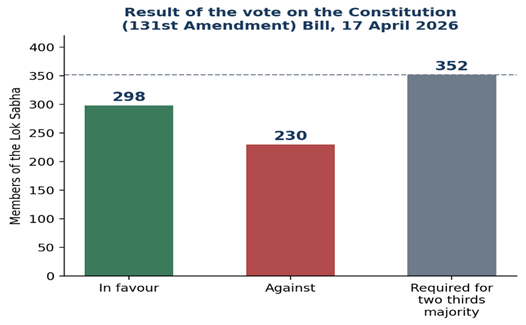
The Bill secured a simple majority but missed the higher bar a constitutional amendment requires.
The caste census dimension
Representation and Social Justice
A large part of the opposition’s objection has centred on caste rather than region alone.
Leader of the Opposition Rahul Gandhi argued repeatedly during the April debate that the government was trying to bypass the results of the ongoing caste enumeration in the 2027 census by rushing delimitation through on the basis of the older 2011 figures, which do not carry caste breakdowns in the same form.
His argument runs roughly as follows. Other Backward Classes, Scheduled Castes and Scheduled Tribes together make up a large majority of India’s population.
Hissa chori and the caste count demand
Congress contends that once a full caste count is available, it should inform how both delimitation and the women’s reservation sub quotas are worked out, so that backward communities receive a share of seats that actually matches their numbers rather than an older and less precise picture.
Gandhi labelled the government’s approach a form of hissa chori, a phrase meaning theft of one’s rightful share, and tied it explicitly to the long-running Congress demand for a nationwide caste census and the removal of the fifty per cent ceiling on reservations.
Government’s Response
The government has pushed back that this argument is itself a delaying tactic, noting that caste enumeration has now been cleared for the 2027 census and that women’s reservation should not be made to wait for a separate and much slower political battle over caste data.
Southern and NDA allied states: a more complicated picture
Tamil Nadu and Kerala Lead the Opposition
It would be a mistake to treat South India as speaking with one voice on this question.
Tamil Nadu under the Dravida Munnetra Kazhagam and Kerala under the Left Democratic Front have been the loudest and most consistent opponents of the package..
Karnataka and Telangana, both governed by Congress, have broadly echoed them.
Andhra Pradesh Takes a Different View
Andhra Pradesh sits in a very different position. Chief Minister N Chandrababu Naidu of the Telugu Desam Party, whose sixteen Lok Sabha members are an important prop for the NDA majority, has actually pushed the central government to move faster on delimitation rather than slower.
On the condition that any increase in total seats is applied proportionally across every state rather than purely based on population growth.
Naidu has also separately lobbied for a standalone delimitation exercise for Andhra Pradesh and Telangana, the two successor states of the old undivided Andhra Pradesh, using a provision in the 2014 Reorganisation Act, arguing that this could be carried out even before the wider national exercise.
YSRCP and AIADMK’s quieter roles
The YSRCP of Y S Jagan Mohan Reddy, ordinarily Naidu’s fiercest rival, also voted with the government in April 2026.
A fact opposition commentators have pointed to as evidence that both of Andhra Pradesh’s major parties prioritised their working relationship with the centre over a unified southern position.
Tamil Nadu’s AIADMK, allied with the BJP for state elections, largely avoided taking a clear public stance during the debate.
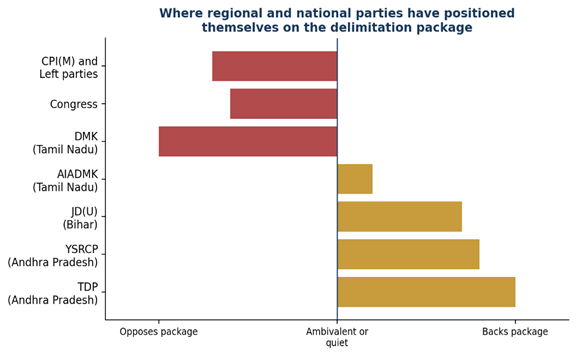
An illustrative summary of how different regional and national parties have leaned on the delimitation package through 2026.
Trinamool Congress, the Left and the eastern states
West Bengal’s Concerns
Outside the south, West Bengal has its own version of this anxiety. The state’s population growth has also slowed relative to the Hindi-speaking states.
Mamata Banerjee’s Trinamool Congress has voiced concern that Bengal, like Tamil Nadu and Kerala, could see its relative voice in Parliament shrink even as its seat count rises in absolute terms.
The Left’s Federalism Argument
The Left parties, principally the Communist Party of India (Marxist), have taken a more sweeping line, framing the entire episode as part of what they describe as a broader centralising trend that has also touched federal finances, governors’ powers and central investigating agencies.
They are calling for the freeze on seat numbers to be extended for a further generation rather than lifted piecemeal.
Bihar and other northern states with higher population growth have, by contrast, generally stayed quiet in public, since a population-based delimitation would most likely work in their favour, though few political leaders there have been willing to say so as bluntly as that.
The women’s reservation law and the August 2026 development
Two different things, often conflated
It helps to separate two different things that often get run together in headlines.
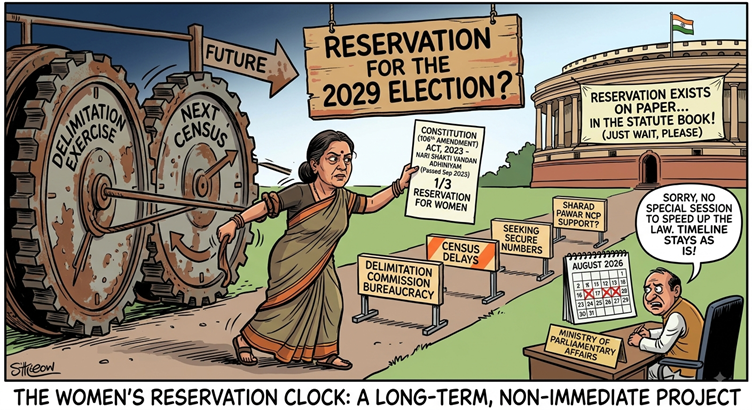
The actual law reserving one third of Lok Sabha and state assembly seats for women, known as the Nari Shakti Vandan Adhiniyam or formally the Constitution (106th Amendment) Act, was already passed by Parliament back in September 2023, with near unanimous support in both Houses.
What remains unresolved is not whether that reservation exists on paper but when it will actually take effect, since the 2023 law tied its commencement to a delimitation exercise carried out after a future census.
The Monsoon Session Outcome
Through the middle of 2026, speculation grew that the government would use the Monsoon Session, running from 20 July to 13 August, to bring back a reworked version of the 131st Amendment Bill .
In the event the government kept both the delimitation package and the women’s reservation amendment off the formal legislative agenda for that entire session, reportedly while it worked to secure firmer numbers, including possible support from parties such as the Nationalist Congress Party led by Sharad Pawar’s faction.
No Bill passed in August
As the Monsoon Session closed on 13 August without the Bills returning, reports suggested ministers were weighing a further special sitting around the middle of August to make a second attempt.
As of the most recent statements available, the Minister of Parliamentary Affairs has explicitly denied any plan for a special session between 16 and 18 August, so no bill altering the timeline for women’s reservation has in fact been passed in these August weeks.
The reservation guaranteed by the 2023 law remains firmly on the statute book, but the separate attempt to bring it forward to the 2029 election through a fresh delimitation exercise remains stalled.
The delimitation and women’s reservation package has moved through several stalled attempts across 2026.
Women’s participation in the Lok Sabha so far
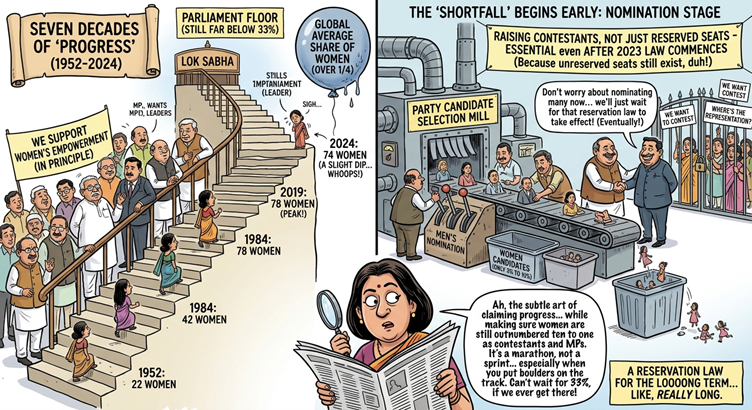
A Slow Rise Since 1952
Even without the new reservation in force, women’s presence in the Lok Sabha has grown slowly across seven decades, from twenty-two women members in 1952, a little over four per cent of the House, to a peak of seventy eight members in 2019, just above fourteen per cent.
The 2024 election returned seventy-four women, roughly thirteen and a half per cent of the House, a slight dip from the previous term.
India’s Parliament therefore still sits well below the thirty-three per cent floor the 2023 law eventually promises, and also below the global average share of women in national parliaments, which sits above a quarter.
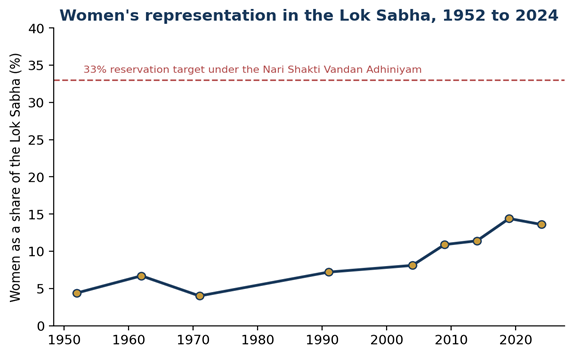
Women’s share of the Lok Sabha has risen unevenly and remains far below the promised one third.
Candidate Representation Remains Low
The shortfall is visible even earlier in the process, before a single vote is cast.
Women have consistently made up a small fraction of the candidates fielded by parties in the first place, rising from under three per cent of all Lok Sabha contestants in 1957 to only around nine or ten per cent by 2024.
Since a reservation of seats can only take effect once boundaries and quotas are actually redrawn, most analysts note that raising the number of women contesting elections, not merely the number of reserved seats, will remain essential even after the 2023 law eventually commences.
Because a law that reserves seats says nothing about how thoroughly parties nominate women in the unreserved seats that remain.
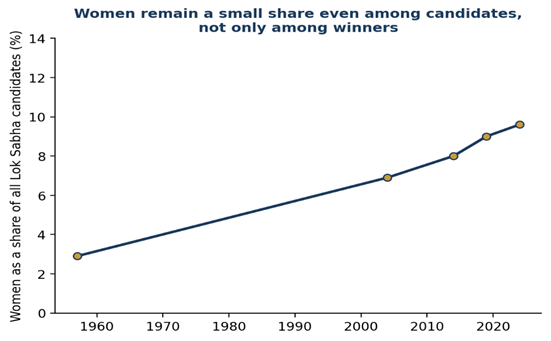
Women remain a small share of Lok Sabha candidates, a gap the reservation law alone will not fully close.
How South India would be affected
Current Representation
The five southern states of Tamil Nadu, Kerala, Karnataka, Andhra Pradesh and Telangana currently hold one hundred and twenty-nine of the five hundred and forty-three Lok Sabha seats, a little under twenty-four per cent of the House.
These states achieved lower population growth than much of the north over the past five decades, largely through sustained investment in education, health and family planning, which is precisely the behaviour the 1976 freeze was designed to reward.
The government’s own projected figures
If delimitation is carried out strictly in proportion to current population, using either the 2011 census or any later count, most projections show the south gaining relatively few new seats compared with northern states.
So its share of an enlarged House would likely fall even if its absolute number of seats rises.
Government’s Seat Projections
During the April 2026 debate the Union Home Minister argued that under the government’s own figures the southern states’ seats would actually rise from one hundred and twenty nine to one hundred and ninety five in an eight hundred and fifty member House.
Nudging their overall share up slightly from twenty-three point seven six per cent to twenty three point eight seven per cent, and he offered this as an assurance that the south would not lose out.
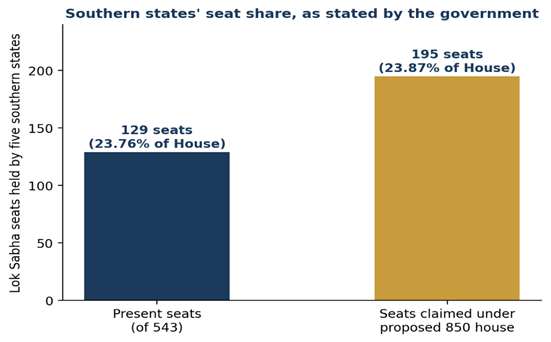
The government’s own figures for how southern seats would change under the 2026 proposal.
The issues South India has raised
Stalin’s protests in Tamil Nadu
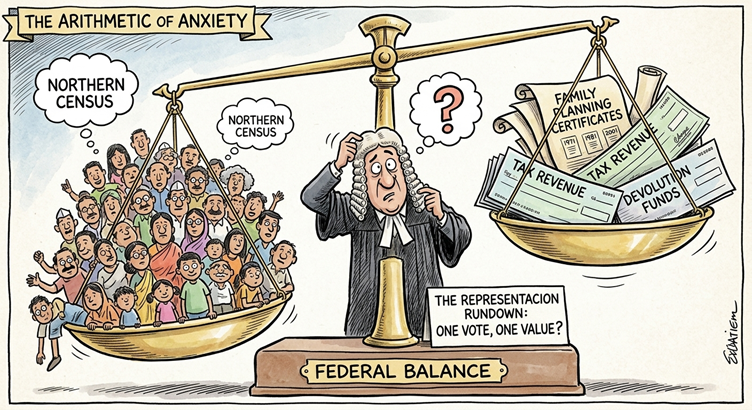
Ex-Chief Minister M K Stalin of Tamil Nadu has led the loudest resistance, describing delimitation as a Damocles sword hanging over the south.
He organised black flag protests, a symbolic burning of a copy of the Bill, and a Joint Action Committee bringing together chief ministers and leaders from Tamil Nadu, Kerala, Karnataka, Telangana and beyond.
Kerala and Karnataka’s objections
Kerala’s government has framed the exercise as a threat to federalism itself, while Karnataka’s leadership has objected specifically to using a recent census rather than the much older 1971 figures that still anchor the present seat allocation.
The core grievance in each case is the same.
States that controlled their population growth responsibly fear being penalised with a shrinking political voice, funding formulas tied to population could also work against them, and a sudden northward shift in seats could alter the balance of power in national politics for a generation.
Several southern assemblies had earlier passed resolutions asking for the freeze to be extended for another two to three decades rather than lifted at all.
The government and BJP’s position
Two promises fulfilled at once
The Bharatiya Janata Party and the wider National Democratic Alliance government have framed the 2026 package as fulfilling two promises at once, honouring the constitutional principle that every vote should carry equal weight and finally operationalising the reservation for women that Parliament approved in 2023.
Union Home Minister Amit Shah told the Lok Sabha that the opposition’s real objection was to women’s reservation itself rather than to any detail of implementation, and stressed repeatedly that the number of seats reserved for Scheduled Castes and Scheduled Tribes also rises through delimitation.
He pointed to the government’s own projected figures to argue that the southern states would not see their voice diminished.
The government has also emphasised that the Bharatiya Janata Party under Prime Minister Narendra Modi brought the women’s reservation Bill to a vote in 2023 after decades in which earlier attempts, including one passed by the Rajya Sabha in 2010 under the previous Congress-led government, never reached a final vote in the Lok Sabha.
Building Parliamentary Consensus
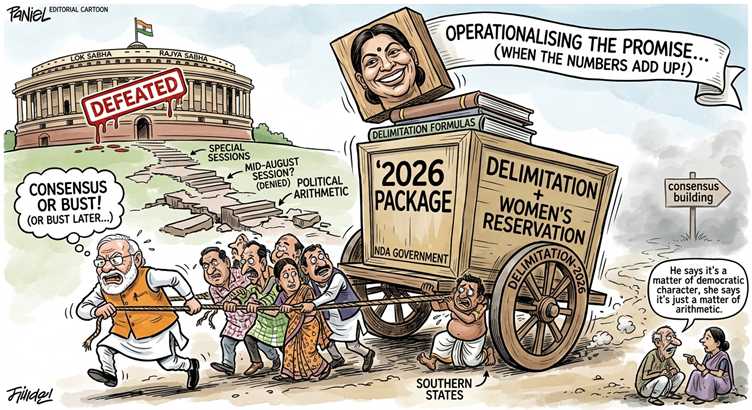
Prime Minister Modi personally appealed to members across party lines during the April debate to back the package on consensus rather than treat it as a partisan contest, framing it as a matter that would define India’s democratic character for decades.
Party managers subsequently worked through the summer to widen support beyond the existing coalition, holding talks with the Nationalist Congress Party faction led by Sharad Pawar’s estranged relative Ajit Pawar’s rivals and other smaller outfits that sit outside the formal opposition bloc, in an effort to cross the higher threshold a constitutional amendment demands.
Naidu’s proportional safeguard propos
Andhra Pradesh’s Chandrababu Naidu became an important public voice for the government’s case during this period.
He argued that a fifty per cent proportional increase clause, which he said had simply been omitted from the original text rather than denied in substance, would resolve the south’s core anxiety once it was written into a revised Bill.
Criticism of the Government’s Strategy
At the same time, the government’s own handling has looked uneven through the year, with the Bill introduced in a hastily called special session in April, defeated, then quietly kept off two subsequent sessions while it worked to secure numbers.
A possible special sitting in mid-August denied by the Parliamentary Affairs Minister just days before this article was written.
Critics inside and outside Parliament have read that pattern as evidence that political arithmetic, rather than any fixed timetable for women’s empowerment, is driving the pace of the whole exercise.
Some commentary sympathetic to the government has offered a different reading, suggesting that the pause reflects a genuine wish to build the broadest possible consensus before returning to Parliament, rather than to abandon the effort.
Reserved seats and Scheduled Castes and Scheduled Tribes representation
A social justice argument
One argument the government has leaned on heavily is that delimitation does not only affect the total number of general seats.
As population figures are updated, the number of seats reserved for Scheduled Castes and Scheduled Tribes is also recalculated in proportion to their share of each state’s population, and in a larger eight hundred and fifty member House the absolute number of such reserved seats would rise even in states whose overall share of the House stayed roughly flat.
Ministers have argued that this makes delimitation a net gain for social justice regardless of the north south debate.
The Opposition’s data objection
Opposition leaders including Rahul Gandhi accept the arithmetic but question the underlying data.
They argue that reserving seats fairly needs an accurate, updated caste count, not a headcount census alone, returning the argument to the caste census demand.
The opposition’s position and the stand taken by Congress
Support for Women’s Reservation
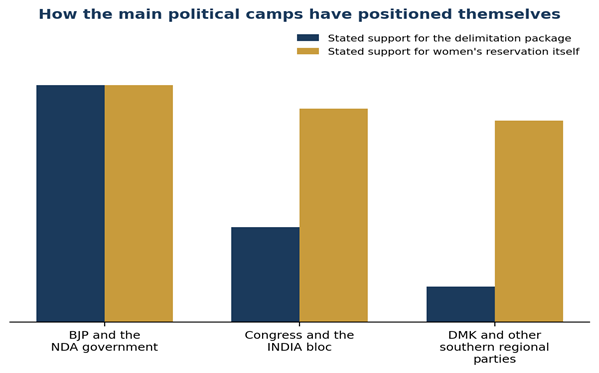
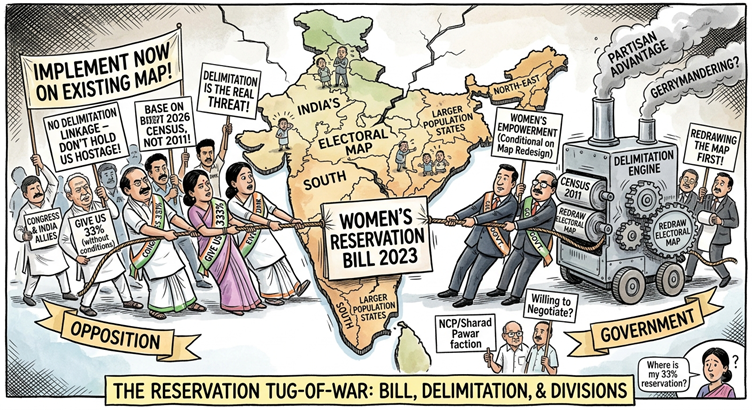
Congress has consistently said it supports the underlying principle of women’s reservation while opposing the way the government has linked it to delimitation.
Speaking for the party in the April debate, Lok Sabha leader Gaurav Gogoi argued that the government was using the language of women’s empowerment to disguise what he called an attempt to redraw India’s electoral map for partisan advantage, and pointed out that a genuine women’s Bill already exists and was passed unanimously in 2023, so nothing further needed to be attached to it.
Warnings of gerrymandering
Senior Congress figures including former finance minister P Chidambaram have gone further, warning that any fresh version of the Bill risks enabling gerrymandering and would cause what he called grave injustice to states that had faithfully followed national population policy.
Congress has repeatedly urged the government to simply implement the thirty three per cent reservation on the existing four hundred and fifty three member Lok Sabha map rather than making it conditional on a wider and more contentious delimitation exercise.
Tharoor and the INDIA bloc’s mixed front
Shashi Tharoor of Congress described the linkage in the April debate as holding the aspirations of Indian women hostage to a separate and more divisive agenda.
Regional allies within the wider INDIA bloc, particularly the Dravida Munnetra Kazhagam, have taken an even firmer line, treating the delimitation proposal itself, not merely its timing, as the central threat to be defeated.
Rahul Gandhi’s Critique
Rahul Gandhi personally led much of the floor opposition, calling the package an anti national act and accusing the government of trying to seize power by rigging the shape of the electoral map rather than by winning votes on a level field.
He connected the fight explicitly to smaller and outlying states as well as to the south, warning that north eastern states with small populations would also see their relative weight in Parliament diminish if seats were reallocated purely by headcount.
He called on the government to base any future exercise on the still to be completed 2026 or 2027 census rather than the older 2011 figures the Bills proposed to use.
Congress has tried, with mixed success, to hold together a common position across its INDIA bloc partners, some of whom, such as the undivided Nationalist Congress Party faction led by Sharad Pawar, later showed signs of willingness to negotiate separately with the government.
It illustrates how difficult it has been for the opposition to maintain a single unified front on an issue that affects different states so differently.
A rough illustration of how the main camps have positioned themselves through 2026, based on statements made in and around Parliament.
Legal and constitutional commentary
Is a Constitutional Amendment Necessary?
Constitutional scholars have been divided over how much room Parliament actually has to manoeuvre here.
Some argue that Articles 82 and 170, as they currently stand, already give Parliament the power to decide the manner and timing of delimitation through an ordinary Delimitation Act.
So a constitutional amendment is not strictly necessary just to bring forward the exercise, only to raise the overall ceiling on the size of the Lok Sabha, which has been fixed since 1950.
A guarantee or a formality
Others counter that the eighty fourth amendment’s specific promise, that no delimitation would occur before the first census after 2026.
It itself has the status of a constitutional guarantee to the states, and that using an ordinary law to sidestep that promise before its own terms had elapsed.
It would have set a troubling precedent for how firmly any future assurance to the states could be relied upon.
Lessons from Jammu and Kashmir
The Jammu and Kashmir episode is often cited on both sides of this argument, since the Supreme Court there ultimately declined to strike down a delimitation exercise carried out through a special reorganisation law rather than the ordinary process.
Some read it as showing the courts are unlikely to second guess Parliament’s chosen legal route, and others read it as a narrow ruling specific to a union territory that should not be extended to the wider country.
How other democracies have handled similar problems
The United States Experience
India is far from alone in wrestling with the tension between equal representation and protecting smaller or slower growing regions.
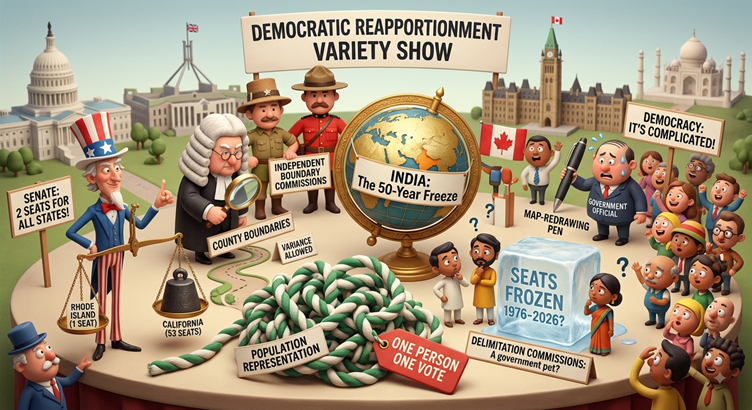
The United States redraws congressional districts after every decade’s census but still guarantees every state at least one seat in the House of Representatives regardless of population, and its Senate famously abandons proportionality altogether by giving every state two seats no matter its size.
Lessons from Other Federations
The United Kingdom’s Boundary Commissions redraw constituencies periodically but work within statutory tolerances that allow some variation in constituency size to respect county and local boundaries.
Australia and Canada both use independent, non partisan boundary commissions insulated from direct government control specifically to avoid the appearance of a ruling party redrawing the map to its own advantage, a safeguard India’s critics argue is weaker here given that the Commission’s members and terms of reference are ultimately set by the central government of the day.
These comparisons are imperfect since India’s federal structure, population scale and party system all differ sharply from these examples, but they are frequently invoked in Indian debate either to argue that some regional protection is normal practice elsewhere, or to argue that India already goes further than most democracies in freezing representation for half a century at a stretch.
Public reaction and the road ahead
Growing Public Anxiety
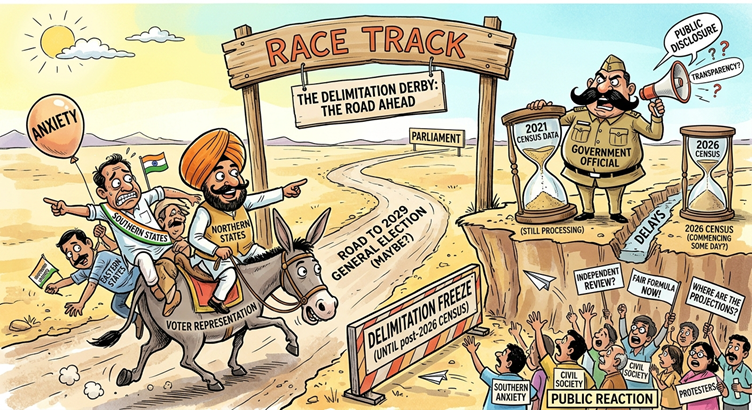
Beyond the party political fight, the delimitation debate has stirred noticeable public anxiety in the south, reflected in local media coverage, opinion articles and organised protests that go well beyond the ruling parties of any one state.
Civil society groups and some retired election officials have called for the entire process to be made more transparent before it resumes, including public disclosure of the population projections the government is using and an independent review of how any new formula would treat every state rather than only the handful most vocal in Parliament.
A timeline stretching past 2029
Given the freeze is not scheduled to lift until the first census after 2026, and that census has faced delays, delimitation is unlikely to complete before 2029 even if a revised Bill passes.
The argument over how to conduct the exercise fairly is therefore likely to keep running well before it is actually carried out.
Where things stand now
No change in the legal position
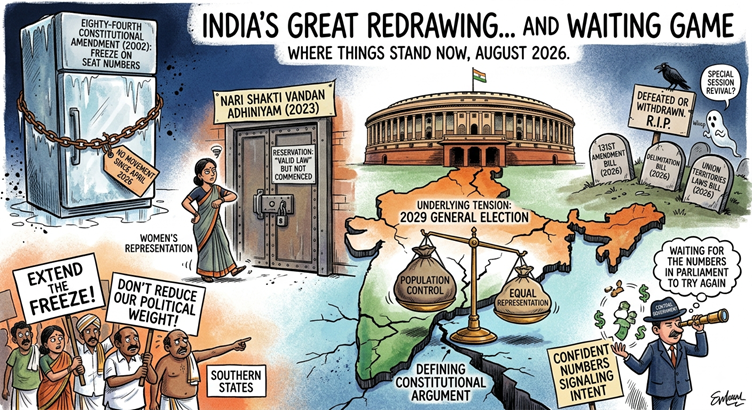
As things stand in the middle of August 2026, the legal position has not moved since April. The freeze on seat numbers remains in force under the eighty fourth constitutional amendment until the first census conducted after 2026.
The Nari Shakti Vandan Adhiniyam of 2023 remains valid law but its reservation has not yet commenced. The 131st Amendment Bill, the Delimitation Bill and the Union Territories Laws Bill of 2026 remain defeated or withdrawn rather than revived, despite persistent speculation about a further special session.
A standoff likely to continue
Southern state governments continue to demand either an extension of the freeze or a guarantee that any future exercise will not reduce their relative political weight, while the central government continues to signal that it intends to try again once it is confident of the numbers in Parliament.
Whatever comes next, the underlying tension between rewarding population control and honouring the principle of equal representation is not going away, and it is likely to remain one of the defining constitutional arguments of the run up to the 2029 general election.
A concluding word
Delimitation looks like a dry administrative exercise on paper, yet it decides who gets heard in Parliament and whose vote counts for more.
India has managed to avoid this reckoning for half a century through successive freezes, but that avoidance cannot continue indefinitely once a fresh census is finally published.
How the country resolves the competing claims of population growth, federal fairness and long overdue representation for women will likely shape its politics for a generation, regardless of which government eventually carries the exercise through.
Bibliography and further reading
PRS Legislative Research, ‘The Delimitation Bill, 2026’, Bill summary and legislative brief, prsindia.org, 2026.
PRS Legislative Research, ‘The Constitution (131st Amendment) Bill, 2026’, Bill summary and legislative brief, prsindia.org, 2026.
Wikipedia, ‘Delimitation Commission of India’, accessed August 2026, en.wikipedia.org.
Wikipedia, ‘Delimitation Bill, 2026’, accessed August 2026, en.wikipedia.org.
Wikipedia, ‘Constitution (131st Amendment) Bill, 2026’, accessed August 2026, en.wikipedia.org.
Press Information Bureau, Government of India, ‘Union Home Minister Shri Amit Shah replies in Lok Sabha to the discussion on the Delimitation Bill, 2026’, pib.gov.in, April 2026.
LiveLaw, ‘Lok Sabha Rejects Constitution (131st) Amendment Bill 2026 To Increase Seats; Centre Withdraws Delimitation Bill’, livelaw.in, 17 April 2026.
The Wire, ‘Explainer: How the Numbers Stack up for the Delimitation Bill in Parliament’, thewire.in, April 2026.
Carnegie Endowment for International Peace, ‘Delimitation After Defeat: India’s Unfinished Debate Over Representation’, carnegieendowment.org, 2026.
Indian National Congress, ‘The Delimitation Bill, 2026’, official party statement, inc.in, 2026.
Deccan Herald, ‘Delimitation row 2026: Stalin warns PM of protests over Tamil Nadu impact’, deccanherald.com, April 2026.
The Print, ‘Stalin ups the ante, calls for black flag protest against delimitation; BJP ally AIADMK silent’, theprint.in, April 2026.
The Week, ‘Why Tamil Nadu and DMK are protesting against the delimitation bill’, theweek.in, April 2026.
ISAS, National University of Singapore, ‘Delimitation of Constituencies in India: Southern States Up in Arms’, ISAS Brief 1230, isas.nus.edu.sg, 2025.
ISAS, National University of Singapore, ‘Indian Parliament Passes Women’s Reservation Bill’, ISAS Brief 1067, isas.nus.edu.sg, September 2023.
Business Standard, ‘NDA may introduce women’s quota Bill in Monsoon Session of Parliament’, business-standard.com, July 2026.
The Tribune, ‘Monsoon Session of Parliament from July 20 to August 13; key bills lined up’, tribuneindia.com, July 2026.
The Tribune, ‘Parliament session: Govt set to skip delimitation, women’s reservation Bills, cancels Thursday Cabinet meeting’, tribuneindia.com, August 2026.
Republic World, ‘No Plan For Special Parliament Session On Delimitation, Women’s Quota Bills: Kiren Rijiju Dismisses Reports’, republicworld.com, August 2026.
The Hans India, ‘Delimitation and women’s quota: Why the Bills were left off the agenda’, thehansindia.com, August 2026.
Chennaionline, ‘NDA Pauses Women’s Reservation and Delimitation Bill Plans’, chennaionline.com, August 2026.
Dataful, Ministry of Statistics and Programme Implementation, ‘State wise Total Number of Women MPs to the total MP seats’, dataful.in, 2026.
Insights, Dataful, ‘Women in Lok Sabha at 13.8%: Slow Gains, Persistent Gaps’, insights.dataful.in, April 2026.
Business Standard, ‘Election results 2024: 73 women elected to Lok Sabha, 5 less than 2019’, business-standard.com, June 2024.
Deccan Herald, ‘Delimitation Damocles sword hanging over South Indian states: M K Stalin’, deccanherald.com.
News on Air, All India Radio, ‘Parliament passes Women’s Reservation Bill’, newsonair.gov.in, September 2023.
Vajiram and Ravi, ‘Delimitation Commission, Chairman, Members, Act, Appointment’, vajiramandravi.com, 2026.
The South First, ‘As monsoon session of Parliament approaches, Chandrababu Naidu pushes for delimitation, at least in Andhra’, thesouthfirst.com, June 2026.
Business Standard, ‘Why Chandrababu Naidu thinks Delimitation Bill can get Parliament nod now’, business-standard.com, June 2026.
The Wire, ‘Union Govt to Reintroduce Delimitation Bill With Clause About 50% Proportional Increase of Seats: Chandrababu Naidu’, thewire.in, June 2026.
The Quint, ‘Delimitation Linked Bill: Why Chandrababu Naidu and Jagan Mohan Reddy Backed It Despite Concerns’, thequint.com, April 2026.
Deccan Chronicle, ‘Delimitation Inevitable, No State will Face Injustice: Naidu’, deccanchronicle.com, April 2026.
The Week, ‘Major showdown in Lok Sabha over delimitation bill: Rahul Gandhi calls it anti national, Modi appeals for consensus’, theweek.in, April 2026.
National Herald, ‘Rahul hits out at Modi’s anti national power grab, bid to rig representation via delimitation’, nationalheraldindia.com, April 2026.
The Print, ‘J&K delimitation to UCC panels, a retired judge for all govt causes: Justice Ranjana Prakash Desai’, theprint.in, July 2026.
The Tribune, ‘Supreme Court dismisses petition challenging validity of delimitation exercise in Jammu and Kashmir’, tribuneindia.com, February 2023.
Press Information Bureau, Government of India, ‘Delimitation Commission Finalises the Delimitation Order’, pib.gov.in, May 2022.
ETV Bharat, ‘Delimitation Commission in Jammu and Kashmir and its ramifications’, etvbharat.com, February 2022.

Amir Khan
Amir Khan is a Delhi-based Public Policy Researcher, Political Consultant, and Educator. He holds a Postgraduate degree in Political Science and International Relations from Jamia Millia Islamia, New Delhi. He is currently associated with Bano IAS as an Editor & Content Creator (Magazine) and serves as the Secretary of HIMS Foundation, where he contributes to policy research, editorial development, governance-focused publications, and institutional initiatives. He has previously worked with Pehchaan The Street School, supporting education and social impact programmes.
His work primarily focuses on public policy, governance, electoral studies, constitutional affairs, public administration, and international relations. Through research-driven writing and policy analysis, he develops evidence-based content for Civil Services aspirants and public policy audiences.
His research and writing are grounded in credible sources, official reports, constitutional principles, and data-driven analysis, with an emphasis on presenting complex policy issues in a clear, objective, and accessible manner. He is committed to promoting informed public discourse through accurate, balanced, and well-researched policy content.