


























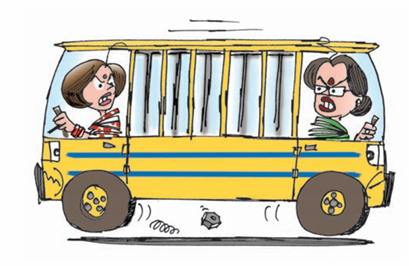
The Indian School in Beijing will soon be shut down, and probably has been already as we go to press. And, hopefully, this will end the war of the wives of the embassy’s senior officials. Or will another round begin on some other issue? The school was started at the height of China’s Cultural Revolution. Since the social upheaval affected standards of education, the Indian Embassy, which was especially targeted during those days, decided to start its own school to benefit its officials and staff.
Over the years, the school acquired a reputation among Beijing’s expat community, especially those sections who could not afford the ones run by the US and British embassies. The Indian School’s forte was affordable quality education matching international standards.
In recent years, it had also become the school of choice for Beijing’s expanding Indian business community.
However, embassy officials subscribed to the view that, since the Cultural Revolution ended quite some time ago, the school had lost its utility. And the war of the wives was another headache.
Royal rule at IIC
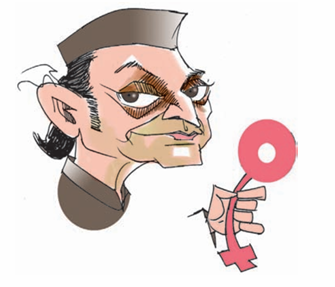
India’s elite indulges itself at the expense of others. And it will not, never ever, be denied. To do so, to deprive those habituated to a free lunch, would be a cardinal offence. Dr Karan Singh can pick anyone he wants to be hired as the editor of the India International Centre quarterly. Long years ago, it was Geeti Sen, who, a little bird tells us, enjoyed enough of his goodwill to get an extension and thereafter head the Indian Cultural Centre in Kathmandu. It is no coincidence that the Centre comes under the Indian Council of Cultural Relations over which Dr Singh presides. By the way, not too long ago, the Centre was in the news for some unsavoury matters involving these personalities.
Ira Pande, the IIC quarterly’s current editor, is due to retire in January 2012. Dr Singh has reportedly selected another attractive woman for the job. The IIC management, like the selection committee tasked with the job of picking the editor, has all but endorsed his choice. His reign at the IIC is total and unquestioned, especially after such stalwarts as Kapila Vatsyayan, NN Vohra and Soli Sorabjee ceased to be in the picture.
And all this happens despite the members of the IIC management being eminent and respected in their own right. But, even if Dr Singh’s royal antecedents charm them, the fact that the IIC is founded on public money should serve as a reminder that it cannot be run as a fiefdom.
Gas let off over Chandra

Some heartening news from the heart of the bureaucracy. There are still many bureaucrats who work for the nation’s interest, make sacrifices and take a stand when it is called for. Apurva Chandra, an IAS officer of the 1988 batch from the Maharashtra cadre, looks after the Gas Division in the Ministry of Petroleum. As a remedy for the crises in the electricity and fertilizer sectors, he suggested to Minister for Petroleum S Jaipal Reddy that the KG Basin gas be allotted to these sectors rather than the private producer supplying the gas to private users.
This means that the KG Basin gas producer will have to sell it on subsidy and there will be no profit. Chandra made the suggestion in a file noting and it created a furore in the Ministry. Soon after, Chandra was surrendered by the Ministry of Petroleum to the DoPT. Thus, the officer lost the prestigious and coveted post in the Ministry of Petroleum due to his effort to further the nation’s interest.
Jadhav parries Bhushan’s stabs

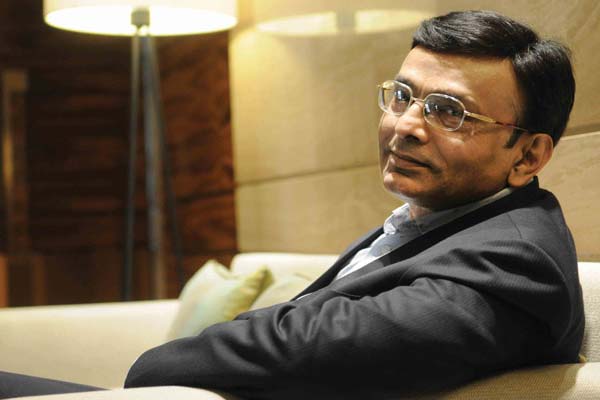
Air India Chairman and Managing Director Arvind Jadhav knew he had his plate full when he took over the task of turning around the national carrier. But little did he realize that he would face a vicious attack from his immediate predecessor, EK Bharat Bhushan – an Additional Secretary who was removed as CMD within weeks of joining.
Now Air India’s Financial Adviser, nominated by the Ministry of Civil Aviation, Bhushan is working relentlessly at his single-point agenda of destabilizing Jadhav. Every Air India paper that goes to the Ministry is put into a spin – so much so that inertia now dogs the airlines and in two years it has not been able to put its turnaround plan on track. Worse, Bhushan’s mala fide intentions were bolstered by the then Secretary, Madhavan Nair.
The ouster from Air India of Praful Patel and Nair’s retirement did not help as Bhushan became the director general of the Directorate General of Civil Aviation. His main preoccupation was briefing the media against the airlines’ minor lapses such as having one crew member less on a flight, pilots flying an hour more than allowed and so on. This bid to portray the airlines as unsafe was aimed at getting Jadhav. Lately, he has intensified his attack as he hopes to replace Jadhav with the latter facing criticism for Air India’s increasing losses.