



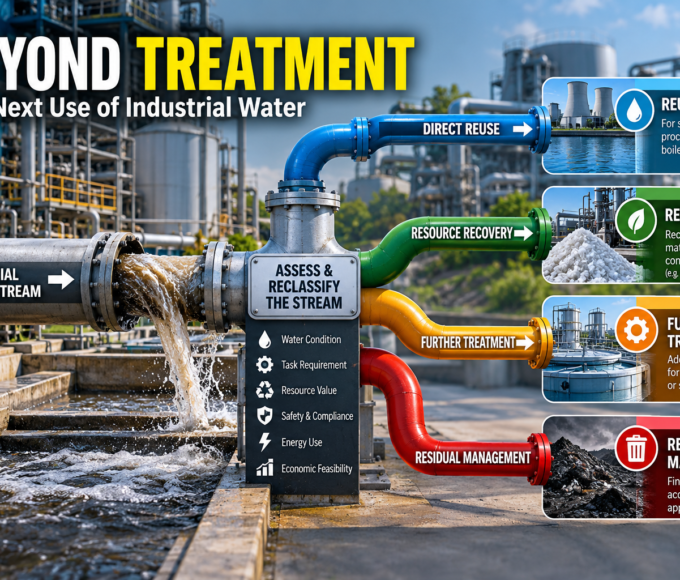



























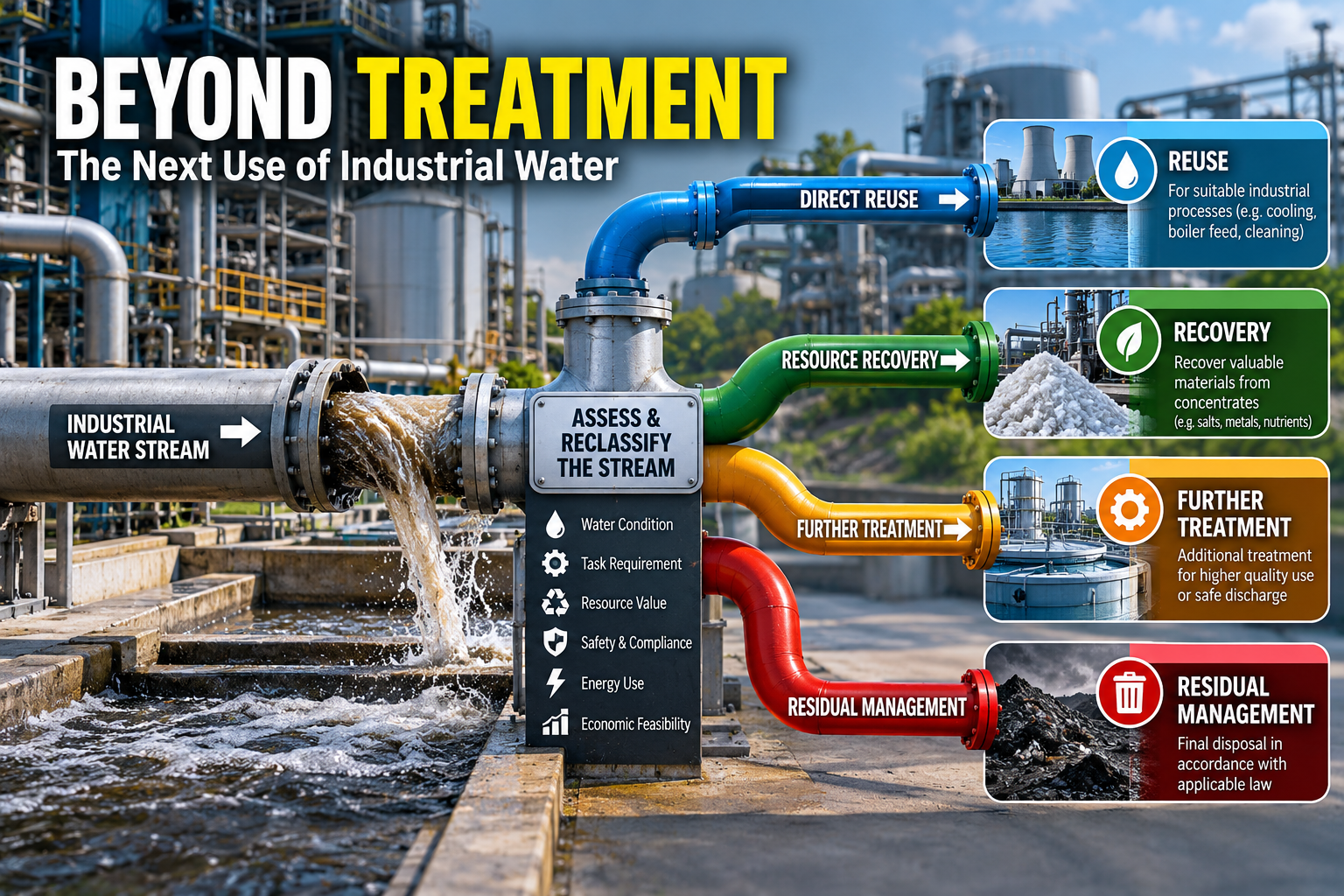
Industrial water management must move beyond treatment and discharge. Stream Reclassification offers a framework for assessing reuse, further treatment, resource recovery and residual management based on safety, technical feasibility and economics.
Executive Summary
Industrial water systems are often organized around treatment and discharge. That is understandable because compliance has to be clear. But the same structure can hide opportunities to match water quality to the next task, reuse suitable return streams, recover materials from concentrates and avoid treatment that the next task does not require.
The central question is therefore not simply how pure water can become, but what specification the next task actually requires.
This article proposes a policy and operational architecture in which water condition, task requirements, resource value, safety, energy and economics help determine the next permissible pathway. A stream may move to direct reuse, further treatment, resource recovery or residual management. The aim is not to force every stream into a closed loop. It is to make the next decision clear, documented and evidence based.
Before a stream is directed to final disposal, its safe, technically feasible, and economically relevant reuse or recovery potential should be assessed and documented in accordance with applicable law.
Within this framework, Stream Reclassification is used as an operational and policy concept. It does not change the legal definition of waste or override applicable regulatory requirements.
Core policy proposition
For selected industrial streams, regulation could require a documented assessment of the safest technically feasible and economically relevant next pathway before final disposal. The framework is a proposal, not a validated industrial system. Its value should be tested through controlled pilot work before full-scale deployment.
What the framework does not say: it does not call for one treatment technology, it does not require every stream to be reused, and it does not treat circularity as a zero-residual promise. Some streams will remain unsuitable for reuse or recovery and must be safely managed as residual waste.
Key distinction
The article combines a Policy Feature + Conceptual Framework with a Research and Validation Pathway. The first explains the proposed architecture. The second sets out how the architecture could be tested. Neither is presented as evidence that the framework has already been proven.
1. The Linear Water Trap
In many industrial settings, water management remains organized primarily around treatment and discharge compliance, even where internal reuse, cascading flows or partial recovery may be technically possible. This is not a claim that industry never reuses water. It is a recognition that the regulatory and operating logic can still be centered on the discharge point rather than on the whole water cycle.
A typical linear pattern is simple: fresh water enters, treatment is applied, the water serves one process and the resulting stream leaves the system. The simplicity has value. The problem appears when the same logic is applied to streams whose condition would allow another safe and useful pathway.

Figure 1A. Simplified linear pattern — conceptual framework.
Alt text: Conceptual flow from fresh water through treatment and use to discharge.

Figure 1B. Condition-based circular pattern — proposed conceptual framework.
Alt text: Conceptual flow in which water condition and task requirements guide treatment, use and reassessment.
The circular model does not assume that every stream can be reused. It asks that the next pathway be assessed before disposal. The proposed shift is therefore not from “good engineering” to “new engineering”. It is from a single end point to repeated assessment.
The operating question becomes simple: what is the next safe and useful job this water can perform? That question also matters for policy. A rule that only measures discharge quality may miss recoverable water or materials upstream. A rule that only counts reuse may encourage treatment that is more intensive than the next task requires.
2. When Purity Becomes Wasteful
Water quality is not a single ladder from poor to perfect. It is a match between a water stream and a task. Cooling make-up, boiler feed, process water and irrigation can require very different specifications.
Treating every stream to the most demanding standard can consume energy and chemicals that the actual task does not need. The principle of minimum sufficient treatment does not mean insufficient treatment. It means applying the minimum treatment needed to meet the required specification reliably and safely for the intended use. This is consistent with the fit-for-purpose approach described by United Nations University. [1]
| Water use | Treatment intensity | Key quality considerations |
| Cooling | Low–Moderate | Scaling, corrosion, microbiological control |
| Boiler | Very High |  |
| Process | Task-specific | Product quality, process compatibility, contaminants |
| Irrigation | Context-specific | Salinity, SAR, pathogens, nutrients |
Figure 2. Task-Specific Water Requirements — conceptual qualitative matrix.
Treatment requirements vary with equipment design, operating conditions, water chemistry, process requirements, and applicable standards. This matrix is illustrative and is not a technical standard.
For regulators this suggests a practical direction: where sector standards allow flexibility, requirements can be linked to the actual task rather than to a blanket idea of maximum purity. The final specification must still follow applicable technical, environmental, public-health, safety and process requirements.
Policymakers could consider regulatory frameworks that encourage minimum sufficient treatment where permitted by applicable technical, environmental, public-health, and safety requirements.
3. Water Gets a Second Life
After use, water does not automatically become a final disposal stream. It becomes a stream with a new condition. The circular system assesses that condition again and asks whether the stream can be reused directly, treated further, separated, used for recovery, or safely disposed of.
Within this framework, a stream is not treated as a final disposal stream until its safe, technically feasible, and economically relevant reuse or recovery potential has been evaluated and documented in accordance with applicable law.
Stream Reclassification is used here as an operational and policy classification. It does not alter the legal definition of waste.
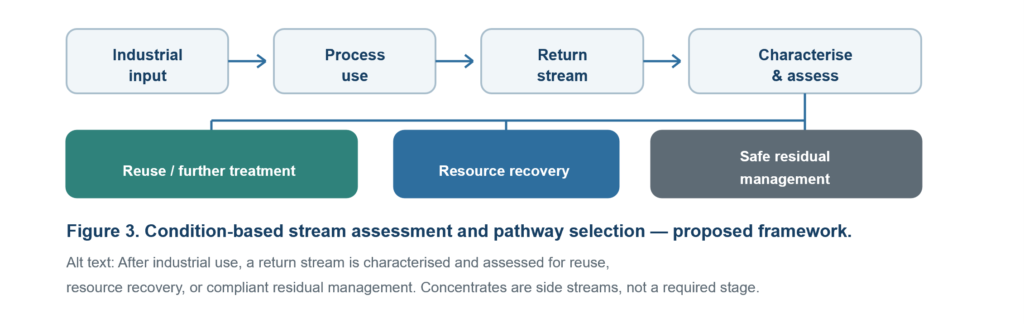
Reclassification does not eliminate residuals. Concentration can increase contaminant loads. Recovery can leave salts or mixed streams that still require disposal. A circular system therefore needs a clear residual pathway and a mass balance rather than a promise of “nothing left”.
Concentrated streams from reverse osmosis, electrodialysis or thermal processes can contain salts and other dissolved materials. Recovery is not automatically worthwhile. The relevant question is whether the material, water and energy value is sufficient to justify the added process under local conditions. Recent work on concentrate recovery and zero-liquid-discharge alternatives shows why energy and operating cost have to be part of that decision.
4. A Documented Brine-Recovery Case
The Haql brine-mining project in Saudi Arabia provides a documented case example of this approach. A 2026 open-access paper describes a demonstration plant in Haql and reports two project phases. Phase 1 targets 6–10 tonnes per day of continuous high-purity sodium chloride production. Phase 2 targets 6–8 kilograms per day of bromine and 100 kilograms per day of magnesium recovery. [6]
| Reported target | Unit |
| High-purity sodium chloride | 6–10 tonnes/day |
| Liquid bromine | 6–8 kg/day |
| Magnesium | 100 kg/day |
Figure 4. Haql Brine Mining Case — reported project targets.
Source: Mustafa et al. (2026), Desalination and Water Treatment, 326, 101788. DOI:
10.1016/j.dwt.2026.101788.
Note: Reported project targets, not independently verified commercial operating results and not validation results for the proposed framework.
The Haql case is therefore used as a documented example of brine-resource recovery, not as proof of the governance architecture proposed here. The European SEA4VALUE project provides a related example: it developed a multi-mineral, modular approach to recovering materials from desalination brines and treated technical and economic feasibility as questions to be demonstrated. [5]
The policy lesson is modest. Recovery functions can be considered within a wider resource system. The lesson is not that every brine stream should be mined, or that recovery is automatically economic.
5. Three Policy Models
The comparison below is conceptual rather than a quantified policy evaluation. It is intended to show how different regulatory approaches organize incentives, responsibilities and implementation requirements.
| Criteria | Conventional compliance | Mandatory reuse | Circular resource management |
| Regulatory focus | Discharge rules | Reuse requirements where mandated | Condition-based assessment within existing law |
| Main advantage | Clear compliance floor | Can reduce freshwater demand | Connects water, energy, resources and residuals |
| Main limitation | May stay focused on discharge | Can add treatment even when fit is poor | Needs data, monitoring and coordination |
| Implementation burde | n Usually lower | Moderate | Higher assessment and coordination burden |
| Monitoring | Compliance monitoring | Reuse quality and volume | Condition, pathway and performance records |
| Public health / safety | Standards and permits | Fit-for-purpose controls | Safety limits can constrain pathway choice |
| Economic implications | Compliance cost | Reuse investment and operating cost | Potential value plus added assessment/recovery cost |
Figure 5. Conceptual comparison of three industrial water policy approaches.
This comparison is conceptual and does not constitute a quantified policy evaluation.
The three approaches can coexist. Conventional compliance remains the regulatory floor. Mandatory reuse can reduce freshwater demand where conditions are suitable. A circular resource model adds a broader decision record covering reuse, recovery, residuals, energy, safety and economics.
The potential benefits of the circular resource approach remain subject to technical, economic, environmental, safety and regulatory validation. The purpose of the comparison is not to declare one model universally superior, but to show where the policy lens is placed.
The practical difference is simple. The first model focuses on the discharge boundary. The second emphasizes reuse. The third asks what should happen to the stream at each stage of its life inside the industrial system.
The Missing Layer: Decision Architecture
A circular system is not simply a collection of treatment units and pipes. Someone still has to determine what happens next. That is the role of the decision layer.
6. The Decision Layer
A circular system is not simply a collection of treatment units and pipes. It also needs a governed process for deciding what happens next.
The physical layer contains treatment, separation, recovery, storage and reuse infrastructure. The decision layer assesses current conditions and determines the next permissible pathway within engineering, safety and regulatory constraints.
| GOVERNED DECISION LAYER |
| Human review • monitoring • analytics • predefined limits • escalation and override |
| Water condition • task requirements • energy • resource value • equipment • safety • economics |
| NEXT PERMISSIBLE PATHWAY |
| PHYSICAL LAYER |
| Treatment • separation • recovery • storage • reuse |
| Direct reuse • further treatment • resource recovery • residual management |
Figure 6. Physical and decision layers of circular water management — proposed conceptual architecture.
Digital monitoring and optimization may support decisions, but do not replace accountable operational authority. Procedures should define who may authorize a pathway, which data are required, which limits trigger escalation and when a stream must move to a defined safe state.
Circular does not mean uncontrolled. Normal operation should resume after a material change only once the relevant conditions and pathway have been reassessed.
7. Four Intersecting Pathways
| WATER | DECISION LAYER | ENERGY |
| Quality • flow • task fit | Assess • authorize • monitor • reassess | Demand • intensity • carbon |
| SAFETY | RESOURCE / ION PATHWAY | ECONOMICS |
| Limits • hazards • compliance | Concentrates • materials • residuals | Costs • benefits • feasibility |
Figure 7. Interacting dimensions of circular water management — proposed conceptual architecture. The resource/ion dimension refers to materials that may be present in streams or concentrates; recovery is conditional, not assumed.
Water quality and flow define possible uses. Energy availability affects treatment and recovery choices. Resource-bearing concentrates may offer recovery opportunities, while safety limits can rule out an otherwise attractive option. The decision layer connects these dimensions rather than optimizing them in isolation.
Test the System Before Scaling It
The central architectural claim is that integration may create value missed when water treatment, resource recovery and operating decisions are planned separately. This is a hypothesis to test, not a result to assume.
A controlled pilot should compare an appropriate conventional baseline with integrated operation under comparable conditions. Predefined criteria should cover technical performance, cost, environmental effects, safety and reliability.
8. Pilot Validation
| Stage | Activity |
| 1. Assess | Define stream, flow, task and baseline. |
| 2. Analyse | Characterize composition and relevant contaminants. |
| 3. Value | Estimate potential water and resource value. |
| 4. Separate | Select and operate a suitable separation step. |
| 5. Measure | Record quality, salinity, energy and chemical use. |
| 6. Recover | Assess concentrate for a feasible recovery route. |
| 7. Evaluate | Measure yield, quality and residuals. |
| 8. Re-measure | Test produced water against the next task. |
| 9. Second cycle | Introduce suitable return water into another cycle. |
| 10. Compare | Compare with the conventional baseline and criteria. |
Figure 8. Proposed ten-stage pilot validation protocol.
Proposed success criteria
| Technical and environmental | Operational and economic |
| Water recovery; resource recovery; water-quality compliance; energy intensity; GHG emissions where measurable. | Lifecycle cost; safety; reliability; operational stability; residual management. |
Define the relative importance of each criterion before testing. This protocol tests the proposal against a baseline; it is not evidence of prior validation.
Measure Value Instead of Volume Proposed KPI: Value Preserved per m³
Net value preserved per m³ = recovered water value or avoided freshwater purchase cost (count one for the same water benefit) + recovered resource value + avoided disposal cost + other independently verified retained value − incremental treatment, recovery, energy, chemical, maintenance and monitoring costs.
This is a proposed conceptual KPI, not an established accounting standard. Define the system boundary, time period, allocation method and valuation rules before use. Avoid counting the same benefit twice.
9. Measure Value Instead of Volume
The economic KPI should not carry the entire evaluation. A circular water project also needs a dashboard that keeps technical, environmental, safety and reliability outcomes visible.
| Dimension | Example indicator |
| Water | Freshwater withdrawal avoided |
| Discharge | Wastewater discharge avoided |
| Energy | Energy consumed per m³ |
| Resources | Quantity and value of recovered resources |
| Environment | Greenhouse-gas emissions, where measurable |
| Reliability | System availability and operational stability |
| Safety | Safety incidents and compliance |
| Quality | Water-quality compliance for intended use |
Supporting performance dashboard
The dashboard complements the proposed economic KPI. It does not imply that every dimension can or should be reduced to a single monetary value. It makes trade-offs visible instead of hiding them inside one number.
Economic Logic and the Path to Scale
Build the economic case from measured results or defensible assumptions. Include water and resource value, avoided disposal, incremental treatment, energy, chemicals, maintenance, monitoring and labour. The World Bank’s 2025 report emphasizes fit-for-purpose reuse, enabling regulation, pricing signals, programmatic investment and bankable delivery models as conditions for scaling reuse. [3]
10. Economic Logic and the Path to Scale
Illustrative model for the proposed Value Preserved per m³ KPI
| Illustrative item | USD/m³ |
| Incremental treatment / processing | −1.00 |
| Recovery process | −0.50 |
| Energy | −0.30 |
| Chemicals | −0.20 |
| Maintenance | −0.30 |
| Monitoring | −0.20 |
| Recovered water value OR avoided freshwater cost | 0.80 |
| Recovered resource value | 0.60 |
| Avoided disposal | 1.20 |
| Other independently verified retained value | 0.70 |
| Illustrative net value | 0.80 |
Figure 9. Illustrative economic model. Values are hypothetical, not measured industrial results. Count the water benefit once and document assumptions.
From Pilot to Policy
Implementation should be staged: feasibility (indicatively months 0–6), pilot validation (6–12), and industrial demonstration (12–24). Progression should depend on evidence, not the calendar alone.
| Phase | Indicative period | Decision gate |
| Feasibility | Months 0–6 | Confirm stream, task, safety and baseline. |
| Pilot validation | Months 6–12 | Test predefined technical, economic and safety criteria. |
| Industrial demonstration | Months 12–24 | Assess performance at relevant scale. |
Figure 10. Indicative roadmap. Timing is a planning range, not a fixed construction schedule.
11. From Pilot to Policy
A credible pilot needs more than treatment equipment. It needs the people and information required to understand what the system is doing and why a pathway was selected.
| Role | Purpose |
| Process engineer | Pilot design, integration and operating envelope |
| Water-treatment specialist | Treatment trains, quality requirements and reuse pathways |
| Analytical chemist | Water, concentrate and recovered-resource characterization |
| Instrumentation / control engineer | Sensors, monitoring, data acquisition and control interfaces |
| Environmental / regulatory specialist | Permitting, compliance, safety and reporting |
| Economic / financial analyst | Avoided-cost, resource-value and KPI assessment |
| Pilot technicians / operators | Sampling, routine operation, maintenance and logging |
| Governance / decision oversight | Authority, escalation, review and human override |
What Policymakers Can Do Now
Practical instruments include task-specific water requirements where appropriate; condition-based assessment before selected streams are sent to final disposal; circularity in planning and permitting; sensible pricing signals and incentives; operator training; and transparent monitoring. Instruments must remain consistent with applicable law and safety standards. [4]
| Regulatory | Financial | Capacity building | Information & monitoring |
| Task-specific requirements Condition-based classification Circularity in permitting | Reduced tariffs where justified Targeted subsidies Green procurement | Operator training Technical guidance Pilot support | Open monitoring data Performance reporting Benchmarking and KPIs |
Figure 11. Proposed policy instrument framework. Options are illustrative and require jurisdiction-specific design.
12. Implications for India
India is not starting from zero. Treated-water reuse, industrial recycling and related circular-water practices are already part of the policy and operating landscape. The opportunity is to connect them more clearly to task requirements, monitoring, energy use and economic value.
India’s National Framework for Safe Reuse of Treated Waste Water provides a policy basis for state reuse policies. A March 2026 government update also reported industrial and power-sector reuse examples. [9][10] These examples illustrate existing practice; they do not validate the proposed architecture.
| Case | What is documented in cited source | Why it matters |
| Panki Thermal Power Plant, Uttar Pradesh | About 40 MLD of treated water is reported in use. | Treated water serves as an industrial input. |
| Jojobera Power Plant, Jharkhand | Government reporting cites about 4 MLD. | Reuse at another industrial scale. |
| Pragati Power Station-III, Delhi | Government reporting cites about 120 MLD. | Reuse within major power infrastructure. |
| IOCL Mathura Refinery, Uttar Pradesh | About 8 MLD supplied from the Trans-Yamuna plant is reported. | Treated municipal water supplied to an industrial user. |
| Laxmi Textile Prints, Jaipur | DST-supported pilot reported at about 10 kL/day. | Illustrates pilot evidence before wider adoption. |
Table 1. Selected Indian water-reuse examples reported by Government of India sources [9–11]. Verify figures against live source pages before publication.
These cases do not prove the proposed architecture. They show operating and pilot experience at different scales. Zero-liquid-discharge systems can reduce liquid discharge, but may carry significant energy and capital requirements. ZLD, reuse and recovery should be evaluated as pathways, not automatic endpoints. [7][8]
13. India: From Reuse Projects to a More Complete Decision System
Existing compliance rules should remain the floor. Selected industrial streams could be assessed using a common decision record: current water condition, intended task, treatment requirement, energy demand, recovery opportunity, safety limits, residual pathway and net value.
This would not require a new national technology standard. It would require better coordination between existing standards, permits, operating data and investment decisions. It could distinguish a stream that can be reused safely as it is, one that needs further treatment, and one for which recovery is not worth the added energy or cost.
The value of the proposed framework is not that it introduces reuse to India. It offers a way to organize existing and future projects around the next decision rather than around a single technology.
Conclusions
The circular resource system architecture offers a way to manage industrial water as an interconnected system in which water, energy, resources, safety and economics are considered together.
Stream Reclassification remains an operational and policy concept; it does not change legal definitions. The proposed decision layer connects physical infrastructure with a documented choice of the Next Permissible Pathway.
The Haql case shows that brine-resource recovery is being pursued in practice, but it does not validate this governance model. SEA4VALUE and recent concentrate-recovery research show an active field, not that recovery is always economic or technically preferable. [5][6][7][8]
The framework remains a conceptual proposal. Pilot testing and independent evaluation are required before its performance or wider applicability can be established.
14. Recommendations
For policymakers
- Require documented assessment of safe, technically feasible and economically relevant reuse or recovery options before finaldisposal for selected industrial streams where appropriate under applicable law.
- Support condition-based classification while preserving legal definitions and regulatory requirements.
- Encourage task-specific requirements where permitted by technical, environmental, public-health and safety requirements.
- Include circularity in planning and permitting for new industrial projects.
- Use pricing signals or targeted incentives where justified.
- Support monitoring, data quality and operator capability.
For industry
- Establish a clear water and mass balance before selecting recovery equipment.
- Pilot the proposed architecture before major capital deployment.
- Test Value Preserved per m³ with transparent boundaries and no double counting.
- Measure energy, water quality, resource recovery, operational continuity, safety and net value together.
- Keep a defined residual pathway for streams that cannot be safely or economically recovered.
Call to Action
Industrial water should be managed as a resource system rather than a one-way treatment-and-disposal process. The objective is not to avoid disposal at all costs. It is to ensure that final disposal follows a documented assessment of safe and feasible reuse or recovery options, in accordance with applicable requirements.
A pilot record should include
- Baseline water quality and flow.
- Intended task and proposed pathway.
- Energy and chemical demand.
- Recovery yield and quality.
- Operating continuity, alarms, deviations and human interventions.
- Incremental cost, avoided cost and Value Preserved per m³.
- Residual streams, risks and final management route.
The next step is to run well-designed pilots in which the full water system can be measured. If integration creates additional value, evidence should guide policy and scale-up. If it does not, the framework should be revised.
References
Institutional publications, government records and open-access research. Verify live metadata and numerical examples during final editorial production.
- Caucci, S. & Ozkul, Z. (2024). Revitalising Resource Efficiency for Industrial Water Reuse in the Circular Economy. United Nations University Policy Brief No. 15. https://unu.edu/publication/revitalising-resource-efficiency-industrial-water-reuse-circular-economy
- OECD (2015). OECD Principles on Water Governance. https://www.oecd.org/en/topics/sub-issues/water-governance/the-oecd-principles-on-water-governance-and-implementation-strategy.html
- Khemka, R. & Eberhard, R. (2025). Scaling Water Reuse: A Tipping Point for Municipal and Industrial Use. World Bank Group. https://www.worldbank.org/en/topic/water/publication/scaling-water-reuse
- European Research Executive Agency (2021). Water in the Circular Economy: Policy Development. https://rea.ec.europa.eu/publications/water-circular-economy-policy-development_en
- European Commission, CORDIS. SEA4VALUE, Grant Agreement 869703. https://cordis.europa.eu/project/id/869703
- Mustafa et al. (2026). Transforming seawater brine into resources: A circular economy approach at the Haql brine mining plant. Desalination and Water Treatment, 326, 101788. https://doi.org/10.1016/j.dwt.2026.101788
- Salas et al. (2026). Desaturation and chemical recovery from desalination concentrates using ion exchange and bipolar membrane electrodialysis as azero liquid discharge process. Environmental Science: Water Research & Technology, 12, 588–600. https://doi.org/10.1039/D5EW00977D
- Chen et al. (2025). Circular Transition of Cooling Tower Blowdown Using Resin Wafer Electrodeionization Technology. ACS ES&T Water, 5(7), 3719–3728. https://doi.org/10.1021/acsestwater.4c01279
- Ministry of Jal Shakti, Government of India (2023). National Framework for Safe Reuse of Treated Waste Water. https://www.pib.gov.in/Pressreleaseshare.aspx?PRID=1943356
- Press Information Bureau, Government of India (2026). Safe Reuse of Treated Water Gains Momentum; Policy Notified in Uttarakhand. 17 March2026. https://www.pib.gov.in/PressReleasePage.aspx?PRID=2241229
- Department of Science & Technology, Government of India. Improved water management system developed can treat toxic textile effluentsfacilitating its reuse in households and industry. https://dst.gov.in/improved-water-management-system-developed-can-treat-toxic-textile-effluents-facilitating-its-reuse
Source discipline Haql figures are reported project targets, not independently verified commercial operating results. Indian case figures are reported by government sources and are not measurements generated by this article. Conceptual figures and the proposed KPI

MAHER HASSAN MOFTAH
Maher Hassan Moftah is an independent strategic development thinker and political economy observer whose work explores governance, institutional decision-making, and human oversight in the age of artificial intelligence. He is the originator of the VAEL governance and decision-making framework and a contributor to The AI Misalignment Problem, published by the Global AI Observatory. He serves on the Global Advisory Board of the International Artificial Intelligence Committee (STANAIC™) as Senior Technical Advisor & Lead System Architecture Consultant, under a three-year appointment effective 7 September 2026.


Leave a comment