




























9,784 km of roads. A ₹12,613-crore Transport, Roads & Bridges budget. A trail of audit objections and corruption allegations. The Tilak Nagar slap may be only the surface—who really controls Delhi’s road money?
The Slap, the Road and Delhi’s ₹12,613-Crore Question
It began with a slap. It may end with a much bigger question: who actually controls the money flowing through Delhi’s roads?
The slap, however, is only the visible part of the story. Beneath it lies the far more consequential question of how Delhi builds, repairs and pays for its roads.
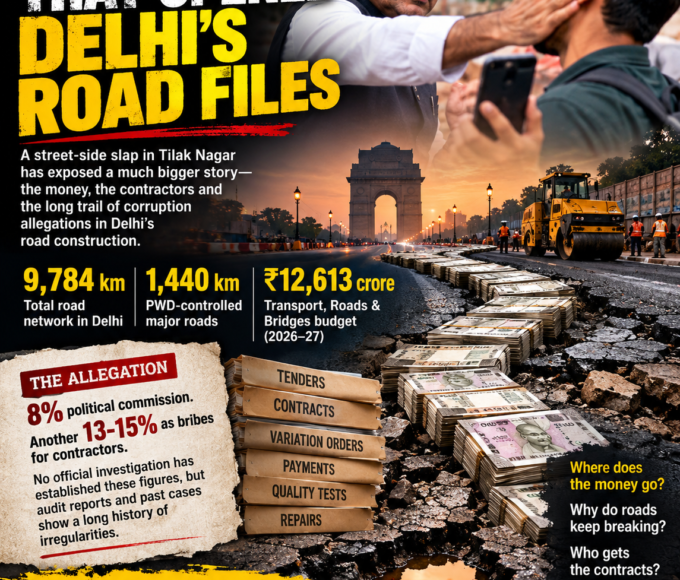
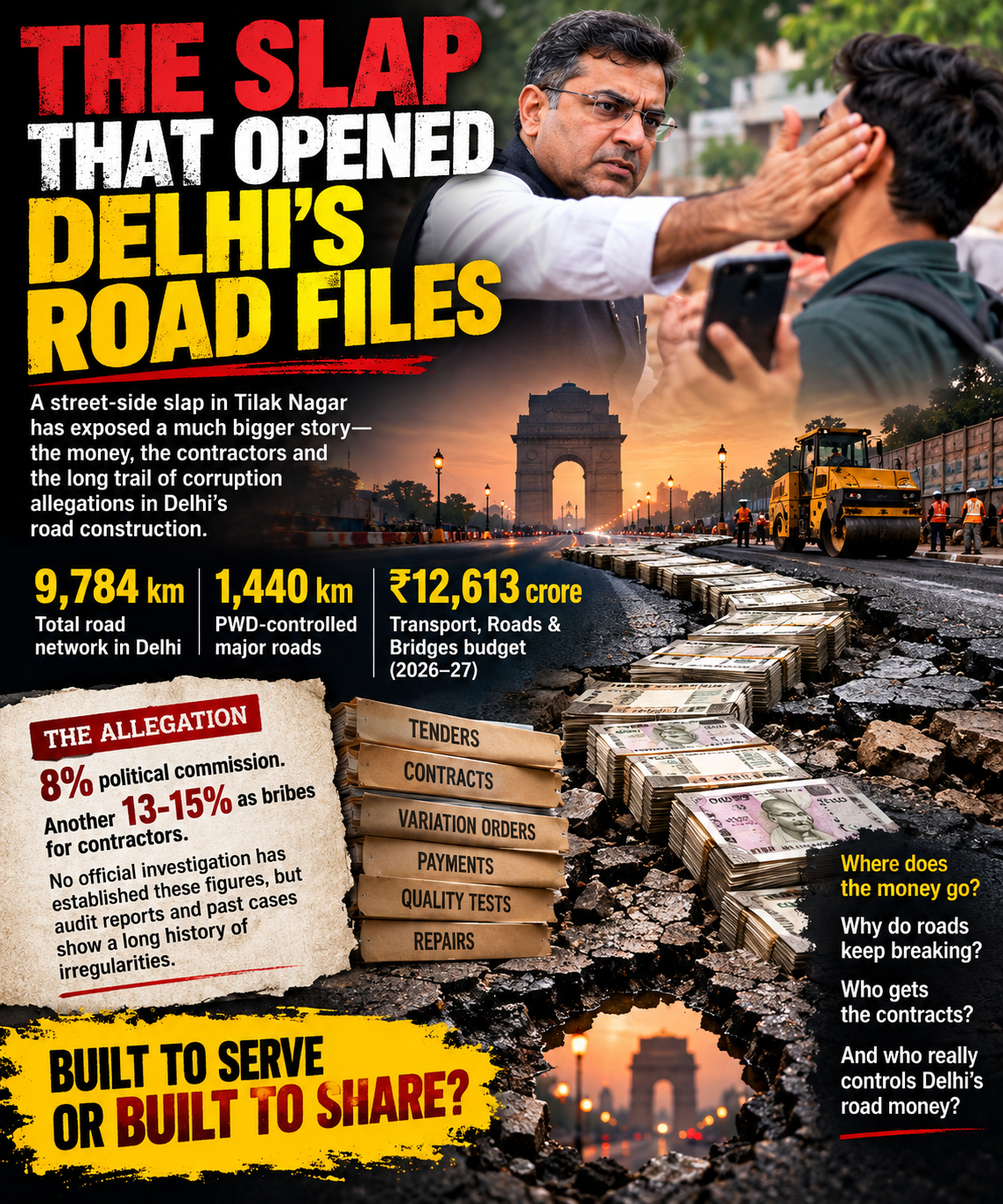
Delhi has a huge road network. The latest government inventory puts the physical road-length universe at 9,784.02 km. Of this, approximately 1,440 km are under Delhi PWD, while the remainder is distributed among MCD, NHAI, I&FC, DDA, DSIIDC, NDMC, DJB, Delhi Cantonment Board, DMRC, NCRTC and CPWD.
The money involved is equally substantial. Delhi’s 2026–27 Budget provides ₹12,613 crore under the broad Transport, Roads & Bridges sector, representing 12.16 per cent of the entire ₹1,03,700-crore Delhi Budget. This is the most defensible official figure for the scale of the sector, although it would be misleading to call the entire ₹12,613 crore “road expenditure” because the head also includes transport and bridge-related spending.
Within that larger envelope, the government has made several explicit road provisions: ₹1,392 crore for end-to-end recarpeting and redevelopment of 750 km of PWD roads, around ₹1,000 crore for MCD roads, ₹800 crore for roads, drainage and lighting in unauthorised colonies and ₹160 crore for roads and drainage in notified and non-conforming industrial areas. The government says 400 km of PWD roads were redeveloped during 2025–26.
So the scale is unmistakable. Delhi has 9,784 km of physical roads, a PWD network of about 1,440 km, and a current annual budget envelope of ₹12,613 crore for the wider Transport, Roads & Bridges sector. The actual consolidated amount spent specifically on roads by every road-owning authority is not published as one audited figure. But we are talking about a road economy worth thousands of crores every year.
And this is where the Tilak Nagar slap becomes something larger than a street-side political controversy.
Delhi does not have to begin investigating the road-contracting system from zero. There is already an established documentary history of allegations, audit objections and investigations concerning irregularities in road contracting.
A Comptroller and Auditor General performance audit of Delhi’s municipal corporations examined the development and strengthening of Delhi’s road network and found irregularities involving contract execution, changes in scope, payments, incomplete works and other financial issues. In one case, a road contract initially valued at about ₹123.64 crore resulted in payments of about ₹137.29 crore, with the audit questioning changes made during execution. The CAG also identified unfruitful expenditure on incomplete road projects.
The PWD has had its own history of controversy. In 2017, an RTI-based investigation reported approximately ₹200 crore in allegedly dubious payments involving 198 roads, drains and footpaths. The allegations included payments where work was allegedly incomplete or inadequately supported. Those were allegations based on RTI material and should not be treated as proof that every contractor or official involved was corrupt.
More recently, Delhi’s anti-corruption authorities have pursued allegations concerning PWD officials and contractors. Such cases establish that corruption allegations in the road-construction system are not merely political gossip; they have repeatedly reached government investigators and audit authorities. But an allegation, investigation or FIR remains different from a proven offence.
That history gives substance to a question contractors and people familiar with government works have discussed for years: how much of the money sanctioned for a road actually reaches the road?
One allegation circulating in contracting circles is particularly explosive: that political intermediaries or “bosses” take around 8 per cent, while contractors may have to absorb another 13–15 per cent in illicit payments and other arrangements. If true, the combined leakage could approach one-fifth of a project’s nominal value.
But this is precisely where an investigation must be disciplined.
There is presently no CAG, CBI, CVC or court finding establishing an across-the-board 8 per cent political commission plus 13–15 per cent contractor bribe on Delhi road contracts. Those percentages therefore have to remain an allegation until documentary evidence establishes them.
The records, however, can answer the larger question.
Take a ₹100-crore road contract. Start with the government’s original estimate. Then follow the winning bid, the contract value, variation orders, extra items, revised quantities, extensions, payments, quality-control reports and the date on which the same road comes back for repair.
If a contractor repeatedly bids dramatically below the government’s estimate and subsequently recovers money through additional items and variation orders, that pattern deserves scrutiny. If the same contractors repeatedly receive work from the same divisions, that deserves scrutiny too. And if a newly constructed road repeatedly returns to the maintenance pipeline, taxpayers have an obvious question: was the original road actually built to the specification for which they paid?
That is the real significance of the Tilak Nagar episode.
The controversy should not end with the slap. It should lead to the files.
Delhi should publish every major road contract: estimated cost, winning bid, contractor, variation orders, extensions, final payment, quality tests and subsequent repair expenditure.
Then the arithmetic can speak.
If the alleged commission system is fiction, the records should kill it.
If it exists, the records should expose it.


Leave a comment