































From ration shops to AI procurement: making Indian public decisions understandable, challengeable and correctable
EXECUTIVE SUMMARY. India does not need every citizen to become a technologist or policy specialist. It needs public decisions whose evidence, assumptions, responsible officers and routes to correction can be understood and challenged. This article proposes a testable public decision record connecting expert analysis, lived experience, lawful authority and independent checking.
PROBLEM STATEMENT. Complex public systems can fail at the point where technical outputs become administrative verdicts. A biometric failure, algorithmic risk score or opaque procurement decision can affect real lives before an ordinary person can discover why, who owns the decision or how a mistake can be corrected.
CONCLUSION. Expertise remains essential, but expertise, authority and legitimacy are different. Democratic competence can be strengthened institutionally by making reasons traceable, uncertainty visible, objections answerable and consequential corrections possible.
RECOMMENDATIONS. Attach a concise decision record to consequential processes; name accountable officers; preserve dissent; require fallbacks and vendor accountability; use AI as an assistive layer rather than allowing an AI output, by itself, to become an administrative verdict; and qualify evidence, rights, catastrophic risk and viability before ranking options.
CALL TO ACTION. Pilot the architecture on a small set of completed cases, compare it with current practice and a simpler checklist, publish adverse findings, and stop if the burden exceeds the benefit. The proposal should earn adoption through evidence, not branding.
Evidence note. I develop MathGov and RippleLogic. The independent studies below examine other systems. The public decision record, procurement terms and pilot described here are proposals to be tested, not established practices or validated interventions. Cartoons are fictional editorial illustrations, not study testimony or official endorsements.
THE ARTICLE
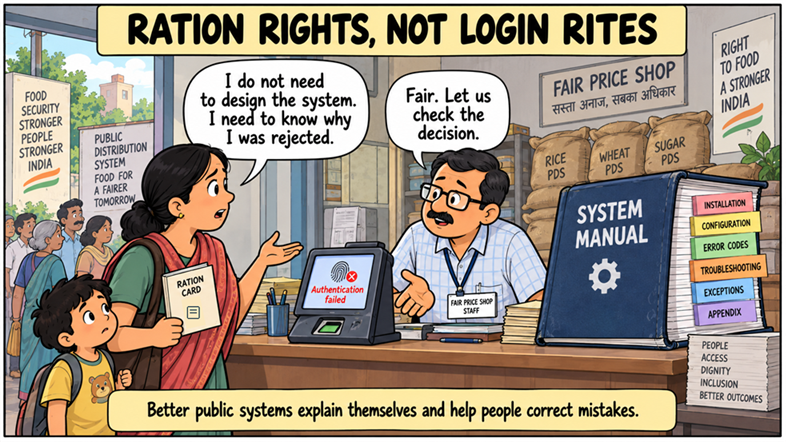
Cartoon 1. Ration rights, not login rites. A fictional error signal deserves an explanation and a workable response.
Ration rights, not login rites
Must a family understand biometric authentication to question losing its food entitlement? Research on Jharkhand’s Public Distribution System makes that question concrete.
Karthik Muralidharan, Paul Niehaus and Sandip Sukhtankar estimated that between 1.5 million and 2 million legitimate beneficiaries – 15-20 lakh people – lost access to benefits at some point during the reforms they studied. Their published study reports reduced corruption alongside substantial exclusion costs, with transition management central to the adverse effects.[1]
That is neither a verdict against all digitisation nor a current count of excluded families. It is a warning: a technically sophisticated system still needs understandable reasons, workable exceptions and someone empowered to correct a wrong decision.
From files to fair questions
In my earlier GFiles article, “Can Mathematics Fix Governance?”, I argued for explicit evidence, protected limits, realistic implementation and accountable reasoning.[2]
This follow-up asks who can use that reasoning. A district official needs a defensible decision; a supplier needs clear obligations; a citizen needs an answer that can be questioned.
These are connected needs, not competing constituencies. India’s opportunity is to connect them through a public decision record attached to existing procedures.
The aim is not a dashboard that answers every question except why. It is a route from the explanation to its evidence, responsible office and possible correction.
Degrees do not define dignity
Competence should govern who exercises power, not whose interests count.
A child, a person with a disability or a farmer without formal schooling does not need technical credentials for their interests to matter.
Research on how democracy uses knowledge, including Hélène Landemore’s work, argues that inclusive deliberation can draw on different perspectives under appropriate conditions.[3]
That is not a claim that every opinion is accurate or every crowd wise. Specialists test mechanisms; affected people can identify consequences they experience.
Citizens should not have to master a model before asking whether its assumptions describe their lives.
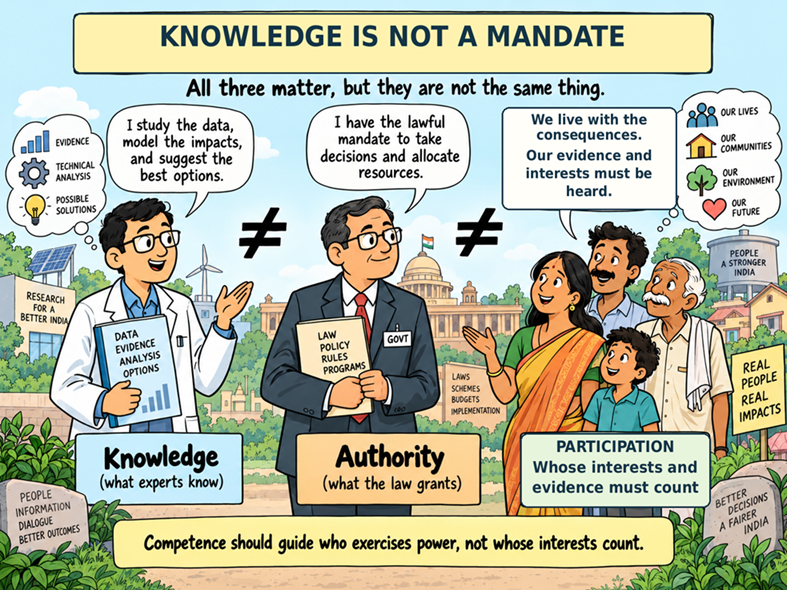
Cartoon 2. Knowledge is not a mandate. Expertise, lawful authority and affected interests have different roles.
The strongest objection: how do I know the expert is sound?
Most citizens cannot personally verify reactor physics, a machine-learning model or a macroeconomic forecast. So how can they tell a sound expert explanation from sophisticated nonsense?
Often, they cannot do that alone. The answer is to make expertise contestable rather than pretend universal verification is possible.
Competing experts should be able to challenge one another; evidence and assumptions should be traceable; uncertainty should be visible; affected people should be able to add missing facts; and consequential decisions should have a review route independent of the proposal team.
The democratic competence we need is therefore partly institutional: a decision system designed to make consequential error easier to detect, answer and correct.
A flag is a question, not a verdict
Proposed checks before treating a system output as a final answer
| Record signal | What still needs checking |
| Authentication failed | Eligibility, alternative verification and continued access |
| Payment marked processed | Whether the correct person received usable value |
| Application flagged | Original evidence and an authorised review |
Table 1. Illustrative checks for public-service records, not an evaluation of a named programme.
Less queue, more life
The former, undivided Andhra Pradesh offers a useful counterpoint. A randomised rollout of biometric Smartcards across 157 subdistricts produced faster, less leaky employment payments without evidence of reduced programme access in the study.[4]
The 2016 paper reports about 22 fewer minutes spent collecting an employment payment. Its estimated reduction in pension collection time was smaller and was not statistically distinguishable from zero at conventional levels.
These were historical results from a particular delivery system, not a guarantee about every biometric reform. Read alongside Jharkhand, the lesson is to scrutinise implementation rather than technology labels.
The public question is practical: what changed for recipients, including those least able to navigate the new process?
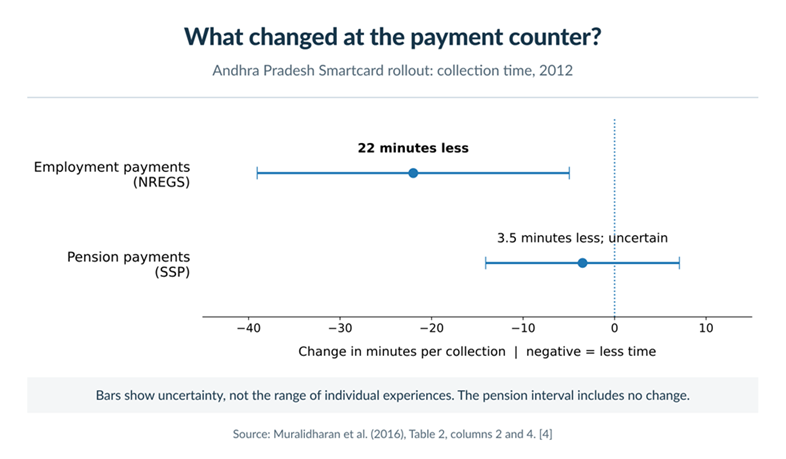
Figure 1. Historical Smartcard rollout effects on payment-collection time. Employment: -22 minutes (SE 8.7); pensions: -3.5 minutes (SE 5.4). Bars are author-calculated approximate 95% intervals using estimate ± 1.96 × clustered SE. Source: Muralidharan et al. (2016), Table 2, columns 2 and 4.[4]
Fallbacks are policy, too
The two studies highlight a revealing design contrast. Andhra Pradesh’s devices worked offline and permitted manual override when authentication failed, while Jharkhand depended more heavily on connectivity and stricter authentication.[1,4]
The authors also contrast greater attention to recipient experience in Andhra Pradesh with a stronger fiscal-savings emphasis in Jharkhand.[1]
These were different programmes, populations and rollouts, not a randomised head-to-head test of fallback rules.
Still, the comparison exposes a question that a technology label cannot answer: what happens to an eligible person when the system fails?
Exception handling belongs in the policy design and budget, rather than arriving as an apology afterwards.
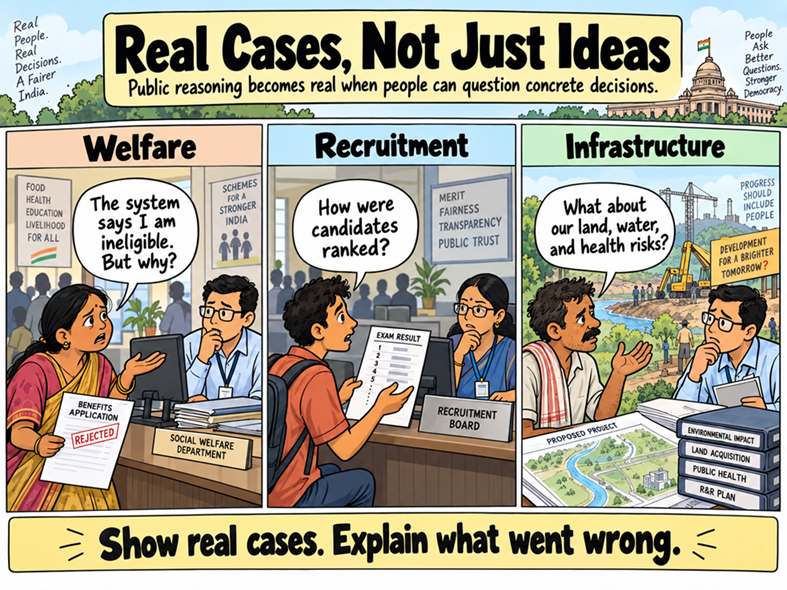
Cartoon 3. Real cases, not just ideas. Welfare, recruitment and infrastructure all raise questions that technical performance alone cannot settle.
The public brings receipts
Andhra Pradesh’s social auditors checked work records with workers and brought complaints into public hearings.
Afridi and Iversen’s study of 2006 to 2010 records found evidence suggestive of learning and detection, but no clear deterrence from repeated audits; harder-to-detect material irregularities increased.[5]
Their India Policy Forum paper calls for follow-up responsibilities to be laid out and credibly enforced. The rollout was not randomised, so the findings require cautious interpretation.[5]
Jonathan Fox’s broader review similarly distinguishes information-only interventions from strategies strengthening both citizen voice and institutional response.[6]
The practical lesson is simple: name who must act on a problem, not merely who recorded it.
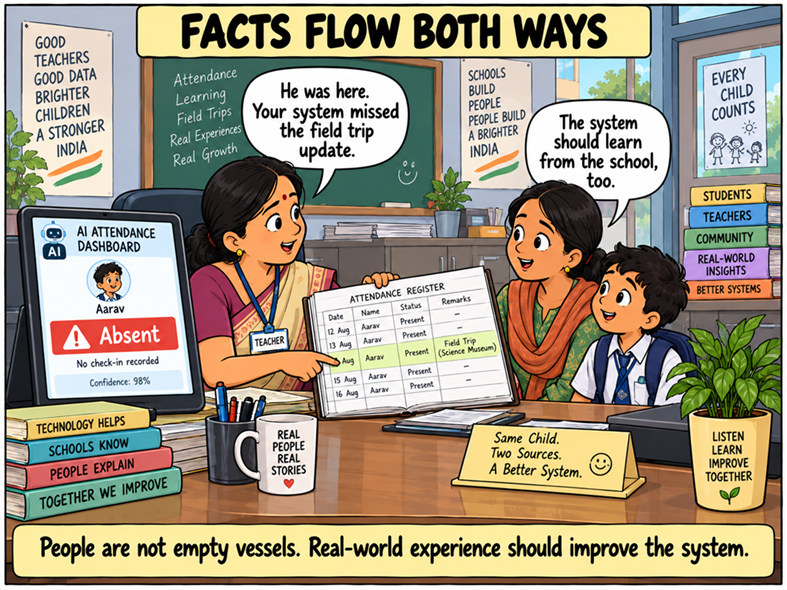
Cartoon 4. Facts flow both ways. A fictional school record shows why a system flag should be checked against documentary and lived evidence.
RTI: reasons, not riddles
India already has a foundation for giving reasons. Right to Information Act section 4(1)(c) concerns publishing relevant facts about important policies and public decisions; section 4(1)(d) requires reasons for administrative or quasi-judicial decisions to affected persons.[7]
In Madhyamam Broadcasting (2023), the Supreme Court examined how non-disclosure can undermine a fair and effective challenge, and stressed the need to justify state action and restrictions on disclosure.[8]
These sources do not mandate this article’s proposed template. They establish why explanation, supporting material and procedural safeguards matter.
A useful record should help fulfil existing duties, subject to lawful exceptions, rather than advertise a new system detached from Indian administration.
Privacy without a paper curtain
The disclosure framework changed in November 2025. Section 44(3) of the Digital Personal Data Protection Act substituted RTI section 8(1)(j) with the exemption “information which relates to personal information”. The substitution was brought into force on 13 November 2025 by G.S.R. 843(E).[9]
The consolidated RTI Act still retains section 8(2), under which a public authority may allow access when the public interest in disclosure outweighs harm to protected interests, and section 10 permits severance of exempt material.[7]
How the amended exemption will interact in practice with RTI section 8(2), constitutional principles and future judicial interpretation should not be treated as fully settled.
For this proposal, the practical response is to distinguish reasons supplied to an affected person from material suitable for general publication. Remove identifying details where required, assess re-identification risk and document disclosure decisions.
An anonymised label is not an automatic legal clearance. Privacy and explanation must be designed together.
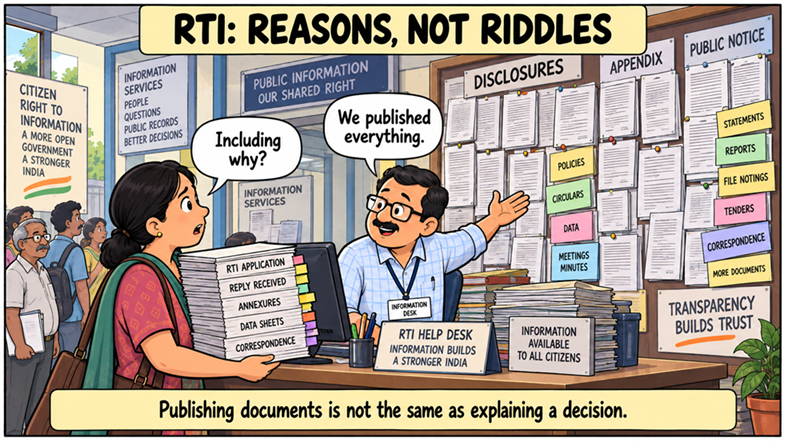
Cartoon 5. RTI: reasons, not riddles. A pile of documents is not yet an understandable explanation.
Who checks the fine print?
The department proposing a decision should name a record officer to assemble its public explanation; the authorised decision-maker remains responsible for the reasons.
Call review independent only when the reviewer is outside the proposal team and supplier reporting lines, discloses and recuses conflicts, has protected access to the evidence, and can publish unresolved dissent. The review arrangement should protect reviewers from removal or disadvantage solely because they issued an adverse finding. A shared pool or rotation can reduce capture where feasible.
The review task is concrete: identify unsupported claims, missing alternatives, understated uncertainty and omitted burdens.
Publish the reviewer’s finding, unresolved disagreement and the decision-maker’s response. This does not abolish discretion; it makes authorship, challenge and accountability visible.
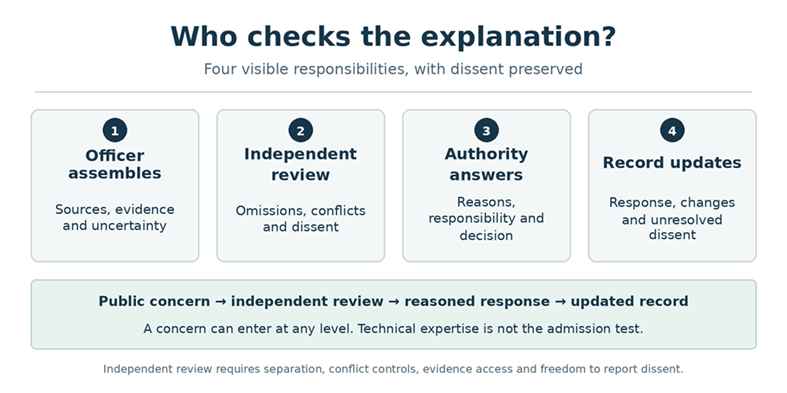
Figure 2. Who checks the explanation? Proposed authorship, independent review, accountable response and versioned revision, with unresolved dissent preserved.
Three doors, one record
A public record needs doors, not a maze.
Its three linked levels let people understand the choice, question its assumptions and verify its supporting evidence. The front page identifies the problem, alternatives, affected groups, uncertainty, decision owner and challenge route.
Supporting comparisons and a protected evidence annex sit behind it, connected by stable references. Preserve dated versions and record what changed after review.
A person can raise a concern from any level without first completing technical verification. The institution should help clarify and investigate the concern.
Local-language summaries must point to the same underlying decision, not become separate accounts that quietly omit inconvenient findings.
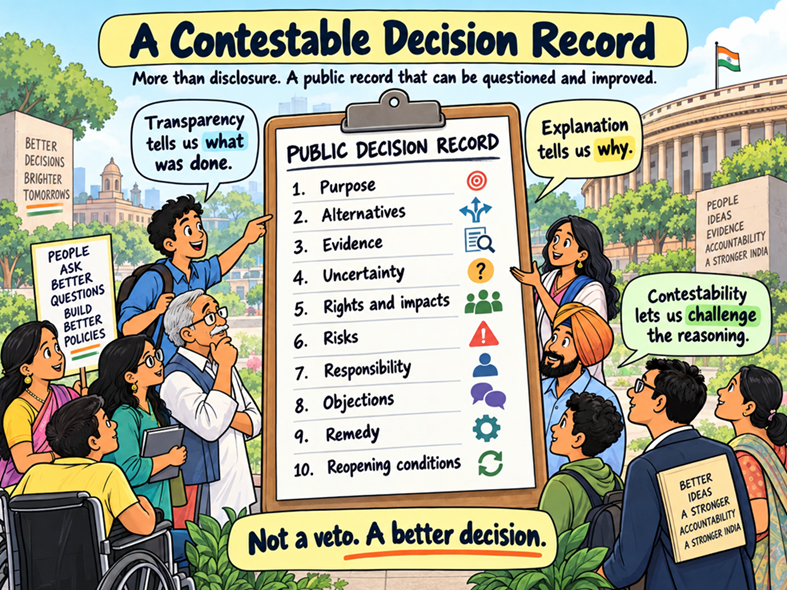
Cartoon 6. A contestable decision record. Transparency says what happened; explanation gives reasons; participation adds evidence; contestability can trigger reconsideration.
Dissent is not a system error
A polished explanation can still conceal a poor choice. Andrea Prat’s theoretical work shows how transparency about actions can, under specified incentives, encourage conformity rather than better decisions.[10]
Require a short dissent field identifying the evidence, affected interest or alternative a reviewer thinks the account overlooks. Preserve the objection alongside the response, with appropriate privacy protections.
Sample supposedly straightforward cases, not just prominent failures. Where AI assists with summarising, retain sources and identify its use.
Agreement among reviewers is not proof of truth. Test contrary evidence and whether objections receive reasoned responses; fluency alone supplies no independent assurance.
Put a name to the promise
At district level, record maintenance can sit inside an existing programme team, with a designated senior officer accountable under the applicable delegation.
A ministry can use its policy division and a shared independent-review pool rather than create a new office for every scheme.
The sponsoring department must budget staff time, translation, assisted access and checking, including cover for displaced work. Here, independent review means no reporting line to the proposal lead, conflict disclosure and recusal, protected evidence access, and freedom to publish dissent.
A nameplate is not a safeguard. Time, resources, authority and review independence must be real.
Roles that stay visible
Proposed responsibilities within existing institutions
| Role | Primary responsibility |
| Decision authority | Mandate, reasons and consequential authorisation |
| Record officer | Evidence links, dated versions and response tracking |
| Independent review pool | Omissions, conflicts, unresolved dissent and documented recusal |
| Supplier or operator | Logs, versions, fallback and correction support |
| Citizen-support desk | Assisted access, receipt and correct remedy route |
Table 2. Independence requires actual separation, conflict controls, evidence access and freedom to report dissent. RTI, scheme appeals and judicial review retain separate functions.
Buy the fix, not just the box
For Indian technology firms and public buyers, accountability should begin in procurement.
Contracts should specify test populations, accessible fallbacks, error logs, model and data versions, correction responsibilities, review access and an exit or handover plan.
Payment milestones can include demonstrated correction and handover, not only installation. Small suppliers need proportionate, published requirements rather than endless bespoke paperwork.
India’s 2025 AI Governance Guidelines also recommend training government officials, regulators and civil servants to understand AI developments and manage public procurements effectively.[11]
The supplier explains the product; the department must explain why it delegated that function and who remains answerable.
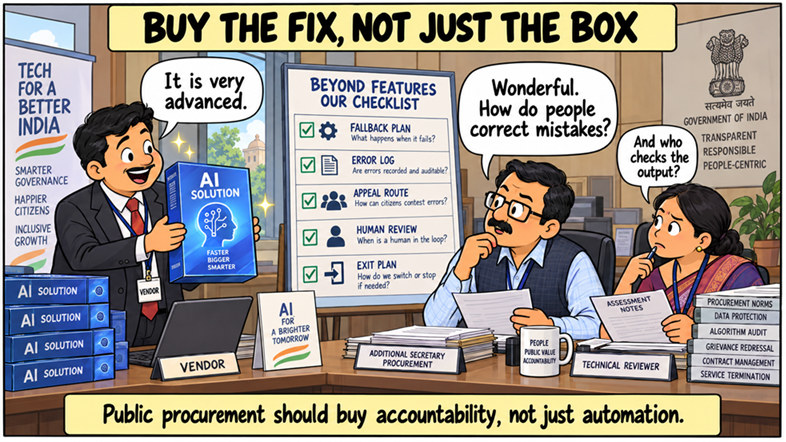
Cartoon 7. Buy the fix, not just the box. Procurement should specify fallback, logging, review, correction and exit before deployment.
A co-pilot, not a crown
AI can help citizens locate eligibility rules, compare explanations or draft complaints. It can help officials organise submissions and detect contradictions.
These are useful roles to test, not a licence to set public priorities or become the sole judge of its own reliability. RippleLogic v13.0 likewise separates functional capability and tool-role from legitimate authority.[16] NIST identifies confabulation and risks arising from human-AI configuration, including over-reliance.[12]
Keep source links visible, check consequential claims independently and name who authorises action.
Computing an answer does not create a public mandate. Assistance should shorten the route to accountability, rather than add another unanswerable counter.
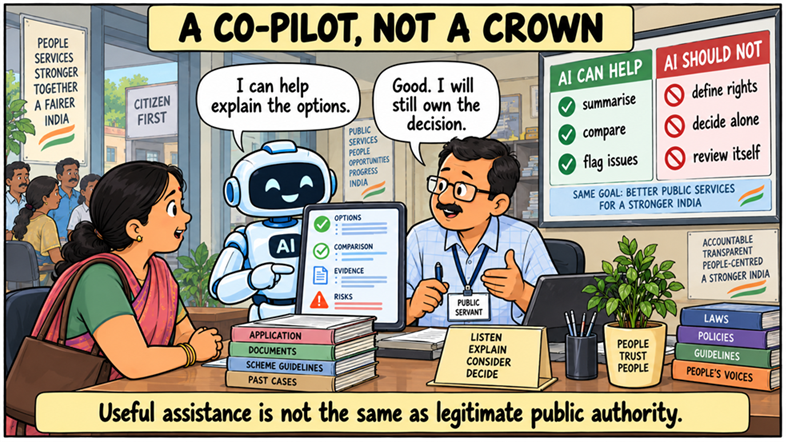
Cartoon 8. A co-pilot, not a crown. AI may assist with explanation and comparison; lawful authority, independent checking and appeal remain separate.
A help desk, not another hurdle
India’s 2025 AI Governance Guidelines recommend that organisations deploying AI establish grievance mechanisms that are accessible and effective, easy and reliable to use, clearly visible, available in multiple languages and formats, usable without fear of retaliation or undue burden, and responsive within reasonable timelines.[11]
For the proposed pilot, that should mean funded assistance: a counter, telephone or oral submission, accessible information and a retainable receipt, without a new challenge fee.
Separate the correction of an individual decision from an information request or policy objection. An Information Commission ordinarily adjudicates access-to-information disputes; it does not determine the applicant’s underlying entitlement to a scholarship.[7]
People need help reaching the right remedy. They should not have to identify the correct institutional doorway unaided.
Plug in, do not pile on
The proposal should use existing Indian channels wherever they fit.
CPGRAMS provides tracking and an appeal facility for covered service-delivery complaints, while expressly excluding RTI and court-related matters.[13] State Right to Public Services laws can impose time-bound duties and appeals; Maharashtra’s 2015 Act is one example.[14]
Rajasthan’s Jan Soochna Portal and its official circular show how scheme information can be organised proactively under RTI section 4(2), while preserving section 8 exemptions.[15]
These instruments perform different jobs. Linking a decision record to them does not merge their powers or prove their effectiveness.
Better architecture should reduce the institutional maze, not build another corridor beside it.
Deadlines do not wait for debugging
Consider a fictional scholarship applicant whose uploaded document is recorded as missing. An assisted desk preserves her concern and receipt immediately.
A proposed service target would acknowledge and check the record within two working days, then provide an authorised response by day five, with urgent escalation before an enrolment deadline.
These are design assumptions, not existing legal deadlines. Where a scholarship is a notified service or a scheme-specific rule sets a timeline, that binding requirement and appeal route come first.[14]
An unresolved case needs reasons, protective steps within lawful powers and a revised response date. Finally, verify the consequential correction: an amended screen is insufficient if the student still loses her place.
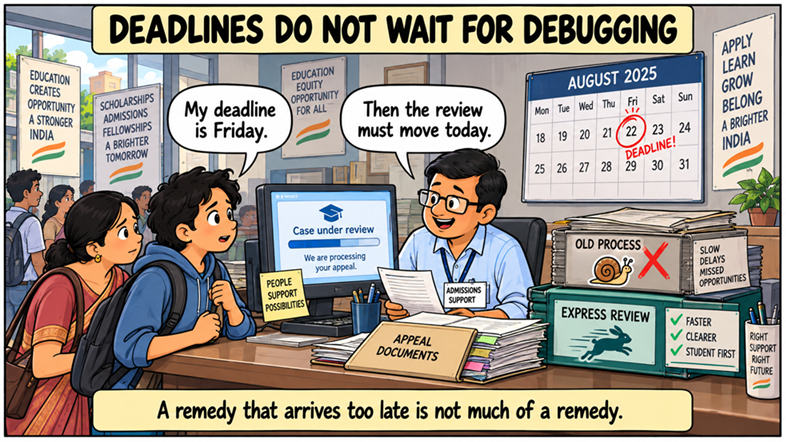
Cartoon 9. Deadlines do not wait for debugging. The Friday deadline is illustrative, not a scheme rule.
A hearing, not a hurdle race
For policy consultations, publish a defined comment window and consolidate repeated arguments into a response register, while preserving distinct evidence and affected interests.
Individual grievances need their own route and should not vanish when a policy window closes. A named officer should explain why a concern falls outside scope, with a review route for that refusal.
New evidence or newly discovered harm should permit reopening. Avoid blanket numerical caps that reward organised repeat players and exclude late-arriving vulnerable people.
The relevant question is whether the concern could change the decision or reveal harm, not whether its author writes like a lawyer.
Rights before rankings
RippleLogic, the framework I develop, offers one proposed discipline.[16]
Ask what the evidence supports, which protected limits apply, whether catastrophic or irreversible exposure is bounded, and whether the option can stand in practice with resources, controls, monitoring, exit and correction.
Compare wider consequences only among qualified options, using declared priorities and uncertainty. Insufficient evidence requires investigation or a narrower claim; it does not establish wrongdoing.
A favourable aggregate score cannot cure a breach of a controlling rights floor, substitute for the lawful justification required where a right may be limited, or make unacceptable catastrophic exposure selectable. Existing appraisal, legal review and specialist safety assessment remain necessary.
The proposal connects these checks; its added value over simpler methods must still be demonstrated.
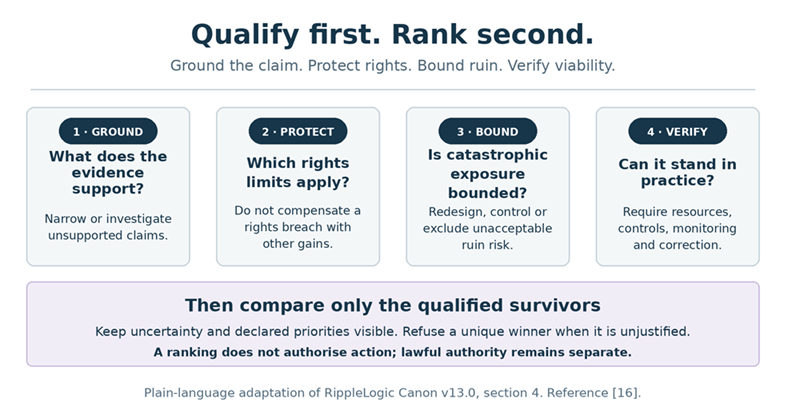
Figure 3. Qualify first, rank second. Grounding limits claims; rights, catastrophic risk and viability constrain selectable options. Ranking does not authorise action.[16]
A toolbox, not a throne
RippleLogic is not meant to replace cost-benefit analysis, regulatory impact assessment, public consultation, administrative law, audit or domain-specific safety review.
Its proposed contribution is sequencing and traceability: ground the claim, protect rights, bound ruin, verify structural viability, make exit and correction real, then compare only the options that survive.[16]
That is a hypothesis about better decision architecture, not a claim to monopoly. The pilot should compare it with current practice and a simpler checklist.
If the simpler method catches the same consequential problems with less burden, use the simpler method.
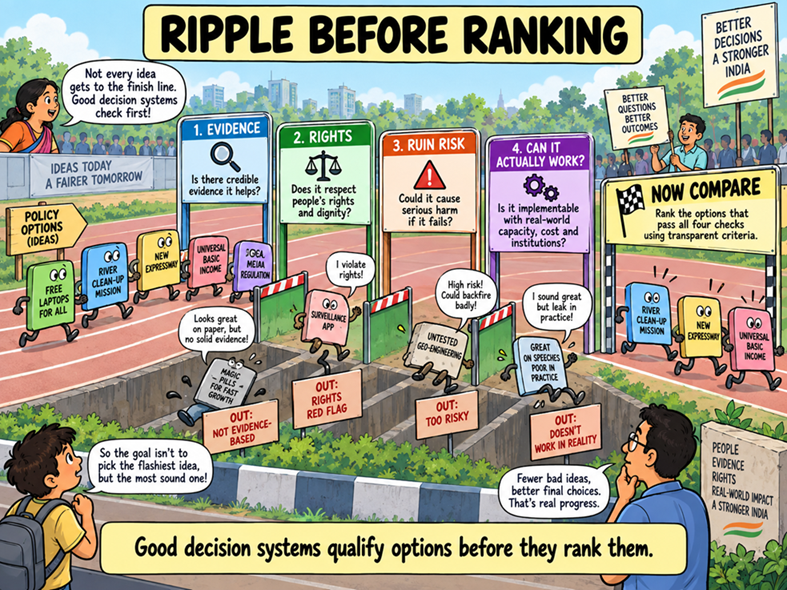
Cartoon 10. Ripple before ranking. Candidate ideas pass evidence, rights, ruin-risk and real-world viability checks before comparison.
No clear winner? Say so.
Even after those checks, defensible priorities can favour different options.
A water portfolio may protect households and ecology while leaving a genuine choice between industrial reuse and agricultural transition. Where evidence cannot settle that value disagreement, publish conditional comparisons rather than manufacture a uniquely correct score.
A lawful authority may still choose among qualified options, stating its mandate and reasons separately from the calculation.
Citizens can understand those reasons and still disagree. The framework should make the remaining political choice explicit, not give it the borrowed authority of mathematics.[16]
Urgent does not mean unanswerable
A cyber incident or heat emergency cannot always wait for a full consultation.
Publish operating protocols, delegated powers and review triggers in advance where possible. Record urgent actions and arrange scrutiny as soon as circumstances permit.
Restrict genuinely sensitive details on an identified legal basis, with a review route, rather than treating urgency as permanent secrecy.
A public-facing explanation must not delay essential protection. Conversely, urgency must not become a permanent exemption from explanation.
The goal is to preserve responsibility when deliberation time is short and consequences are serious.
Small pilot, working brakes
Begin with one district scholarship workflow and twenty completed decisions, selected through published criteria to include approvals, refusals and corrections.
Use lawfully accessible, safely redacted research copies in a twelve-week pilot whose outputs cannot determine live entitlements. Record participant consent, data safeguards and any required ethics approval before research begins.
A planning envelope might reserve 160 staff-hours and 40 reviewer-hours, plus separately costed translation, participant support and overheads. These are assumptions, not validated staffing norms.
If the resources cannot sustain proper review, narrow the scope transparently or stop rather than quietly weakening safeguards.
Budget before the launch photograph
Illustrative 12-week study of 20 completed decisions; experimental outputs do not determine live entitlements
| Work package | Illustrative planning allowance |
| Set-up and training | 40 staff-hours |
| Prepare records: 20 × 4 hours | 80 staff-hours |
| Participant checks and follow-up | 40 staff-hours |
| Independent review | 40 reviewer-hours |
| Total | 160 staff-hours plus 40 reviewer-hours |
Table 3. Illustrative planning assumptions: 160 staff-hours plus 40 reviewer-hours. Add translation, assisted access, overheads and replacement cover at approved local rates. These are not measured costs or safe-staffing standards.
Test the record, not the applause
First compare the proposed record with existing practice and a simple checklist using equivalent evidence.
Allocate cases or review sessions to formats through a pre-specified method. Where the same reviewers see more than one format, control order effects and contamination rather than pretending repeated exposure is independent.
Measure understanding, consequential omissions detected, time burden and accessibility, reporting who participated and who could not. Test flattering summaries and planted errors only in synthetic research copies, never by changing operational records.
Debrief participants and reviewers where the test design could otherwise leave a false impression.
Twenty cases can test feasibility and reveal failure modes; they cannot establish nationwide effectiveness or reliable subgroup effects. Better comprehension matters, but it is not proof of better government.
Measure the gain, and the drag
Three pre-registered pilot measures that fit on one screen
| Measure | What it tests |
| Comprehension delta | Difference in correct understanding and objection identification across the current format, a simple checklist and the proposed record. |
| Correction detection | Share of known or planted consequential errors that readers identify and route to the correct remedy in research copies. |
| Administrative drag | Added handling time and workload for routine, non-disputed cases. |
Table 4. Proposed pilot metrics, not current performance claims. Pre-register definitions, scoring rules and failure thresholds before examining results.
Even the framework must pass
Before examining results, register the comparison, measures, case-selection rules and what counts as failure.
Stop activity that compromises privacy, delays an existing entitlement or requires unfunded work. Publish adverse findings and reviewer disagreement.
If the checklist catches the same tested consequential errors with lower burden, prefer it. If the small sample is inconclusive, claim no superiority.
Specify meaningful improvement and cost tolerances before testing, rather than choosing them after seeing a favourable result.
At twelve weeks, the pilot expires unless separately renewed with reasons. A framework worth using must permit the finding that it adds insufficient value.

Cartoon 11. The false choice. Citizens can ask consequential questions without designing the system.
Better reasons. Real repairs.
Return to the ration recipient, the student and the official responsible for delivery.
None benefits from a beautiful explanation that changes nothing. Nor does an Indian supplier benefit from unclear requirements followed by blame when responsibilities were never allocated.
The aim is a public system that uses expertise, hears relevant experience and can correct itself without requiring everyone to become an expert.
The hopeful test is concrete: fewer avoidable obstacles, more useful answers and mistakes repaired in time to matter.
Democracy does not require everyone to be an expert. It requires power to explain itself, and a challenge that power must answer.
Sources and editorial notes
Last legally checked: 10 September 2026. Historical studies are not current programme statistics. Legal sources guide this discussion, not individual legal advice. Cartoons are editorial illustrations. RippleLogic v13.0 is an author-supplied source for the framework description; the public repository may contain a different release state and should be treated as background unless version identity is confirmed.
[1] Muralidharan, K., Niehaus, P. and Sukhtankar, S. (2025). Identity Verification Standards in Welfare Programs: Experimental Evidence from India. Review of Economics and Statistics, 107(2), 372-392. DOI: 10.1162/rest_a_01296. Historical findings, not a current exclusion count. Source | Accessible source
[2] McGaughran, J. (2026). Can Mathematics Fix Governance? From Discretion to Disciplined Judgment. GFiles India, 13 August 2026. Source
[3] Landemore, H. (2013). Deliberation, cognitive diversity, and democratic inclusiveness: an epistemic argument for the random selection of representatives. Synthese, 190, 1209-1231. DOI: 10.1007/s11229-012-0062-6. Conditional theoretical argument. Source
[4] Muralidharan, K., Niehaus, P. and Sukhtankar, S. (2016). Building State Capacity: Evidence from Biometric Smartcards in India. American Economic Review, 106(10), 2895-2929. DOI: 10.1257/aer.20141346. Table 2, columns 2 and 4; rollout and fallback discussion. Source | Accessible source
[5] Afridi, F. and Iversen, V. (2014). “Social Audits and MGNREGA Delivery: Lessons from Andhra Pradesh.” India Policy Forum, 10, 297-341; authors’ paper pp. 297-331, followed by published discussion. Non-randomised 2006-2010 panel. Source | Accessible source
[6] Fox, J. (2015). Social Accountability: What Does the Evidence Really Say? World Development, 72, 346-361. DOI: 10.1016/j.worlddev.2015.03.011. Evidence review, not an evaluation of RippleLogic. Source | Accessible source
[7] Government of India. Right to Information Act, 2005. India Code consolidated text, as on 18 November 2025: sections 4, 8(1)(j), 8(2), 10, 18 and 19. Source
[8] Supreme Court of India (2023). Madhyamam Broadcasting Limited v. Union of India, judgment of 5 April 2023. Discussion of procedural guarantees, relevant material and effective challenge. Source
[9] Government of India. Digital Personal Data Protection Act, 2023, section 44(3). Commencement notification G.S.R. 843(E), 13 November 2025, brought section 44(3) into force on publication. Official Gazette
[10] Prat, A. (2005). The Wrong Kind of Transparency. American Economic Review, 95(3), 862-877. DOI: 10.1257/0002828054201297. Theoretical incentive mechanism, not an empirical finding about Indian officials. Source | Accessible source
[11] Ministry of Electronics and Information Technology (2025). India AI Governance Guidelines. Section 2.2 on public-sector capacity and AI procurement; section 2.5 on grievance redressal for organisations deploying AI. Recommendations, not proof of implementation. Source
[12] National Institute of Standards and Technology (2024). Artificial Intelligence Risk Management Framework: Generative Artificial Intelligence Profile. NIST AI 600-1. Sections 2.2 and 2.7 on confabulation and human-AI configuration. Source | Accessible source
[13] Department of Administrative Reforms and Public Grievances. CPGRAMS official portal. Service-delivery grievance tracking and appeal; RTI and court-related matters are excluded. Checked 10 September 2026. Source
[14] Government of Maharashtra. Maharashtra Right to Public Services Act, 2015. Official state explanation of notified services and appeal routes. A particular scholarship’s coverage must be checked separately. Source
[15] Government of Rajasthan. Jan Soochna Portal and official circular on Jan Soochna Portal, describing proactive disclosure under RTI section 4(2), scheme information for citizens, and preservation of section 8 exemptions. Portal | Official circular
[16] McGaughran, J. (2026). RippleLogic Canon v13.0. Author-supplied research and teaching specification used as the source for the framework description in this article. It describes, but does not independently validate, the proposed method; the article therefore treats RippleLogic as a testable proposal rather than an established intervention. Public repository background
Illustration provenance. Cartoons are AI-generated fictional editorial scenes and do not document named individuals or official endorsement. The numerical chart is separately sourced. Descriptive captions accompany every visual in the article.

James McGaughran
James McGaughran is an educator, independent researcher, and the founder and lead architect of MathGov, a rights-constrained framework for ethical governance and decision-making. He is currently a Lecturer and Teaching Fellow in the School of Business at British University Vietnam, where his teaching spans international business strategy, marketing, digital content creation, and digital analytics.
McGaughran holds a Master of Arts in Strategic Leadership and Communication from Stephens College in Missouri, United States, where he graduated with a 4.0 GPA. He also holds a Bachelor of Arts in Political Science and Environmental Studies from the University of Colorado Boulder. His interdisciplinary work brings together governance, ethics, public policy, sustainability, strategic leadership, systems thinking, and artificial-intelligence alignment.
He is the principal architect of RippleLogic, the operational decision architecture within MathGov. RippleLogic is designed to help institutions examine evidence, protect fundamental rights, manage catastrophic and irreversible risks, test whether proposed systems are structurally viable, and compare the wider consequences—or “ripples”—of competing decisions. Its purpose is not to replace human judgment, but to make consequential decision-making more transparent, auditable, evidence-grounded, and accountable.
His broader research examines how public institutions can govern complex technologies and high-consequence decisions without reducing ethics to subjective preference or allowing promised benefits to override rights. He is particularly interested in the practical application of auditable decision systems to public administration, regulatory impact assessment, artificial-intelligence governance, environmental policy, education, and long-term civilizational risk.
McGaughran is also a co-author of the peer-reviewed article “Simple techniques to bypass GenAI text detectors: implications for inclusive education,” published in the International Journal of Educational Technology in Higher Education in 2024.
He is currently working with academic supervision to develop prospective doctoral research in public policy, focused on improving how institutions evaluate rights, evidence, uncertainty, and high-consequence interests in regulatory decision-making.
He is based in Hanoi, Vietnam.



Leave a comment