



























In a previous piece for this publication, I examined why compliance dashboards fail enterprise boards — the essence of the argument being that visibility is not synonymous with control, and a dashboard glowing uniformly green can sit directly atop a culture in quiet decay. This piece takes up the harder question that follows: what happens when leadership does notice the decay, and reaches for restructuring in place of the reckoning that decay actually demands?
To answer it, I offer a story that never happened. In the fictional Indian state of Purvanchal, the Progressive Democratic Front secures a knife-edge re-election. The setting does not exist. The figures who inhabit it never lived. But the mechanics animating the story are drawn from documented governance failures — constitutional, historical, and corporate — that recur with almost mechanical regularity wherever institutions choose restructuring over candor. I have chosen the fictional frame because the pattern reveals itself more clearly across one compressed narrative than across a decade of scattered, unconnected headlines. Every structural beat in this story, however, has a real-world counterpart, cited as we proceed, so the parallel is not merely asserted — it is verifiable.
Phase I: The Illusion of the Chart
State Party Chief Anand Varma spends the campaign making a promise he cannot honor. To hold a fragile coalition together, he assures 60 winning legislators, verbally and repeatedly, that a cabinet seat awaits each of them. Once the votes are counted, the arithmetic asserts itself: his cabinet is capped at 25.
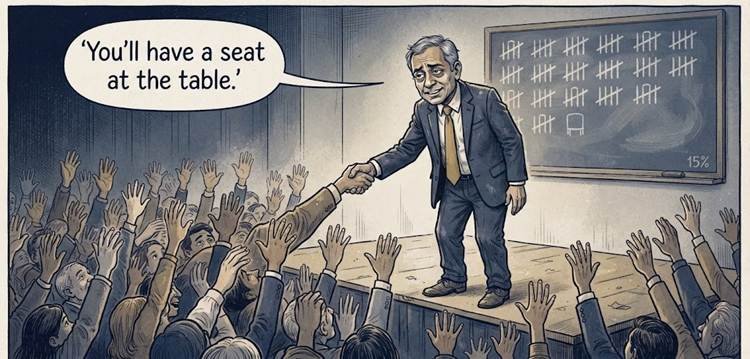
“60 raised hands. 25 chairs. The arithmetic was never going to wait.”
This is not dramatic license. Indian state cabinets are bound by statute, and the statute exists precisely because leaders before Varma made Varma’s mistake at scale. The Constitution (91st Amendment) Act, 2003 inserted a clause into Article 164 capping the size of a state’s Council of Ministers, the Chief Minister included, at 15 percent of the legislative assembly’s total strength, with a floor of 12 ministers for the smallest assemblies. Before 2003, no such ceiling existed, and the consequences were precisely what unconstrained political arithmetic produces. In October 2003, Uttar Pradesh Chief Minister Mulayam Singh Yadav swore in 91 ministers in a single expansion, bringing his Council of Ministers to 98 members — a cabinet nearly four times the size the 91st Amendment would later permit for an assembly of that scale. His predecessor, Kalyan Singh, had inducted more than 90 ministers in 1997 for the identical underlying reason: coalition arithmetic that could only be resolved by distributing titles faster than the state could absorb them. The 91st Amendment closed that door permanently. Varma’s dilemma — campaign-season promises colliding with a hard statutory ceiling — is the exact friction the amendment was written to extinguish.
The corporate parallel requires no fictional embellishment whatsoever. Every scaling company, and every enterprise assembled hastily through acquisition, harbors its own version of the jumbo cabinet: titles promised in the heat of a hiring war, equity implied but never formalized, “we’ll settle the org chart later” commitments extended to close a deal or retain a coveted hire. The structural ceiling always arrives eventually — a board, an investor, a budget, a compensation committee finally demanding the full headcount plan. What differs is only whether leadership absorbs that reckoning candidly and renegotiates its promises in the open, or allows 35 disappointed people to discover, one by one and in private, that the number never worked.
Phase II: Remote Control Oversight
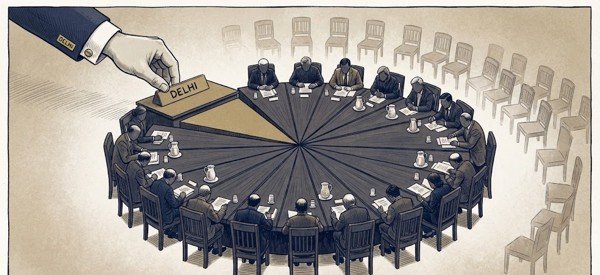
Delhi enters the narrative. National Vice President Rajiv Tandon pressures Varma into seating five of his own loyalists, chief among them Vikrant Thakur — an operator possessed of deep financial ties to headquarters but no local constituency whatsoever. Varma yields rather than confront Tandon directly, and a shadow center of power takes root inside his own cabinet.
“The chart said Chief Minister. The incentives said otherwise.”
This is no invented dynamic. Indian political history furnishes a close, thoroughly documented analogue: the 2020 Rajasthan crisis, in which Deputy Chief Minister Sachin Pilot — passed over for the top post following the 2018 election — spent the better part of two years in open tension with Chief Minister Ashok Gehlot before decamping from Jaipur to Delhi with roughly 18 loyalist legislators, claiming sufficient support to topple the government outright. The rebellion was contained within a month through the national leadership’s intervention, but the rift beneath it — a passed-over deputy commanding an independent base, a chief minister who never fully resolved the conflict, and a high command attempting to manage both from a distance — never actually closed. It resurfaced repeatedly across the following two years, and the Congress party went on to lose the Rajasthan state election in December 2023. Thakur’s arc in this story compresses that same shape: a rival installed, or merely tolerated, for reasons entirely unrelated to local legitimacy, whose loyalty runs upward to headquarters rather than sideways to the coalition he ostensibly serves.
The underlying mechanism carries a name in management theory: agency problems, as formalized by Jensen and Meckling in their foundational 1976 account of the separation of ownership and control. When a local executive’s incentives are divided between local performance and a distant principal’s political agenda, alignment erodes — not through irrationality, but because each party is behaving rationally toward a different master. Varma’s failure is not that he yielded to Tandon’s pressure. It is that he yielded silently, leaving Thakur’s upward loyalty unnamed and unaddressed in the room where it mattered.
Every board that has watched a regional president report, in substance, to headquarters rather than to the chief executive in front of them has witnessed this precise dynamic. The org chart declares one thing. The governing incentive structure declares another. Documents codify intent. Culture decides outcomes.
Phase III: Restructuring as Refusal
As the passed-over legislators begin quietly undermining the ministers who did secure seats, the party suffers a string of municipal defeats. Rather than undertake the conversations this demands — with the dissenters, and with Tandon over Thakur’s maneuvering — Varma unveils a sweeping “Organisational & Cabinet Alignment Redesign.” Disgruntled ministers are reassigned to newly invented “Grassroots Rejuvenation Councils,” their reporting lines rewritten to dilute Thakur’s reach.
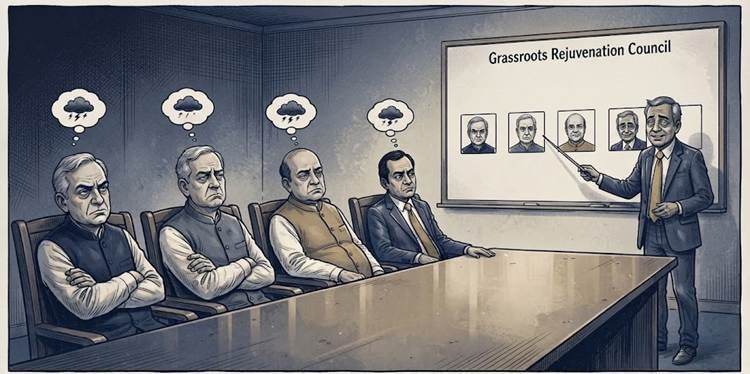
“Same faces. New boxes. Nothing resolved.”
The device Varma reaches for carries real precedent, and the precedent instructs precisely because of how sharply it diverges from its use of it. In 1963, Congress leader K. Kamaraj proposed that senior ministers — six Union ministers and six chief ministers in total, including Lal Bahadur Shastri and Morarji Desai — voluntarily relinquish their government posts to rebuild the party at the grassroots level following a period of electoral erosion. Nehru accepted the plan. Whatever its ultimate results, the Kamaraj Plan was a genuine act of organizational humility: leaders removing themselves from power to strengthen the institution they served. Varma’s version inverts the gesture entirely. He does not step back himself; he deploys the same organizational vocabulary to sideline rivals while evading the conversation that alone would resolve the conflict.
Corporate boards require no foreign case study to recognize this pattern, though a well-documented one exists regardless. Sears spent decades reorganizing around its own decline rather than confronting it directly — at various junctures adopting a holding-company structure and repeatedly reshuffling its financial-services businesses among competing internal fiefdoms overseen by rival executives, none of which addressed the operating failures beneath. In 2017 alone, the company announced a restructuring plan targeting roughly a billion dollars in annualized savings, consolidated corporate functions between its Sears and Kmart brands, divested its Craftsman tools business, and eliminated hundreds of corporate positions — in the same year it reported its twentieth consecutive quarter of declining sales. None of these moves were fraudulent, nor even poorly executed on their own terms. They were simply aiming at the wrong stratum of the problem. Analysts and former executives who studied the company’s decline pointed not to a single missed product cycle but to decades of leadership treating reorganization as the remedy for what was, beneath the surface, a failure of trust and accountability between store operations and headquarters. Restructuring accomplished what restructuring always accomplishes when it substitutes for candor: it produced new boxes on a chart, left the actual conflict untouched, and purchased time rather than resolution — until Sears filed for Chapter 11 in 2018.
Phase IV: Matrix Paralysis
Delhi answers Varma’s redesign with a redesign of its own — a parallel “Zonal Coordination Committee” reporting directly to the National Working Committee. Cadres across Purvanchal no longer know whether authority resides with the district minister, the rejuvenation council, or Delhi’s zonal delegate. In public, every faction poses for photographs of unity. In private, dossiers circulate.
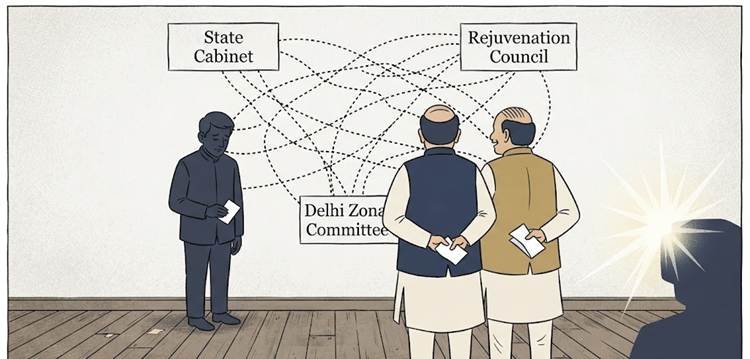
“In public, one photograph. In private, three reporting lines and a dossier apiece.”
Sociologist Anthony Giddens described precisely this tension in his theory of structuration as the duality of structure: formal systems and informal systems continuously act upon one another, each shaping and reshaping the other, and once trust collapses, the informal network — the backchannel, the leaked memorandum, the private alliance — begins to dominate the formal one, however many times the formal chart is redrawn. The org chart ceases to function as a map of how decisions are actually made and becomes instead a costume the real decision-making wears in public. Every additional restructuring adds administrative friction without adding accountability, since every failure can now be attributed to “transition friction” rather than to the individuals responsible for it, while every genuine improvement is credited to whichever faction currently commands the narrative rather than to the work itself.
This is the point at which the fictional narrative ceases to be about Purvanchal specifically and becomes diagnostic for any institution: a chart redrawn under mutual suspicion does not converge toward stability. It converges toward exhaustion. Employees — or cadres, or legislators — cease investing energy in the mission and begin investing it instead in tracking which faction currently prevails, because that is the information that actually determines whether their position survives the next redesign.
Phase V: The Loyalist Failure
Worn down by the churn, the high command replaces Varma with Suresh Patel — a quiet backbencher of no independent standing, selected precisely for his pliancy. Patel executes every mandate issued from Delhi without resistance. Deprived of a leader possessing genuine grassroots credibility, and with the underlying trust deficit never resolved, the party suffers a landslide defeat at the next election.
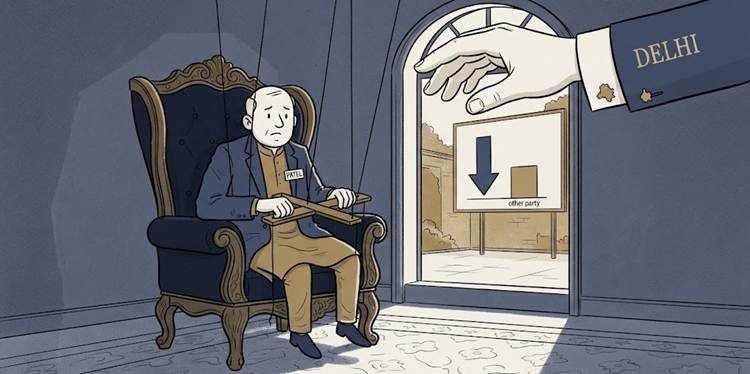
“Chosen for loyalty upward. Inheriting nothing downward.”
Indian political history furnishes more than one genuine instance of a national leadership displacing a strong regional figure in favor of a compliant nominee, only to watch the state unit collapse in the elections that followed. The pattern is old enough, and repeated often enough, to be treated as a governance rule rather than a narrative device: a leader selected for loyalty upward, absent any base of trust cultivated downward, inherits an organization that has already ceased believing in its own chart.
The Governance Takeaway
Every phase of this narrative maps onto a documented reality — a constitutional ceiling and the jumbo cabinets that preceded it, a historical precedent for genuine organizational sacrifice alongside its inversion, an actual rebellion inside an actual state government, a thoroughly chronicled corporate collapse, and an academic account of why formal and informal structures diverge under distrust. None of it required invention of the underlying mechanism. It required only the assembly of that mechanism into one continuous arc.
The governing principle beneath all five phases is the one I return to most often with boards: structure follows trust, not the other way around. Redrawing reporting lines to manage a trust problem does not resolve the trust problem — it institutionalizes it, affixes a new letterhead to it, and purchases a few months before the next reshuffle becomes unavoidable.
For boards on the receiving end of a restructuring memo, four questions merit asking before approval, not after:
Is this redesign solving a structural problem, or managing the optics of a trust problem? Varma’s Grassroots Rejuvenation Councils solved nothing structurally. They relocated people. The distinction matters, because only one of these two problems responds to an org chart.
Are we conducting the difficult conversation with the specific individuals involved, or hoping a new chart renders that conversation unnecessary? Every deferred conversation in this story — Varma with the 35 passed-over legislators, Varma with Tandon regarding Thakur — grew more costly the longer it was postponed, never less.
Whom does this restructuring actually protect — the mission, or someone’s position relative to someone else’s? Delhi’s Zonal Coordination Committee was not built to help Purvanchal govern more effectively. It was built to prevent Varma from accumulating too much strength. Boards owe themselves candor about which of these two motives is truly driving the proposal before them.
Were we to redraw this chart again in six months under the same unresolved tensions, would we arrive at a different answer, or merely a different arrangement of the same avoidance? This is the question boards skip most often, precisely because it demands admitting that the first redesign failed — and naming why.
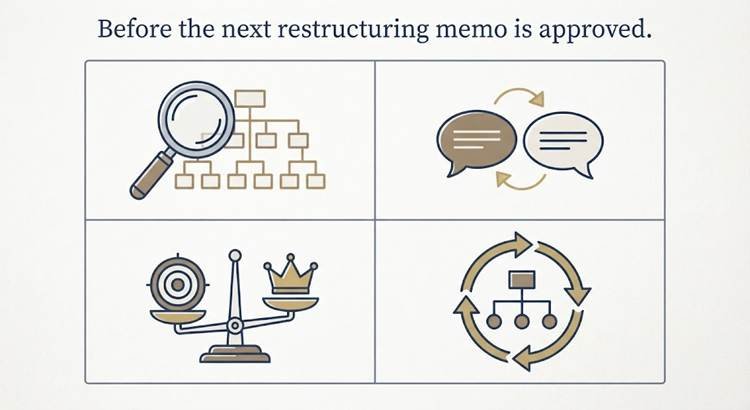
“Before the next restructuring memo is approved.”
Once bad news is punished — or simply deferred long enough — silence becomes the operating system. No quantity of redrawn boxes remedies that. Only the conversation does. Purvanchal lost its election. Varma lost his seat. Neither loss surprised anyone attentive to what the reshuffles were actually for. The only question that remains for any board reading this is whether its own next restructuring memo would survive that same scrutiny.
Sources referenced: The Constitution (91st Amendment) Act, 2003, Government of India (Article 164, Council of Ministers ceiling); Uttar Pradesh cabinet expansions under Mulayam Singh Yadav (2003) and Kalyan Singh (1997), contemporaneous reporting, The Tribune; 2020 Rajasthan political crisis (Sachin Pilot–Ashok Gehlot), contemporaneous reporting, Deccan Herald and The Print; Kamaraj Plan, 1963 (Congress Working Committee records, August 1963); Jensen, M.C. & Meckling, W.H., “Theory of the Firm: Managerial Behavior, Agency Costs and Ownership Structure,” Journal of Financial Economics, 1976; Giddens, A., The Constitution of Society: Outline of the Theory of Structuration, 1984; “Sears’ Seven Decades of Self-Destruction,” Yahoo Finance/The Atlantic, 2019; Sears Holdings restructuring announcements, Retail Dive, 2017–2018.

John M Birchbauer
John M. Birchbauer is a Strategic Diagnostician and Independent Board Advisor with more than 25 years of experience across automotive retail and global B2B logistics. He is the founder of Paradise Group LLC, an independent advisory practice, and held senior leadership roles at JM Family Enterprises, where his work included the AAX acquisition, the Retail Suite platform, and the VIN Explosion Tool — bridging algorithmic intelligence with frontline dealership operations. He currently holds a Chairman role with INVESTARMS PLC and is co-founder of Definait, an early-stage AI fintech venture with planned operations in Dubai.
His advisory practice centers on his "Third Question" diagnostic framework — a governance methodology built on a simple premise: most boards stop at what happened and what they're doing about it, when the question that actually changes outcomes is what the current answer assumes, and who benefits if that assumption goes unchallenged. He mentors entrepreneurs through MicroMentor, including participation in a joint World Bank and Caribbean Climate Innovation Center international pilot program.
He is based in Waukesha, Wisconsin, USA.



Leave a comment