

































Neutralizing Foreign Telecom Vulnerabilities & Securing Physical AI
The Imperative for Sovereign Runtime Enforcement
India’s rapid digital modernization and defense AI integration face a persistent structural threat from foreign telecom hardware backdoors (Huawei/ZTE) and legacy CCTV exfiltration vectors. Traditional enterprise cybersecurity relies on passive, cloud-based post-hoc log auditing, which fails when underlying transport infrastructure or edge silicon is untrusted. True sovereign data protection requires shifting from retroactive incident response to prospective, deterministic O(1) runtime boundary enforcement at the network socket layer.
Core Strategic Conclusions
- Cloud Security Fails Below the OS: Application-layer wrappers and cloud firewalls cannot prevent unauthorized data exfiltration or rogue commands executing inside foreign firmware or hardware switches.
- “Harvest Now, Decrypt Later” Threat: Adversaries continuously siphon encrypted sovereign telecommunications traffic at the physical layer, storing it for post-quantum decryption.
- Deterministic Boundary Isolation: Securing sovereign national networks requires deterministic ingestion gating that evaluates policy conditions and drops unauthorized payloads in sub-1.2ms time before serialization occurs.
Policy Recommendations & Call to Action
- Mandate Ingestion Tier Gating: Require mandatory, kernel-level execution gates across all national 5G/6G backbones and public municipal infrastructure.
- Adopt Hardware-Agnostic Defense: Deploy fail-closed O(1) runtime boundaries to insulate national security networks while legacy foreign hardware is systematically decommissioned.
- Establish Physical AI Safety: Enforce strict deterministic boundary limits on autonomous drones, power grid controllers, and defense robotics operating at the edge.
The Sovereign Infrastructure Paradox
India is advancing toward an unprecedented era of digital capability and sovereign technological leadership. Defense allocations are increasingly directed toward artificial intelligence, autonomous drones, and smart city infrastructure. However, this expansion relies on a complex telecommunications backbone that historically integrated legacy foreign hardware. When critical 5G/6G grids and municipal CCTV networks depend on potentially compromised silicon, data sovereignty becomes fragile. Cloud-based security tools cannot mitigate risks embedded directly within the underlying hardware transport layers.
The Failure of Post-Hoc Governance
Traditional cybersecurity frameworks operate on a reactive audit model, analyzing network telemetry long after an event occurs. When a foreign switch or compromised edge device exfiltrates data, post-hoc logs merely record the breach after capital, intelligence, or sensitive credentials have left the perimeter. In a sovereign context, relying on retroactive detection creates a dangerous window of exposure. True national security demands prospective controls that evaluate execution requests before a transaction writes to the network.
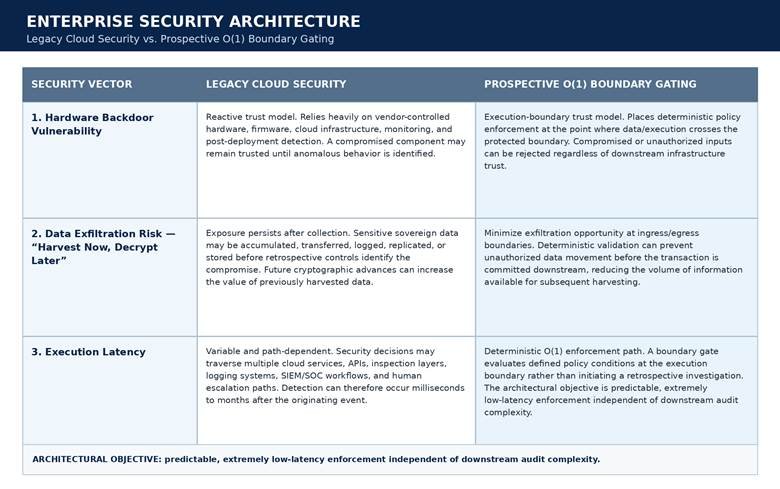
Caption: Comparison of Legacy Cloud Security versus Prospective O(1) Boundary Gating across sovereign threat vectors.
Harvest Now, Decrypt Later Mechanics
The exclusion of untrusted foreign vendors from national 5G rollouts was a critical policy victory. Nevertheless, legacy devices remain active across regional distribution points. Adversaries exploit these positions through “Harvest Now, Decrypt Later” strategies, quietly capturing encrypted data streams at the physical layer. This harvested telemetry is stored until quantum computing capabilities permit offline decryption. Cloud-level encryption fails to stop physical packet mirroring at untrusted switches, highlighting the urgent need for local ingestion gating.
Rogue Firmware and Sub-OS Threats
The emergence of autonomous physical AI—including defense robotics, smart grid actuators, and public surveillance—introduces immediate physical risk. Malicious firmware instructions embedded below the operating system layer can bypass traditional user-space security software entirely. If an autonomous edge agent receives a hijacked command from an untrusted node, it may execute unauthorized actions in the physical world. Protecting critical infrastructure requires hardcoded execution perimeters that physically restrict device behavior regardless of model hallucinations or sub-OS exploits.
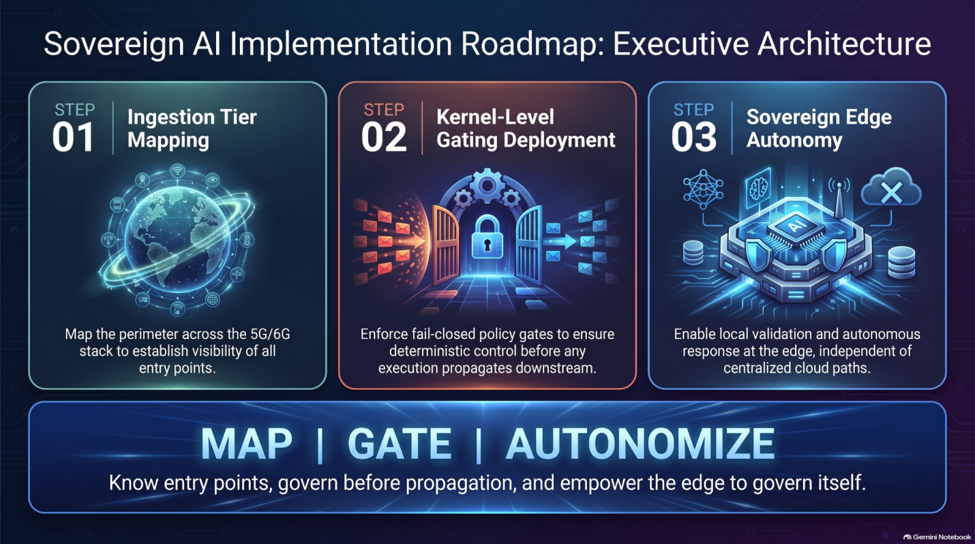
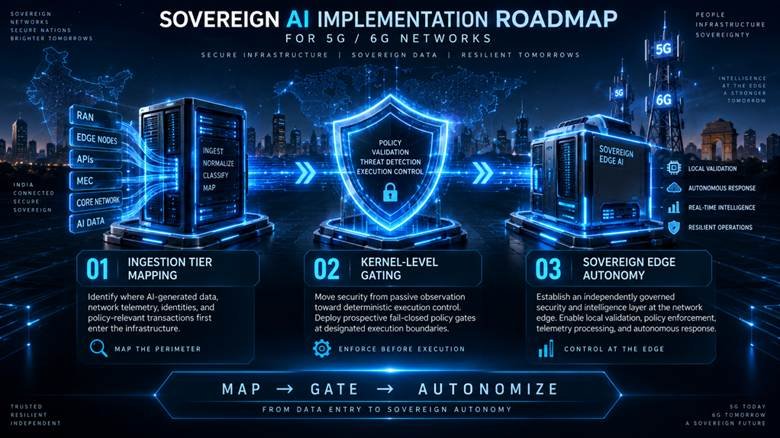
Caption: Figure 1. Executive Policy Framework: A 3-Stage Sovereign Governance Progression (Map Ingestion -> Gate Kernel -> Autonomize Edge).
Architectural Mechanics of O(1) Boundary Gating
Neutralizing hardware-level threats requires moving enforcement directly to the local ingestion socket. By deploying prospective O(1) runtime boundary gating, security evaluation occurs at constant time relative to policy complexity. When an unauthorized packet or rogue API call attempts to cross the network boundary, the execution engine evaluates its structural attributes in sub-1.2ms time. If the payload violates statutory parameters, the socket triggers an immediate fail-closed block, dropping the data before serialization.
Hardware-Agnostic Sovereign Defense
Replacing thousands of kilometers of legacy telecommunications equipment requires years of capital investment and supply chain coordination. Prospective O(1) boundary enforcement provides an immediate, hardware-agnostic shield during this transitional period. Because the enforcement engine sits at the local kernel and ingestion perimeter, it operates independently of the underlying silicon source. Untrusted hardware is effectively sandboxed, rendering foreign firmware backdoors mathematically incapable of transmitting unauthorized exfiltration streams across the broader national network.
Caption: Figure 2. Sovereign 5G/6G Edge Infrastructure: Hardware-level socket isolation and deterministic O(1) runtime gating across physical RAN, MEC, and core network nodes.
Mandating Ingestion Tier Controls
National regulatory bodies must evolve from passive compliance checklists toward enforced runtime standards. Future telecommunications licenses and national defense procurements should mandate kernel-level execution boundaries across all core 5G/6G nodes and cloud entry points. Sovereign data policy must extend beyond geographic data storage laws to enforce jurisdictional authority over every microsecond of network execution. Hardcoding boundary controls transforms regulatory policy into real-time, un-bypassable operational law.
Securing the Future of Physical AI
As India deploys dual-use autonomous systems and edge intelligence, establishing hardcoded execution limits becomes vital to national resilience. Autonomous systems operating in energy, transport, and defense must not depend on cloud connectivity for basic safety controls. Local, deterministic execution gates ensure that edge devices maintain operational integrity even during network partitions or electronic warfare environments. Securing the edge boundary guarantees that national infrastructure remains resilient, sovereign, and entirely under human policy control.

Carlton Grant Bey
Principal Architect, Grant Global Associates (GGA) | Creator of The Sentinel L5 Protocol™
Carlton Grant Beyis the Founder and Principal Architect of Grant Global Associates (GGA), an elite technology think tank and advisory firm specializing in Enterprise AI Governance, Revenue Cycle Security, and Sovereign Edge Infrastructure.
He is the creator of The Sentinel L5 Protocol™, a proprietary O(1) prospective runtime enforcement architecture designed to secure autonomous AI agents and critical enterprise workflows at the hardware ingestion boundary.
Advising executive leadership—from healthcare C-suites to defense-tech operators—Carlton bridges the gap between complex probabilistic AI inference and deterministic regulatory compliance. His work fundamentally shifts enterprise risk from retroactive auditing to
real-time, mathematically enforced containment.



Leave a comment